

Smart cities are using a new kind of AI that can think, decide, and act on its own to manage complex city systems more smoothly.
I see many cities dealing with traffic jams, power failures, water leaks, and slow public services, and this is exactly where Agentic AI in Smart Cities starts to help you in a practical way. Instead of waiting for human input, these AI systems watch what is happening across the city, understand problems early, and take action before things get worse. This means fewer delays, better use of resources, and services that work quietly in the background while you go on with your day.
For you, this change is not about technology buzz. It shows up as shorter travel times, more stable power, cleaner streets, and quicker help from civic services. Cities are choosing agentic AI solutions because it handles large systems at the same time and keeps learning from real situations, which makes city operations more reliable over time.
To understand why city leaders are investing so heavily in this approach, it helps to look at the real numbers behind smart city AI adoption.
Key Statistics That Show the Growth of Agentic AI in Smart Cities
Now let’s look at some real numbers that help you see how big and fast smart city technologies — especially Agentic AI in Smart Cities are growing. These stats are not just guesses; they come from actual industry and market projections.
1. Explosive Market Growth for Agentic AI in Smart Cities
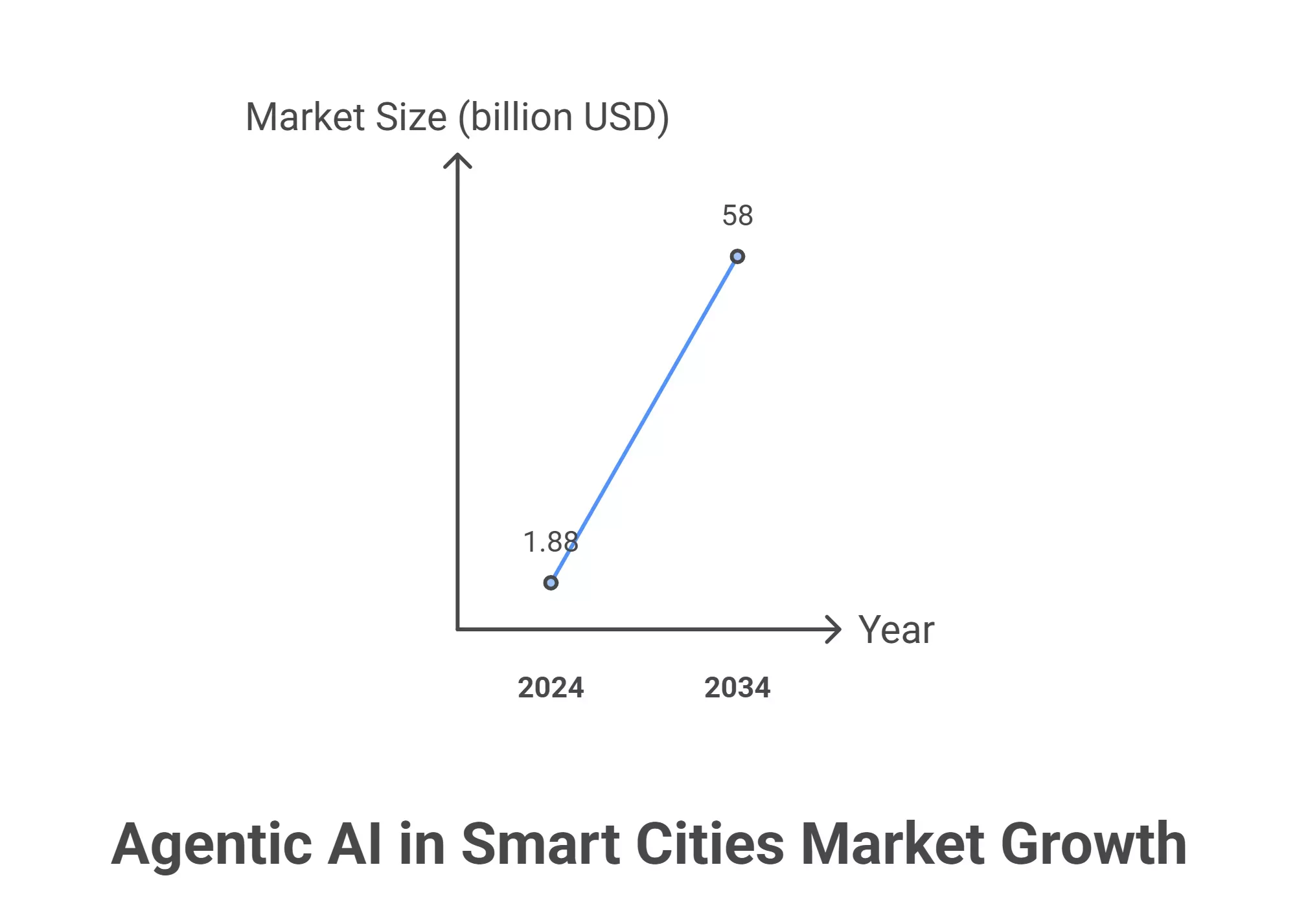
Experts expect the Agentic AI in Smart Cities market to grow from about $1.88 billion in 2024 to around $58 billion by 2034, expanding really fast at a 40.9% compound annual growth rate (CAGR). This shows how powerful and important autonomous AI systems will become in city planning and operations.
2. Smart City AI Market to Reach Huge Global Value
Looking at broader AI in smart cities technologies, the global market is expected to jump from roughly $50 billion in 2025 to more than $460 billion by 2034, growing steadily each year. This tells you that AI technologies are going mainstream in cities around the world.
3. Rapid Overall Smart City Growth Worldwide
The entire smart cities market, including IoT, infrastructure, services, and AI, was valued at over $1,400 billion in 2024 and is projected to nearly triple by 2033, rising to about $4,900 billion. This broad trend is a strong foundation for AI-driven systems to expand.
4. AI Helping Improve Real Life Quality in Cities
Studies show that digital and AI solutions can improve key aspects of city life like safety, commute times, and public services by as much as 10–30% for residents. That means real changes in how you live each day.
5. Global AI Adoption Increasing Rapidly in Enterprises
Across many industries — not just cities — about 79% of organizations are already using AI agents in some way, and most plan to expand their use over time. This reflects a bigger shift toward systems that act on their own, even in complex environments like public infrastructure.
Want to know? How AI Agents Are Disrupting Traditional Business Processes
What Is Agentic AI and Why Smart Cities Rely on It
Let me explain this in very simple words, the way I usually explain it to teams and city leaders.
Agentic AI is a type of artificial intelligence that does not just wait for instructions. It watches what is happening, understands the situation, makes a decision, and then takes action on its own. Once it acts, it checks the result and learns from it. This loop keeps going all the time.
Normal AI systems are limited. They follow fixed rules or respond only when someone tells them what to do. Agentic AI is different because it works like a responsible helper that knows its goal and keeps working toward it without constant supervision.

Smart cities rely on this type of AI because city systems are large and always moving. Traffic changes every minute. Power demand goes up and down. Water systems face leaks and pressure changes. A human team cannot watch everything at the same time, all day and night.
Agentic AI can handle many systems together. It connects data from sensors, cameras, meters, and city platforms. Then it decides what matters most at that moment and acts fast. This is why cities trust it for tasks that need speed, accuracy, and consistency.
For you, this means fewer delays, fewer breakdowns, and services that feel smoother without you needing to think about the technology behind them.
How Agentic AI in Smart Cities Makes Decisions on Its Own
Before getting into details, I want you to understand one simple thing. City systems never stop. Traffic, power, water, and services keep changing every second. Agentic AI is built to handle this nonstop movement without getting tired or confused. Now let me explain how it does that, step by step, using clear subheadings.
Continuous Data Collection From City Systems
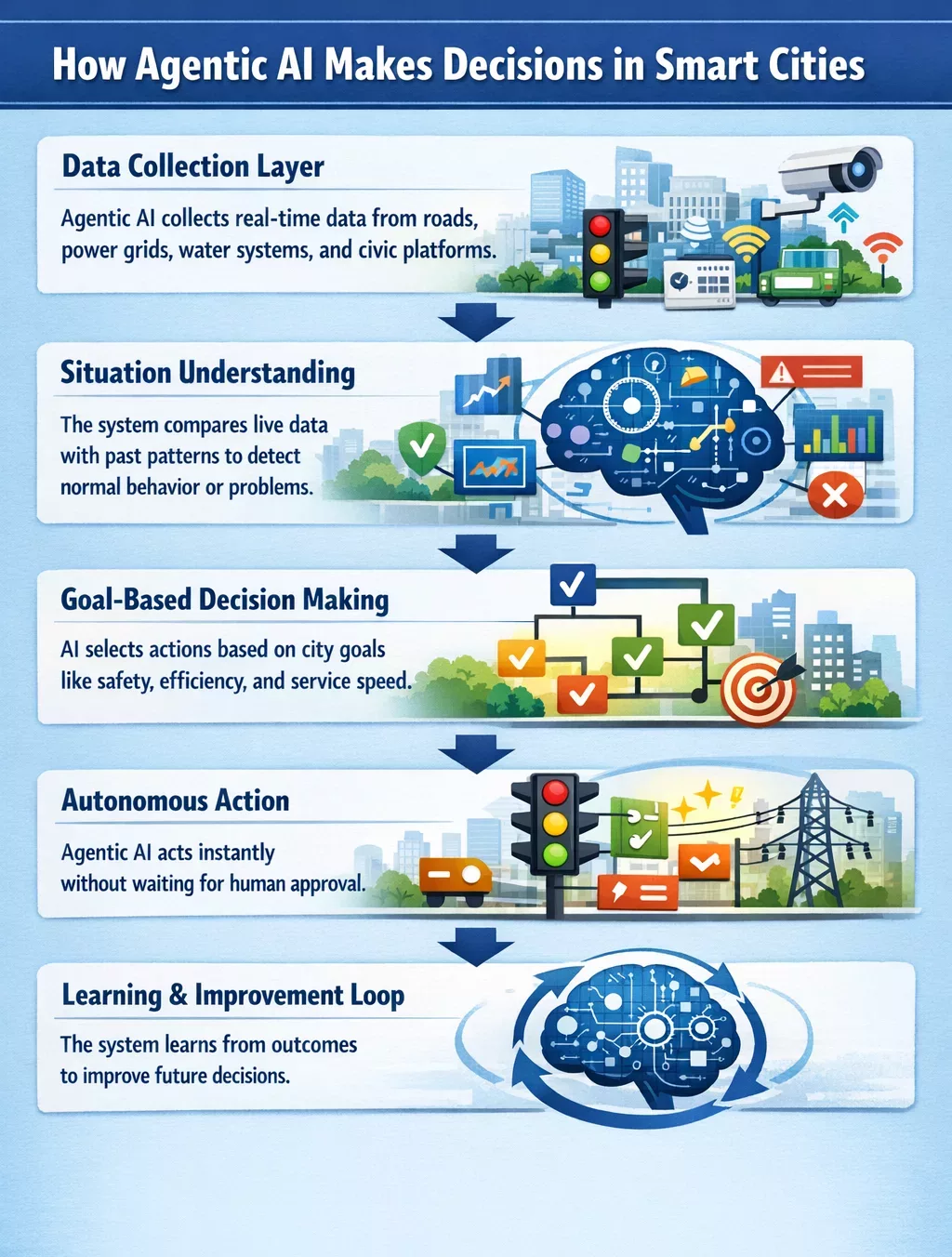
Agentic AI keeps collecting live data from across the city. This includes traffic cameras, road sensors, power meters, water systems, and public service platforms. The system does not wait for reports. It watches everything in real time, all day and night.
Understanding Situations Using Past and Present Data
Once data comes in, the AI compares it with past patterns. It knows what normal looks like and what signals a problem. For example, it can tell the difference between regular rush-hour traffic and an unexpected blockage that needs attention.
Setting Priorities Based on City Goals
Agentic AI does not act randomly. Cities give it clear goals, such as improving safety, saving energy, or reducing delays. Based on these goals, the system decides what matters most at that moment and focuses on it first.
Taking Action Without Waiting for Human Input
After deciding what to do, the AI takes action on its own. It may adjust traffic lights, balance power loads, trigger maintenance alerts, or update civic service systems. This happens instantly, without waiting for human approval for every small step.
Learning From Results to Improve Future Decisions
After acting, the system checks the outcome. If the action works well, it remembers it. If not, it adjusts next time. This learning process helps city operations become smoother and more reliable over time.
This is how agentic AI manages complex city environments quietly in the background, while you experience fewer disruptions and better services.

7 Key Applications of Agentic AI in Smart Cities and Civic Services
This is the most important part of the topic, because this is where you clearly see how agentic AI works in real city life. These applications are not ideas on paper. Cities are already using them to manage systems that affect people every single day. I’ll explain each application in detail so you understand what is happening behind the scenes and how it helps you.
1) Smart Traffic Management and Road Safety
Let me start with traffic, because this is where most people immediately feel the impact of agentic AI. Traffic is not just about cars moving. It affects your time, your stress level, fuel use, and even air quality.
Agentic AI manages traffic by watching live data from cameras, road sensors, GPS systems, and public transport networks. Instead of following fixed signal timings, the system understands what is happening right now. If one road suddenly becomes crowded, the AI adjusts traffic lights within seconds. If an accident happens, it reroutes vehicles and gives priority to emergency services.
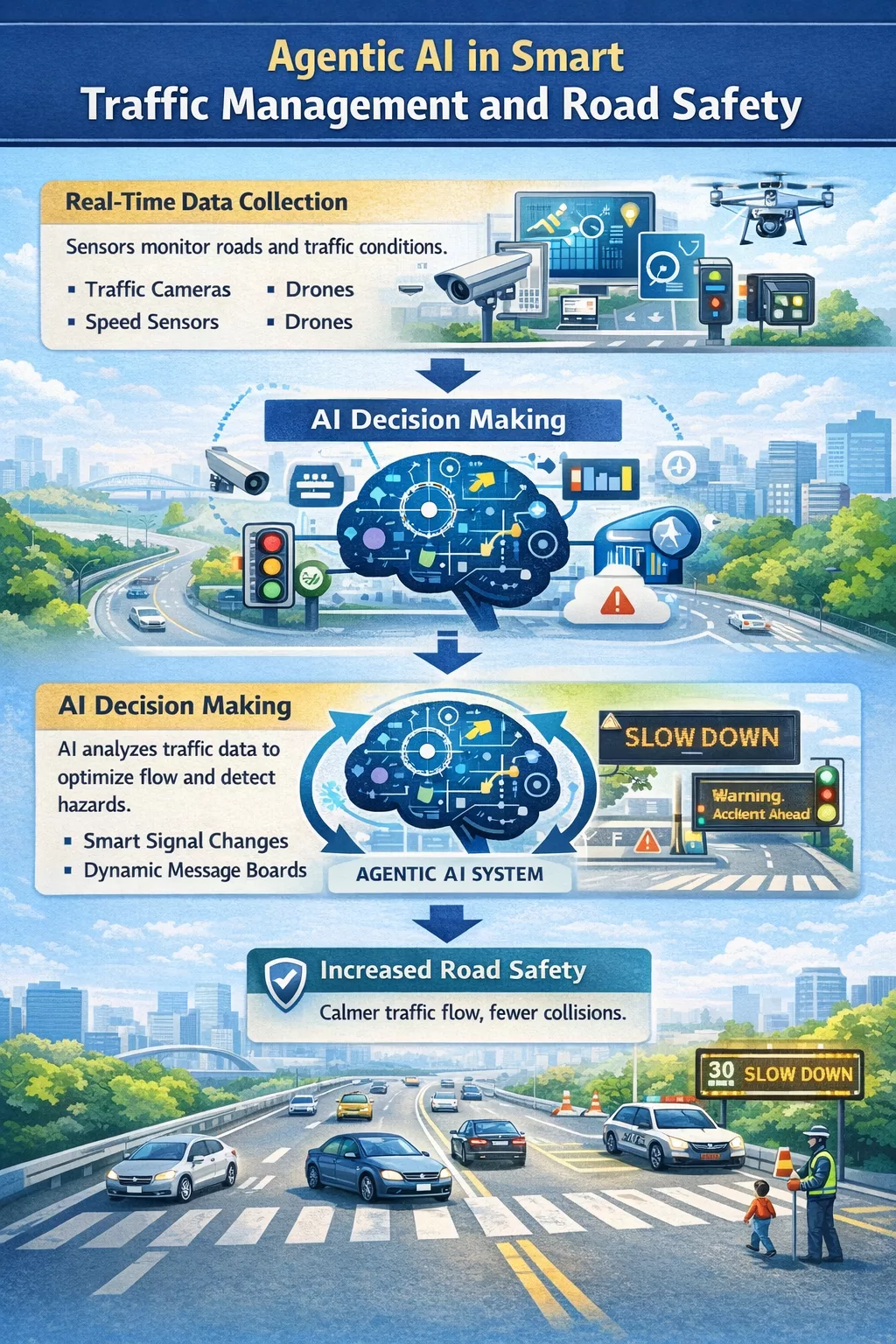
Here’s a simple example. Imagine a busy office area during evening hours. Normally, traffic lights change on a fixed schedule. Agentic AI notices that one exit road is filling up faster than usual. It increases green-light time for that road and reduces waiting time on less busy lanes. This happens automatically, without traffic police stepping in.
Cities using AI-based traffic systems have reported up to 25–30% reduction in congestion and around 20% improvement in average travel time. That means you spend less time stuck in traffic and more time at home or work.
Road safety also improves. Agentic AI detects risky patterns like sudden braking, wrong-way driving, or overcrowded crossings. It can trigger warnings, adjust signals, or alert authorities early. Over time, the system learns which locations are accident-prone and helps cities redesign traffic flow.
For you, this means smoother drives, safer roads, and fewer daily frustrations—without even realizing AI is working behind the scenes.
Read once! Top Agentic AI Companies Can Accelerate Innovation and Business Growth?
2) Energy Management and Smart Power Distribution
Energy is one of the hardest things for a city to manage because demand keeps changing every hour. Homes, offices, hospitals, transport systems, and public lighting all pull electricity at different times. Agentic AI helps cities stay balanced without power failures or waste.
Agentic AI monitors energy usage in real time through smart meters and grid sensors. It understands when demand is rising and where pressure is building. Instead of waiting for overloads to happen, the system shifts power automatically. This keeps the grid stable even during peak hours.
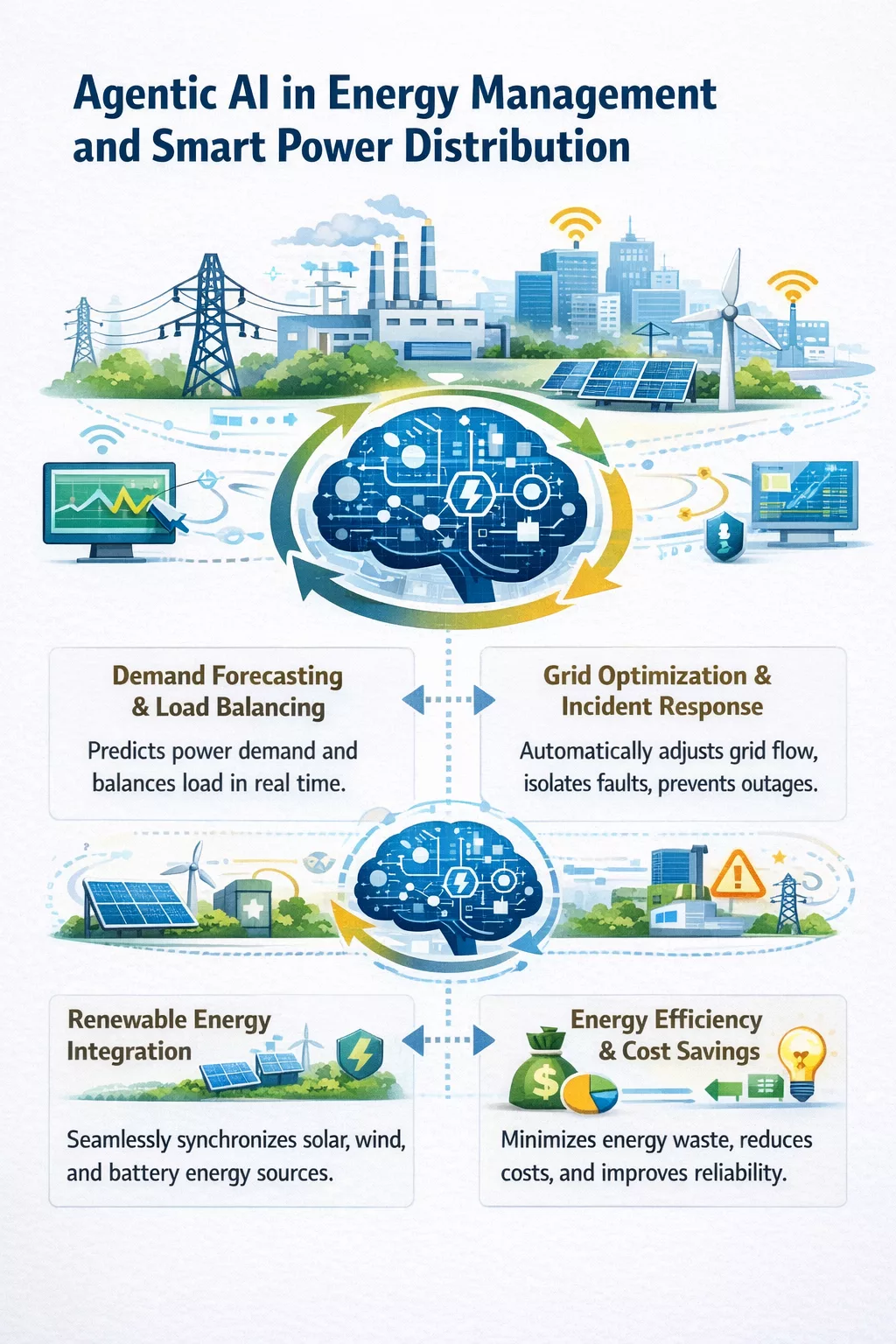
Let me give you a simple example. On a hot summer day, many people turn on air conditioners at the same time. Normally, this could overload local transformers. Agentic AI notices the surge early and redistributes power from low-demand areas. It may also reduce power to non-critical systems for a short time to protect essential services like hospitals.
Cities using AI-based energy systems have seen up to 15–20% reduction in energy waste and around 30% fewer power outages. This saves millions in operational costs and reduces stress on infrastructure.
Agentic AI also helps cities use renewable energy better. Solar and wind energy are not constant. The system predicts availability and balances supply smoothly. For you, this means more reliable electricity, lower energy losses, and fewer sudden blackouts.
This kind of smart energy control makes cities stronger and more efficient without disrupting daily life.
3) Water Supply Management and Leak Prevention
Water is one of the most valuable resources in a city, yet a large amount is lost every day due to hidden leaks and poor monitoring. Agentic AI helps cities protect water systems by watching them continuously instead of checking them only after problems appear.
Agentic AI tracks water pressure, flow rate, and usage patterns across the entire network. It knows what normal water behavior looks like in each area. When pressure drops or flow changes suddenly, the system detects it within minutes. This allows cities to act before a small leak becomes a major pipe burst.
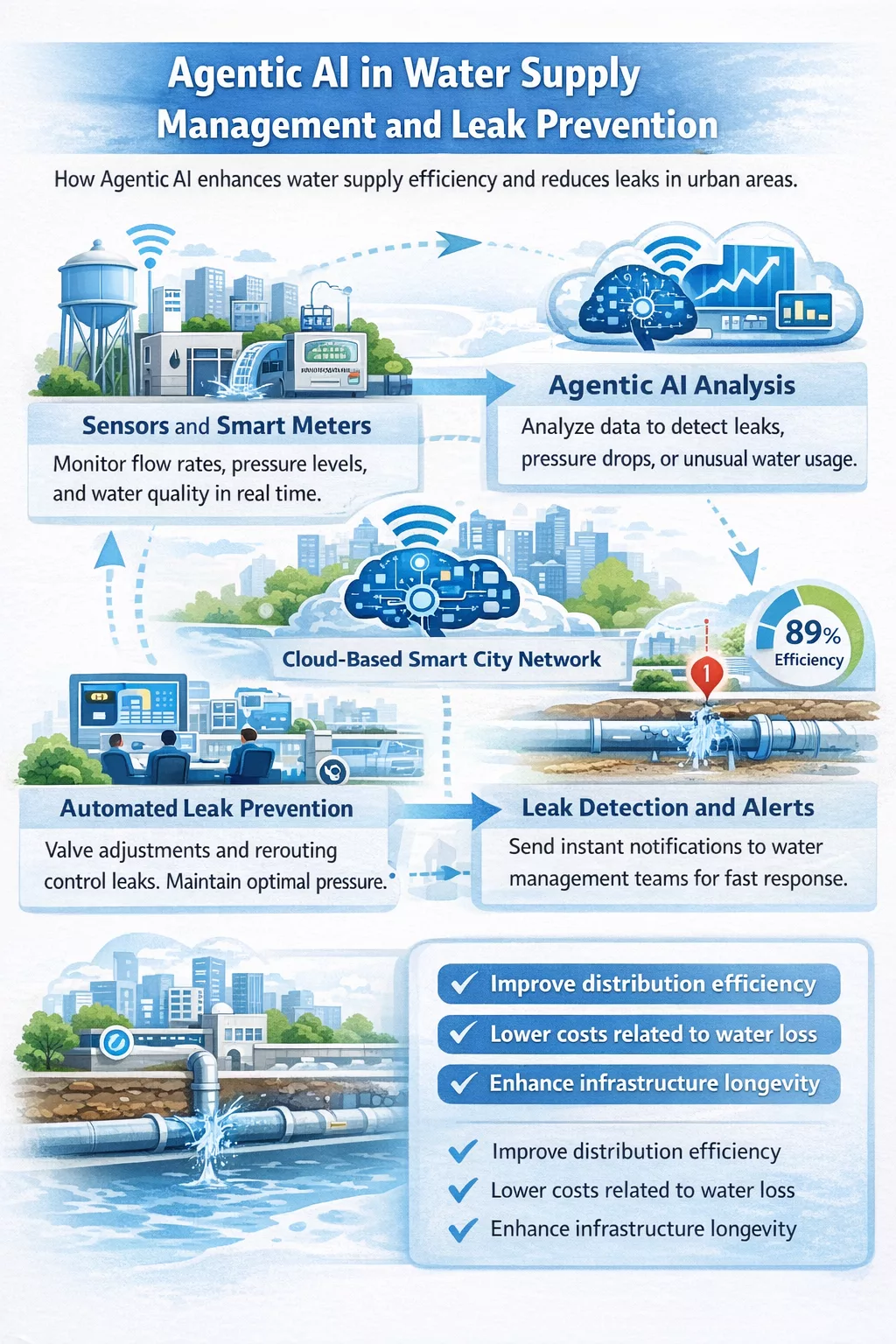
Here is a simple example. Imagine a residential area where water usage suddenly increases late at night. Agentic AI understands that this is unusual. It checks pressure data, identifies a possible underground leak, and alerts maintenance teams immediately. In some cases, it can even reduce water flow automatically to limit damage.
According to global water studies, cities lose nearly 30% of treated water due to leaks and inefficiencies. AI-based water monitoring systems have helped reduce these losses by up to 15–20% in some cities. This saves water, money, and time.
For you, this means fewer water outages, better pressure at home, and less disruption from road digging and emergency repairs. Over time, it also helps cities ensure reliable water supply as populations grow.
4) Waste Collection and Environmental Management
Waste management may not look complex from the outside, but for a city, it is a daily challenge. Fixed pickup schedules often lead to overflowing bins in busy areas and unnecessary trips in low-use areas. Agentic AI helps cities manage waste in a smarter and cleaner way.
Agentic AI monitors waste levels using smart bins and sensors placed across neighborhoods, markets, and public spaces. The system knows which bins are full, which are half-empty, and which can wait. Based on this data, it plans the best collection routes in real time.
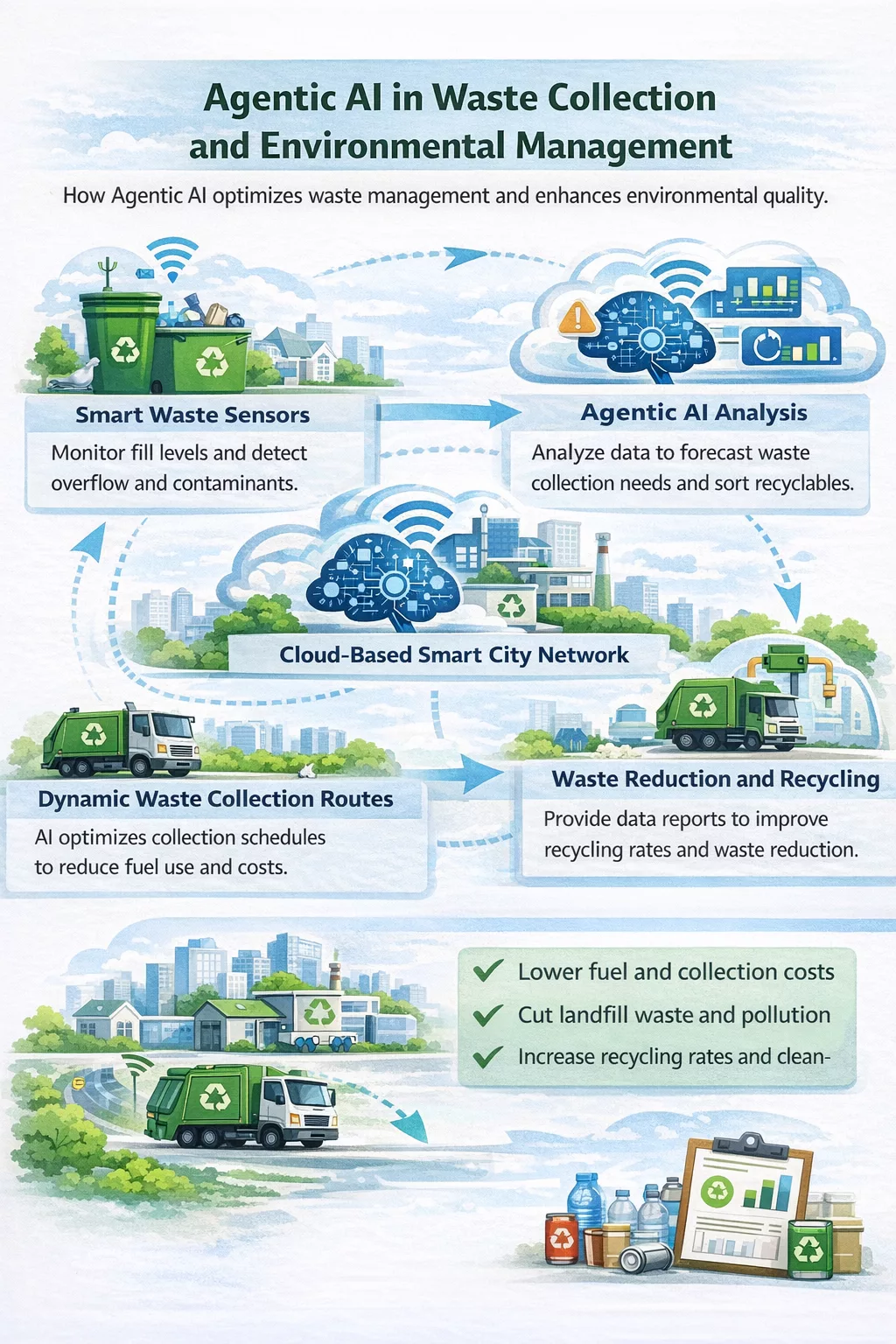
Here is an easy example. In a commercial area, waste bins fill up faster during weekends. Agentic AI learns this pattern and schedules more frequent pickups only when needed. At the same time, it reduces trips in residential areas where bins are still empty. This balance keeps streets clean without wasting fuel or time.
Cities using AI-based waste systems have reported up to 20–25% reduction in fuel costs and around 30% improvement in collection efficiency. Fewer waste trucks on the road also mean less traffic and lower air pollution.
Agentic AI also supports recycling efforts. It analyzes waste patterns to help cities improve recycling programs and reduce landfill use. For you, this means cleaner surroundings, better hygiene, and a healthier environment without extra effort.
5) Emergency Response and Disaster Management
Emergency situations are where speed and coordination matter the most. Delays, confusion, or poor communication can cost lives. Agentic AI helps cities respond faster and more accurately by analyzing information the moment something goes wrong.
Agentic AI monitors emergency calls, surveillance feeds, traffic data, weather alerts, and sensor signals at the same time. When it detects an incident, it understands the type of emergency and its location. The system then alerts the right teams and suggests the fastest routes for response vehicles.
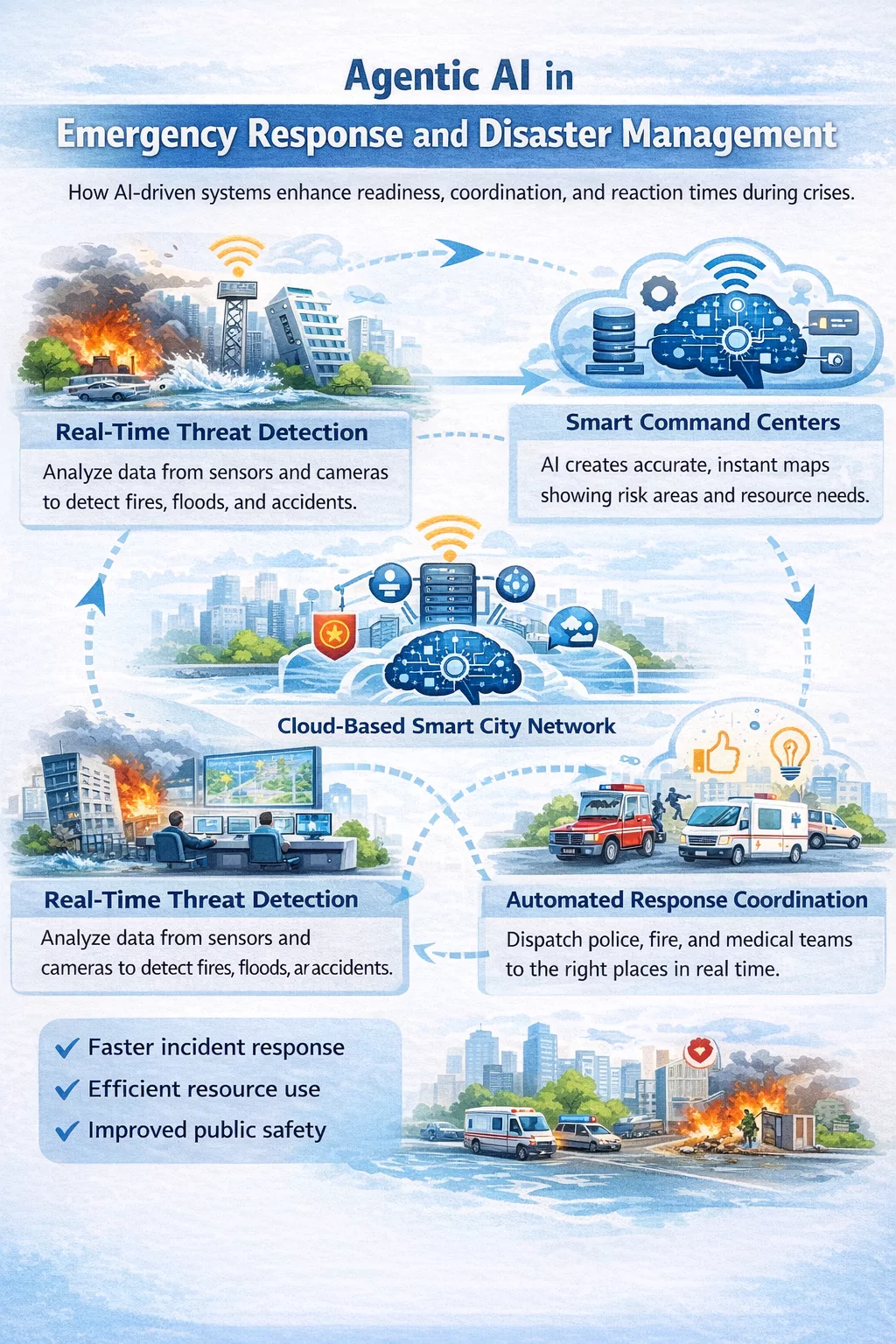
Here’s a simple example. If a fire breaks out in a crowded area, agentic AI immediately identifies nearby fire stations, checks traffic conditions, and directs fire trucks along the quickest path. At the same time, it can adjust traffic lights to clear the route and alert hospitals to prepare for possible injuries.
Studies show that AI-supported emergency systems can reduce response times by up to 30%. In disasters like floods or earthquakes, faster response can save lives and reduce damage. The system also helps predict risk zones by analyzing weather and infrastructure data, allowing cities to prepare before emergencies escalate.
For you, this means quicker help when it matters most and safer public spaces. Emergency services become more organized, and chaos is reduced during critical moments.
6) Digital Civic Service Platforms for Citizens
Civic services are often where people feel the most frustration. Long waiting times, unclear processes, and repeated follow-ups make simple requests stressful. Agentic AI helps cities fix this by making civic service platforms faster, clearer, and more responsive.
Agentic AI manages digital platforms where citizens report issues, apply for permits, or request services. It understands the type of request, assigns it to the right department, and tracks progress automatically. Nothing gets lost or delayed due to manual sorting.
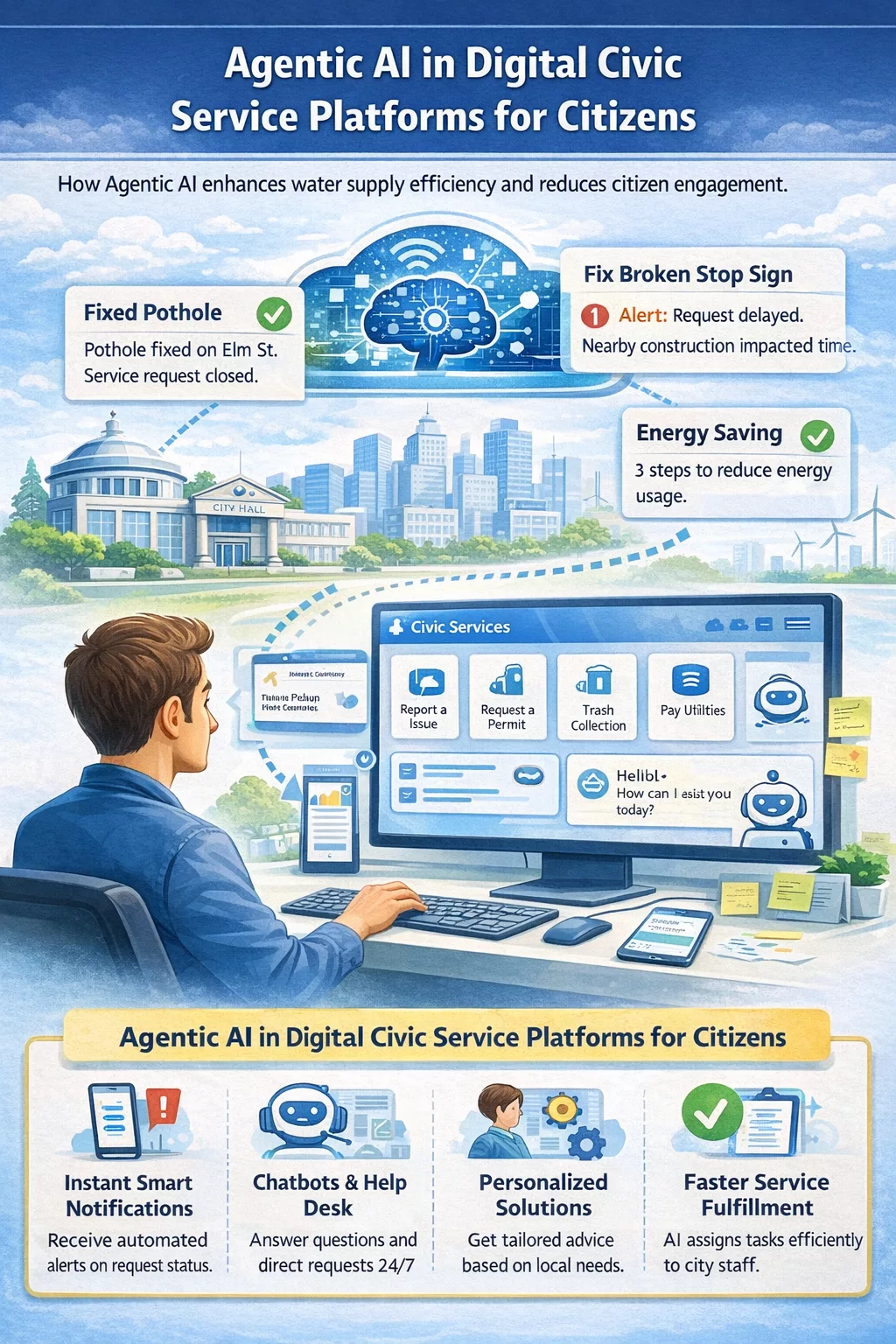
Here’s a simple example. If you report a broken streetlight through a city app, agentic AI reads the request, identifies the location, and sends it directly to the maintenance team. It sets a priority level and monitors whether the issue is resolved on time. You receive updates without needing to call or visit an office.
Cities using AI-driven civic platforms have seen up to 40% faster issue resolution and around 25% reduction in administrative workload. This allows city staff to focus on complex tasks instead of repetitive paperwork.
Agentic AI also learns from citizen interactions. If many people report similar issues in one area, the system highlights it for long-term planning. For you, this means services feel more organized, transparent, and respectful of your time.
7) Public Safety Monitoring and Prevention
Public safety is not only about responding after something happens. It is also about preventing risks before they turn into serious incidents. Agentic AI helps cities move from reactive safety measures to proactive prevention.
Agentic AI analyzes data from cameras, sensors, emergency calls, and public reports. It looks for patterns that signal potential risk, such as repeated accidents at the same intersection, unusual crowd movement, or rising incidents in specific areas. When the system detects a risk, it alerts authorities or adjusts city systems automatically.
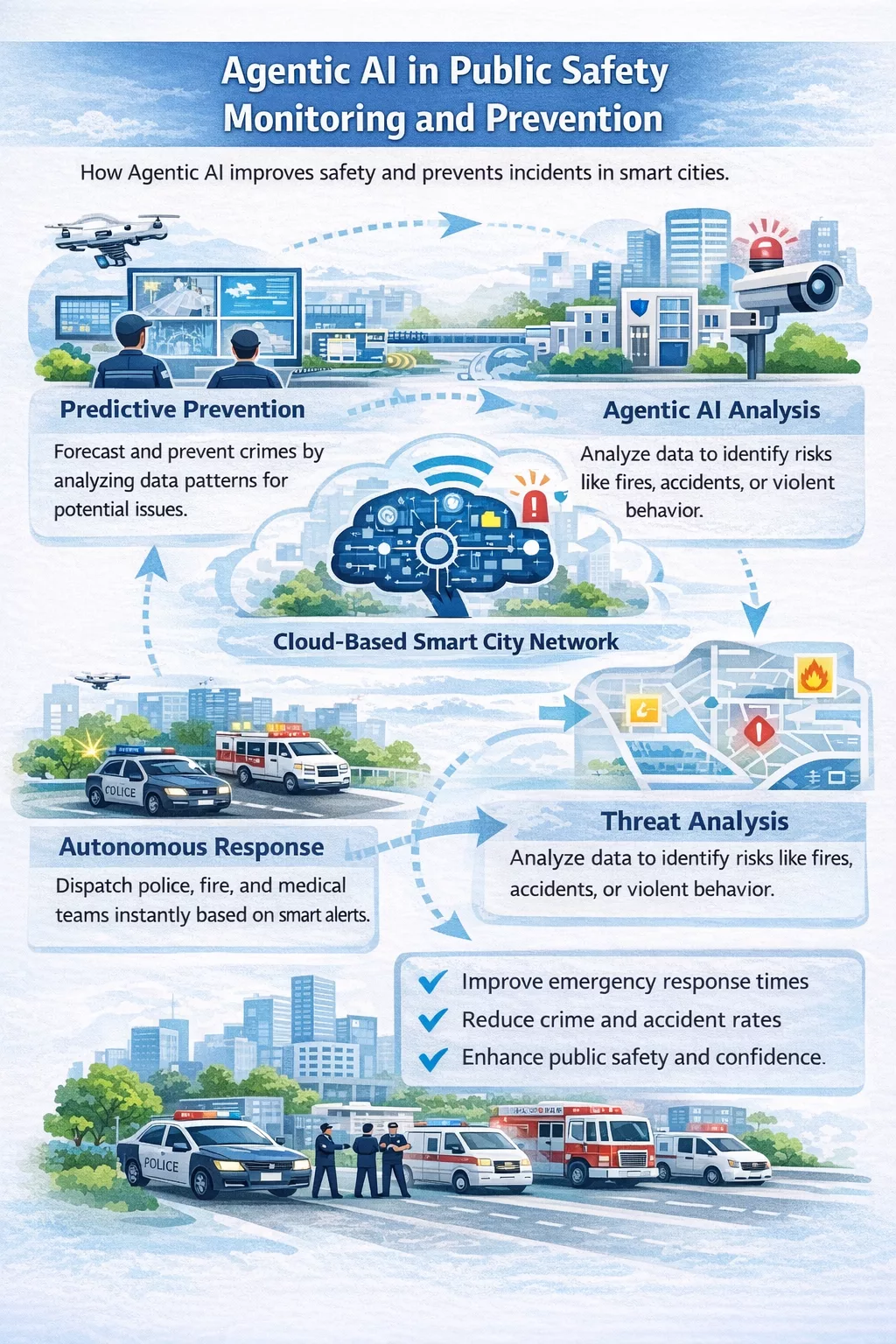
Here’s a practical example. If an area shows repeated minor accidents late at night, agentic AI identifies the pattern. It may recommend better lighting, adjust traffic signals, or increase patrol presence during high-risk hours. These actions reduce incidents without waiting for a major accident to occur.
Research shows that AI-assisted safety systems can help reduce crime and accident rates by 10–20% in monitored areas. This happens because risks are identified early and addressed consistently.
Agentic AI also supports event safety. During large public gatherings, the system monitors crowd density and movement. If overcrowding starts, it alerts teams before the situation becomes dangerous.
For you, this means safer streets, safer public spaces, and quicker action when something feels wrong. Safety improves quietly, without disrupting daily life, while trust in city systems grows over time.
Together, these applications show how agentic AI works as a silent support system for cities. It watches, learns, and acts without needing constant attention, while people experience smoother services and safer surroundings.
For you, this means a city that feels more organized, more responsive, and easier to live in. The technology stays in the background, but its impact shows up every day in small, meaningful ways that improve urban life.
Agentic AI for Automating Critical Urban Infrastructure
Urban infrastructure is what keeps a city alive. Roads, power systems, water pipelines, and public transport must work all the time. When even one system fails, thousands of people are affected. Agentic AI helps cities manage this complexity by acting early instead of reacting late. I’ll now explain each part in detail so you clearly understand how it works and why it matters to you.
Continuous Monitoring of Roads, Bridges, and Transport Assets
Cities have thousands of kilometers of roads and many bridges, tunnels, and transit systems. Manually inspecting all of them regularly is almost impossible. Agentic AI solves this by continuously collecting data from sensors, cameras, drones, and connected vehicles.
The system looks for small signs of damage, such as cracks, unusual vibrations, surface wear, or traffic stress. These signs often appear long before a major failure happens. When agentic AI detects something unusual, it alerts maintenance teams immediately or schedules inspections automatically.
For example, if a bridge shows unusual vibration patterns during heavy traffic, the system flags it early. Engineers can inspect and fix the issue before it becomes dangerous. This reduces accidents and avoids sudden closures that disrupt daily travel for you.
Predictive Maintenance for Power Infrastructure and Grids
Power systems must stay balanced at all times. Even small failures can cause blackouts across large areas. Agentic AI continuously monitors transformers, substations, and power lines to understand how electricity flows through the city.
The system predicts equipment failure by studying temperature changes, load patterns, and historical data. Instead of waiting for something to break, maintenance is scheduled at the right time. This approach prevents sudden outages and reduces emergency repair costs.
For you, this means fewer blackouts, more stable electricity, and better protection for essential services like hospitals and public transport.
Smart Management of Water Pipelines and Sanitation Networks
Water and sanitation infrastructure mostly runs underground, making problems hard to spot. Agentic AI watches pressure levels, flow rates, and usage patterns across the entire network.
When the system detects leaks, blockages, or unusual flow behavior, it acts quickly. It can alert repair teams or adjust water flow automatically to reduce damage. Early detection prevents flooding, water loss, and health risks.
Cities using AI-based monitoring have reduced water loss significantly. For you, this results in better water pressure, fewer service interruptions, and less road damage from emergency digging.
Automated Scheduling of Infrastructure Maintenance
Traditional maintenance often follows fixed schedules, even when systems are working fine. Agentic AI replaces this with condition-based maintenance. It decides when and where maintenance is truly needed.
The system schedules work during low-usage periods to reduce inconvenience. This means fewer daytime road closures, less noise, and minimal disruption to your routine.
By avoiding unnecessary repairs and focusing on real needs, cities save money and extend the life of infrastructure assets.
Improving Infrastructure Reliability Through Continuous Learning
One of the strongest features of agentic AI is learning over time. Each action the system takes is recorded and analyzed. The AI learns which maintenance actions worked best and which areas need more attention.
As cities grow and change, the system adapts. It becomes better at predicting failures and managing resources. This creates infrastructure that improves year after year instead of wearing down.
For you, this means a city that feels stable and dependable, where breakdowns become rare and services stay consistent even as demand increases.
Agentic AI does not replace human expertise. It supports it by handling continuous monitoring and decision-making, so engineers and city teams can focus on planning and improvement. This balance helps cities stay strong, efficient, and ready for the future.
Agentic AI in Civic Services Improving Daily Life for Citizens
Civic services are the services you interact with as a citizen almost every day. These include safety, healthcare, public support, and communication with city authorities. When these services are slow or confusing, people feel ignored. Agentic AI helps cities fix this by making civic services more responsive, organized, and citizen-friendly. Let me explain each part in detail.
Faster Emergency Response and Better Service Coordination
When emergencies happen, time matters more than anything else. Agentic AI helps emergency services respond faster by analyzing data the moment an incident occurs. It reads emergency calls, sensor alerts, camera feeds, and location data together instead of treating them separately.
For example, if a road accident happens, the system identifies the exact location, checks traffic conditions, and guides ambulances along the fastest route. It can also alert nearby hospitals to prepare in advance. Cities using AI-supported emergency systems have reported up to 30% faster response times, which can directly save lives.
For you, this means help reaches you quicker, and emergency teams work in a more organized way without confusion.
Smarter Healthcare Access and Public Health Support
Public healthcare systems handle large numbers of people every day. Agentic AI helps manage appointments, staff availability, and patient flow in hospitals and clinics. It reduces overcrowding by spreading appointments more evenly and prioritizing urgent cases.
As an example, if many patients cancel appointments, the system reallocates slots automatically. It can also track disease patterns and help health departments respond early to outbreaks. This improves public health planning and service quality.
For you, this means shorter waiting times, clearer schedules, and more reliable access to healthcare services.
Automated Handling of Citizen Complaints and Requests
Cities receive thousands of complaints and service requests daily. Manual handling often causes delays. Agentic AI reads each request, understands its category, assigns it to the correct department, and tracks progress automatically.
For example, if you report a pothole, the system sends it directly to road maintenance and follows up until it is fixed. Cities using AI-based request systems have seen around 40% faster resolution times.
For you, this removes the need for repeated follow-ups and makes civic services feel more respectful of your time.
Public Safety Monitoring and Early Risk Prevention
Agentic AI improves safety by identifying risks before they turn into serious incidents. It studies patterns such as repeated accidents, unsafe areas, or unusual crowd behavior.
If an area shows rising safety concerns, the system alerts authorities early. It may suggest better lighting, traffic changes, or increased monitoring. Studies show AI-assisted safety systems can reduce incidents by 10–20% in monitored areas.
For you, this means safer streets and public spaces without heavy disruption.
Clear and Consistent Communication With Citizens
One of the biggest problems in civic services is poor communication. Agentic AI helps cities send clear updates, alerts, and service notifications automatically.
You receive accurate information about service delays, emergencies, or issue resolutions without chasing officials. This builds trust and keeps you informed.
Overall, agentic AI helps civic services work quietly but efficiently. You may not see the system, but you feel the difference through faster help, clearer communication, and services that simply work when you need them.
Top Benefits of Agentic AI for Governments and Citizens
Cities invest in agentic AI not just for technology upgrades, but to solve real problems that affect both governments and people. When systems become smarter and more independent, the benefits show up in daily operations, service quality, and public trust. I want to walk you through the key advantages that cities and citizens experience when agentic AI is used the right way, explained in a clear and practical manner.
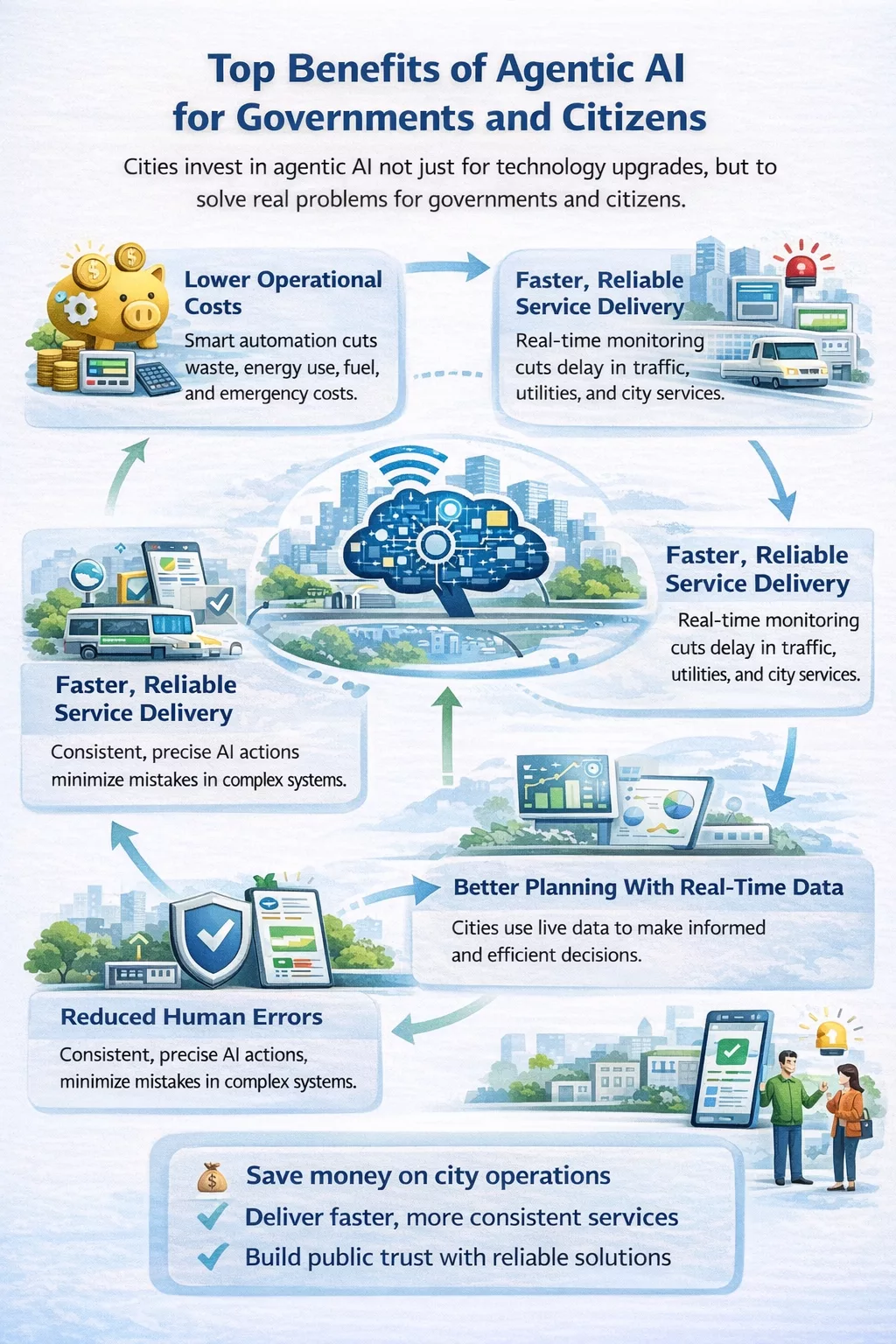
Lower Operational Costs for City Governments
Running a city costs a huge amount of money. Governments spend heavily on fuel, repairs, staff hours, emergency fixes, and repeated manual checks. Many of these costs come from reacting too late to problems. Agentic AI helps cities change this pattern.
Agentic AI continuously monitors infrastructure and services. It detects issues early and acts before systems fail. This reduces emergency repairs, which are always more expensive than planned maintenance. For example, fixing a small water leak early costs far less than repairing a burst pipeline that damages roads and buildings.
The system also reduces waste. In energy, traffic, and waste management, agentic AI ensures resources are used only when needed. This cuts fuel use, electricity loss, and unnecessary service trips. Cities using AI-driven automation have reported cost savings of 15–30% in operational expenses across different departments.
Another major saving comes from reduced manual work. Tasks that once needed large teams running 24/7 can now be handled automatically, allowing staff to focus on planning and oversight instead of constant monitoring.
For governments, this means better budget control and the ability to invest saved money into improving services instead of fixing repeated failures.
Faster and More Reliable Service Delivery
One of the biggest complaints people have about city services is slow response. Whether it is traffic issues, power problems, or civic requests, delays create frustration. Agentic AI helps cities deliver services faster and with more consistency.
Agentic AI does not wait for reports to pile up. It watches systems in real time and acts the moment something changes. If traffic builds up, signals adjust immediately. If energy demand rises, power distribution shifts automatically. If a civic request comes in, it is routed to the right department without delay.
Here’s a simple example. In a traditional system, a broken streetlight might take days to be noticed, reported, assigned, and fixed. With agentic AI, the system detects the issue, creates a task, assigns it to maintenance, and tracks completion automatically. This reduces delays at every step.
Cities using AI-driven service automation have seen response times improve by 30–40% in areas like utilities, traffic management, and public services. This reliability builds trust because people know services will work the same way every time.
For you, this means fewer long waits, quicker fixes, and services that feel dependable instead of unpredictable. The city starts working at the speed people expect.
Reduced Human Errors in Complex Systems
City systems are large, connected, and always active. Managing them manually increases the chance of mistakes, especially when teams are overloaded or under pressure. Agentic AI helps reduce these errors by handling tasks with consistency and accuracy.
Agentic AI follows predefined rules and goals without distraction. It does not get tired, rush decisions, or miss signals. When managing traffic, energy, or water systems, the AI applies the same logic every time. This consistency reduces mistakes that often happen due to human fatigue or delayed reactions.
For example, during peak traffic hours, manual control can miss sudden congestion points. Agentic AI notices these changes instantly and responds without waiting for intervention. In power systems, it balances loads accurately to avoid overloads that could lead to outages.
Studies in automated system management show that AI-assisted operations can reduce operational errors by up to 50% compared to manual monitoring. Fewer errors mean fewer service disruptions and fewer complaints from citizens.
This does not mean humans are removed from the process. Instead, city teams move into supervisory roles. They oversee AI decisions and step in only when needed. For you, this means systems work smoothly in the background, with fewer unexpected failures and more predictable services.
Better Planning Using Real-Time Data
Good city planning depends on understanding what is really happening, not just what reports say weeks later. Agentic AI helps governments plan better by using real-time and historical data together.
Agentic AI continuously collects data from traffic systems, energy grids, water networks, and civic platforms. It identifies patterns, trends, and recurring problems. This gives city planners a clear picture of how services are used and where improvements are needed.
For example, if certain roads stay congested every morning, agentic AI highlights this pattern. Planners can then redesign traffic flow, adjust public transport routes, or change signal timing permanently. Without AI, such decisions rely on limited surveys or delayed reports.
Cities using data-driven planning have seen up to 20–25% improvement in infrastructure utilization. This means existing systems are used more efficiently before new investments are made.
For you, better planning means fewer unnecessary road projects, smarter public transport, and services designed around actual needs. Decisions are based on real behavior, not assumptions, which leads to more effective use of public funds.
Higher Citizen Satisfaction and Trust
At the end of the day, technology only matters if it improves how people feel about the services they use. One of the strongest benefits of agentic AI is how it builds trust between cities and citizens.
When services work smoothly, people notice. Roads stay clear, power outages are rare, water supply is stable, and civic issues are resolved faster. Agentic AI helps deliver this consistency by reducing delays and preventing failures before they happen.
Clear communication also plays a big role. Agentic AI-powered systems keep citizens informed with updates, alerts, and service status messages. You do not feel ignored or left in the dark. Even when issues occur, knowing what is happening builds confidence.
Cities using AI-driven civic platforms have reported up to 35% improvement in citizen satisfaction scores. Fewer complaints and faster resolution lead to better public perception and stronger trust in local governments.
For you, this means living in a city that feels responsive and reliable. Instead of struggling with slow systems, you experience services that support daily life quietly and efficiently. Over time, this trust strengthens the relationship between people and the city they live in.
Challenges Cities Face When Using Agentic AI Systems
Before talking about challenges, I want to be clear about one thing. Agentic AI brings strong benefits, but it is not a plug-and-play solution. Cities must plan carefully, set clear rules, and stay responsible while using this technology. When challenges are ignored, even powerful systems can create problems instead of solutions. Let me explain the main agentic AI solutions challenges cities face and why they matter to you.
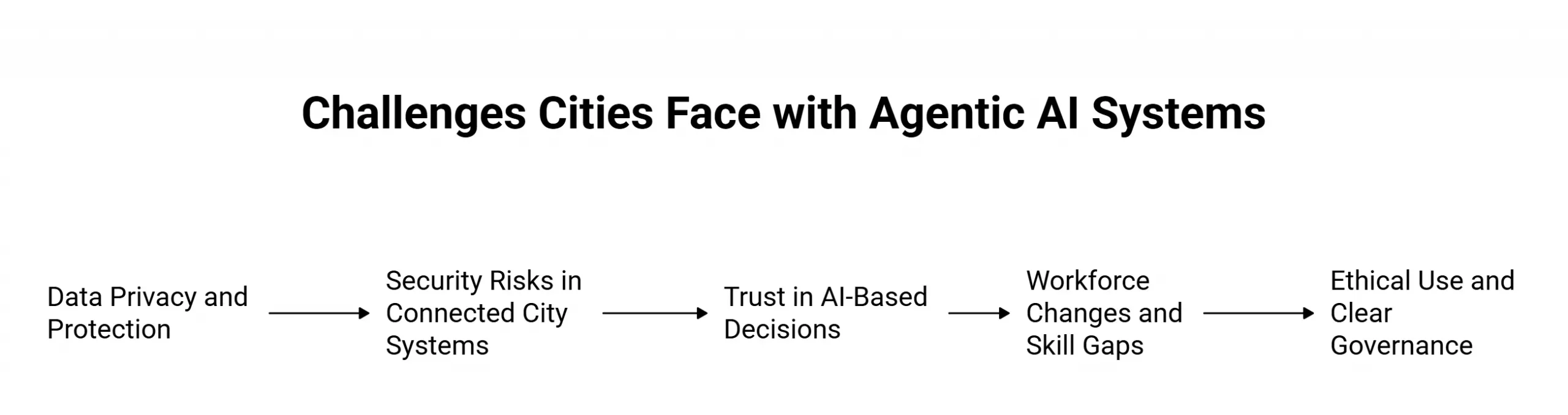
Data Privacy and Protection of Personal Information
Let me start with the biggest concern most people have, and honestly, it’s a valid one. Agentic AI systems work by collecting and analyzing large amounts of data. This data can include traffic movement, energy usage, service requests, and sometimes even location-based information linked to citizens.
The challenge for cities is making sure this data is protected at every stage. If data is not stored properly or shared without control, it can lead to misuse or loss of public trust. People want better services, but they also want to feel safe knowing their personal information is not being exposed.
For example, when a city uses AI to manage traffic or civic complaints, the system may process location details or usage patterns. Cities must clearly define what data is collected, why it is collected, and how long it is stored. Strong encryption, access controls, and clear data policies are necessary to prevent breaches.
If privacy is not handled well, even a useful AI system can face resistance from citizens. That is why successful cities focus on transparency and strict data protection rules from the start. When people trust how their data is handled, they are more open to AI-driven services.
Security Risks in Connected City Systems
Smart cities depend on many connected devices like sensors, cameras, meters, and control systems. Agentic AI connects all of these parts to make decisions. While this connectivity brings efficiency, it also creates security risks if not handled carefully.
The main challenge is that every connected device can become a possible entry point for attacks. If one system is compromised, it can affect traffic control, power supply, water systems, or emergency services. This is a serious concern because these systems support daily life and public safety.
For example, if a power grid control system is not well protected, attackers could disrupt electricity distribution. Agentic AI relies on accurate data, so false or manipulated data can lead to wrong decisions. Cities must secure not just the AI software, but also the devices feeding it information.
To manage this risk, cities need strong cybersecurity practices. This includes regular system updates, continuous monitoring, and strict access control. AI systems should also be tested to detect unusual behavior early.
For you, strong security means confidence that city services will continue to work safely and reliably. Without proper protection, even advanced AI systems can become a risk instead of a solution.
Trust in AI-Based Decisions
One of the biggest challenges cities face is building trust in decisions made by agentic AI. Many people feel uneasy when systems act without direct human involvement, especially when those decisions affect public services or safety.
The issue is not that AI makes decisions, but that people often do not understand how or why those decisions are made. If a traffic route changes suddenly or a service request is delayed, citizens want clear reasons. Without transparency, AI systems can feel confusing or unfair.
For example, if agentic AI redirects traffic through a residential area to reduce congestion elsewhere, residents may question the decision. Cities need ways to explain the logic behind AI actions in simple terms. Clear communication helps people understand that decisions are based on data and city goals, not random choices.
To build trust, cities must keep humans involved at key points. Agentic AI should operate within defined rules and allow oversight. Regular audits and performance reviews help ensure decisions remain fair and effective.
When people understand how AI works and see consistent results, trust grows naturally. This trust is essential for long-term acceptance of AI-driven city systems.
Workforce Changes and Skill Gaps
When cities introduce agentic AI systems, the way people work also changes. This is one of the most sensitive challenges, because it directly affects jobs, roles, and responsibilities.
Agentic AI automates many routine tasks such as monitoring systems, sorting service requests, and analyzing data. While this improves efficiency, it also means some traditional roles become less needed. At the same time, new roles appear that require different skills, like managing AI systems, analyzing outputs, and ensuring systems run correctly.
For example, instead of manually checking traffic cameras all day, staff may need to learn how to supervise AI dashboards and interpret alerts. This shift can feel uncomfortable if workers are not given proper training or support.
Cities must invest in upskilling their workforce. Training programs, workshops, and gradual role transitions help employees adapt. When workers understand that AI is a tool to support them rather than replace them, resistance decreases.
For you as a citizen, a well-trained workforce means better service quality. Staff can focus on complex problems, human interaction, and decision-making while AI handles repetitive tasks.
Want to knwo? How SMBs Are Using Agentic AI to Automate Operations
Ethical Use and Clear Governance of Agentic AI Systems
The final and most important challenge is making sure agentic AI is used in an ethical and responsible way. Because these systems can act on their own, cities must set clear boundaries on what the AI can and cannot do.
Ethical concerns come up when AI decisions affect people’s access to services, safety, or movement. Cities need clear rules to prevent bias, unfair treatment, or misuse of authority. Agentic AI should always follow public values and legal standards.
For example, if AI is used to prioritize emergency services or public safety monitoring, cities must ensure it does not unfairly target certain areas or groups. Clear guidelines help prevent discrimination and misuse.
Strong governance frameworks define accountability. Cities should clearly decide who is responsible when AI makes a mistake. Human oversight must remain in place, especially for critical decisions.
Transparency is also key. Citizens should know when AI is being used and for what purpose. When people understand the system and see that it operates within ethical limits, trust increases.
Handled correctly, agentic AI becomes a reliable partner in city management rather than a risk. Clear ethics and governance turn powerful technology into a tool that serves people fairly and responsibly.
Final Say
Let me wrap this up in a simple and clear way. Cities are becoming more complex every year. More people, more vehicles, more pressure on energy, water, and public services. Managing all of this with only manual systems is no longer practical. That is why agentic AI is becoming such an important part of city operations.
What makes Agentic AI in Smart Cities truly valuable is its ability to learn and improve over time. The more it operates, the better it understands city needs and citizen behavior. When used carefully, with strong security and clear rules, it becomes a quiet support system that keeps urban life running smoothly.
As cities continue to grow, solutions like these will play a key role in making sure growth does not come at the cost of quality of life.

FAQs
How much does it cost to implement agentic AI for smart city infrastructure?
The cost to implement agentic AI for smart city infrastructure depends on city size, system complexity, and existing digital readiness. For small to mid-sized cities, pilot projects usually start between $500,000 and $2 million, covering data integration, AI models, and basic automation.
Large cities with advanced infrastructure may invest $5 million to $20+ million for full-scale deployment across traffic, energy, water, and civic systems. Ongoing costs include cloud services, system monitoring, cybersecurity, and staff training. While the upfront investment is significant, cities often recover costs through reduced maintenance, lower energy waste, and improved service efficiency over time.
What is the average cost of deploying agentic AI for traffic management systems?
The average cost of deploying agentic AI for traffic management systems usually ranges between $1 million to $10 million, depending on the city size, traffic volume, and system complexity. Smaller cities may spend less by using existing cameras and sensors, while large cities often require new hardware, advanced AI models, and system integration.
Costs typically include data infrastructure, AI software, sensor upgrades, cloud services, and ongoing monitoring. Although the initial investment can be high, cities often recover costs through reduced congestion, lower fuel consumption, fewer accidents, and improved traffic efficiency over time.
Is agentic AI implementation affordable for small or mid-sized cities?
Yes, agentic AI implementation can be affordable for small and mid-sized cities when planned in the right way. Cities do not need to deploy large, complex systems all at once. Many start with focused use cases such as traffic control, waste management, or civic service automation, which keeps costs manageable.
Cloud-based platforms, modular AI solutions, and phased rollouts further reduce upfront investment. Over time, cost savings from reduced energy waste, fewer system failures, and lower manual effort help offset initial expenses. With clear goals and proper planning, agentic AI becomes a practical and scalable option rather than a financial burden.