

Agentic AI vs Traditional AI comes down to one fundamental difference: who controls the decision-making process. Traditional AI systems respond to predefined inputs and follow fixed rules or trained patterns. Agentic AI systems, in contrast, can set goals, plan actions, use tools, and adjust their behavior with minimal human input.
This distinction matters for anyone evaluating AI technology—whether you are a service buyer, a business leader, or someone learning how modern AI systems work. Understanding how these systems operate helps you choose the right solution, avoid unrealistic expectations, and manage risks properly.
This article explains the differences clearly, using simple language and practical examples. You will learn not just what these systems are, but how they work, where they are useful, and where they may not be the right fit.
Traditional AI vs Agentic AI at a Glance
| Aspect | Traditional AI | Agentic AI |
|---|---|---|
| Task Control | Human-triggered | Goal-driven |
| Execution Flow | Linear | Cyclical |
| Adaptation | Requires retraining | Adjusts during runtime |
| Error Recovery | Manual | Automated retries |
| Decision Scope | Narrow | Context-aware |
| Resource Use | Fixed | Dynamic |
| Oversight Need | High | Moderate |
| Deployment Risk | Lower | Higher if unmanaged |
What Is Traditional AI?
Traditional AI refers to systems designed to perform specific, predefined tasks based on rules, models, or learned patterns.
These systems work within boundaries defined by humans. They do not decide what task to do next. They wait for input, process it, and return an output.
Common Characteristics of Traditional AI
- Operates on fixed instructions or trained models
- Requires human initiation for every task
- Does not set or change goals independently
- Works best in controlled environments
A spam email filter uses traditional AI. It analyzes incoming messages and labels them as spam or not spam based on learned patterns. It does not decide to create new rules or adjust its purpose unless retrained by humans.
Traditional AI has been widely adopted because it is predictable, easier to test, and easier to control.
What Is Agentic AI?
Agentic AI refers to systems designed to act as agents rather than simple tools. These systems are given goals instead of step-by-step instructions.
Once a goal is set, the system can:
- Plan actions
- Execute steps
- Monitor progress
- Adjust behavior when conditions change
This makes agentic AI suitable for complex tasks that involve multiple steps and decisions.
An AI system tasked with managing cloud resources might monitor usage, allocate servers, reduce costs, and respond to failures without waiting for constant human input.
This approach is increasingly relevant as organizations build Autonomous AI systems that must operate continuously with minimal supervision.
Do you know? AI Agents Are Disrupting Traditional Business Processes
Technical Architecture of Traditional AI vs Agentic AI
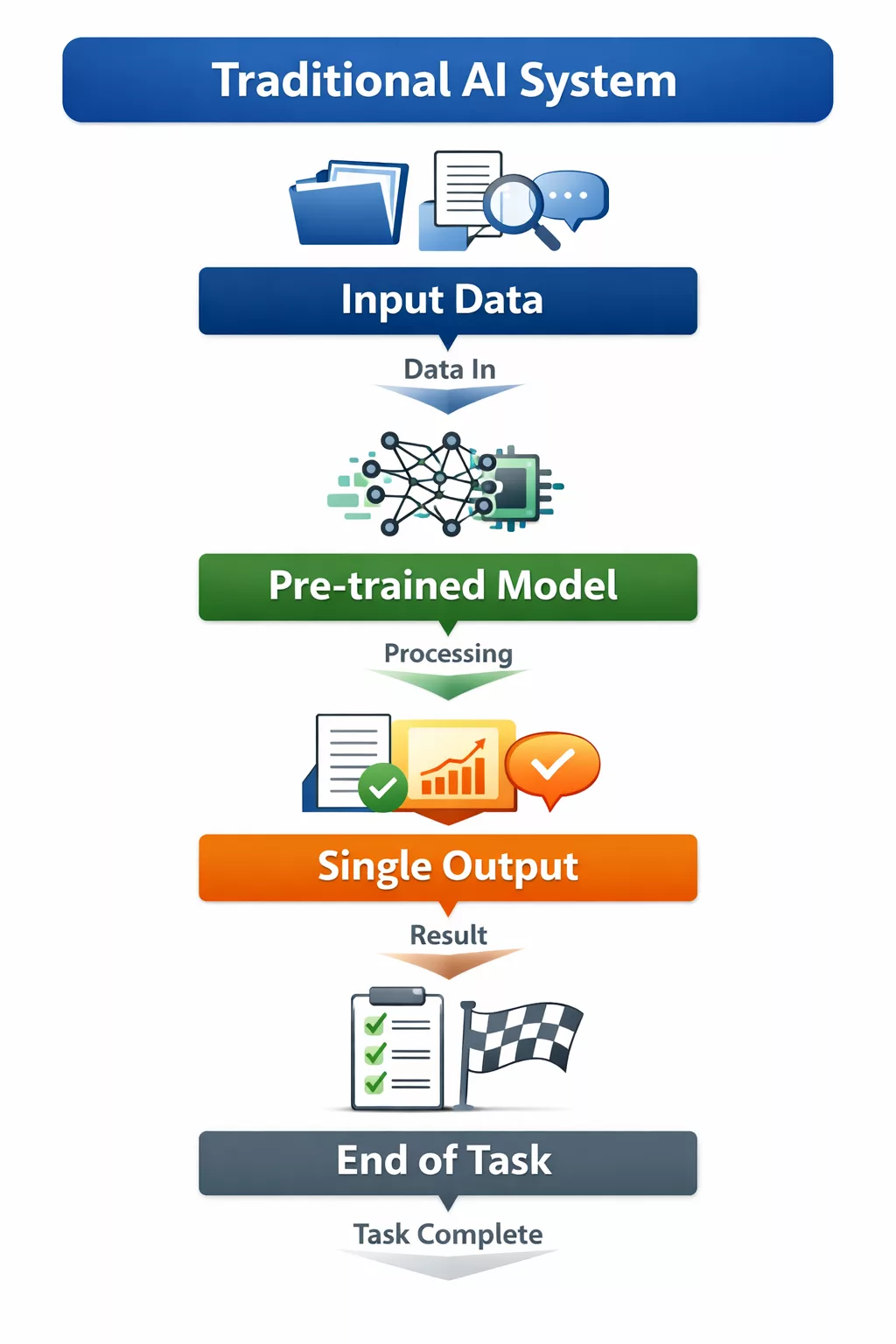
Before comparing individual differences, it helps to understand how both systems are structured internally. The contrast between agentic AI and traditional AI becomes clearer when we examine how data flows, decisions are made, and actions are executed.
This structure shows that traditional AI follows a linear execution path. Once the output is produced, the system stops and waits for the next instruction.
Agentic systems operate in continuous loops. They evaluate outcomes and adjust actions without restarting the entire process.
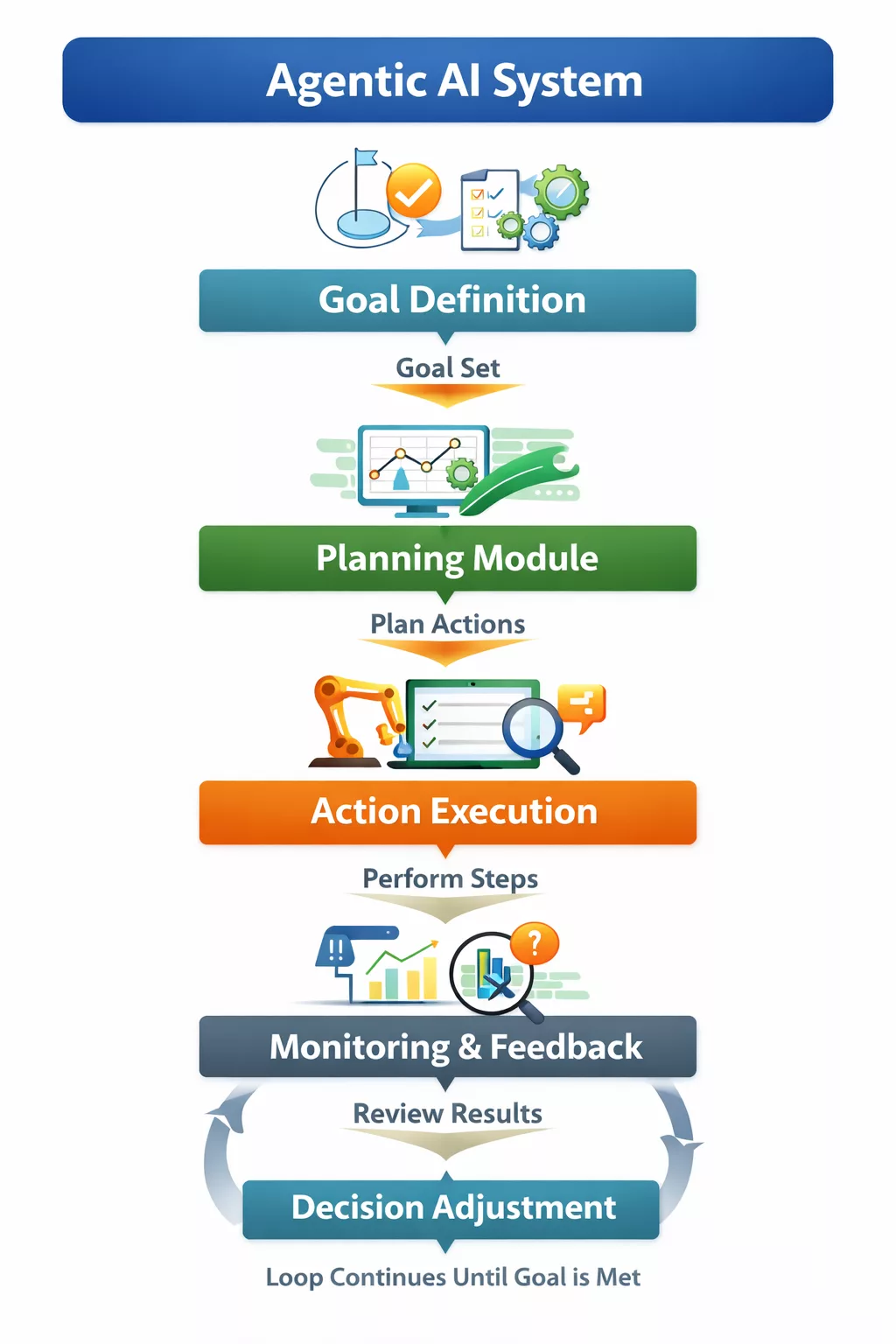
This architectural difference directly affects performance, cost, reliability, and operational risk.
Read once! Why Partnering with Top Agentic AI Companies Can Accelerate Innovation and Business Growth?
Top 10 Key Differences Between Agentic AI vs Traditional AI
The Key Differences Between Agentic AI vs Traditional AI explain how modern AI systems have evolved. Traditional AI focuses on fixed, human-triggered tasks, while agentic AI operates around goals, autonomy, and continuous decision-making. These differences affect adaptability, error handling, scalability, and human involvement, helping organizations choose the right AI approach for real-world operational needs.
Difference 1: Level of Autonomy
Autonomy refers to how much control an AI system has over its own actions.
Traditional AI systems have low autonomy. They do not act unless a human or another system explicitly triggers them. Once activated, they perform a single task and then stop. Even if the task fails, the system does not decide what to do next.
Agentic AI systems have higher autonomy. They are given a goal and allowed to decide how to achieve it. This includes deciding which actions to take, in what order, and whether to retry or change strategy if something goes wrong.
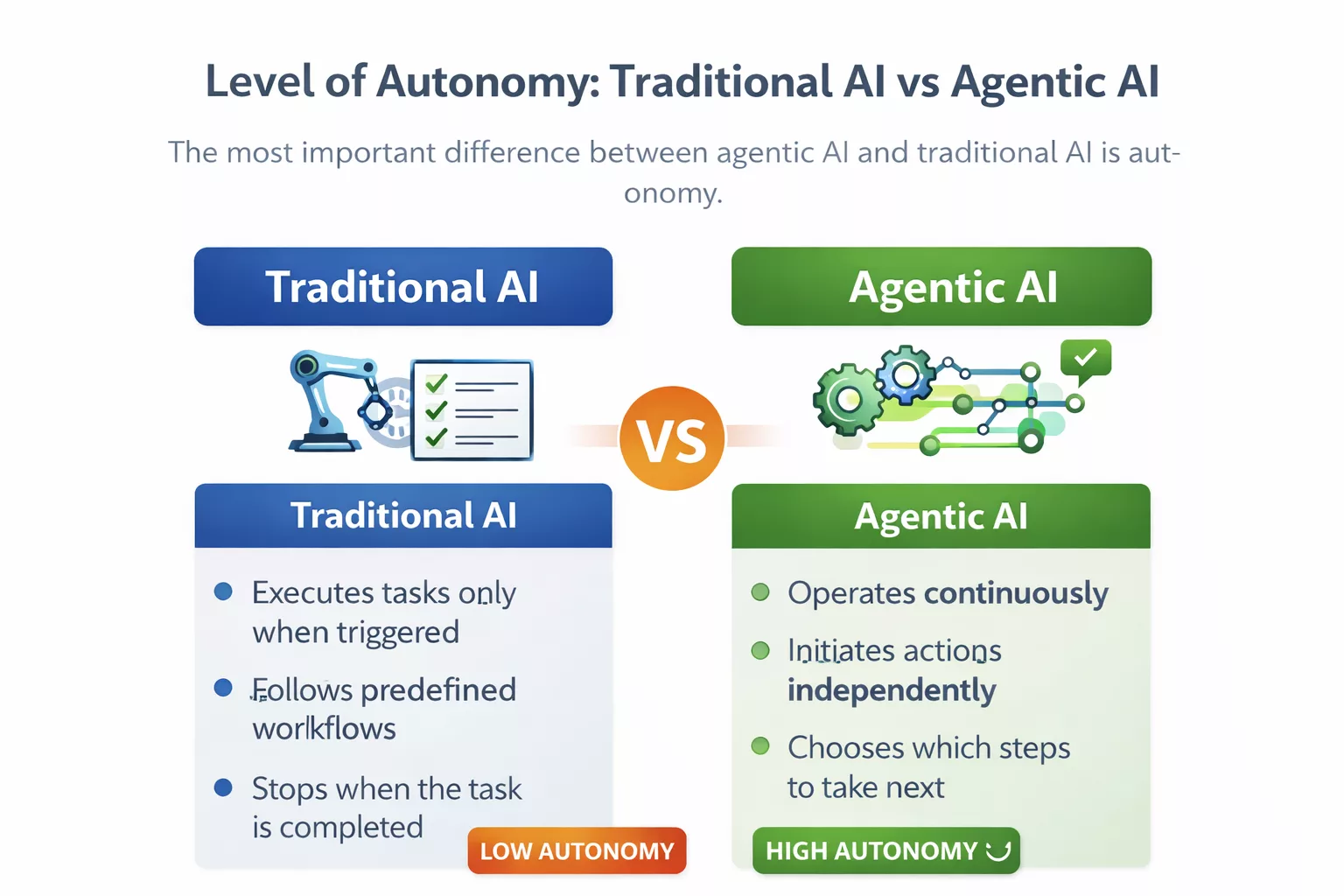
From a technical perspective, this is possible because agentic systems maintain internal state and decision logic across time. They are not stateless functions. They continuously evaluate their environment and their progress toward the goal.
This difference directly impacts system reliability. Traditional AI requires constant human supervision. Agentic AI reduces supervision but requires stronger safeguards.
Difference 2: Task Execution vs Goal Orientation
Traditional AI operates on tasks. A task is a clearly defined unit of work with a fixed start and end.
For example, a traditional AI model might:
- Classify an image
- Translate text
- Detect fraud in a transaction
Once the task is complete, the system stops.
Agentic AI operates on goals, which are broader and may not have a clear execution path at the start. A goal can involve multiple tasks, dependencies, and conditions.
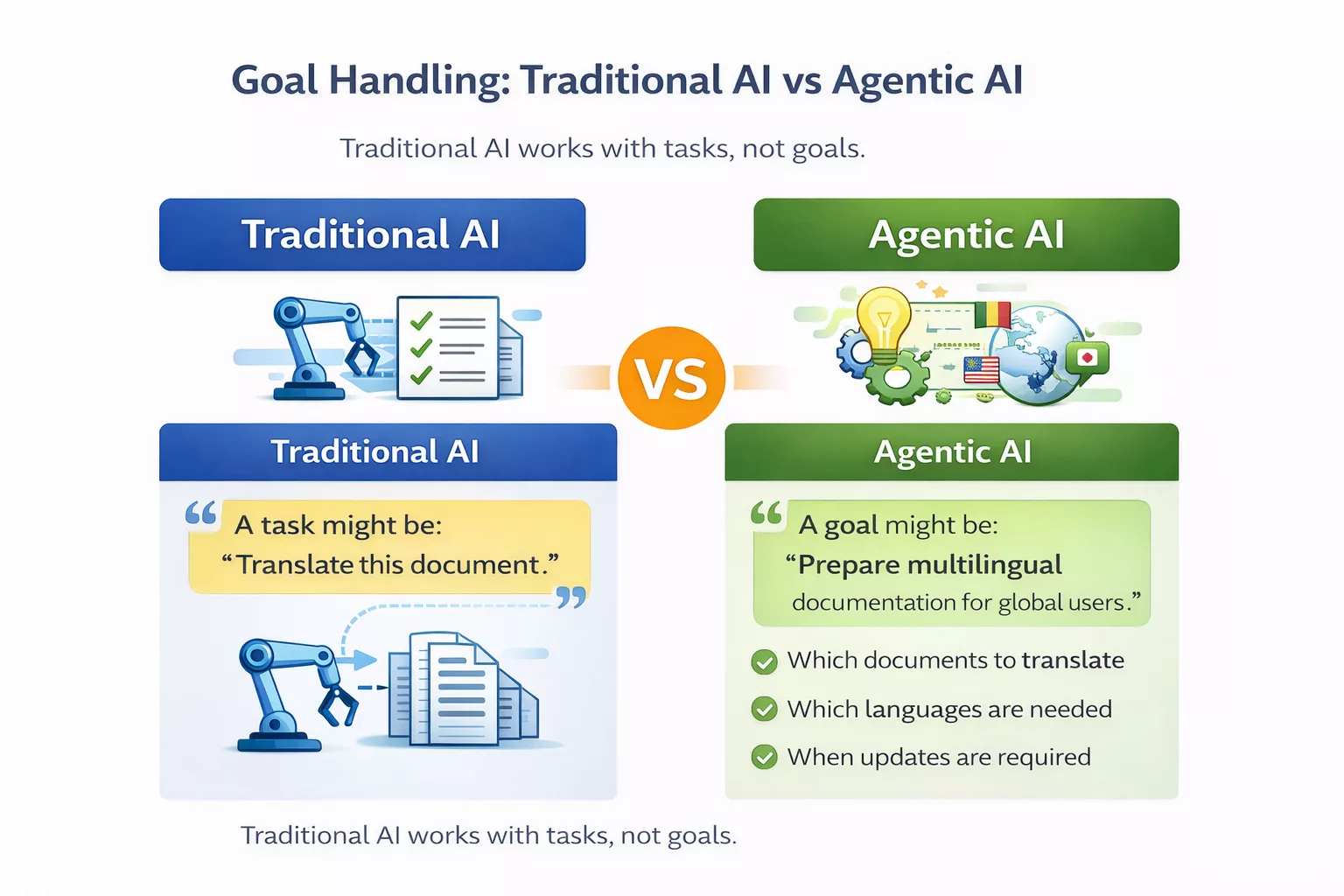
For example, instead of “generate a report,” the goal might be “ensure weekly performance reports are accurate and delivered on time.” The system must then determine how to achieve that outcome.
This goal-based approach is a fundamental distinction in Agentic AI vs Traditional AI, especially for complex workflows where the steps cannot be fully defined in advance.
Difference 3: Decision-Making Depth
Traditional AI systems make decisions through model inference. They analyze input data and generate output based on learned patterns. The decision process is fixed at inference time.
Agentic AI systems make decisions through deliberation. They evaluate multiple possible actions, consider constraints, and choose actions based on expected outcomes.
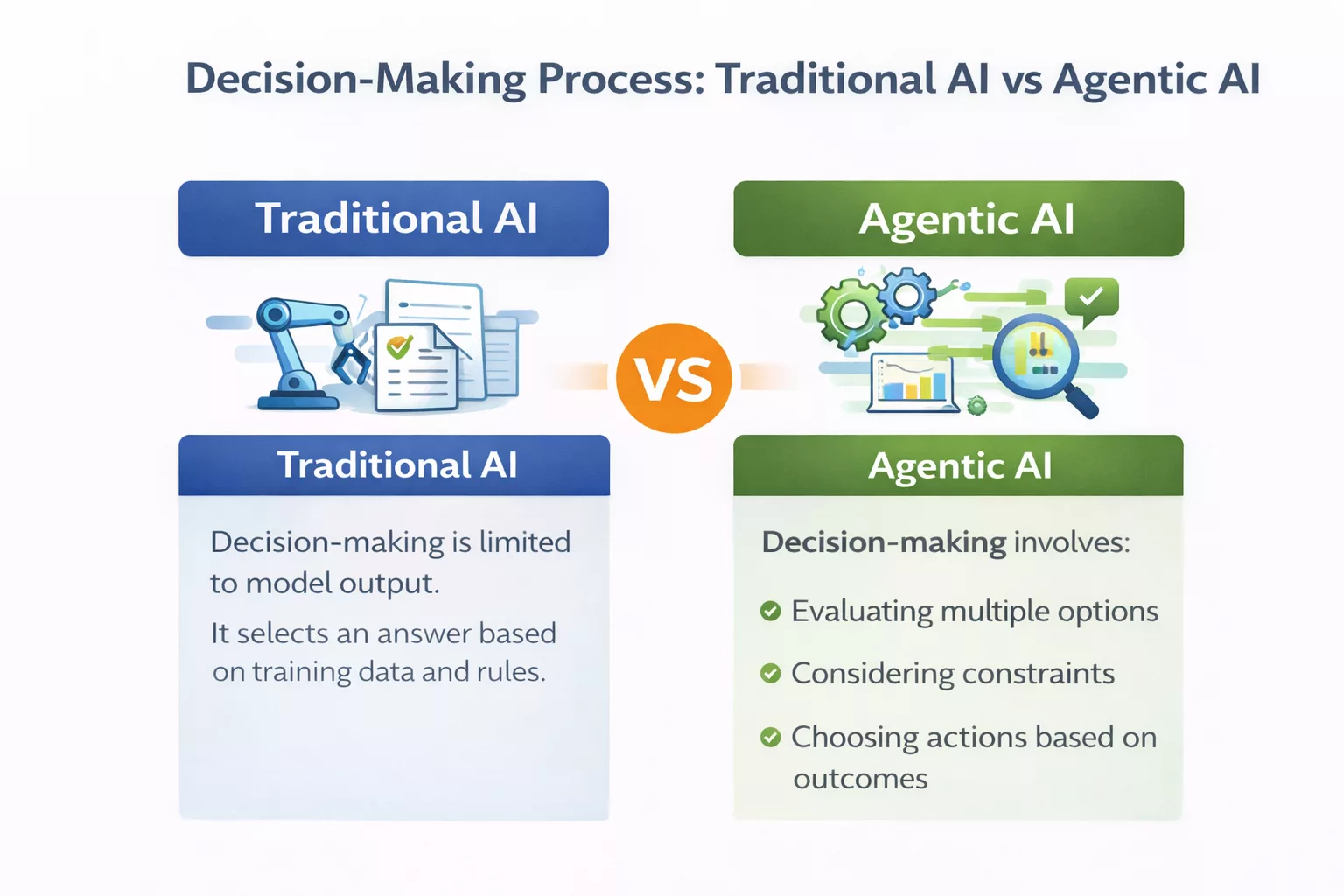
This often involves planning algorithms that simulate potential futures before acting. The system can compare options such as speed, cost, risk, and resource usage.
This deeper decision-making allows agentic systems to operate effectively in environments where trade-offs matter and conditions change frequently.
Difference 4: Adaptability to Change
Traditional AI systems assume that the environment during deployment is similar to the environment during training. When this assumption fails, performance drops.
If a traditional system encounters unexpected data or conditions, it cannot adapt on its own. Engineers must update rules or retrain the model.
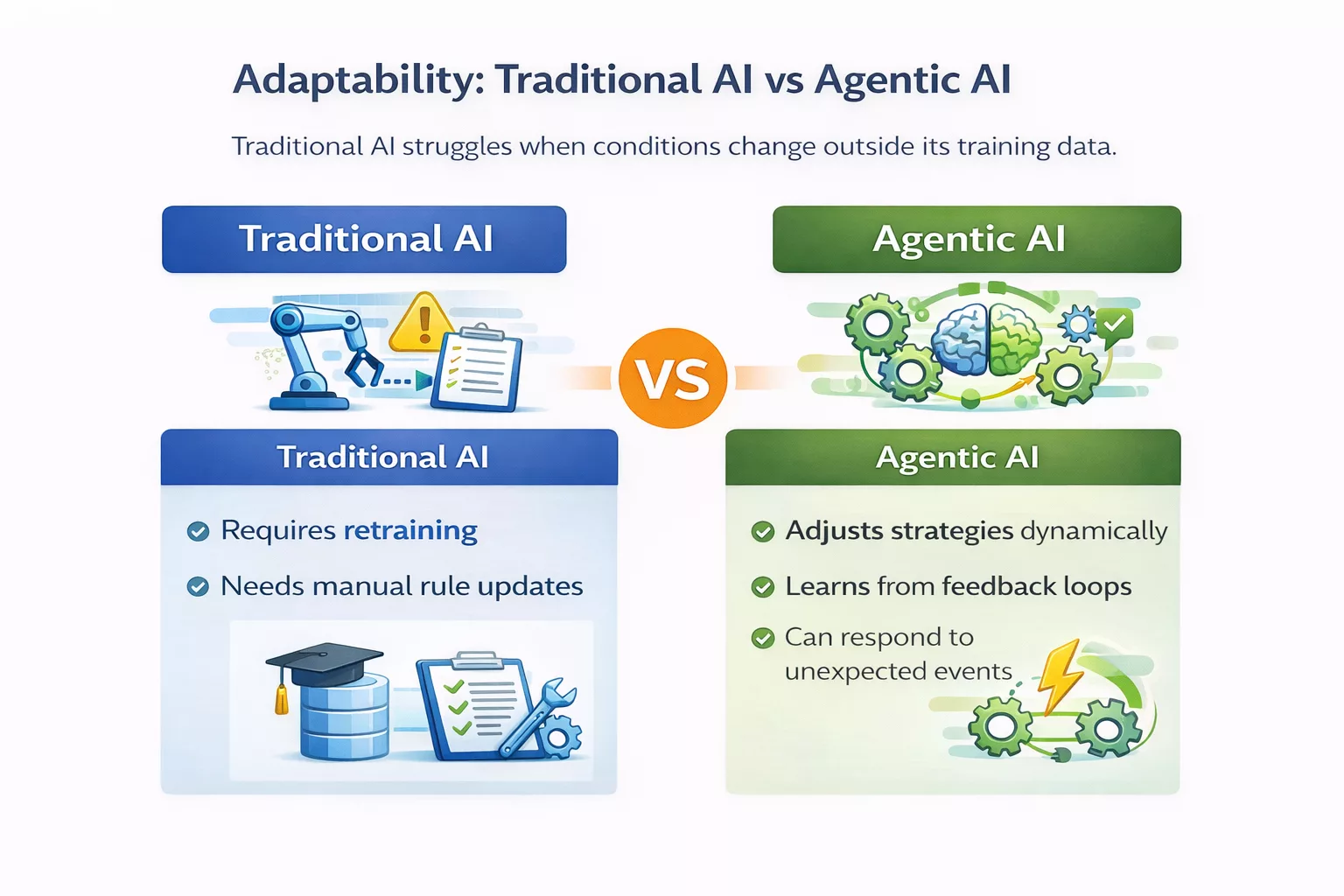
Agentic AI systems are designed to operate in dynamic environments. They monitor outcomes, detect changes, and adjust their behavior without retraining the core model immediately.
This capability is one reason why agent-based designs are becoming common in Autonomous AI systems in 2026, where systems must run continuously under changing conditions.
Difference 5: Human Involvement and Oversight
Traditional AI systems require humans throughout the workflow. Humans trigger actions, review results, and handle errors. The system itself does not manage exceptions.
Agentic AI shifts human involvement to a higher level. Humans define goals, constraints, and safety rules. The system handles execution and only escalates issues when it cannot resolve them.
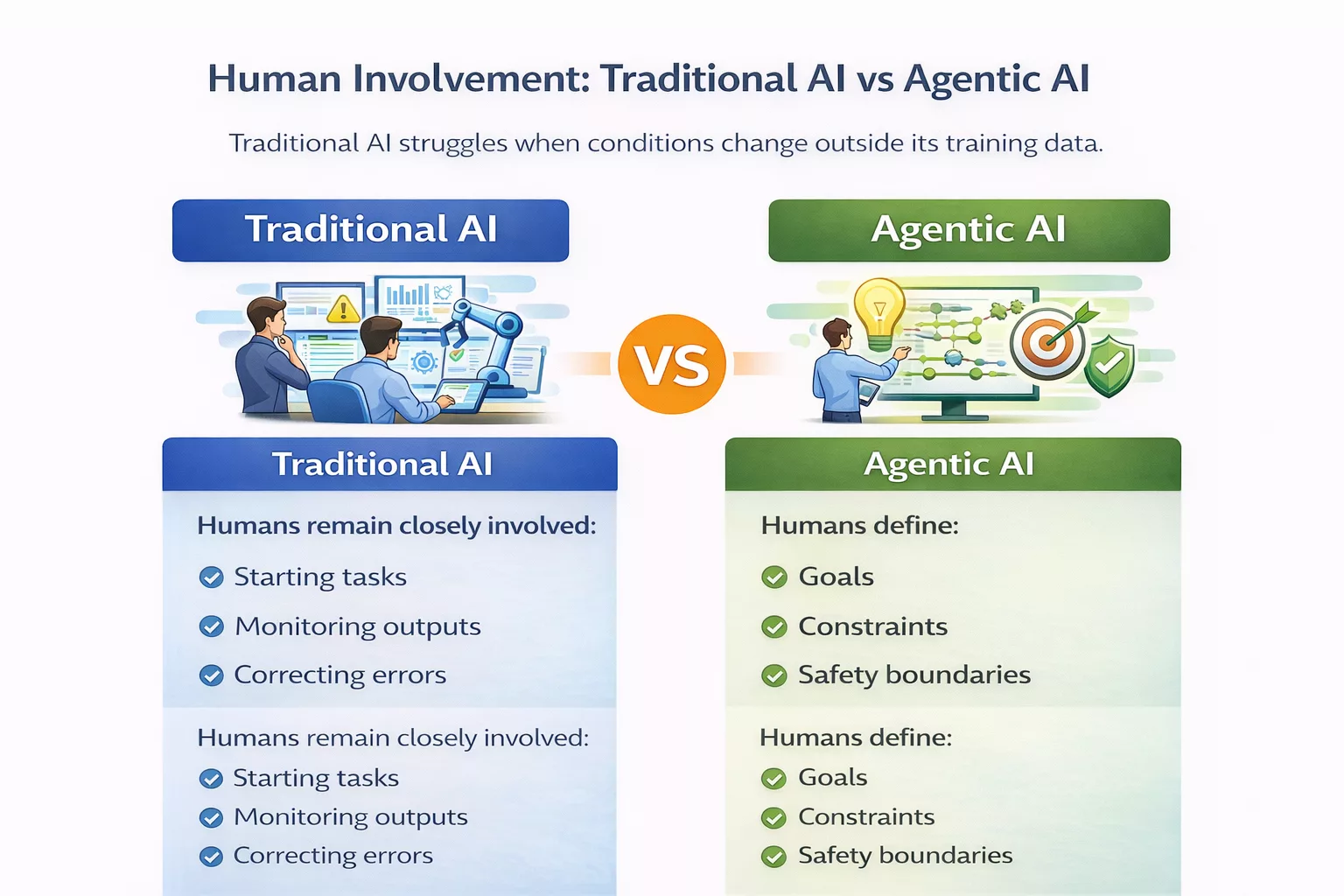
This changes how teams work. Instead of managing tasks, humans manage policies and outcomes. While this reduces operational workload, it increases responsibility during system design.
Difference 6: System Architecture
Traditional AI systems are usually simple in structure. They consist of a trained model, an input pipeline, and an output interface.
Agentic AI systems have layered architectures. These systems include planning modules, memory storage, execution tools, and feedback mechanisms. Each component serves a different role in achieving the goal.
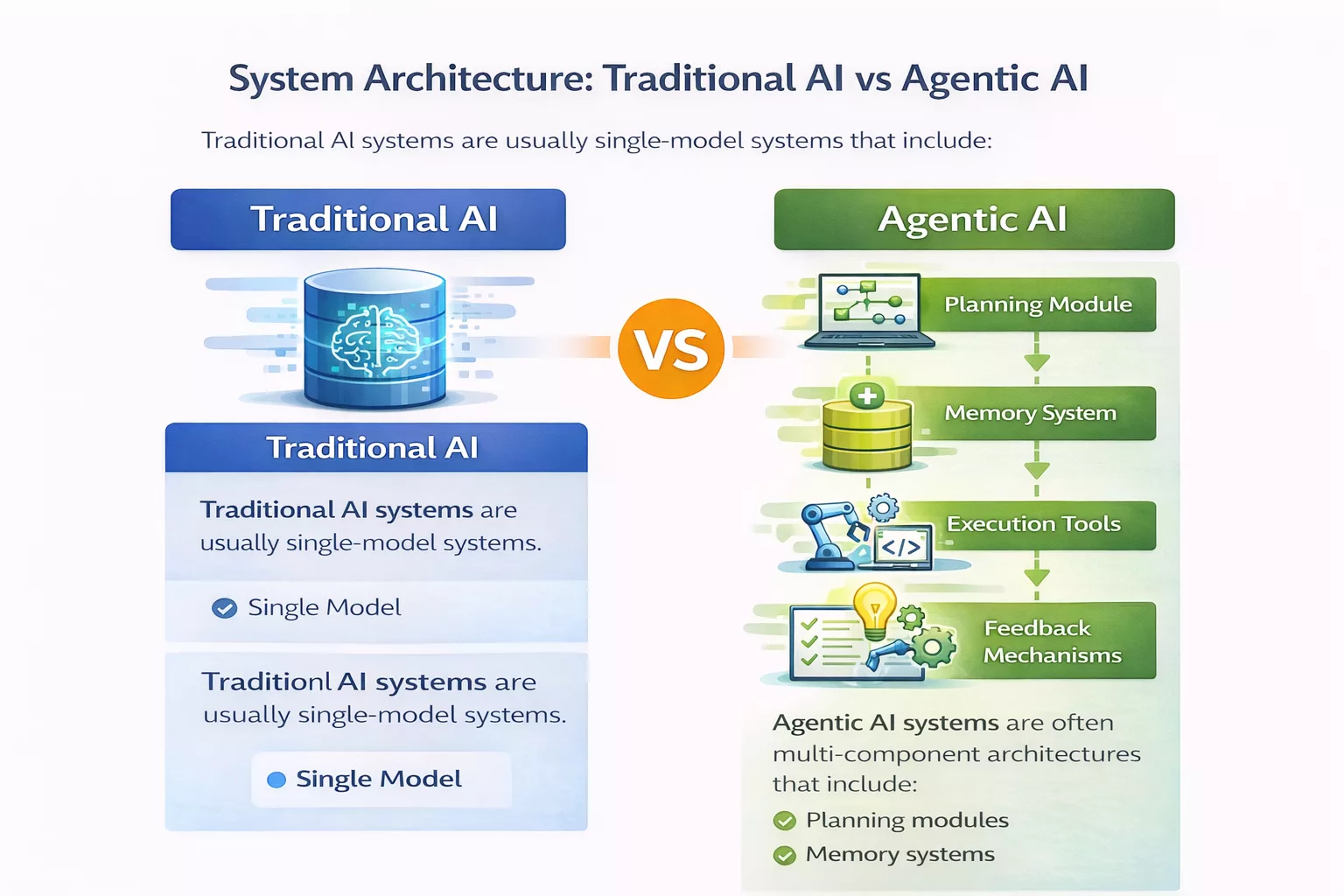
This architectural complexity increases development effort and testing requirements. It also explains why many early deployments are led by experienced teams and the best agentic ai companies.
Difference 7: Learning and Feedback Mechanisms
Traditional AI learns during training. Once deployed, it does not learn unless explicitly updated. Feedback is collected separately and applied later.
Agentic AI uses feedback during execution. Outcomes influence future actions in real time. This allows the system to refine strategies within predefined boundaries.
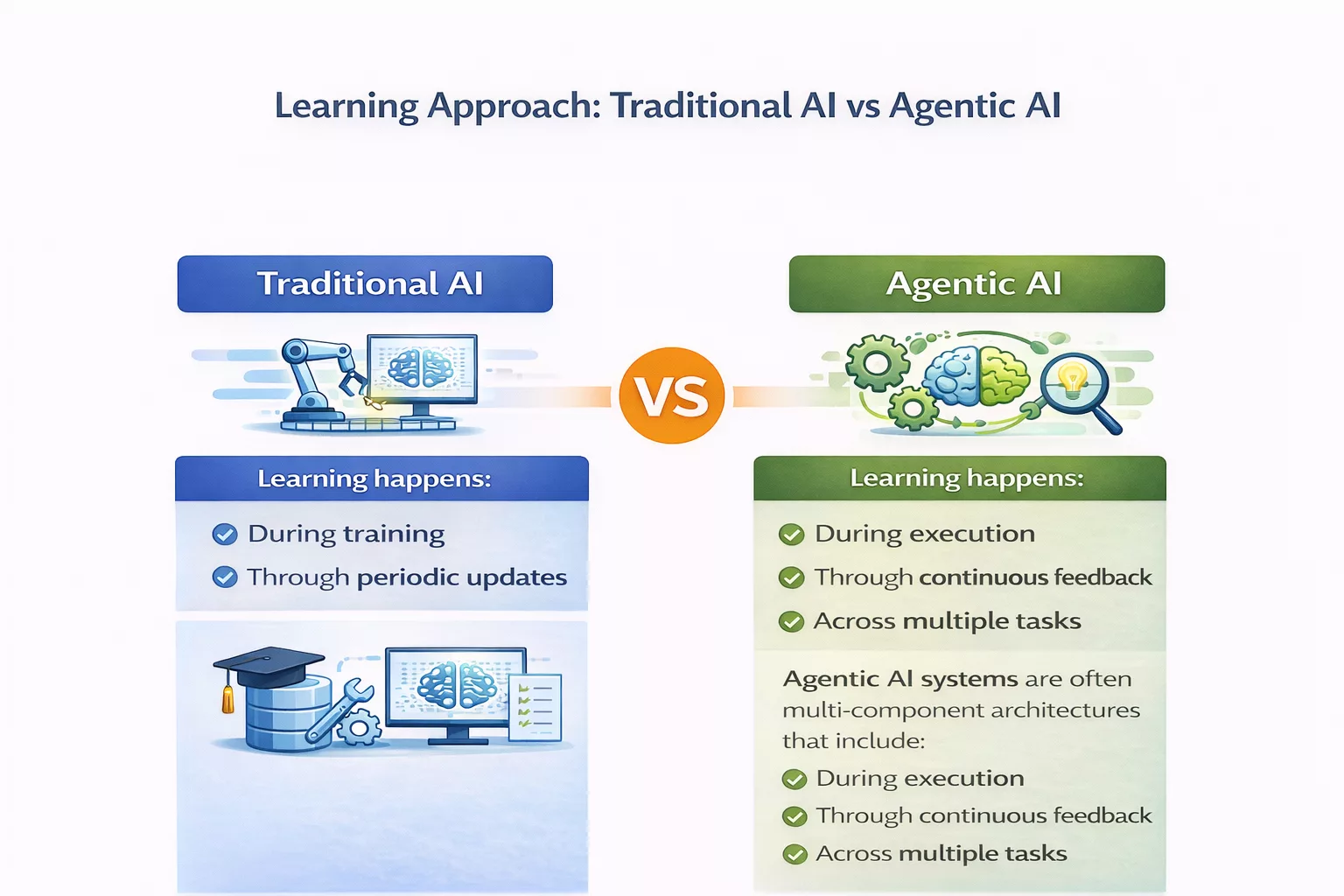
It is important to note that this does not mean unlimited self-learning. Agentic systems still operate under strict constraints set by developers.
Difference 8: Error Handling and Recovery
When traditional AI encounters an error, it typically stops or produces incorrect output. Human intervention is required to diagnose and fix the issue.
Agentic AI treats errors as part of the process. If an action fails, the system can attempt alternative approaches, retry with adjusted parameters, or change the execution plan.
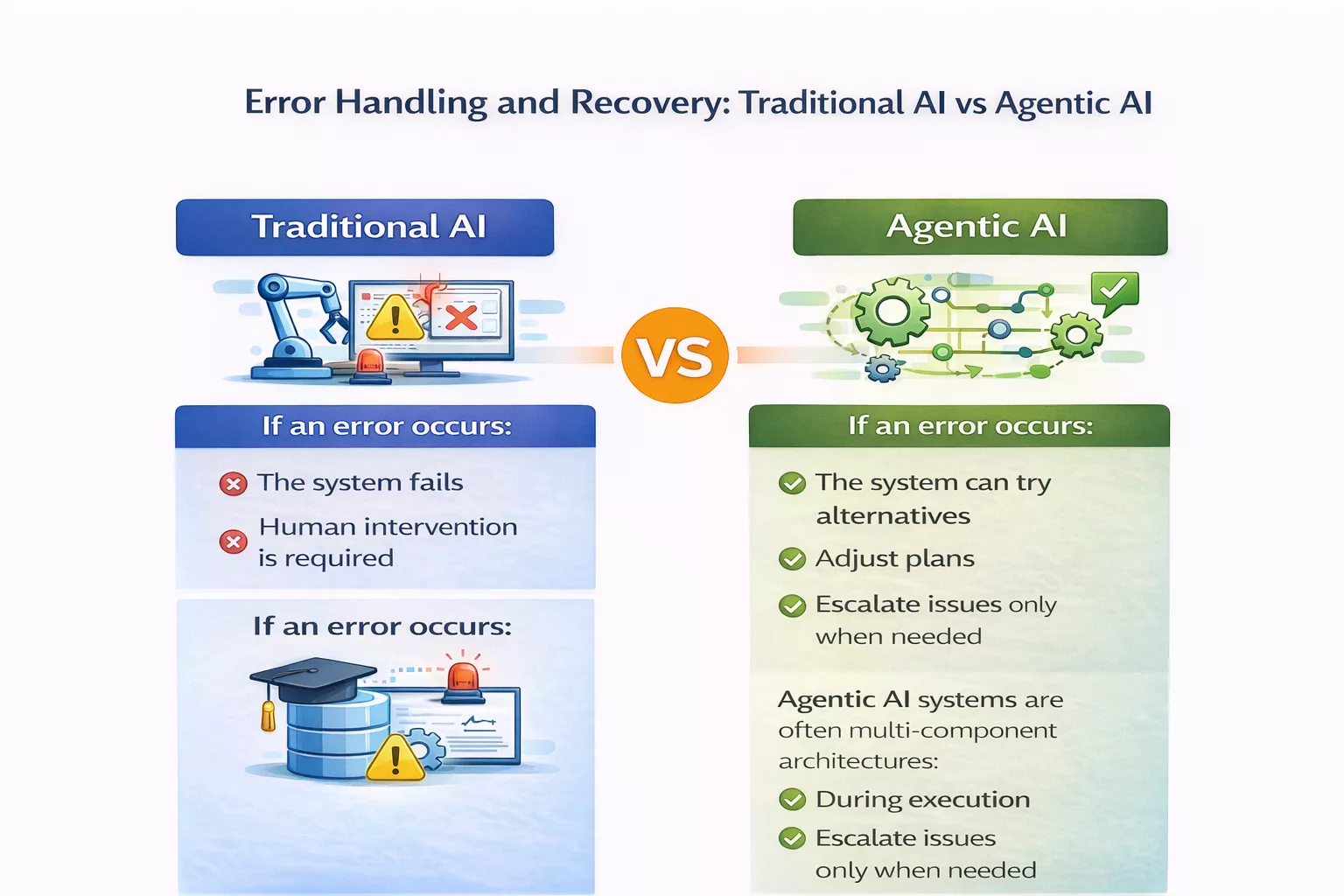
This approach improves resilience, especially in long-running systems where manual intervention is not always available.
Difference 9: Coordination and Scalability
Traditional AI systems usually operate independently. Even when integrated, coordination logic is handled externally through orchestration tools.
Agentic AI systems can include multiple agents working together. Each agent handles a specific role and communicates with others to achieve the overall goal.
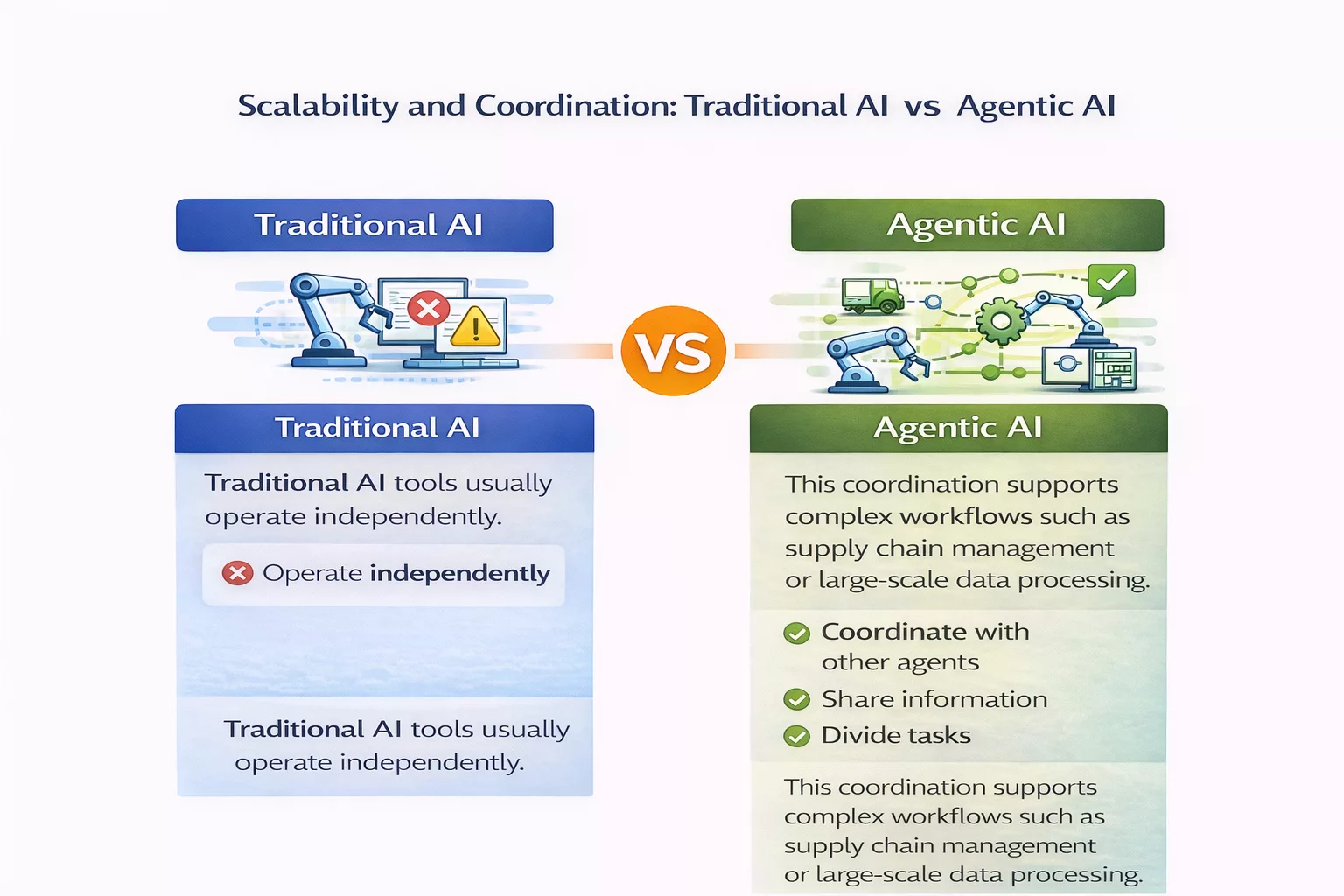
This design supports large-scale operations and is commonly seen in enterprise environments supported by agentic AI firms in New York that specialize in coordination-heavy systems.
Difference 10: Real-World Deployment Use Cases
Traditional AI remains effective for well-defined problems such as prediction, classification, and pattern recognition. These systems are easier to test, audit, and regulate.
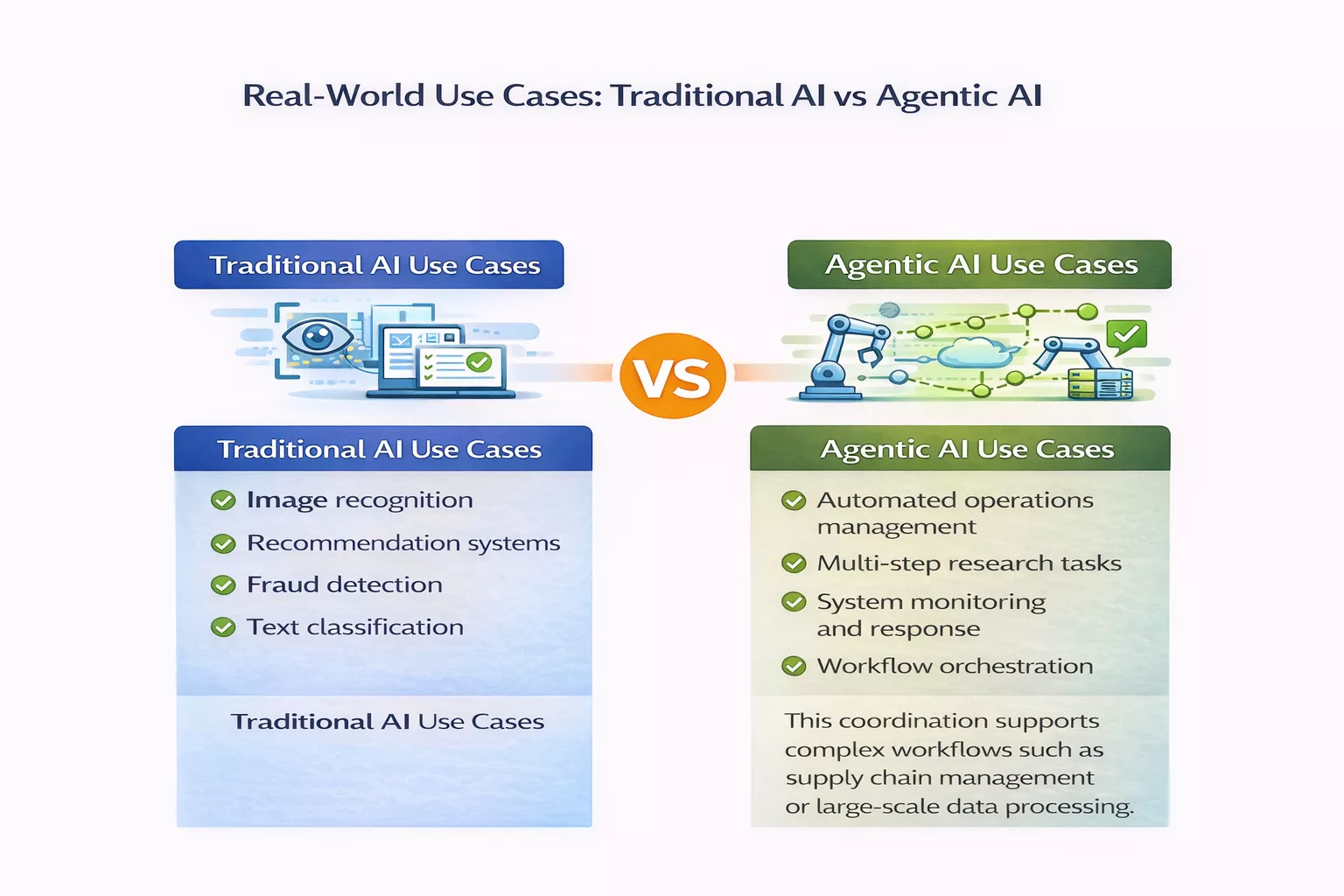
Agentic AI is better suited for complex, ongoing processes such as operations management, system monitoring, and adaptive workflows.
Organizations evaluating agentic ai companies USA often discover that agentic systems are most valuable when human attention is limited and decision complexity is high.
We have listed! Agentic AI vs Autonomous AI: Key Differences
Why Organizations Are Moving Toward Agentic AI in 2026
In 2026, this question is shaping how organizations rethink their AI strategy. Traditional AI remains effective for specific, well-defined tasks, but many organizations now face environments where tasks are connected, conditions change frequently, and decisions must be made continuously. In these situations, triggering AI manually or managing it step by step becomes inefficient and, in some cases, risky.
This is where agentic AI is gaining attention. Instead of focusing on single tasks, agentic systems are designed to pursue goals, monitor outcomes, and adjust actions over time. Organizations are not adopting agentic AI because it sounds advanced, but because it aligns better with how real systems operate today. The shift is especially noticeable among teams evaluating long-term automation strategies and working with the best agentic AI solution providers who focus on operational reliability rather than short-term automation.
Below are the main reasons driving this transition.
- Increasing Complexity of Business Operations: Modern organizations rely on interconnected systems spanning cloud infrastructure, data platforms, internal tools, and customer-facing services. Traditional AI performs well when tasks are isolated, but it struggles when actions depend on multiple systems and changing inputs. Agentic AI is designed to manage these interconnected workflows by maintaining context across steps and coordinating actions over time.
- Need for Continuous, Long-Running AI Processes: Many operational processes no longer run once and finish. Monitoring system health, managing resources, and detecting issues require continuous attention. Agentic AI systems operate in loops, allowing them to observe conditions, take action, and reassess outcomes without restarting the process or waiting for human input.
- Limited Human Capacity for Real-Time Oversight: As organizations scale, it becomes impractical for teams to monitor every AI-driven process in real time. Traditional AI requires frequent human involvement to handle exceptions and failures. Agentic AI reduces this burden by handling routine decisions autonomously and escalating only when predefined thresholds are crossed.
- Faster Adaptation to Changing Conditions: Business environments rarely stay static. Data patterns change, workloads fluctuate, and external conditions evolve. Traditional AI systems often require retraining or manual updates to stay effective. Agentic AI adjusts its behavior during runtime, allowing organizations to respond faster without stopping operations.
- Improved Operational Efficiency Across Workflows: Agentic systems do more than execute instructions. They evaluate timing, resource availability, and dependencies before acting. This leads to fewer redundant actions, smoother workflows, and more efficient use of computing and human resources.
- More Reliable Handling of Errors and Exceptions: When traditional AI encounters unexpected conditions, it often fails or produces incomplete results. Agentic AI treats errors as part of the process. It can retry actions, select alternative approaches, or adjust plans based on feedback, improving system stability in production environments.
- Shift Toward Outcome-Focused AI Measurement: Organizations are increasingly measuring AI success based on business outcomes rather than model-level metrics alone. Agentic AI aligns well with this approach because it is designed around achieving goals, making it easier to evaluate performance in practical terms.
- Scalability Without Matching Growth in Staffing: Scaling AI-driven operations traditionally requires adding more people to monitor and manage systems. Agentic AI allows organizations to expand operations without a proportional increase in human oversight, supporting growth while keeping operational costs controlled.
- Maturity of Supporting Infrastructure: Advances in orchestration frameworks, monitoring tools, and cloud infrastructure now support the safe deployment of agentic systems. What once required heavy custom engineering has become more standardized, lowering adoption barriers.
- Alignment with Long-Term System Design: Organizations planning new digital platforms are prioritizing systems that can operate independently within defined boundaries. Agentic AI fits this design philosophy better than task-based AI, making it a practical choice for long-term architecture rather than a short-term upgrade.
Organizations are moving toward agentic AI in 2026 because operational demands have changed. Systems must run continuously, adapt to change, and function with limited human oversight. Agentic AI addresses these needs directly, making it a practical evolution rather than a replacement for traditional AI.
Final Say
Agentic AI and traditional AI represent two different approaches to solving problems with software.
Traditional AI focuses on precision, predictability, and defined tasks.
Agentic AI focuses on autonomy, planning, and adaptive behavior.
Understanding these differences helps service buyers, developers, and organizations choose the right system for their goals. For deeper research, technical comparisons, and industry updates, readers can explore more related insights on AppsInsight, which covers AI system design and implementation trends in detail.