

Small and mid-sized businesses are quietly using a new type of AI to take real work off their teams’ plates.
Unlike earlier automation tools that followed rigid rules, these systems can interpret goals, decide what steps to take, and adjust when conditions change. Agentic AI for SMB operations automation is increasingly being used to handle repetitive coordination work that once required constant human attention, especially in lean teams where every hour matters.
For many SMBs, the appeal isn’t speed or scale alone; it’s relief from operational drag. Tasks like routing support requests, following up on sales leads, reconciling routine finance actions, or coordinating internal work no longer have to be manually triggered or supervised step by step.
As a result, many teams are now evaluating the Best Agentic AI Companies For SMBs based on how well their tools can take ownership of these workflows within clearly defined boundaries. When implemented thoughtfully, AI agents manage routine processes while allowing people to focus on judgment-heavy and customer-facing work.
To understand why this shift is happening now, it’s important to first clarify what agentic AI actually means in practical SMB terms.
What Agentic AI Means for SMB Operations
Agentic AI refers to AI systems that can take a goal, decide how to achieve it, and carry out a series of actions with limited human input. For SMBs, this usually doesn’t mean a fully autonomous system making major business decisions. It means software agents handling routine operational work that normally requires constant coordination.
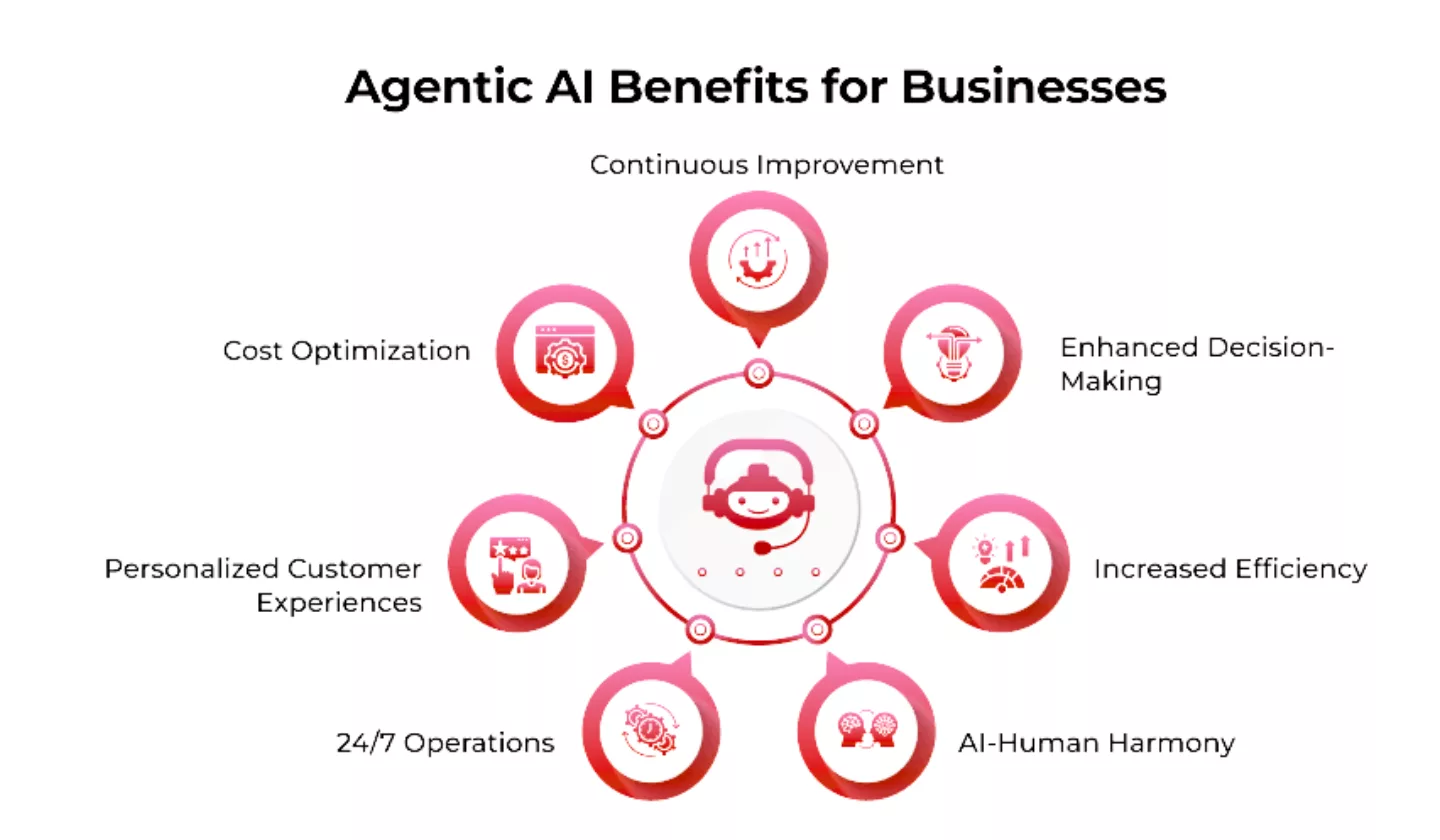
Traditional automation tools work through fixed rules: if X happens, do Y. Agentic systems work differently. They can evaluate context, choose between multiple possible actions, and adapt when something changes. For example, instead of simply assigning a support ticket, an agent might assess urgency, check past customer history, route the issue, request missing information, and follow up if there’s no response.
In practical terms, Agentic AI for SMB operations automation sits between basic automation and human decision-making. It operates within boundaries set by the business—approved tools, defined workflows, and escalation rules—while still having flexibility in how tasks are completed.
This distinction matters because SMB operations are rarely clean or predictable. Work often spans email, CRM systems, billing tools, and internal chat, with exceptions happening daily. Agentic AI is useful not because it’s “smart,” but because it can manage these messy, cross-tool workflows without requiring a person to manually push each step forward.
Why SMBs Are Adopting Agentic AI Now: Top Reason
SMBs are not adopting agentic systems because they are new or impressive. They are adopting them because existing ways of running operations are no longer sustainable.
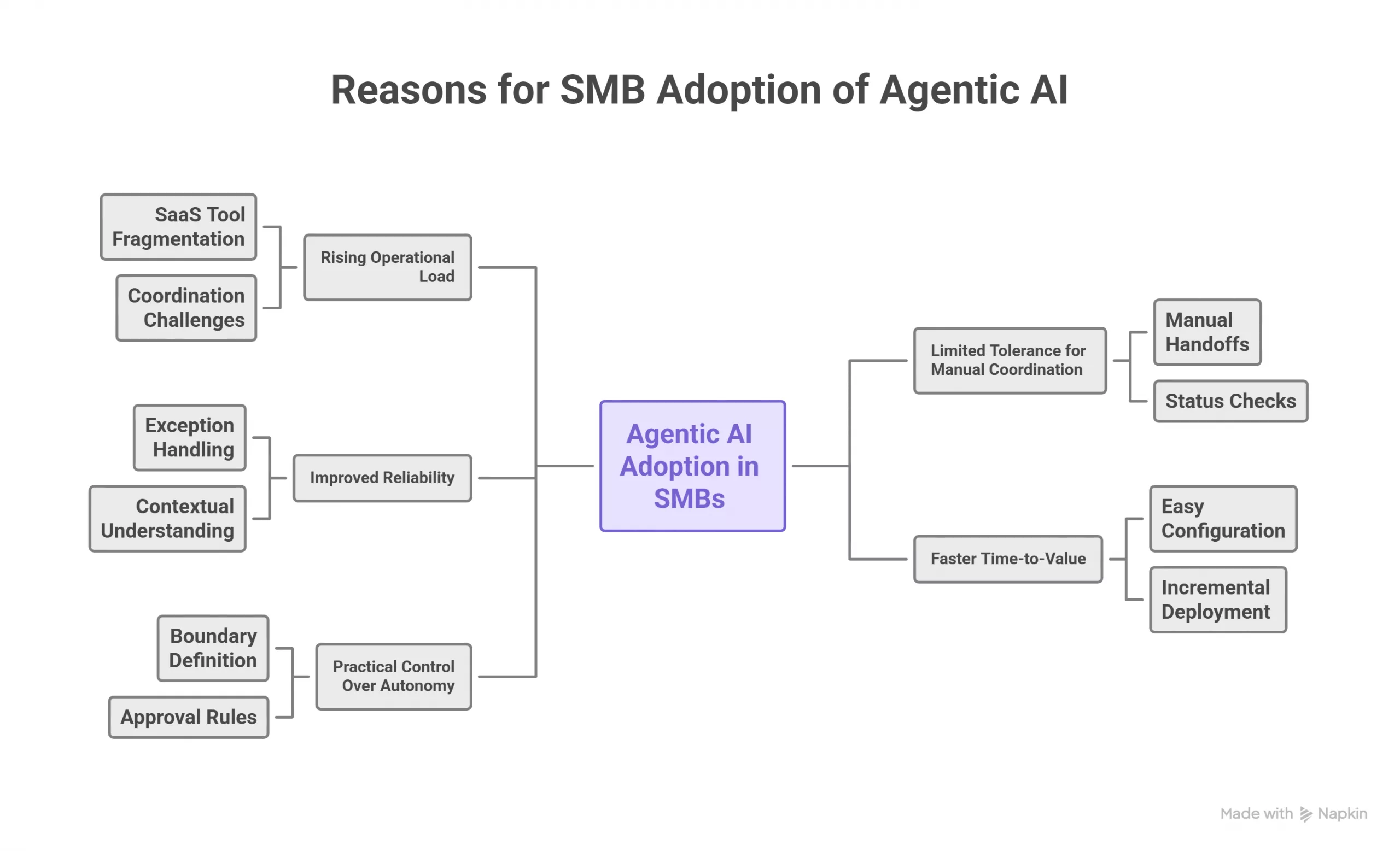
Below are the top reasons SMBs are adopting agentic AI, based on how work actually happens inside small teams.
Rising Operational Load Without Team Growth
As SMBs adopt more SaaS tools, everyday work becomes fragmented across systems. Even simple tasks now require coordination between email, CRM, support platforms, and internal messaging. Agentic AI for SMB operations automation helps manage this growing workload without forcing teams to expand headcount.
Limited Tolerance for Manual Coordination
Manual handoffs, reminders, and status checks consume a disproportionate amount of time in SMB environments. Agentic systems reduce this friction by tracking progress, triggering next steps, and following up automatically when something stalls.
Improved Reliability Compared to Early AI Tools
Earlier AI solutions often failed in real-world conditions because they couldn’t handle exceptions. Modern agentic systems are more resilient, better at understanding context, and designed to escalate instead of breaking. This makes adoption far less risky for operationally sensitive workflows.
Faster Time-to-Value for Small Teams
Unlike large enterprises, SMBs cannot wait months to see results. Agentic AI tools are now easier to configure, integrate with existing software, and deploy incrementally. Teams can automate one workflow at a time and see benefits quickly.
Practical Control Over Autonomy
SMBs want assistance, not unchecked automation. Today’s agentic tools allow businesses to define boundaries, approvals, and fallback rules. This balance—between autonomy and oversight—is a key reason Agentic AI for SMB operations is gaining trust and traction.
This shift sets the stage for understanding where SMBs are applying agentic AI most effectively across their operations.
Agentic AI Use Cases in Small and Mid-Sized Businesses
In small and mid-sized businesses, agentic AI is most effective when applied to work that is repetitive, spans multiple tools, and requires light decision-making rather than deep judgment. Below are the most common and practical use cases SMBs are implementing today.
End-to-End Customer Request Handling
Instead of stopping at ticket classification, agentic systems can manage an entire customer request lifecycle. An agent can receive an inquiry, assess urgency, check prior interactions, route it to the right queue, request additional information if needed, and follow up until resolution. Humans step in only when the issue exceeds predefined limits.
Read more! Agentic AI for Customer Support Automation
Lead Management and Sales Follow-Through
Many SMBs lose deals due to missed follow-ups rather than poor sales performance. Agentic AI can monitor lead activity, trigger outreach based on engagement signals, update CRM fields, and alert sales reps when human intervention is required. This reduces reliance on manual reminders and status checks.
Finance Operations and Cash Flow Monitoring
In finance teams, agents are used to track invoices, monitor payment status, send reminders, and flag anomalies. Rather than automating single steps, agentic systems manage the full process and escalate exceptions—such as overdue payments or mismatched records—for review.
Internal Request and Approval Workflows
HR, IT, and operations teams often deal with repetitive internal requests. Agentic AI can intake requests, validate required information, route approvals, and notify stakeholders automatically. This shortens response times and reduces internal bottlenecks without removing human oversight.
Cross-Tool Task Coordination
One of the strongest use cases is coordinating work across disconnected systems. An agent can move information between email, project management tools, shared documents, and chat platforms while tracking progress toward a defined goal. This is where Agentic AI for SMB operations automation delivers the most noticeable efficiency gains.
These use cases show that agentic AI is less about replacing roles and more about owning workflows—handling the operational glue work that slows SMB teams down.
How Agentic AI Fits into Existing SMB Workflows
For SMBs, the success of agentic AI depends less on intelligence and more on how well it integrates into real operational environments. Most businesses are not redesigning workflows from scratch, they are layering agents into systems they already use.
Goal-Based Execution, Not Open-Ended Autonomy
Agentic systems operate around clearly defined goals such as “resolve this support request” or “move this deal to the next stage.” They decide how to reach the goal, but not what the goal should be. This keeps decision-making aligned with business rules and prevents unpredictable behavior.
Working Across Existing Tools
Rather than replacing software, agents connect email, CRM platforms, accounting tools, ticketing systems, and internal chat. They move information between systems, track status, and trigger actions where needed. This cross-tool coordination is where agentic AI provides value that simple automation cannot.
Human-in-the-Loop Oversight
In most SMB deployments, humans remain part of the workflow. Agents escalate edge cases, request approvals, or pause execution when confidence is low. This shared control model allows teams to trust the system without losing visibility or accountability.
Incremental Adoption Instead of Full Rollouts
SMBs typically introduce agents one workflow at a time. This allows teams to test reliability, measure impact, and refine rules before expanding usage. It also helps avoid disruption to day-to-day operations.
When agentic AI is treated as an operational assistant rather than a replacement system, it fits naturally into SMB workflows and delivers consistent, predictable value.
Risks and AI Agent Challenges SMBs Should Understand
Agentic AI can reduce operational friction, but it also introduces new kinds of risk that SMBs are not always prepared for. Most problems don’t come from the technology itself—they come from mismatched expectations, weak processes, or unclear ownership.
Over-Automation Without Clear Boundaries
One of the fastest ways to create problems is allowing agents to act without tightly defined limits. When escalation rules, permissions, or confidence thresholds are unclear, agents may complete tasks that technically meet a goal but violate business norms or customer expectations. Effective deployments treat autonomy as something that must be earned over time.
Data Quality and System Dependence
Agentic systems depend heavily on the accuracy of the systems they interact with. If CRM records are outdated or finance data is inconsistent, agents may act on incorrect assumptions. Many AI Agent Challenges originate from long-standing data hygiene issues that become more visible once automation is introduced.
Hidden Complexity in Exception Handling
SMBs often underestimate how many “edge cases” exist in everyday operations. While agents handle standard scenarios well, exceptions still require thoughtful escalation paths. Without these paths, teams may end up spending more time fixing mistakes than they save through automation.
Cost Creep and Tool Sprawl
Agentic AI is frequently layered on top of existing tools, which can increase software costs if not carefully managed. SMBs that don’t regularly review agent usage, task frequency, and value delivered may find costs growing faster than benefits.
Trust and Team Adoption
Even well-performing agents can fail if teams don’t trust them. Lack of transparency into why an agent took a specific action can create resistance. Successful SMBs invest time in explaining agent behavior, documenting workflows, and gradually increasing responsibility as confidence grows.
These challenges don’t mean agentic AI isn’t suitable for SMBs. They highlight the importance of disciplined implementation, realistic expectations, and ongoing oversight as part of day-to-day operations.
We have listed! What Are the Main Challenges of AI Agents? Problems and Solutions
Final Takeway
Agentic AI is becoming practical for SMBs not because it promises full autonomy, but because it reliably handles the coordination work that slows small teams down. When applied to the right workflows, it reduces manual effort, improves consistency, and allows people to focus on work that actually requires human judgment. At the same time, successful adoption depends on clear boundaries, realistic expectations, and an understanding of where agents can fail.
Looking ahead, Autonomous AI systems in 2026 are likely to remain narrow, goal-driven, and heavily supervised in SMB environments rather than fully independent. This means SMB leaders evaluating tools today should focus less on vision and more on execution quality, vendor support, and operational fit. Whether you are comparing the best agentic ai companies, exploring agentic AI firms in New York, or assessing broader agentic AI companies in the USA, the real question is how well these systems integrate into your existing operations.
FAQs
How long does it typically take to deploy an agentic AI system in an SMB?
From an expert perspective, initial deployment usually takes 2–6 weeks, depending on process clarity and system readiness. The biggest time factor is not the AI itself, but documenting the workflow, defining decision boundaries, and validating edge cases. SMBs that already have standardized processes tend to move faster and encounter fewer issues during early rollout.
Do SMBs need in-house AI or engineering teams to manage these systems?
In most cases, no dedicated AI team is required. What is necessary is someone who understands the business process deeply and can translate it into rules, goals, and exceptions. Ongoing management is closer to operations optimization than software development, with periodic tuning rather than continuous technical maintenance.
Can agentic systems operate without access to sensitive business data?
Expert implementations follow a least-access principle, where agents only see the data required to complete a specific task. This reduces risk and simplifies compliance. Sensitive actions can be abstracted behind approvals or handled through tokenized or masked data instead of full record access.
What happens when an agent makes an incorrect decision?
In mature deployments, incorrect decisions are treated as process failures, not AI failures. Logs, confidence thresholds, and checkpoints make it possible to trace why an action occurred and adjust constraints accordingly. Over time, error rates drop as workflows are refined, much like improving any operational system.
Are agentic systems suitable for regulated or compliance-heavy workflows?
They can be, but only when designed conservatively. Experts recommend limiting autonomy to preparation and coordination tasks, while reserving final decisions for humans. Strong audit trails, immutable logs, and explicit approval steps are essential. In regulated environments, agentic AI should support compliance—not interpret or enforce it independently.