
Cryptocurrency payments are gaining attention from businesses looking to reach digital asset users and serve customers across different markets. Rather than depending entirely on traditional payment options such as credit cards, bank transfers, and other conventional methods, companies can introduce cryptocurrency as an additional payment option within their existing systems.
A crypto payment gateway acts as a bridge between customers, merchants, digital wallets, and blockchain networks to process cryptocurrency transactions. Depending on its capabilities, it can handle payment requests, transaction verification, blockchain confirmations, settlement, and payment records. This allows businesses to manage crypto payments without building every part of the payment infrastructure from scratch.
However, simply accepting cryptocurrency does not automatically make it useful for every business. Companies need to understand how digital asset payments align with their customers, services, transaction requirements, and overall business operations.
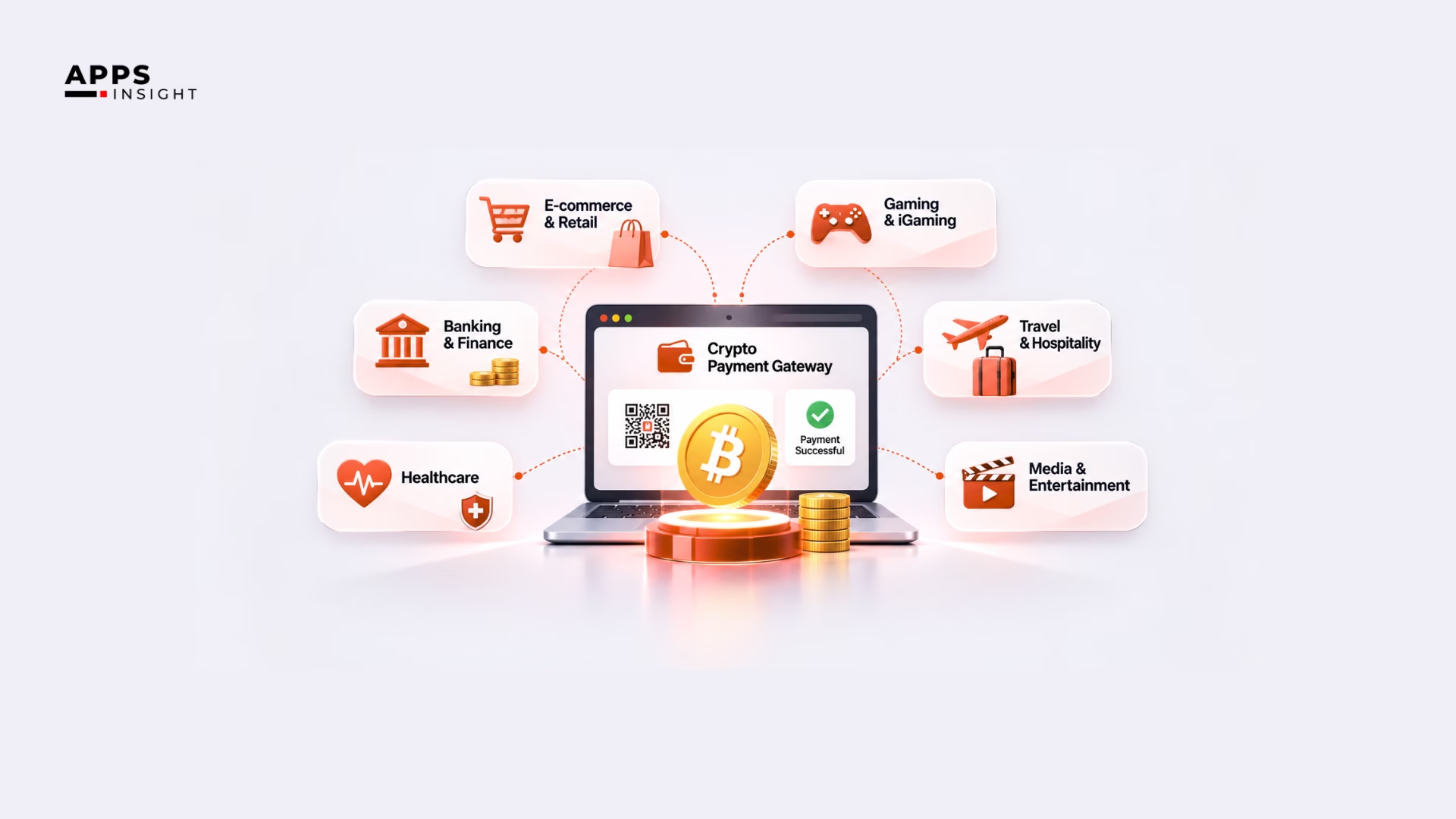
Different industries can apply crypto payment gateways in different ways. E-commerce businesses may use them to accept payments for online purchases, while travel companies can offer another payment option for bookings. Similarly, gaming platforms, real estate businesses, educational institutions, SaaS providers, and international service companies can explore cryptocurrency payments based on their specific business needs.
Looking for? Crypto Payment Gateway Development Companies
How Businesses Can Use Crypto Payment Gateways
The way a business uses a crypto payment gateway depends on its industry, target customers, transaction volume, and payment settlement needs. For example, an online store selling digital products may only require a basic cryptocurrency checkout option. In contrast, an international business may need multi-chain support, automated payment settlement, wallet integration, and transaction monitoring.
Crypto payment gateways can support several business operations and payment models. Let’s look at some of the common use cases.
1. E-Commerce and Online Retail
E-commerce businesses can integrate crypto payment gateways into their checkout process to accept cryptocurrency for physical and digital products. Customers can select a supported cryptocurrency, connect their wallets, and authorize the transaction. Once the gateway detects and verifies the payment according to its confirmation requirements, the merchant receives a payment notification.
Businesses can accept crypto payments for various offerings, including:
- Physical products
- Digital goods and downloads
- Software subscriptions
- Membership plans
- Online services
- Premium products
Offering Customers More Payment Options
Accepting cryptocurrency gives online retailers another payment option for customers who prefer using their digital assets for purchases. It can also help businesses serve international audiences by supporting cryptocurrency payments alongside traditional payment methods.
However, businesses should consider supported cryptocurrencies, network fees, payment processing requirements, and applicable regulations before enabling this option.
Integrating Crypto Payments With Order Management Systems
A crypto payment gateway can connect with an e-commerce platform, payment dashboard, or order management system to automate payment-related activities.
For example, consider a customer purchasing a product from an online store using cryptocurrency. The payment process may follow this sequence:
Customer places an order → Payment request is generated → Blockchain transaction is detected → Payment is verified → Order status is updated.
This integration helps businesses reduce manual payment verification and keep order records updated. It also makes it easier for merchants to track completed, pending, or unsuccessful transactions from a centralized system.
For additional research into the adjacent exchange-development market, see AppsInsight’s guide to Cryptocurrency Exchange Development Companies.
2. Travel and Hospitality
Travel and hospitality businesses often serve customers from different countries, making flexible payment options an important part of the booking experience.
Hotels, resorts, travel agencies, online booking platforms, and other hospitality providers can consider accepting cryptocurrency for various services, including:
- Hotel and resort reservations
- Holiday and travel packages
- Guided tours and excursions
- Premium travel experiences
- Extended stays and accommodation
- Other travel-related services
Making Payments Easier for International Customers
International travelers may face currency conversion fees, payment restrictions, or limitations when using traditional payment methods. Cryptocurrency can offer another way to pay for bookings, particularly for customers who already hold and use digital assets.
By adding crypto payments alongside conventional options, travel businesses can give eligible customers more flexibility when completing reservations.
Managing High-Value Travel Bookings
Travel companies often process expensive reservations, such as luxury resort stays, customized holiday packages, and premium travel experiences. A crypto payment gateway can help businesses generate payment requests, monitor transaction progress, verify payments, and maintain organized transaction records.
However, the payment setup should match the business’s operational needs. Companies need to consider which cryptocurrencies they accept, how they want to receive or settle funds, and the regulatory requirements that apply to their markets.
3. Gaming and Digital Entertainment
The gaming and digital entertainment industry offers several opportunities for cryptocurrency payments. Since many gaming platforms already sell digital products and virtual services, integrating a crypto payment gateway can provide players with another way to make purchases.
Gaming companies can consider accepting cryptocurrency for:
- Purchasing games and downloadable content
- Buying in-game currency or credits
- Unlocking virtual items and accessories
- Purchasing digital collectibles
- Paying for gaming subscriptions and memberships
- Accessing premium features and exclusive content
- Paying for other gaming-related services
Integrating Crypto Payments With Digital Assets
Blockchain-based gaming platforms can connect cryptocurrency payments with digital assets such as gaming tokens, NFTs, and virtual collectibles.
For example, a player might want to purchase a virtual item using cryptocurrency. Once the player completes the transaction, the payment gateway can detect the payment and verify it on the blockchain. After successful verification, the gaming platform can automatically add the purchased item to the player’s account or wallet.
This integration helps connect the payment process with digital asset delivery, reducing the need for manual transaction checks.
For gaming businesses, a well-designed crypto payment system can also simplify transaction tracking, support wallet-based purchases, and make it easier to manage payments for blockchain-enabled gaming products.
5. Healthcare and Wellness
Healthcare and wellness providers that serve patients or customers from different countries can consider cryptocurrency payments for eligible services, provided they comply with applicable regulations.
Potential use cases include:
- Online medical consultations
- Wellness and fitness services
- Medical tourism packages
- Healthcare subscriptions
- Specialized medical treatments
- Other eligible healthcare services
Making Payments More Flexible for International Patients
Patients traveling abroad for medical treatment may encounter currency conversion fees, international payment restrictions, or other financial challenges.
Accepting cryptocurrency can provide an additional payment option for patients who already use digital assets. For example, an international patient booking a medical consultation or wellness package could use a supported cryptocurrency to complete the payment.
This option should complement, rather than automatically replace, traditional payment methods.
Organizing Healthcare Payment Records
A properly integrated crypto payment gateway can connect transaction data with a healthcare provider’s billing or accounting systems. It can help businesses monitor incoming payments, verify transaction confirmations, and maintain organized financial records.
Blockchain transaction records can also support payment reconciliation by providing transaction details that businesses can match against their internal records.
However, healthcare providers must carefully evaluate data privacy, payment security, financial compliance, and healthcare-specific regulations before introducing cryptocurrency payments. Payment processing should also remain separate from sensitive patient information unless the integration meets the relevant privacy and security requirements.
6. Education and Online Learning
Online education platforms and training providers increasingly attract students from different countries. Offering flexible payment methods can make it easier for international learners to purchase courses and access educational services.
Educational institutions, e-learning platforms, certification providers, and digital training businesses can explore cryptocurrency payments for:
- Online courses and learning programs
- Professional certifications
- Skill development and training sessions
- Monthly or annual learning subscriptions
- Educational software and tools
- Premium study materials and resources
Automating Course Enrollment and Access
One practical application of a crypto payment gateway is connecting payment verification directly with a course enrollment system.
For example, when a student purchases an online course using cryptocurrency, the gateway can monitor the blockchain transaction and verify whether the required payment has been received. Once the payment is confirmed, the platform can automatically update the student’s payment status and activate course access.
The process typically follows these steps:
Student selects a course → Payment request is generated → Blockchain transaction is detected → Payment is verified → Payment status is updated → Course access is activated.
This workflow can reduce manual payment checks, simplify enrollment management, and help students access their purchased courses without unnecessary delays.
For education businesses serving international learners, cryptocurrency can also provide an additional payment option for students who already hold digital assets. The platform should consider supported cryptocurrencies, transaction fees, settlement preferences, and applicable payment regulations when implementing this feature.
7. Freelancing and Remote Services
Freelancers and remote service providers often work with clients located in different countries. Managing international payments can sometimes involve currency conversion, intermediary fees, and delays in receiving funds.
Professionals such as developers, designers, consultants, marketing agencies, writers, and digital creators can consider cryptocurrency as an additional way to receive payments for eligible services.
Potential applications include:
- Payments for freelance projects
- Consulting and advisory fees
- Software and web development services
- Graphic design and creative work
- Digital marketing services
- Content writing and other digital services
- Payments under international service contracts
Making International Payments More Flexible
Cryptocurrency can provide another payment route for freelancers and remote businesses working with clients who already use digital assets.
For example, a software development agency working with an overseas client could generate a crypto payment request after completing a project milestone. The payment gateway can monitor the transaction, verify the required confirmation, and update the payment status.
Before accepting cryptocurrency, freelancers and businesses should evaluate the complete cost of receiving payments. This includes blockchain network fees, gateway processing charges, currency conversion expenses, applicable taxes, and settlement costs.
8. SaaS and Subscription Businesses
Software-as-a-Service (SaaS) companies can also integrate cryptocurrency payments into their billing systems. This can be particularly useful for platforms serving international customers, technology businesses, and users who already hold digital assets.
A crypto payment gateway can be connected with subscription and account management systems to accept payments for:
- Monthly and annual subscription plans
- Software licenses
- Premium features and upgrades
- API access and usage-based services
- Enterprise software packages
- Additional digital services
Connecting Crypto Payments With Subscription Management
For SaaS businesses, receiving a payment is only one part of the billing process. The platform must also recognize the transaction and update the customer’s account accordingly.
A payment gateway integrated with the subscription system can help automate these steps. Once the required payment is detected and verified, the application can update the subscription status and provide access to the selected plan.
A typical workflow looks like this:
Customer selects a subscription plan → Payment request is generated → Cryptocurrency transaction is detected → Payment is verified → Subscription is activated or renewed.
This reduces the need for manual payment confirmation and helps keep subscription records organized. For businesses targeting international customers or Web3 users, cryptocurrency can serve as an additional billing option alongside credit cards, bank transfers, and other conventional payment methods.
Companies should also decide how to handle recurring subscriptions, payment confirmations, failed transactions, refunds, and cryptocurrency price fluctuations before integrating crypto payments into their billing infrastructure.
9. Web3 and Blockchain Businesses
Businesses operating within the Web3 and blockchain ecosystem are natural candidates for cryptocurrency payment integration. Their customers often interact with digital assets, blockchain networks, and decentralized platforms, making crypto payments a relevant addition to their existing payment options.
Blockchain development companies, Web3 platforms, digital asset businesses, and decentralized applications can explore cryptocurrency payments for:
- Access to blockchain-based platforms
- Web3 subscriptions and memberships
- Developer tools and technical services
- Blockchain development and consulting services
- Digital products and applications
- Other Web3-related services
Creating a Connected Payment Experience for Web3 Users
Since many Web3 customers already use cryptocurrency wallets, integrating a crypto payment gateway can make the purchasing process more familiar and convenient.
For example, a decentralized application could allow users to pay for premium features using supported digital assets. The gateway can monitor the transaction, verify payment confirmation, and notify the platform when the payment is successful.
This creates a more connected experience between the customer’s wallet, the blockchain network, and the Web3 application.
10. International B2B Payments
Cryptocurrency payment infrastructure can also support selected business-to-business (B2B) transactions involving companies in different countries.
Businesses working with international suppliers, contractors, technology providers, agencies, and service partners may explore digital assets as an alternative payment method for eligible commercial transactions.
Potential applications include:
- International vendor payments
- Contractor and freelancer settlements
- Cross-border service payments
- Technology and software payments
- Payments to overseas business partners
- Other eligible international commercial transactions
Exploring Cryptocurrency for Cross-Border Business Payments
International business payments can involve multiple financial institutions, currency conversions, processing fees, and settlement procedures. Cryptocurrency may offer another way to transfer value between businesses, particularly when both parties are equipped to accept and manage digital assets.
For example, a US-based technology company working with an overseas software development agency could agree to settle an eligible invoice using a supported cryptocurrency. A payment gateway can help generate the payment request, monitor the transaction, and record its confirmation.
However, this approach is not suitable for every business transaction. Companies must evaluate the jurisdictions involved, transaction values, accounting and tax requirements, compliance obligations, cryptocurrency volatility, and preferred settlement methods before adopting this payment model.
Want to know? Crypto Payment Gateway Development Cost
How a Crypto Payment Gateway Works
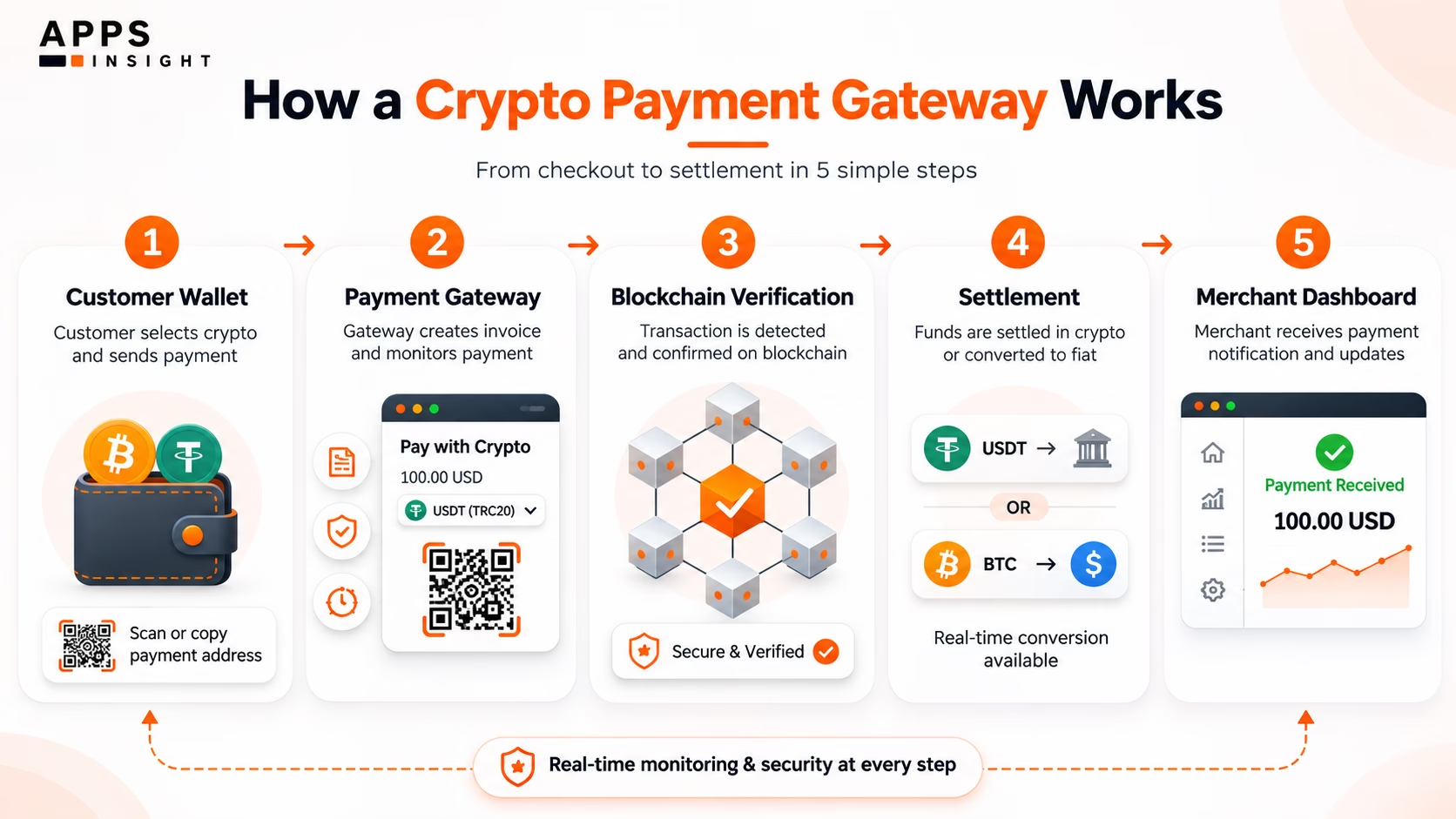
A crypto payment gateway acts as an intermediary between a customer’s cryptocurrency wallet and a merchant’s payment system. It manages the payment request, monitors blockchain transactions, verifies incoming funds, and notifies the merchant when a payment is confirmed.
Let’s understand how a crypto payment gateway works through the following steps.
Step 1: Customer Selects Cryptocurrency at Checkout
The process begins when a customer chooses the cryptocurrency payment option at checkout. The customer can then select a supported digital asset and blockchain network, depending on the options provided by the merchant.
For example, a customer might choose USDC on the Base network or Bitcoin to pay for an order.
Step 2: Payment Request and Exchange Rate Calculation
After the customer selects a cryptocurrency, the gateway generates a payment request. It displays the amount to be paid, along with the merchant’s payment address or a QR code that the customer can scan using their wallet.
If the payment involves cryptocurrency conversion, the gateway may also calculate the exchange rate and lock the quoted amount for a limited period. This helps reduce uncertainty caused by price fluctuations during checkout.
For example, BitPay invoices remain valid for 15 minutes, giving customers a defined window to complete the payment.
Step 3: Blockchain Transaction Detection
The customer transfers the required cryptocurrency from their wallet to the payment address provided by the gateway.
Once the transaction is submitted, the gateway monitors the relevant blockchain network to detect the incoming payment. It checks transaction details, including the receiving address, transferred amount, selected network, and transaction status.
The gateway may wait for a specified number of blockchain confirmations before treating the payment as complete. Confirmation requirements can vary depending on the cryptocurrency, network, and transaction value.
Step 4: Payment Verification and Merchant Notification
After the required confirmations are received, the gateway updates the payment status and notifies the merchant’s application.
This notification is commonly handled through a webhook, which allows the payment gateway to communicate transaction updates automatically with the merchant’s system.
The merchant can then update the order status, generate a payment receipt, and notify the customer that the payment has been received.
Step 5: Merchant Settlement
Once the payment is verified, the merchant receives the funds according to the settlement settings configured with the gateway.
Depending on the provider’s supported services, settlement may be available in cryptocurrency, stablecoins, or a supported local currency.
The merchant can choose a settlement model that matches its financial operations, accounting requirements, and preference for managing cryptocurrency exposure.
The payment process does not end with transaction confirmation. A crypto payment gateway can also provide transaction notifications, payment status updates, alerts, and reports.
These features help merchants monitor completed, pending, and unsuccessful payments while maintaining organized transaction records.
Read once! How to Build a Crypto Payment Gateway
Why Use a Crypto Payment Gateway? 5 Key Benefits
A crypto payment gateway offers several advantages for businesses, customers, and digital platforms. From simplifying payment processing to supporting international transactions, it can help companies create more flexible payment systems.
Let’s look at five important benefits of using a crypto payment gateway.
1. Simplified Payment Processing
A crypto payment gateway helps businesses manage cryptocurrency transactions through a centralized payment interface. Customers can complete payments using supported digital assets, while merchants can monitor transaction status from a single system.
Some gateways also support automated payouts and bulk payment processing, allowing businesses to manage multiple transactions more efficiently.
For example, if a customer sends an incorrect payment amount, the gateway may identify the discrepancy and notify the merchant. Depending on the platform’s features, the merchant can then request the remaining amount or initiate a refund.
This additional layer of payment management is particularly useful for businesses operating in decentralized markets, where traditional customer support and payment dispute processes may not always be available.
Gaming platforms and Web3 applications can also attract customers who already hold cryptocurrency, giving them another convenient way to purchase digital products and services.
2. Access to New Markets
Cryptocurrency payments can help businesses reach customers in regions where conventional payment options may be limited or difficult to use.
For example, some international customers experience difficulties with foreign card payments, banking restrictions, or cross-border payment processes. Accepting supported cryptocurrencies can provide another way for these customers to complete purchases.
Another important difference is that confirmed blockchain payments generally cannot be reversed through a traditional card chargeback process. This can reduce certain types of payment disputes, including cases where customers receive products or services and then dispute legitimate card transactions.
However, businesses must still provide appropriate refund policies and customer support. Cryptocurrency refunds usually require a separate transaction from the merchant to the customer.
Price volatility is another consideration. Businesses can manage this risk by accepting stablecoins or using gateways that automatically convert incoming cryptocurrency into a preferred fiat currency, where supported. This can help reduce direct exposure to fluctuations in cryptocurrency prices.
3. Lower Transaction Costs
Traditional international payments can involve processing fees, currency conversion charges, intermediary banks, and other transaction expenses.
A crypto payment gateway may reduce some of these costs by allowing payments to move directly between blockchain addresses without relying on the same network of financial intermediaries used in conventional payment systems.
This can be particularly relevant for businesses handling frequent international orders, cross-border transactions, or large volumes of payouts.
However, cryptocurrency payments are not automatically cheaper in every situation. Businesses should compare blockchain network fees, gateway processing charges, conversion costs, and withdrawal expenses before choosing a payment solution.
4. Faster Payment Settlement
Cryptocurrency transactions can be processed at any time, including weekends and public holidays, without depending on traditional banking hours.
Depending on the blockchain network, transaction fees, and required confirmation levels, payments may be verified within minutes. This can help businesses reduce the waiting time associated with some conventional cross-border payment methods.
Faster payment processing can be useful for industries such as:
- Travel and hospitality businesses handling time-sensitive bookings
- Healthcare providers managing eligible international payments
- Gaming platforms delivering digital products
- SaaS companies processing subscription payments
- Freelancers and agencies receiving international payments
For businesses managing frequent transactions, faster settlement can also improve cash flow visibility and simplify payment management.
5. Better Transaction Visibility and Security Controls
Blockchain technology records transactions on a distributed ledger, allowing users to verify transaction details using publicly available network information.
A crypto payment gateway can build on this transparency by providing payment dashboards, transaction monitoring, confirmation notifications, and organized payment records.
Depending on the provider, additional security features may include:
- Cold storage: Keeps selected digital assets in offline storage to reduce exposure to online threats.
- Signed webhooks: Helps applications verify that payment notifications genuinely originate from the gateway.
- Wallet address screening: Checks wallet addresses against relevant risk indicators.
- AML checks: Supports anti-money laundering monitoring and compliance processes.
- Transaction monitoring: Tracks payment activity and identifies unusual or incomplete transactions.
It is important to understand that blockchain transparency alone does not guarantee payment security. The gateway’s architecture, wallet management practices, access controls, monitoring systems, and operational procedures all play an important role.
Final Thoughts
A crypto payment gateway can offer businesses much more than a simple option to accept cryptocurrency. It can become an important part of their payment infrastructure, helping them manage digital-asset transactions, serve international customers, and connect payments with their existing business systems.
E-commerce companies can use it to expand their payment options, while travel businesses can offer additional flexibility to international customers. Gaming platforms can connect payments with digital products, and real estate companies can explore eligible digital-asset transactions. Healthcare providers, educational institutions, freelancers, SaaS businesses, Web3 platforms, and international service providers may also find opportunities to incorporate cryptocurrency payments into their operations.
However, choosing the right solution requires more than deciding which cryptocurrencies to accept. Businesses should first understand their payment requirements, target customers, transaction volumes, and operational goals.
Before starting development, carefully evaluate supported cryptocurrencies, blockchain networks, payment processing workflows, wallet integrations, fund settlement, security controls, regulatory compliance, and third-party integration requirements.
When these elements are planned and implemented together, a crypto payment gateway can become a reliable component of a business’s broader payment ecosystem, rather than just another payment button at checkout.