

Artificial intelligence is rapidly reshaping how businesses design and operate their applications. By 2026, AI-powered app features will become essential for companies seeking to enhance efficiency, improve customer engagement, and drive data-driven decisions. These features range from Predictive Analytics and personalization to intelligent chatbots, AI-driven security, and augmented reality integration.
Incorporating AI allows apps to anticipate user needs, automate complex tasks, and deliver tailored experiences, giving businesses a competitive advantage in a digital-first world.
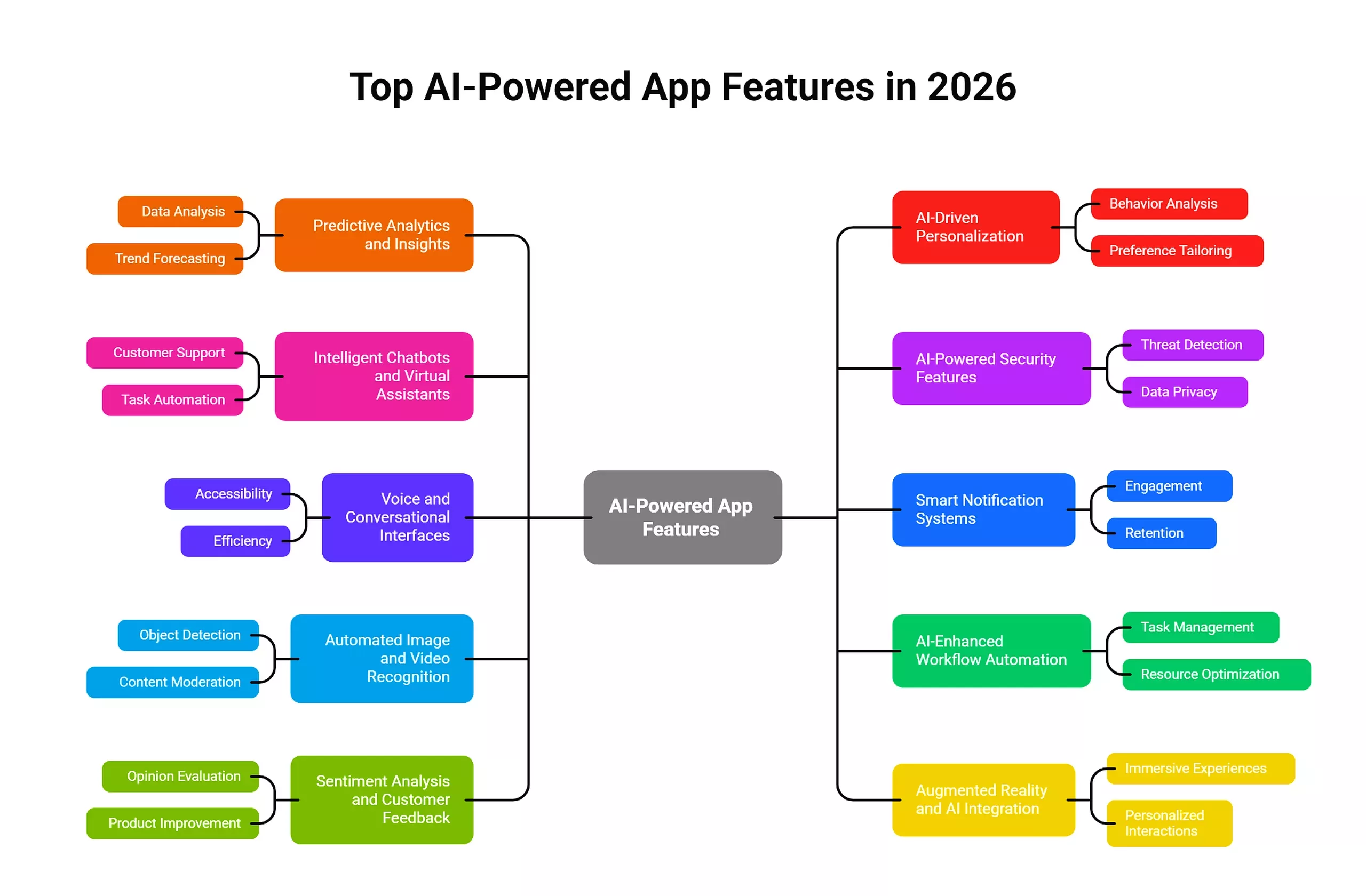
Staying ahead with these features ensures that applications remain innovative, responsive, and capable of meeting evolving market demands.
1) Predictive Analytics and Insights
Predictive analytics uses AI algorithms to analyze historical and real-time data to forecast future trends, behaviors, and outcomes. This AI-powered app feature enables businesses to make proactive decisions, optimize operations, and enhance customer satisfaction in 2026.
Customer Behavior Prediction
AI models analyze patterns in user activity, preferences, and engagement to anticipate future behavior. Businesses can use these insights to target offers, optimize marketing campaigns, and improve retention.
Sales Forecasting
Predictive analytics helps estimate future sales based on historical trends, seasonality, and market conditions. Accurate forecasting enables better inventory management, resource allocation, and revenue planning.
Demand Planning
AI predicts product or service demand, allowing businesses to scale operations efficiently. This reduces stockouts, minimizes overproduction, and ensures that customer needs are consistently met.
Trend Analysis
AI identifies emerging trends and shifts in consumer behavior, enabling businesses to adapt quickly. Applications can guide strategy, product development, and marketing efforts based on actionable insights.
Read once! How AI Is Reshaping Android App Development in 2026
2) AI-Driven Personalization
AI-driven personalization tailors app experiences to individual users by analyzing their behavior, preferences, and interactions. This AI-Powered App Feature helps businesses improve engagement, satisfaction, and retention by delivering relevant content and recommendations in 2026.
Customized User Experience
Apps can adjust layouts, content, and features based on user behavior. Personalized interfaces increase usability, reduce friction, and make each user feel the app is designed specifically for them.
Product Recommendations
AI algorithms suggest products or services based on a user’s browsing and purchase history. This increases conversion rates, drives sales, and enhances the overall shopping experience.
Adaptive Content
Apps can dynamically modify content to match user interests, preferences, or location. For instance, news, entertainment, or educational apps can deliver the most relevant articles, videos, or lessons to each individual.
Dynamic Interface Adjustments
AI can reorganize menus, buttons, or workflows in real time to suit user habits. This ensures smoother navigation and optimizes interactions for efficiency and satisfaction.
3) Intelligent Chatbots and Virtual Assistants
Intelligent chatbots and virtual assistants use AI and natural language processing (NLP) to interact with users in a human-like manner. This AI-Powered App Feature enhances customer support, automates tasks, and provides 24/7 assistance, making apps more efficient and responsive in 2026.
Automated Customer Support
AI chatbots handle routine inquiries, troubleshoot common issues, and provide instant responses. This reduces wait times, improves user satisfaction, and frees human agents to focus on complex problems.
Natural Language Understanding
NLP enables chatbots to comprehend context, intent, and nuances in user messages. This allows more accurate responses, better engagement, and meaningful interactions that feel personalized and conversational.
Task Automation
Virtual assistants can perform tasks such as scheduling, reminders, data entry, and order tracking automatically. This minimizes manual effort, increases efficiency, and allows users to focus on higher-value activities.
Context-Aware Responses
Intelligent assistants remember user history and context to provide relevant recommendations or answers. For example, a virtual assistant can suggest actions based on previous interactions, location, or current trends, enhancing overall usability.
We have listed! Most Profitable Mobile App Niches to Build in 2026
4) AI-Powered Security Features
AI-powered security features enhance app protection by detecting threats, preventing fraud, and ensuring data privacy. This App Feature is critical in 2026 as businesses face increasing cyberattacks and regulatory requirements for secure operations.
Threat Detection
AI algorithms monitor app activity in real time to identify unusual patterns, suspicious behavior, or potential intrusions. This proactive detection allows apps to prevent attacks before they cause damage, protecting both business and user data.
Fraud Prevention
AI analyzes transactions and user interactions to detect fraudulent activity. By learning from patterns and anomalies, apps can flag or block unauthorized actions, safeguarding financial transactions and sensitive information.
Biometric Authentication
AI enhances authentication through facial recognition, fingerprint scanning, and voice verification. This ensures secure and convenient access, reducing reliance on passwords while maintaining high security standards.
Automated Risk Assessment
AI continuously evaluates vulnerabilities and potential threats across the app ecosystem. Automated assessments allow businesses to prioritize fixes, update defenses, and maintain compliance with data protection regulations efficiently.
Want to know? What is the Best Way to Hire App Developers in 2026?
5) Voice and Conversational Interfaces
Voice and conversational interfaces allow users to interact with apps using natural language, making the experience intuitive and hands-free. This AI-Powered App Feature is increasingly important in 2026, enhancing accessibility, efficiency, and engagement across business applications.
Voice Command Integration
Apps can execute functions based on spoken commands, enabling hands-free operation. Users can perform searches, control settings, or complete tasks simply by speaking, improving convenience and accessibility.
Speech-to-Text Features
AI converts spoken language into written text accurately, enabling seamless communication and documentation. This is particularly valuable for messaging, transcription, and note-taking applications.
Contextual Voice Responses
Conversational AI understands context, intent, and previous interactions to deliver relevant and meaningful responses. Users receive guidance, suggestions, or answers that feel intelligent and personalized.
Multilingual Support
Advanced AI allows apps to recognize and respond in multiple languages. Businesses can serve global audiences efficiently, providing inclusive and localized experiences to diverse user bases.
6) Smart Notification Systems
Smart notification systems use AI to deliver timely, relevant, and personalized alerts to users. This AI-Powered App Feature increases engagement, drives user retention, and ensures important information reaches users at the right moment in 2026.
Key Features and Benefits:
- Predictive Alerts: AI predicts when users are most likely to engage and sends notifications accordingly, improving open rates and interaction.
- User Engagement Optimization: Notifications are tailored to individual behavior, ensuring content resonates and encourages meaningful actions.
- Behavior-Based Triggers: Alerts are automatically triggered based on user actions, such as abandoned carts, completed tasks, or activity milestones.
- Automated Scheduling: AI determines the optimal time to send messages, reducing user annoyance and increasing effectiveness of notifications.
By leveraging AI in notifications, businesses can maintain consistent engagement while providing a more personalized and user-friendly experience.
We have listed! Top 101 AI App Ideas
7) Automated Image and Video Recognition
Automated image and video recognition uses AI to analyze visual content, detect objects, and extract meaningful information. This AI-Powered App Feature is essential in 2026 for applications in e-commerce, security, content moderation, and quality inspection.
| Subheading | Description | Application Example |
|---|---|---|
| Visual Search | AI enables users to search for products or content using images instead of text | |
| Quality Inspection | AI analyzes images or video streams to detect defects or anomalies | Manufacturing apps identifying defective items on production lines |
| Content Moderation | AI automatically detects inappropriate or harmful content in media | |
| Object Detection | AI recognizes and tracks objects in images or videos | Security apps detecting intruders or monitoring assets in real time |
8) AI-Enhanced Workflow Automation
AI-enhanced workflow automation streamlines business processes by intelligently managing tasks, priorities, and resources. This AI-Powered App Feature in 2026 helps businesses reduce manual effort, increase efficiency, and optimize operational performance.
Task Prioritization
AI analyzes workload, deadlines, and dependencies to prioritize tasks effectively. This ensures that critical tasks are addressed first, improving productivity and decision-making.
Process Optimization
AI identifies inefficiencies in workflows and suggests improvements. Businesses can automate repetitive processes, reduce bottlenecks, and achieve faster turnaround times.
Predictive Scheduling
AI predicts the optimal timing for tasks based on historical data and resource availability. This minimizes delays, balances workloads, and enhances overall operational efficiency.
Real-Time Performance Analytics
AI monitors ongoing workflows and provides actionable insights in real time. Businesses can track progress, detect issues early, and make informed adjustments to maintain smooth operations.
9) Sentiment Analysis and Customer Feedback
Sentiment analysis uses AI to evaluate user opinions, emotions, and feedback from multiple sources. This AI-Powered App Feature in 2026 helps businesses understand customer perceptions, improve products, and make data-driven decisions.
Social Media Monitoring
AI scans social media platforms to track mentions, comments, and trends related to a business. This helps companies gauge public opinion, detect emerging issues, and respond proactively to maintain brand reputation.
Review Analysis
AI analyzes customer reviews and ratings to identify recurring themes, pain points, and satisfaction levels. Businesses can use these insights to enhance products, services, and overall customer experience.
Emotion Detection
Advanced AI can detect emotions expressed in text, voice, or video interactions. Understanding customer sentiment allows businesses to tailor responses, improve engagement, and create more empathetic interactions.
Feedback-Driven Recommendations
AI transforms collected feedback into actionable recommendations for product development, marketing strategies, and service improvements. This ensures that user input directly contributes to business growth and innovation.

10) Augmented Reality and AI Integration
Augmented reality (AR) combined with AI creates immersive, interactive, and personalized experiences within apps. This AI App Feature is increasingly adopted in 2026 to enhance shopping, learning, and entertainment applications.
AR-Enhanced Shopping
AI analyzes user preferences and behavior to provide personalized AR shopping experiences. Users can virtually try products like furniture, clothing, or cosmetics before making a purchase, improving confidence and conversion rates.
Interactive Learning
AI-powered AR apps create engaging educational experiences by overlaying interactive 3D content onto real-world environments. Students can explore concepts visually, improving comprehension and retention.
Virtual Try-On Features
AI uses AR to simulate realistic fitting of products such as apparel, accessories, or eyewear. This reduces returns, increases engagement, and enhances customer satisfaction in e-commerce applications.
Spatial Awareness for Apps
AI enhances AR applications with spatial understanding, allowing digital objects to interact naturally with the environment. This enables realistic gaming, navigation, and collaborative experiences that feel immersive and intuitive.
Want to know? Cost to Develop an AI App in 2026
Sum up
AI-powered app features are transforming the way businesses operate and interact with users. From predictive analytics and personalized experiences to intelligent chatbots, automated visual recognition, and AR integration, these AI-Powered App Features allow businesses to enhance efficiency, engagement, and decision-making in 2026.
By adopting these features, companies can create smarter, more responsive, and future-ready applications that anticipate user needs, streamline workflows, and deliver exceptional experiences. Many of the best AI app development firms focus on integrating these capabilities to help businesses stay ahead of market demands. Staying informed about these advancements ensures organizations remain competitive, innovative, and fully equipped to leverage AI for sustainable growth and higher customer satisfaction.
FAQs
What are the top AI-Powered App Features for businesses in 2026?
Top features include predictive analytics, AI-driven personalization, intelligent chatbots, AI-powered security, voice interfaces, smart notifications, automated image/video recognition, workflow automation, sentiment analysis, and AR/AI integration.
How does predictive analytics benefit businesses?
Predictive analytics uses AI to forecast customer behavior, sales, and market trends. This helps businesses make proactive decisions, optimize resources, and improve planning for better outcomes.
Why is AI-driven personalization important for apps?
Personalization tailors content, recommendations, and interfaces to individual users. This improves engagement, satisfaction, and retention by delivering experiences that match user preferences and behavior.
How do AI-powered chatbots improve customer support?
Chatbots provide instant responses, automate repetitive tasks, and understand user intent using NLP. They reduce response times, improve efficiency, and allow human agents to focus on complex issues.
What role does AR combined with AI play in business apps?
AR and AI together create immersive and interactive experiences, such as virtual try-ons, AR shopping, and educational simulations. This enhances engagement, reduces friction in decision-making, and offers innovative user experiences.