


Have you noticed how certain real estate companies are expanding quickly, closing more transactions, and delivering outstanding client experiences while others find it difficult to maintain momentum? The difference often comes down to the adoption of AI-driven app ideas that are reshaping the way the industry operates. As we move into 2026, embracing advanced AI solutions is no longer optional. It has become essential for staying competitive and accelerating growth in a technology-focused market.
The real estate landscape is changing rapidly, with AI at the center of this shift. From precise property valuations and data-based investment forecasting to automated lead generation and customized virtual property tours, AI is transforming how buyers, sellers, agents, and investors engage with the market. Companies that implement strong real estate AI app concepts are enhancing efficiency, boosting revenue, and delivering a more intelligent and streamlined customer experience.
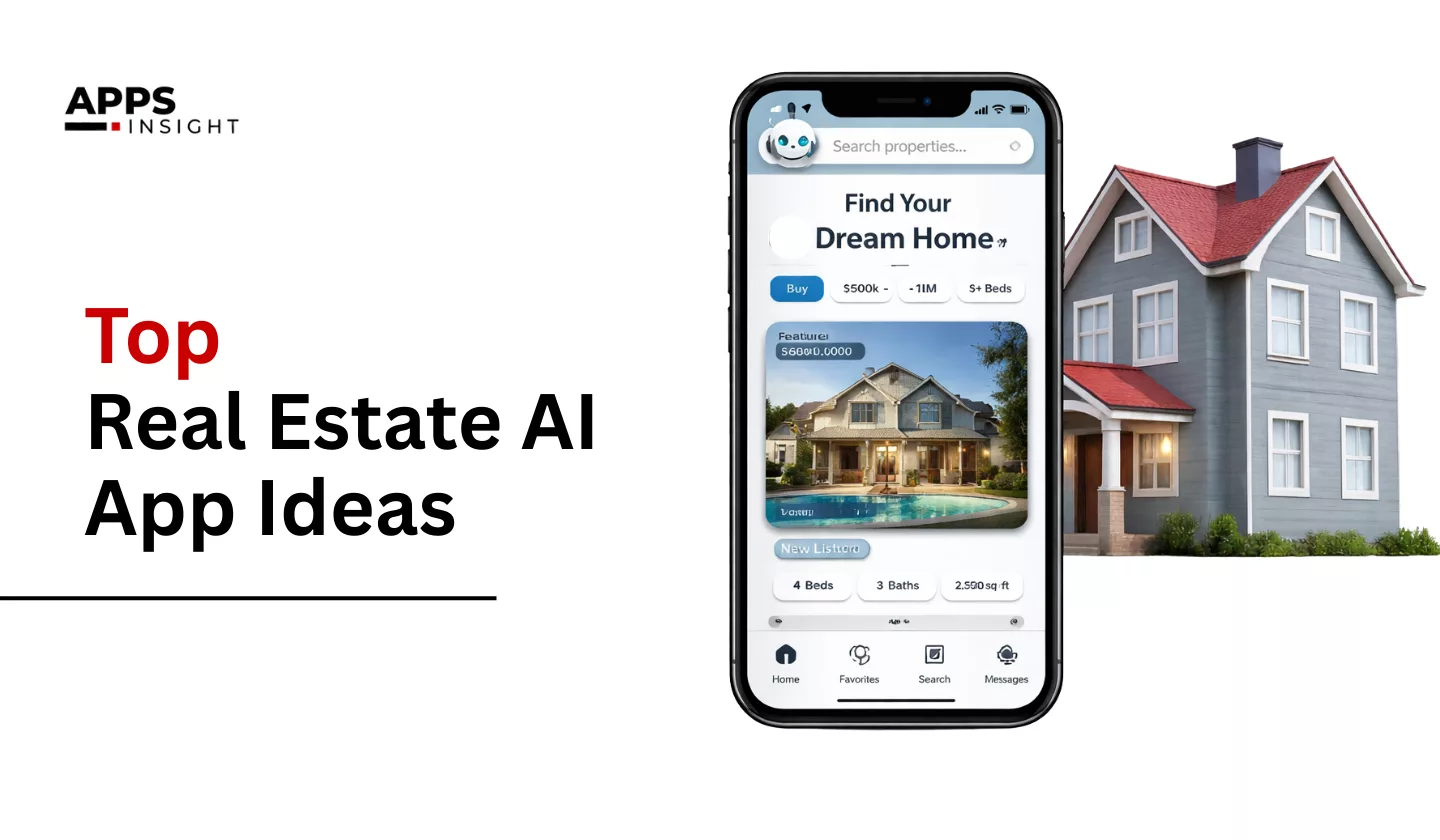
Whether you are a real estate professional looking to attract higher-quality leads, a developer aiming to simplify operations, an investor seeking insights backed by data, or a startup planning to introduce innovation, this guide is designed for you. In the following sections, we explore leading AI real estate app ideas that can drive growth and reshape your position in the property industry.
Connect With “Top Real Estate & PropTech Agentic AI Companies“
Why AI Is Transforming the Real Estate Industry
The real estate sector is changing rapidly, and Artificial Intelligence is playing a central role in that shift. What used to rely heavily on manual processes and personal judgment is now supported by data analytics, automation, and intelligent systems. For agents, developers, investors, and startup founders, adopting AI is no longer just an innovative step. It has become essential for staying competitive, relevant, and profitable in 2026 and the years ahead.
1. Converting Large Volumes of Data into Actionable Insights
Real estate decisions involve analyzing extensive data such as property values, buyer behavior, market trends, and neighborhood development. AI can process this information in seconds and deliver insights that would otherwise take significant time to uncover. This enables more accurate property valuation, identification of high-potential locations, and informed investment decisions based on data rather than assumptions.
2. Improving Efficiency Through Automation
AI helps streamline operations by automating repetitive tasks. It can handle customer inquiries, update property listings, schedule appointments, and qualify leads efficiently. By reducing time spent on routine activities, real estate professionals can focus more on strategic tasks like negotiating deals and strengthening client relationships.
3. Offering Tailored Property Recommendations
Today’s buyers and renters expect personalized experiences. Instead of reviewing generic listings, they want properties aligned with their budget, lifestyle, and future goals. AI systems analyze user preferences and behavior to provide highly relevant property suggestions. This personalized approach enhances customer satisfaction and strengthens long-term client engagement.
4. Anticipating Market Movements
AI’s predictive capabilities allow businesses to forecast future trends in property demand, pricing, and neighborhood development. By analyzing historical patterns alongside current market conditions, AI tools provide forward-looking insights. This helps professionals identify emerging opportunities early and make strategic plans with greater certainty.
5. Strengthening Competitive Position
In a competitive market, speed, accuracy, and data-driven strategies make a significant difference. Companies using AI can respond faster to market shifts, deliver customized services, and operate more efficiently. Many leading real estate firms across the United States have already incorporated AI into their workflows and are experiencing measurable growth as a result.
These factors explain why AI is reshaping real estate into a more efficient, informed, and opportunity-driven industry.
Also, Read: How to Plan your App Project with a App Development Agency
Top 12 Real Estate AI App Ideas
If you work in real estate, 2025 presents a strong opportunity to rethink how you operate.
These AI-driven app ideas for the real estate sector aim to reduce manual tasks, strengthen client interaction, and help professionals finalize transactions more efficiently.
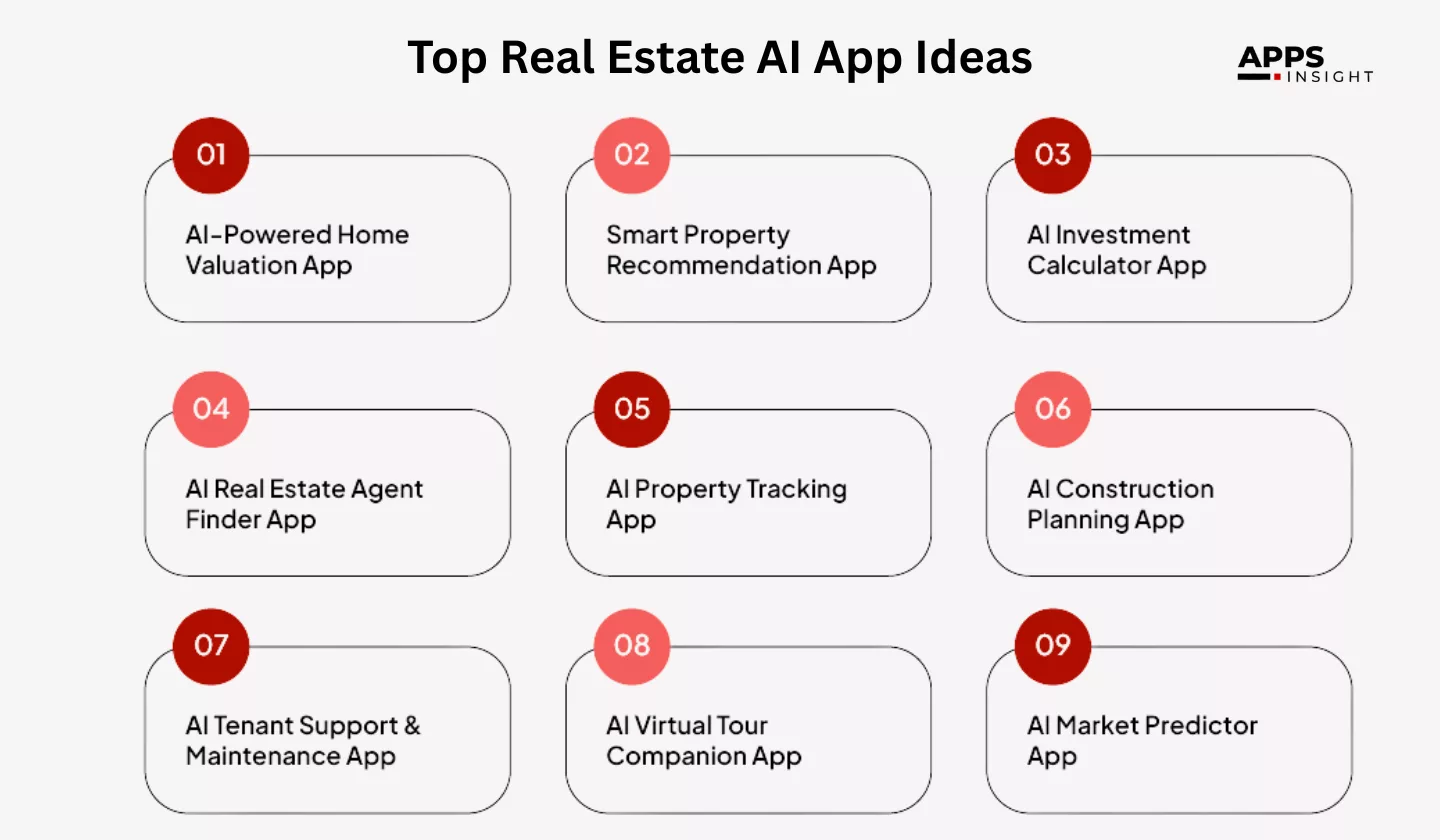
Below are 12 promising app concepts worth exploring:
1. AI-Based Property Valuation App
Buyers and sellers increasingly expect quick and accurate property pricing. That is why AI-powered home valuation apps are gaining attention in 2026. These applications use artificial intelligence to analyze market trends, comparable properties, and neighborhood data to generate real-time price estimates.
For buyers, this brings transparency and confidence. For sellers, it supports accurate pricing decisions. For agents, it becomes a valuable resource for establishing credibility early in the process.
If you are planning to develop such a solution, understanding the AI Real Estate App Development Cost is essential for budgeting and long-term planning.
2. Intelligent Property Recommendation App
This is one of the most practical AI-driven solutions for real estate professionals today. The app analyzes buyer behavior such as preferences, budget range, browsing activity, and saved listings to suggest properties they are most likely to explore further.
It works much like a personal shopping assistant for each client. Agents gain stronger engagement and higher-quality leads, while buyers experience a smoother and more intuitive property search process.
For agents, it strengthens lead conversion. For buyers, it delivers a tailored and relevant experience.
3. AI-Powered Real Estate Investment Calculator App
Real estate investment decisions depend heavily on accurate data. This type of app uses machine learning to provide return on investment estimates, rental income projections, and property appreciation forecasts.
It is especially useful for investors who want to evaluate multiple properties efficiently. Instead of manually calculating figures, users can rely on automated insights to guide high-value decisions with greater clarity and confidence.
You can explore a detailed guide on building an AI Real Estate Investment Calculator App to create a solution designed for investor-level accuracy.
4. AI-Based Real Estate Agent Matching App
Selecting the right real estate agent should feel structured, not uncertain. This app uses AI-driven rankings, client reviews, performance data, and area expertise to match buyers and sellers with suitable agents.
It is particularly helpful for first-time buyers who need direction. Sellers can identify agents who specialize in specific neighborhoods or property categories.
If you are considering this concept, reviewing the development cost of an AI Real Estate Agent Finder app and understanding which features provide the strongest value can help shape your strategy effectively5. AI Property Tracking App
Real estate investors often manage multiple properties at the same time, which can make tracking performance challenging. An AI-powered property tracking app provides a centralized dashboard where investors can monitor rent cycles, occupancy status, maintenance schedules, expenses, and overall portfolio performance in one place.
This type of app helps investors scale their portfolios without losing visibility. Automated alerts notify users about upcoming rent payments, overdue balances, lease renewals, or pending repairs. With performance insights and real-time data, investors can make informed decisions quickly. Instead of juggling spreadsheets or manual tracking systems, everything is streamlined into one intelligent platform that keeps assets performing efficiently and consistently.

6. AI Construction Planning App
In real estate development, delays and cost overruns can significantly impact profitability. An AI construction planning app addresses these challenges by forecasting project timelines, estimating material requirements, identifying potential risks, and tracking milestones in real time.
Developers and project managers gain better control over scheduling, budgeting, and resource allocation. Predictive insights help anticipate supply chain disruptions or workforce gaps before they become major issues. Investors also benefit from improved transparency, as they can track progress against timelines and budgets. By reducing uncertainty and improving planning accuracy, this type of app supports smarter, more predictable construction management.
Looking for? How to Build an AI App? Steps, Features, Costs, Trends
7. AI Tenant Support & Maintenance App
Managing tenant communication and property maintenance can be time-consuming, especially for landlords handling multiple units. An AI-powered tenant support and maintenance app automates routine tasks such as rent reminders, payment confirmations, service request logging, and issue tracking.
Tenants can submit maintenance requests through the app, and AI systems can categorize, prioritize, and even assign tasks to contractors automatically. This reduces response time and improves service consistency. For property managers, it means fewer manual follow-ups and more efficient operations. For tenants, it results in quicker resolutions and better overall satisfaction. It is particularly valuable for small teams managing large or growing portfolios.
8. AI Virtual Tour Companion App
Traditional property videos often lack interaction. An AI virtual tour companion app enhances digital showings by offering guided, interactive walkthroughs. As potential buyers explore a property virtually, the AI assistant can answer common questions, highlight features, and provide additional details in real time.
This is especially useful for remote buyers who cannot attend in-person viewings. Real estate agents also benefit, as the app handles initial inquiries and walkthrough explanations automatically. It creates a more engaging experience and allows buyers to explore properties at their own pace while still receiving informative guidance. The result is a more immersive and efficient property presentation.
9. AI Market Predictor App
Understanding market trends is crucial for pricing and investment decisions. An AI market predictor app analyzes historical data, neighborhood trends, buyer demand patterns, rental yields, and pricing fluctuations to forecast future movements.
For agents, this tool supports strategic pricing recommendations and competitive positioning. Investors can identify promising neighborhoods or emerging markets before broader shifts occur. The app acts as a data-driven advisory system, helping users base decisions on predictive analytics rather than assumptions. It is especially useful for agencies and investment-focused platforms that rely heavily on market insights.
10. AI Property Marketing App
Creating compelling property listings takes time and effort. An AI property marketing app streamlines this process by automatically generating property descriptions, optimizing images, and formatting listings according to different platforms.
Agents can upload basic property details and photos, and the AI produces polished, professional-quality content within minutes. It can also tailor descriptions to highlight unique selling points or match specific audience segments. This reduces listing preparation time and ensures consistent quality across marketing channels. For busy agents managing multiple listings, the app improves efficiency while maintaining high presentation standards.
11. AI Tenant Support & Maintenance Management Suite
Beyond simple reminders, a comprehensive AI tenant management app can automate rent collection, track payment histories, log maintenance issues, and assign contractors automatically. It functions as a centralized property operations system.
Property managers can monitor all units, view financial performance, and receive alerts about unresolved issues. Automated workflows reduce manual coordination, while tenants benefit from structured communication and timely updates. By combining payment automation and maintenance tracking into one solution, the app supports hands-off management while maintaining control and accountability across the portfolio.
12. Voice-Controlled Real Estate Assistant App
A voice-controlled real estate assistant app enables users to search listings, schedule property viewings, request documents, or check property details simply by speaking. This hands-free functionality is particularly useful for agents who spend significant time driving or multitasking.
Homebuyers can also use voice commands to narrow down search criteria, explore available listings, or book appointments instantly. Additionally, it enhances accessibility for users who prefer voice interaction over traditional typing. By integrating voice recognition with property databases and scheduling tools, the app delivers convenience and efficiency for professionals and buyers alike.
The Future of Real Estate AI Apps
The real estate industry is evolving quickly with the continued advancement of Artificial Intelligence. In the coming years, the sector is expected to see more advanced, data-focused solutions that enhance how businesses operate. As AI technology progresses, real estate companies will move beyond simple automation and begin implementing intelligent systems capable of analyzing patterns, forecasting trends, and supporting strategic decision-making.
From immersive digital experiences to powerful predictive analytics, the next wave of AI-powered applications will reshape how properties are purchased, sold, managed, and promoted. These innovations will transform traditional processes into smarter, more efficient workflows driven by real-time insights and intelligent automation.
Below are the key trends that will shape the future of real estate AI applications:
1. Highly Personalized Property Experiences
Future AI-powered real estate apps will move far beyond simple recommendations. They will create deeply customized property journeys based on user behavior, lifestyle patterns, financial objectives, and even personal preferences. By understanding users at a deeper level, these systems will deliver more accurate property suggestions and smarter investment guidance. This advanced personalization will enhance client satisfaction and significantly improve conversion outcomes.
What to expect:
- AI systems will merge behavioral insights with financial data to suggest precise property matches
- Real-time virtual assistants will support users throughout the entire property process
- Platforms will anticipate future property needs before users actively begin searching
2. Advanced Predictive Market Intelligence
AI will develop into a strong forecasting tool capable of estimating property prices, rental demand, and neighborhood development trends well in advance. Companies will depend on predictive analytics not only for investment decisions but also for long-term planning and risk control strategies.
What to expect:
- Algorithms will evaluate both global and local economic indicators for future projections
- Users will receive early alerts about potential market changes
- Real estate firms will apply predictive modeling to shape portfolio and expansion plans
3. Generative AI Combined with Virtual Reality
Generative AI will make it possible to create lifelike property visuals, digital staging, and immersive previews. When combined with virtual reality, buyers will be able to explore and adjust properties even before construction begins. Together, these technologies will reshape property marketing and sales strategies.
What to expect:
- Buyers will preview layouts and interior designs instantly
- Developers will showcase upcoming projects using interactive 3D environments
- Clients will personalize layouts, materials, and finishes digitally prior to purchase
4. Automated Real Estate Operations
AI will gradually take over complex operational responsibilities with minimal manual involvement. Tasks such as leasing management, inspections, and contract drafting will become more streamlined, accurate, and cost-efficient through automation.
What to expect:
- AI-powered systems will oversee documentation, compliance tracking, and scheduling
- Intelligent maintenance tools will address tenant concerns proactively
- Leasing, billing, and communication processes will operate with limited human oversight
5. AI-Enabled Financial and Investment Platforms
The future will introduce integrated AI platforms that combine property analytics, financial evaluation, and investment planning within a single ecosystem. These systems will help both individuals and institutions manage real estate portfolios more strategically and with reduced uncertainty.
What to expect:
- AI will suggest customized investment opportunities aligned with user profiles
- Platforms will estimate potential returns and refine long-term strategies
- Advanced risk assessment tools will support informed investment decisions
6. Responsible and Compliant AI Adoption
As AI becomes central to real estate operations, ethical standards and regulatory compliance will gain greater importance. Future platforms will prioritize data privacy, fairness, and operational transparency to maintain trust and meet legal requirements.
What to expect:
- AI solutions will incorporate built-in compliance and transparency mechanisms
- Fairness monitoring systems will reduce bias in property recommendations
- Strong data governance frameworks will safeguard sensitive client information
These developments will shape the next phase of AI in real estate, delivering smarter, more predictive, and highly personalized applications that redefine how the industry operates in the years ahead.

Want to know? Are App Development Companies Still Relevant In The AI Era?
Final Thoughts
Real estate today goes far beyond physical location. Success increasingly depends on automation, personalized experiences, and data-driven forecasting, and AI makes all three possible.
Whether you run a startup, a well-established brokerage, or a property management company, adopting intelligent AI solutions can create a meaningful competitive advantage. Smart technology helps streamline operations, improve client engagement, and support faster decision-making.
From increasing lead conversions to overseeing property portfolios with automated systems, these real estate AI app ideas represent practical progress. They are no longer optional innovations but strategic tools for growth.
If you are ready to turn your concept into reality, consider exploring leading app development companies that specialize in the real estate sector. Working with professionals who understand both artificial intelligence and the property market can help transform your vision into a scalable, future-ready solution.
FAQs
Will AI Replace Real Estate Agents?
With AI now managing tasks like property pricing, tour scheduling, and data analysis, it may seem like real estate agents could be phased out. However, the reality is different. AI is unlikely to replace real estate professionals. Instead, it will outpace those who choose not to adopt it.
Buying or selling a home is deeply personal and often emotional. Clients want guidance from someone they trust, especially when making one of the largest financial decisions of their lives. Technology cannot replicate human empathy, strong negotiation abilities, or genuine relationship-building.
What AI can do is enhance an agent’s efficiency. It can automate routine tasks such as lead screening, follow-up messages, and document preparation. This frees up time for agents to focus on client relationships, strategic discussions, and successful deal closures.
AI should be viewed as a supportive digital assistant rather than a replacement.
If you’re interested in seeing how advanced AI systems can strengthen real estate operations, consider exploring enterprise-level AI solutions designed specifically for the real estate industry.
What are the best AI real estate app ideas to start?
Some of the most practical AI real estate app ideas include smart property recommendation engines, AI-powered virtual tour assistants, automated property valuation tools, predictive investment analytics platforms, and AI chatbots for lead qualification. These ideas focus on solving real problems such as matching buyers with suitable homes, forecasting price trends, and automating customer communication. The best idea depends on your target audience, local market demand, and long-term business model.
How can AI improve the real estate buying and selling process?
AI enhances the buying and selling journey by automating repetitive tasks, analyzing market data, and personalizing property recommendations. It can match buyers with relevant listings, estimate fair property values, and predict market trends using historical data. AI chatbots also handle inquiries instantly, reducing response time. For sellers and agents, AI streamlines lead management and marketing efforts, making the overall transaction process more efficient and data-driven.
Is building a real estate AI app expensive?
The cost of building a real estate AI app depends on features, complexity, data requirements, and scalability goals. Basic AI integrations such as chatbots or recommendation engines are more affordable, while advanced predictive analytics and machine learning models require higher investment. Infrastructure, cloud hosting, data security, and ongoing maintenance also affect costs. Starting with a focused feature set and scaling gradually can help manage the overall budget effectively.
Can AI be integrated into existing real estate platforms?
Yes, AI can be integrated into existing real estate platforms through APIs and modular development approaches. Businesses can add features such as intelligent search, automated valuation models, predictive analytics, or AI chat support without rebuilding the entire system. Integration typically involves aligning databases, workflows, and user interfaces with AI capabilities. This approach allows companies to enhance performance while maintaining their current infrastructure and brand experience.
What industries benefit most from AI in real estate?
Several industries benefit from AI in real estate, including property brokerage firms, property management companies, real estate investment firms, mortgage lenders, and construction developers. AI supports these sectors by improving data analysis, customer engagement, and operational efficiency. It helps investors forecast returns, assists agents in lead conversion, and enables property managers to monitor assets more effectively, creating value across the broader property ecosystem.
How can PixelBrainy help me build a real estate AI app?
PixelBrainy can support your real estate AI app development by offering expertise in artificial intelligence, data integration, and scalable mobile or web solutions. From concept validation and feature planning to AI model development and deployment, the team can guide each stage of the process. By aligning technical capabilities with your business goals, PixelBrainy helps transform ideas into functional, secure, and growth-ready AI-powered platforms.