
Top Software Development Companies in Poland
List of top companiesPoland has become one of Europe’s most attractive hubs for custom software development, nearshore outsourcing, and end‑to‑end product engineering. Businesses from the US and Western Europe increasingly choose Polish vendors to balance high technical quality with competitive pricing. Partnering with the right software development company in Poland can help you accelerate digital transformation while keeping delivery predictable and transparent.
Top software development companies in Poland combine strong engineering culture, fluent English communication, and industry expertise in fintech, healthcare, e‑commerce, logistics, and manufacturing. With a mature outsourcing ecosystem and robust IT export growth, these teams are well equipped to handle complex cloud, data, and AI initiatives. For many organizations, Poland offers the “sweet spot” between low‑risk collaboration and tangible savings compared to Western markets.
Choosing the right Polish software development partner matters because it directly impacts project timelines, product quality, and total cost of ownership. A good fit can reduce development costs by 30–50% versus local vendors, while a poor fit often leads to delays, rework, and budget overruns. Evaluating technical depth, domain focus, and delivery methodology upfront ensures your investment delivers long‑term business value.
What Do Top Software Development Companies in Poland Do?
Top software development companies in Poland provide end‑to‑end digital product services, from initial strategy to ongoing maintenance. Typical offerings include:
Custom web and mobile application development (greenfield builds, product modernization, and feature extensions for existing platforms).
Enterprise software engineering covering ERP, CRM, supply chain, and workflow automation tailored to mid‑market and enterprise clients.
Cloud migration and DevOps on AWS, Azure, and GCP, including CI/CD, infrastructure as code, and performance optimization.
Data engineering, analytics, and AI/ML solutions, such as recommendation engines, predictive maintenance, and generative AI integrations.
Quality assurance, security testing, and long‑term application support with SLAs to keep business‑critical systems stable.


 Trusted by 12K+ users






Andersen Inc.
Andersen Inc. is a globally recognized leader in the tech industry, specializing in metaverse app development. With its roots in innovative technology, the company is dedicated to pushing the boundaries of digital transformation. Its mission is to create immersive and interactive digital Read more about Andersen Inc.
Appearing In
ARC Software
ARC Software is a custom software development company that creates tailored digital products for clients, with a strong focus on the medical, healthcare and wellness sectors. Headquartered in Wrocław, Poland and founded in 2017, it works mainly with startups and growing businesses Read more about ARC Software
Appearing In
Belitsoft
Belitsoft is a full-cycle software development business that provides services for developing healthcare solutions. With the help of medtech specialists and our proficiency in medical software development, we have finished over ten projects. To ensure security and adherence to health IT standards Read more about Belitsoft
Appearing In

Bertrandt AG
Bertrandt AG is an international engineering and software development company based in Ehningen, Germany, founded in 1974 as a small engineering office in Baden-Württemberg. Over the years, it has grown into one of the leading development service providers, with more than 50 Read more about Bertrandt AG
Appearing In
Devqube
Devqube is a software house from Wrocław, Poland that designs and builds modern web and mobile applications for businesses. It focuses on creating digital products and IT solutions that support business growth, process automation and digitalization in sectors such as manufacturing, logistics, Read more about Devqube
Appearing In
Exaco
Exaco is a Polish custom software development company that acts as a full technology partner for business clients. It focuses on the B2B sector and builds tailor‑made web and mobile applications that solve specific business problems and help companies grow faster. The Read more about Exaco
Appearing In
FlexDev
FlexDev is a global software development and services company that builds “Next Generation Delivery Centers” (NGDC+) for large enterprises. Headquartered in Poznań, Poland and operating internationally, it focuses on creating nearshore IT and BPO centers that are fully tailored to each client’s Read more about FlexDev
Appearing In

Future Processing
Future Processing is a technology consultancy and software delivery partner based in Gliwice, Poland. The company was founded in 2000 and has grown into a team of over 500 specialists who help clients build and run digital products. Its main goal is Read more about Future Processing
Appearing In
IIIT Innovation In IT
IIIT Innovation In IT is a Polish IT services and consulting company that develops tailor‑made IT systems for complex business processes. Based in Warsaw, it focuses on creating custom platforms and products that help clients increase profits, automate work and gain better Read more about IIIT Innovation In IT
Appearing In
Inwedo
Inwedo is a Poland‑based AI and .NET software development company that builds custom digital solutions for enterprise clients. Founded in 2011 and headquartered in Łódź, it focuses on the Microsoft ecosystem, combining .NET, cloud and AI to help organizations modernize systems and Read more about Inwedo
Appearing In
Jit Teams
Jit Teams (often branded as Jit Team) is an IT services and outsourcing company that builds complete software development teams for clients. Founded in 2010 and headquartered in Gdynia, Poland, the company focuses on providing cross‑functional teams that take full care of Read more about Jit Teams
Appearing In

LansoftDev
LansoftDev is a software development company that works with clients from the USA and Europe, delivering custom digital solutions and product development from idea to market. Headquartered in Gdansk, Poland, it focuses on helping companies launch and run digital products, improve operations Read more about LansoftDev
Appearing In

SDCLabs
SDCLabs is a software development and IT services company that focuses on on‑demand, full‑cycle web and mobile application development. Operating since 2011, it works with more than 40 clients across the USA, EU and Australia, helping them design, launch and support digital Read more about SDCLabs
Appearing In

Software Mind
Software Mind is a leading software engineering company that offers comprehensive Generative AI consulting services to help businesses harness the power of advanced AI technologies. With a focus on delivering tailored solutions, Software Mind empowers organizations to enhance productivity, automate processes, and Read more about Software Mind
Appearing In

SoftwareHut Ltd.
SoftwareHut Ltd. is a fast‑growing custom software development and IT outsourcing company based in Białystok, Poland. Founded in 2015, it positions itself as a “bespoke development company” that builds tailored digital solutions for startups, agencies and enterprises around the world. The company Read more about SoftwareHut Ltd.
Appearing In
SolveIt
SolveIt is a Poland‑based mobile app development firm headquartered in Warsaw. Founded with a focus on helping startups and small‑to‑medium businesses bring their ideas to market quickly and efficiently, the company’s mission is to deliver mobile solutions that combine strong user experience Read more about SolveIt
Appearing In
Speednet
Speednet is a Polish software and IT services company that builds bespoke digital products mainly for the banking, fintech and insurance sectors. Founded in 2000 and headquartered in Gdańsk, it supports clients in Europe and beyond with end‑to‑end software projects and dedicated Read more about Speednet
Appearing In
Spyrosoft
Spyrosoft is a Poland-based software and mobile app development company headquartered in Wrocław. Founded in 2015, the company focuses on delivering innovative, high-quality digital solutions to businesses worldwide. Their mission is to provide scalable, reliable, and user-friendly applications that help clients grow Read more about Spyrosoft
Appearing In
TDCM
TDCM is a software development agency and IT consultancy based in Łódź, Poland. Founded in 2011, it started as a startup and has grown into a boutique company that focuses on craftsmanship in software development. The company works with international clients, offering Read more about TDCM
Appearing In
The Software House
The Software House is a web development and digital product company based in Europe. The company focuses on building custom web applications that are stable, scalable, and easy to use. Its main goal is to help businesses solve real problems through well-designed Read more about The Software House
Appearing In
Poland has become one of Europe’s most attractive hubs for custom software development, nearshore outsourcing, and end‑to‑end product engineering. Businesses from the US and Western Europe increasingly choose Polish vendors to balance high technical quality with competitive pricing. Partnering with the right software development company in Poland can help you accelerate digital transformation while keeping delivery predictable and transparent.
Top software development companies in Poland combine strong engineering culture, fluent English communication, and industry expertise in fintech, healthcare, e‑commerce, logistics, and manufacturing. With a mature outsourcing ecosystem and robust IT export growth, these teams are well equipped to handle complex cloud, data, and AI initiatives. For many organizations, Poland offers the “sweet spot” between low‑risk collaboration and tangible savings compared to Western markets.
Choosing the right Polish software development partner matters because it directly impacts project timelines, product quality, and total cost of ownership. A good fit can reduce development costs by 30–50% versus local vendors, while a poor fit often leads to delays, rework, and budget overruns. Evaluating technical depth, domain focus, and delivery methodology upfront ensures your investment delivers long‑term business value.
What Do Top Software Development Companies in Poland Do?
Top software development companies in Poland provide end‑to‑end digital product services, from initial strategy to ongoing maintenance. Typical offerings include:
Custom web and mobile application development (greenfield builds, product modernization, and feature extensions for existing platforms).
Enterprise software engineering covering ERP, CRM, supply chain, and workflow automation tailored to mid‑market and enterprise clients.
Cloud migration and DevOps on AWS, Azure, and GCP, including CI/CD, infrastructure as code, and performance optimization.
Data engineering, analytics, and AI/ML solutions, such as recommendation engines, predictive maintenance, and generative AI integrations.
Quality assurance, security testing, and long‑term application support with SLAs to keep business‑critical systems stable.
Trusted by 12K+ usersList Your Firm

Recent Posts





Advertise With Us

How to Choose the Right Top Software Development Companies in Poland as a Partner
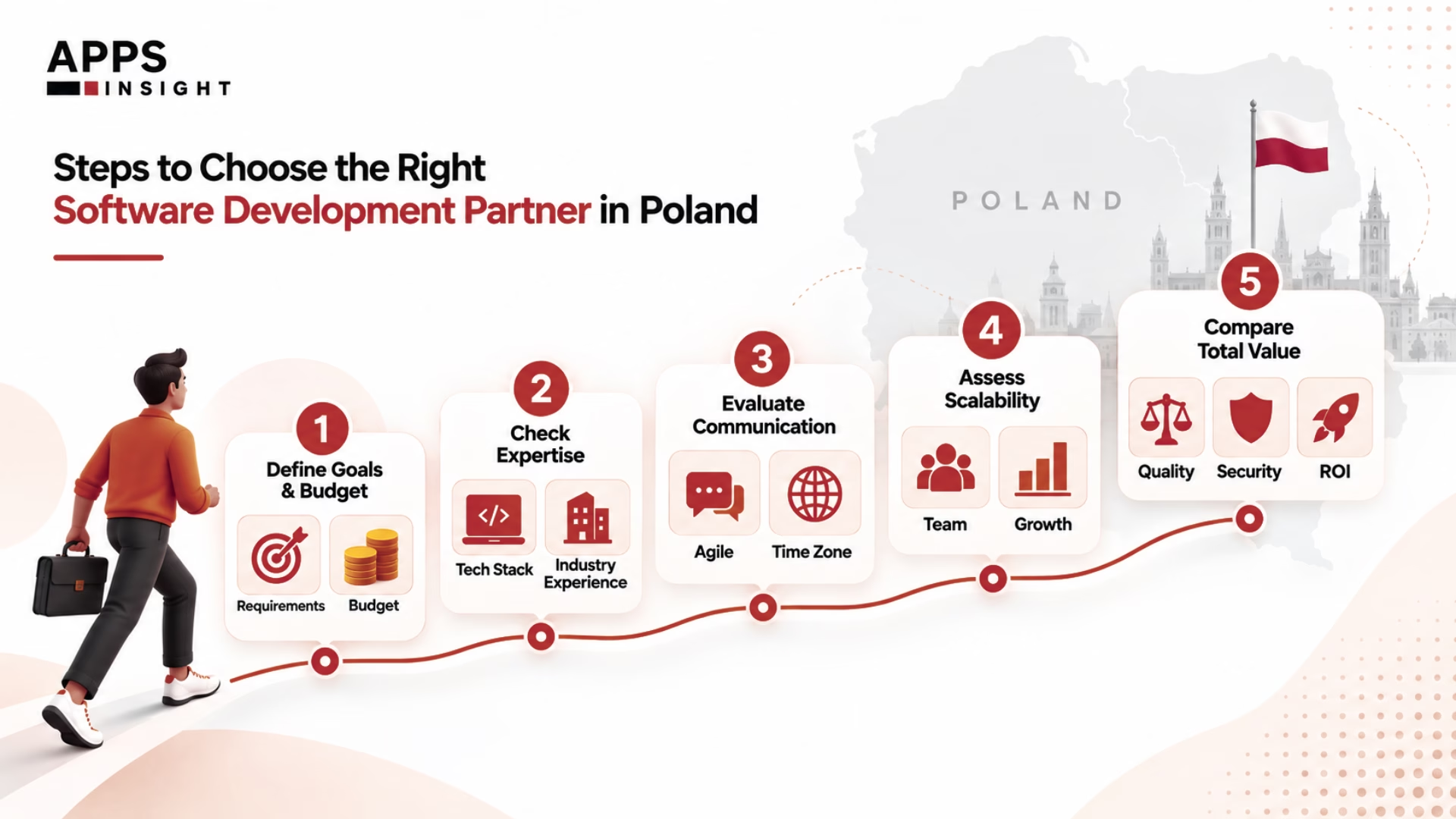
1. Define Business Goals, Scope, and Budget
Start by clarifying what you want to achieve, which platforms you target, and how success will be measured. Align this with a realistic budget range, knowing that many Polish firms charge 30–70 USD per hour for standard work and up to 150 USD for niche expertise like AI or advanced DevOps. For an MVP, plan for at least 40,000–120,000 USD depending on complexity, integrations, and security needs.
2. Check Industry Experience and Technical Depth
Shortlist vendors that already work in your industry (fintech, healthcare, e‑commerce, logistics, manufacturing, etc.) so they understand your regulatory and operational environment. Review case studies, client logos, and tech stacks (cloud, data, AI, mobile, web) to ensure they can handle both current requirements and future roadmap items. Domain familiarity can reduce miscommunication and speed up discovery by 20–30%.
3. Evaluate Delivery Model, Culture, and Communication
Poland’s time zone and cultural fit make it ideal for nearshore and offshore collaboration, with minimal overlap issues for Europe and 3–6 shared hours for North America. Ask how the company runs agile ceremonies, demos, and planning sessions, and test responsiveness during early calls and a small paid pilot. Strong English proficiency and similar work ethic further reduce friction and make day‑to‑day coordination easier.
4. Assess Team Structure, Scalability, and Engagement Model
Understand how teams are composed—typical setups include a tech lead, 2–5 developers, QA engineers, and optional DevOps/UX specialists. Confirm that the vendor can scale your team by 50–100% within 1–2 months if you need to accelerate delivery. Discuss engagement models such as dedicated teams, time‑and‑materials, staff augmentation, or fixed‑price phases and choose the one that best matches your risk tolerance and planning horizon.
5. Look Beyond Price to Total Value and Risk
Avoid choosing purely on the lowest hourly rate, especially since fewer than 2% of Polish providers operate below 30 USD per hour and these often rely heavily on junior talent. Compare vendors on productivity, quality, security practices, and integration experience—not just on the rate card. Well‑run Polish teams can still deliver 30–50% total cost savings versus local Western vendors when you factor in fewer defects and faster time‑to‑market.
Read once! How to Manage an Offshore App Development Team
Common Mistakes to Avoid When Choosing Top Software Development Companies in Poland
1. Focusing Only on Hourly Rates
Many buyers chase the lowest hourly rate without assessing the impact on quality, throughput, and rework. In Poland, more than half of companies charge between 30–70 USD per hour, while about 40% go up to 150 USD for senior and specialized roles for a reason: they deliver higher value and stability. Selecting an ultra‑cheap vendor can actually increase total project cost once delays, bugs, and refactoring are included.
2. Skipping Proper Discovery and Requirements Definition
Another common mistake is rushing into development without a structured discovery phase. Skipping or compressing this step leads to unclear scope, frequent change requests, and 20–40% timeline overruns, especially on integration‑heavy projects. A 2–6 week discovery sprint with workshops, architecture planning, and a prioritized backlog substantially reduces risk and aligns everyone on objectives.
3. Underestimating Integration, Legacy Systems, and Technical Debt
Some organizations treat integration with legacy ERPs, CRMs, or in‑house platforms as a minor task, which it rarely is. Polish software companies often handle complex, multi‑system landscapes, but they still need full visibility into your current stack to design robust interfaces. Failing to provide this context early increases the odds of breaking existing workflows and adds hidden technical debt that becomes expensive to unwind later.
4. Treating Security and Compliance as Optional
Security and compliance are sometimes pushed to “Phase 2,” especially for MVPs, but this is risky in domains like fintech and healthcare. Polish vendors usually comply with GDPR by default and often work with PSD2, PCI‑DSS, and other frameworks, yet their maturity varies. If you do not assess secure SDLC practices, penetration testing, and certification status upfront, you may face costly remediation or audit issues down the road.
5. Ignoring Documentation, Knowledge Transfer, and Long‑Term Ownership
Clients frequently focus on shipping features and overlook documentation and knowledge transfer. Without clear expectations around code standards, architecture docs, and handover sessions, you risk vendor lock‑in and slow onboarding of internal or replacement teams later.
Build documentation, training, and regular knowledge‑sharing workshops into your contract so you retain control of your product and can adapt your vendor strategy over the next 3–5 years as your needs evolve.
Also Read! Benefits of AI Software Development for Digital Transformation
What Is the Typical Cost of Hiring Software Development Companies in Poland?
The typical cost of working with software development companies in Poland ranges from 30 to 150 USD per hour, depending on city, tech stack, and seniority. In major hubs like Warsaw and Krakow, more than half of companies fall into the 30–70 USD per hour bracket, while 40%+ operate up to 150 USD per hour for advanced or niche services.
For a small MVP or pilot (8–12 weeks, 2–4 developers plus part‑time QA and PM), budgets commonly sit between 40,000 and 120,000 USD. Larger, multi‑module platforms or enterprise systems running 6–12 months with 6–10 specialists can easily reach 250,000 to 800,000 USD, especially when security, integrations, and compliance play a major role.
Organizations from Western Europe and North America often achieve 30–50% cost savings versus hiring similar talent locally. This is due to lower labor costs and a high concentration of senior engineers capable of handling complex architectures without the overhead typically associated with onshore teams. When calculating ROI, factor in productivity and quality to avoid comparing hourly rates in isolation.
What Is Driving Software Development Outsourcing Trends in Poland?
Software development outsourcing in Poland is growing rapidly and is projected to generate several billion USD in revenue as more global companies adopt nearshore models. The broader IT services market is on track to exceed 10 billion USD with a CAGR above 5%, while software outsourcing specifically is forecast to grow at nearly 9% annually.
Key trend drivers include strong technical education, a large pool of experienced engineers, and widespread adoption of cloud, data, and AI technologies. Many organizations are now integrating generative AI into their products, with nearly a quarter to a third of IT companies already experimenting or planning to implement AI solutions, further boosting demand for advanced software skills.
At the same time, Poland benefits from its EU membership, stable economy, and strategic time‑zone position, which simplifies legal frameworks and operational collaboration for European clients.
Combined with competitive costs and high English proficiency, these factors make Poland one of the most attractive outsourcing and engineering hubs in Central and Eastern Europe.
Read once! Criteria for Choosing the Right Software Development Company
Get Featured on AppsInsight
Start by creating a concise profile covering your company name, headquarters, founding date, and core focus areas in software development. Highlight your primary tech stacks (for example, Java, .NET, Node.js, React, Python) and delivery models such as dedicated teams, staff augmentation, or end‑to‑end project delivery.
This helps AppsInsight quickly understand where you fit in the Polish software development landscape.
Showcase Services, Industries, and Case Studies
List your main services, including custom web and mobile development, cloud and DevOps, QA, and any AI or data capabilities that set you apart.
Specify the industries you serve—such as fintech, healthcare, e‑commerce, logistics, or manufacturing—and include 2–3 case studies with measurable outcomes (for example, 30% cost reduction or 2x user growth after launch).
Submit via the Official AppsInsight Channels
Once your materials are ready, submit them through the official AppsInsight site. Ensure all URLs, emails, and social profiles are correct so editors can easily review additional information if needed. Keeping data accurate and up to date increases the chance of being shortlisted for inclusion.
Respond Quickly to Follow‑Up Requests
If AppsInsight contacts you for clarifications, additional metrics, or updated case studies, reply promptly and provide detailed, factual information.
Editors may ask about typical project sizes, average engagement duration, team structure, and client locations to better categorize your company.
Companies that collaborate proactively and transparently are more likely to be featured in future editions of the “Top Software Development Companies in Poland” listings.
Final Words
Top software development companies in Poland play a crucial role in helping startups, scale‑ups, and enterprises ship reliable digital products faster and at a competitive cost.
With strong engineering talent, mature agile practices, and experience across regulated industries, Polish teams are well suited for complex, long‑term initiatives that demand both technical depth and business understanding.
By choosing the right partner, organizations can shorten time‑to‑market by several months, reduce total development spend by 20–50%, and improve product quality through better testing, security, and architecture decisions.
Take the time to evaluate expertise, collaboration style, and scalability so that your investment in Poland delivers maximum ROI and supports your roadmap for many releases to come.
FAQs
How much do software development projects in Poland usually cost?
Software development projects in Poland generally start around 40,000–60,000 USD for small MVPs and can exceed 500,000 USD for complex, multi‑module enterprise platforms. Hourly rates often range from 30–70 USD for standard work and 70–150 USD for senior or specialized roles such as solution architects, DevOps, or AI experts.
Compared to Western Europe or North America, these rates can reduce engineering costs by 30–50% while maintaining similar quality, especially for long‑term engagements. When planning your budget, include discovery, testing, and post‑launch support, which together may represent 25–40% of the total investment but significantly improve system stability and long‑term ROI.
Which industries do top Polish software development companies serve?
Top software development companies in Poland serve a diverse set of industries, with particular strength in fintech, banking, and financial services. Many vendors also specialize in healthcare, e‑commerce, logistics, manufacturing, and telecom, providing domain‑specific workflows, integrations, and regulatory knowledge.
In recent years, there has been strong growth in projects related to industrial IoT, Industry 4.0, and data‑driven decision making for sectors like manufacturing and transport. This breadth of industry coverage allows clients to find partners who already understand their business context, reducing onboarding time and accelerating requirements clarification by 20–30%.
What are typical project timelines with software development companies in Poland?
Typical project timelines vary by scope, but many MVPs and first production releases take 3–4 months with a focused team of 3–5 engineers. More complex platforms with multiple user roles, third‑party integrations, and strict security requirements often require 6–12 months of continuous work.
Discovery and architecture phases usually take 2–6 weeks, during which teams refine requirements, prioritize features, and design the technical stack. After launch, most clients engage in ongoing development and maintenance cycles, often renewing contracts yearly and planning new releases every 4–8 weeks to keep up with market needs.
What ROI can businesses expect from outsourcing to Poland?
Businesses outsourcing software development to Poland commonly see ROI in the form of cost savings, faster time‑to‑market, and improved product quality. Cost savings alone can reach 30–50% compared to hiring similar expertise in Western Europe or North America, thanks to competitive rates and strong productivity.
Additional ROI comes from access to experienced talent that might be scarce locally, enabling organizations to launch new digital products or features months earlier than otherwise possible. Over a 2–3 year horizon, these combined benefits can translate into higher revenue, better customer retention, and lower maintenance costs due to cleaner architectures and robust QA practices.
Should I choose a global vendor or a local Polish software company?
Global vendors with Polish delivery centers can be a good fit for large enterprises that need multi‑country coverage and standardized processes. However, local Polish software companies often offer more flexibility, faster decision‑making, and closer access to senior engineering leadership, which is valuable for product‑driven organizations.
Local providers can still serve global clients effectively thanks to Poland’s strong English proficiency, EU regulatory alignment, and favorable time zones. The best choice depends on your governance requirements, internal procurement rules, and whether you prioritize boutique attention or large‑scale, multi‑region capacity.
How do Polish software companies handle integration with existing systems?
Polish software development companies routinely integrate new solutions with legacy ERPs, CRMs, payment gateways, and data warehouses. They typically rely on REST or GraphQL APIs, message queues, and integration platforms, and can also work directly with older protocols when necessary.
During discovery, experienced vendors analyze your current landscape, document data flows, and identify high‑risk interfaces, which helps avoid 20–40% timeline overruns linked to underestimated integration work. Many teams also set up staging environments and automated regression suites to ensure that changes do not disrupt existing business processes.
How do top Polish software development firms address security and compliance?
Leading Polish software companies incorporate security into each phase of the SDLC, including threat modeling, secure coding standards, and regular vulnerability scans. Many are familiar with GDPR, PSD2, PCI‑DSS, and sector‑specific regulations affecting finance, healthcare, and e‑commerce.
For high‑risk environments, vendors may add penetration testing, hardened infrastructure on major cloud platforms, and detailed logging and monitoring to detect suspicious activity. This layered approach helps minimize data breach risks and supports audits, making Poland an appealing destination for security‑sensitive projects.
Are software development companies in Poland suitable for SMEs and startups?
Yes, many software development companies in Poland actively target SMEs and startups with flexible engagement models and smaller initial teams. MVP‑oriented packages and discovery workshops allow startups to validate ideas with budgets in the 40,000–100,000 USD range before scaling further.
Because Polish engineers often have experience working with international product companies, they can provide strategic input on UX, monetization, and scalability, not just coding. This combination of affordability and product mindset makes Poland particularly attractive for early‑stage businesses that need to move quickly but still care about quality and future growth.
What engagement models do Polish software companies typically offer?
Common engagement models include dedicated teams, fixed‑price projects for well‑defined scopes, and time‑and‑materials for evolving requirements. Staff augmentation is also popular, allowing you to add 1–5 remote engineers to your existing team while keeping product ownership in‑house.
Dedicated teams usually work best for long‑term roadmaps lasting 12 months or more, while fixed‑price contracts are often limited to smaller, clearly specified initiatives. For innovation projects and continuous product development, many clients prefer a hybrid model—starting with a fixed‑price discovery phase followed by time‑and‑materials or dedicated capacity.
What software development trends will shape Poland in the coming years?
Upcoming trends include wider adoption of AI and machine learning, especially generative AI capabilities embedded in business applications. Many Polish companies are expanding their expertise in data platforms, MLOps, and intelligent automation to meet global demand.
Cloud‑native architectures, microservices, and event‑driven systems will continue to dominate new builds, alongside stronger emphasis on cybersecurity and privacy.
As remote and hybrid work models stabilize, Poland is also expected to deepen its role as a nearshore engineering hub for both European and North American firms seeking long‑term, strategic technology partnerships.
Other Services
Explore every top-level category on the directory.