


Hey, if you’re thinking about building an app, you’re already ahead of most people. You’ve probably got an idea buzzing in your head. Maybe it’s the next big SaaS product, a marketplace, or even an AI-powered tool that could disrupt your industry. And naturally, the first instinct is:
“Let’s start development.”
But here’s the uncomfortable truth we’ve seen again and again while working with founders and startups:
Most apps don’t fail because of bad development. They fail because of bad decisions before development even starts.
That’s where things quietly fall apart.
- Wrong assumptions
- No validation
- Misaligned budgets
- Hiring the wrong team
- Or building something nobody actually needs
And the scary part? These mistakes don’t show up immediately. They creep in slowly… until you’ve already spent thousands of dollars and months of effort.
In this guide, we’re going to walk through the most common mistakes founders make before starting app development, the kind that can make or break your product before it even launches.
More importantly, we’ll also show you:
- How to avoid these mistakes
- What experienced founders do differently
- And how you can set your app up for real success from day one
Think of this as your pre-flight checklist before you hit “build.”
Looking for? Web and Mobile App Ideas for American Entrepreneurs in 2026
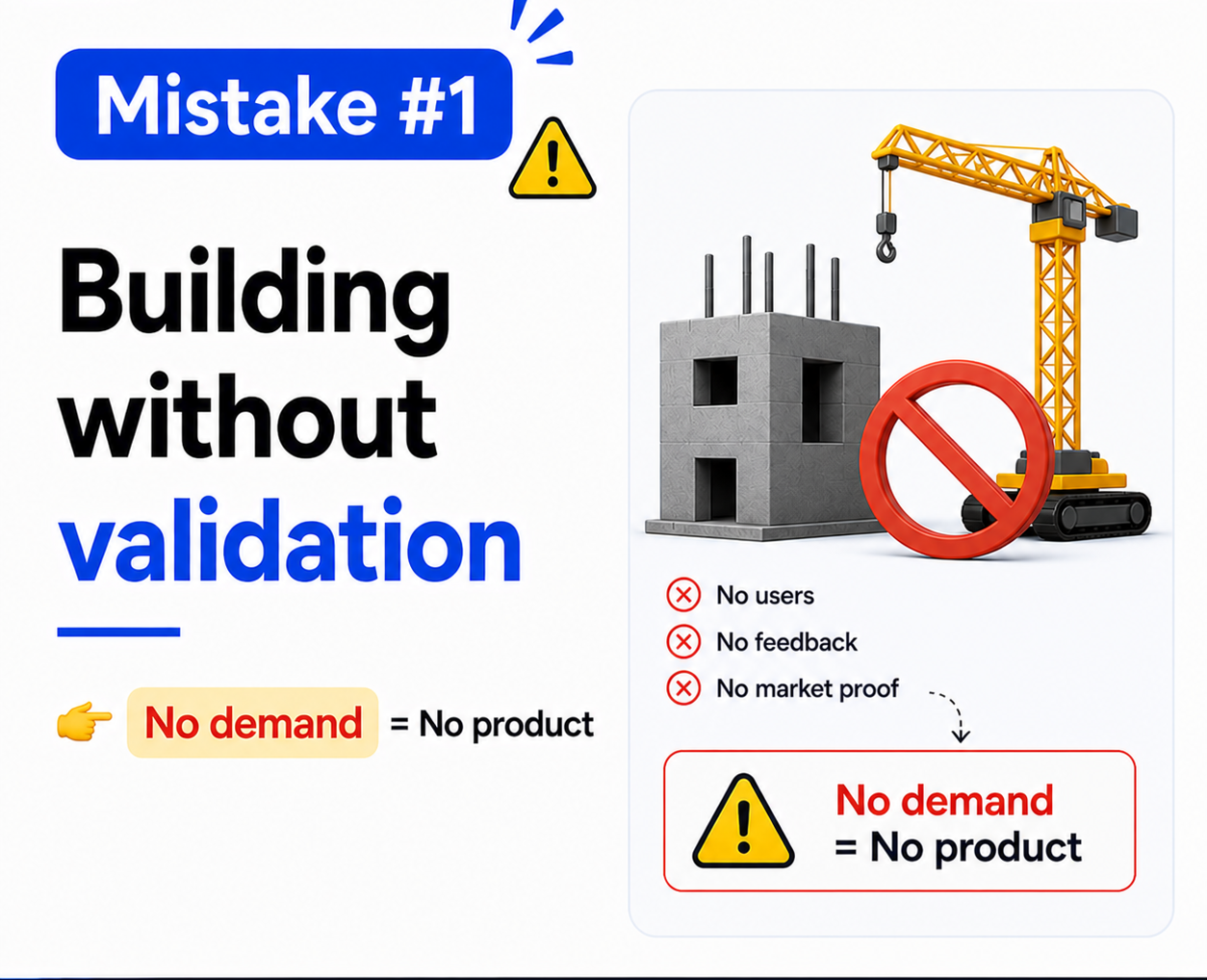
Mistake #1: Building an App Without Validating the Idea
Let’s be honest for a second. Most founders don’t start with validation. They start with excitement.
You get an idea, it feels fresh, maybe even disruptive, and your brain immediately jumps to features, UI screens, and development timelines. You start imagining downloads, users, revenue… everything looks promising in your head.
But here’s the uncomfortable reality we’ve seen repeatedly while working with startups:
Ideas don’t fail because they’re bad. They fail because they were never tested in the real world.
When you skip validation, you’re essentially guessing. And in business, guessing is expensive.
We’ve seen founders invest months into building apps that nobody uses. Not because the app was poorly built, but because the problem wasn’t strong enough, or worse, didn’t exist in the way they imagined.
Here’s where most founders go wrong:
They assume that if they face a problem, millions of others must be facing it too. That’s not always true. Sometimes your problem is too niche. Sometimes people have already found easier ways to deal with it. And sometimes, people simply don’t care enough to switch to a new solution.
Another common trap is thinking, “There are already similar apps, so the market is validated.”
Yes, the market may exist. But that doesn’t mean there’s room for your version unless you bring clear differentiation or better execution. Otherwise, you’re just adding noise to an already crowded space. Let’s take a simple example.
Imagine you’re building a task management app. Sounds safe, right? There’s demand. People need productivity tools.
But when you look closer:
- Users already rely on existing tools
- Switching costs are high (data, habits, workflows)
- Your app needs a very strong reason for users to move
Without validation, you might end up building “just another app” in a saturated market.
And this is where most founders lose time and money.
Because development gives you the illusion of progress. You feel like you’re moving forward. But if the foundation is weak, everything built on top of it eventually collapses.
How to Validate Your App Idea (Simple Ways)
Validation doesn’t need to be complex, technical, or expensive. In fact, the best validation methods are often the simplest.
What you’re really trying to answer is:
“Do people actually care enough about this problem to use or pay for a solution?”
Start with conversations. Not surveys filled with generic questions, but real, honest discussions with your target users.
Ask them about their current challenges. Ask how they’re solving those problems today. Ask what frustrates them. What you’ll often discover is more valuable than your original idea.
Then, instead of building the full product, test the concept.
You can create a simple landing page explaining your app. No backend, no complex design. Just clearly communicate:
- What problem you solve
- Who it’s for
- Why it’s better
Then track how people respond.
- Are they signing up?
- Are they interested?
- Are they ignoring it completely?
That tells you more than months of guessing.
Another powerful approach is running small ad campaigns. Even a small budget can help you understand if your idea attracts attention. If people don’t click or engage, that’s a signal you shouldn’t ignore.
You can also build a lightweight MVP using no-code tools. The goal here isn’t perfection. It’s speed and learning. Give users something basic, observe how they interact, and gather feedback early.
One of the strongest validation signals is when people are willing to pay — even before the product is fully built. That’s when you know the problem is real and valuable.
And here’s something most founders overlook:
Validation isn’t about proving you’re right. It’s about discovering where you might be wrong early, cheaply, and safely.
What Smart Founders Do Differently
Experienced founders approach this stage very differently. They don’t rush into development. They slow down strategically.
Instead of asking, “How do we build this app?” they first ask, “Should we even build this?”
They spend time understanding users deeply. They observe behavior, not just opinions. Because what people say and what they do are often very different.
Smart founders also focus on the strength of the problem rather than the brilliance of the idea.
A strong problem creates demand. A weak problem needs marketing tricks to survive.
They test assumptions early. They are comfortable hearing “this won’t work” because it saves them from bigger losses later.
Another key difference is that they don’t aim for perfection in the beginning. They aim for clarity.
They launch small, learn fast, and adapt quickly. Instead of building a full-featured app, they validate the core value first. Once they see real interest and engagement, then they scale development.
And most importantly, they stay flexible.
They don’t get emotionally attached to their first idea. If the data shows something isn’t working, they pivot without hesitation.
Listed! Top Mobile App Development Trends To Watch In 2026
Mistake #2: Underestimating the Total Cost of App Development
There’s a moment almost every founder goes through. You ask a developer or agency, “How much will it cost to build an app?” They give you a number. It feels manageable. You breathe easy.
And then, a few months later… the budget starts stretching like elastic pulled too far. More features. More revisions. Unexpected delays. Infrastructure costs. Maintenance. Marketing.
Suddenly, the original estimate feels like the trailer of a movie that forgot to show the full plot.
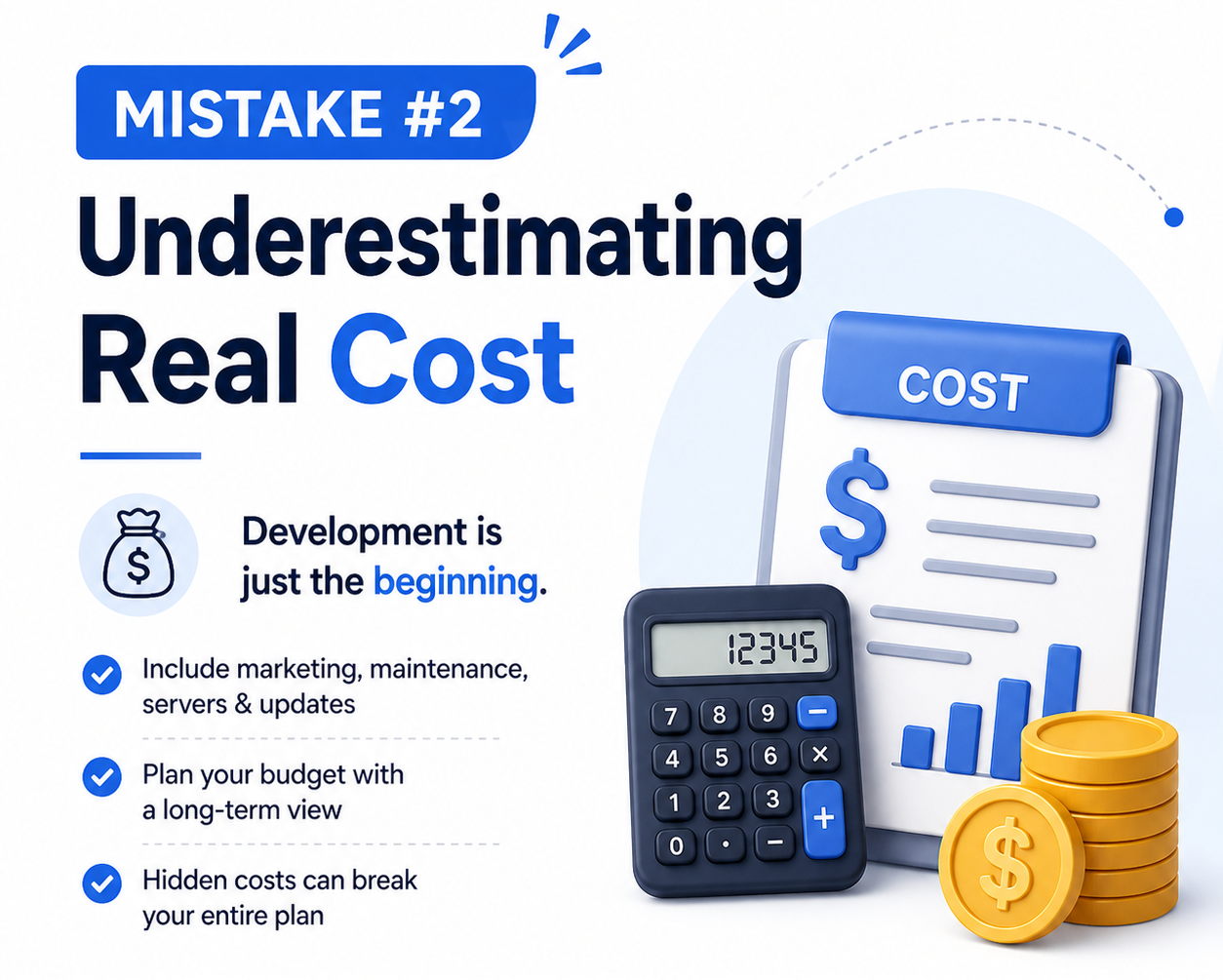
This is one of the most common and dangerous mistakes founders make: underestimating the true cost of building and running an app.
Not because they’re careless, but because they’re only looking at development cost, not the entire product lifecycle. And that’s where things quietly spiral.
How to Estimate the Real Cost (Beyond Just Development)
If you’re serious about building an app, you need to think in layers, not just a single price tag.
Development is just one piece of the puzzle. The real cost includes everything required to bring your app to life and keep it alive.
Let’s break it down in a practical way.
First, there’s the core development cost. This includes design, frontend, backend, APIs, testing, and deployment. This is what most quotes cover. But even here, costs can vary widely depending on complexity, features, and the team you hire.
Then comes UI/UX design. A clean, intuitive experience isn’t optional anymore. If users don’t understand your app in the first few seconds, they leave. Good design takes time, research, and iteration.
Next is infrastructure. Your app needs servers, databases, cloud storage, and performance optimization. Whether you’re using AWS, Google Cloud, or another provider, these costs grow as your users grow.
Then there’s third-party integrations. Payment gateways, maps, analytics tools, AI APIs, authentication systems, each one adds cost, both in implementation and ongoing usage.
Now comes the part many founders overlook: maintenance and updates. No app is “done” after launch.
You’ll need to fix bugs, release updates, improve performance, adapt to new OS versions, and respond to user feedback. This is a continuous investment, not a one-time cost.
And finally, the biggest surprise for many founders: marketing and user acquisition.
You can build the best app in the world, but if no one knows about it, it doesn’t matter. Ads, content marketing, ASO (App Store Optimization), influencer campaigns, these costs can easily match or exceed development expenses.
So when you think about cost, don’t ask:
Instead ask:
“How much does it cost to build, launch, grow, and sustain an app?”
That’s the real number.
What Smart Founders Do Differently
Experienced founders treat budgeting like strategy, not just estimation. They don’t chase the cheapest option. They focus on cost efficiency, not cost cutting.
They start by defining a clear MVP scope. Instead of building everything at once, they prioritize only the core features that deliver value. This reduces initial costs and speeds up validation.
They also plan for phased investment. Instead of pouring all their budget into development, they allocate funds across:
- Product development
- Testing and iteration
- Marketing and growth
- Ongoing maintenance
This creates balance and reduces risk. Smart founders also build a buffer budget.
Because no matter how well you plan, things change. Features evolve. Timelines shift. Unexpected challenges appear. A buffer protects you from hitting a financial wall mid-project. Another key difference is transparency.
They ask the right questions before hiring a team:
- What’s included in the quote?
- What happens if requirements change?
- How are additional costs handled?
- What post-launch support is provided?
This prevents misunderstandings later.
And importantly, they understand that cheap development often becomes expensive later.
Low-cost teams may cut corners in code quality, scalability, or security. This leads to higher maintenance costs, performance issues, and even full rebuilds down the line.
So instead of asking, “What’s the lowest price?” they ask, “What gives me the best long-term value?”
Mistake #3: Trying to Build Too Many Features at Once
There’s a tempting voice that shows up early in every founder’s journey. It whispers: “If we add just a few more features, users will love it even more.” So you keep adding.
- A chat feature here.
- Analytics dashboard there.
- AI recommendations. Notifications. Social sharing. Gamification.
Before you know it, your “simple app idea” has turned into a bloated digital jungle. And here’s the paradox:
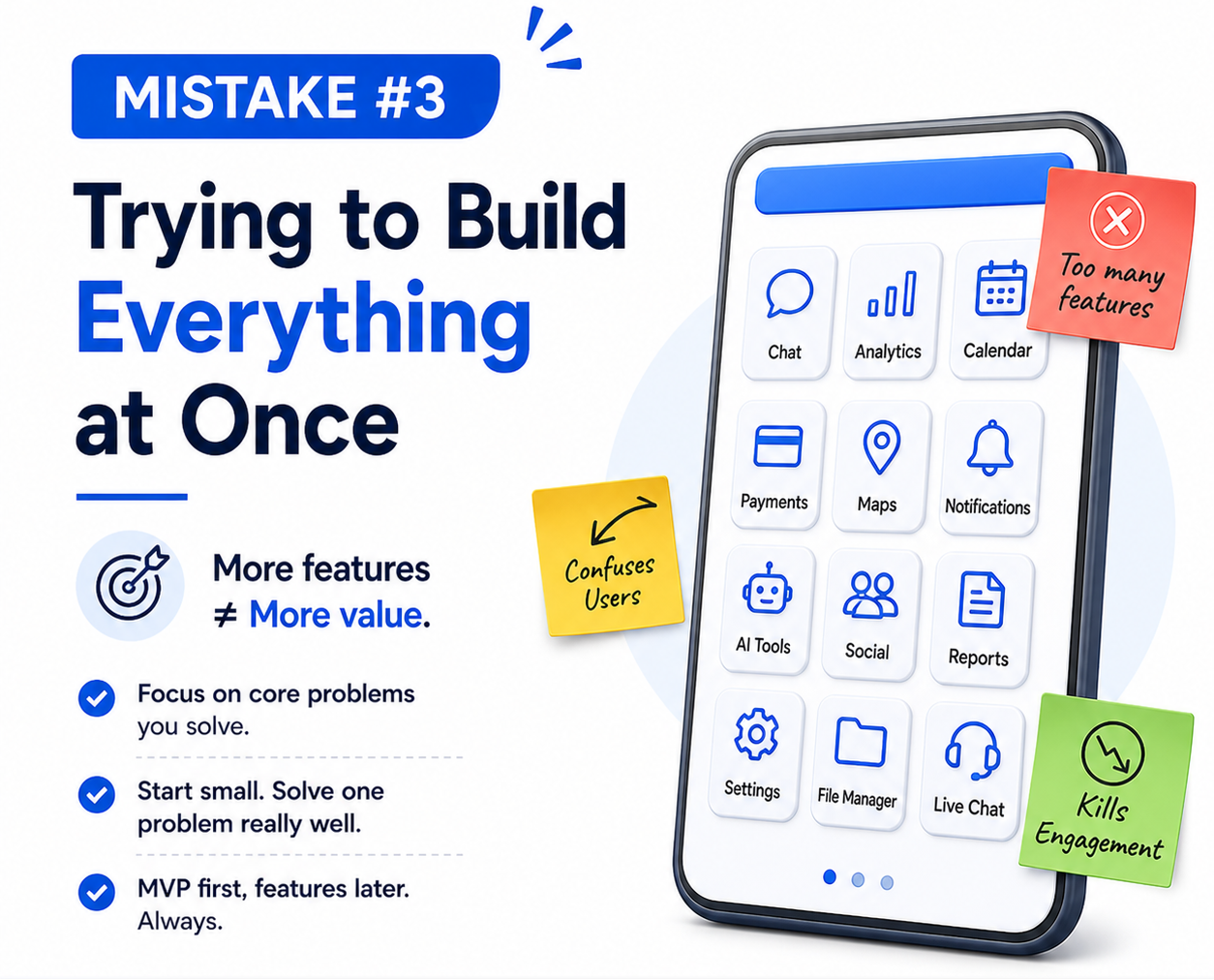
The more features you add early on, the higher the chances your app will fail. Not because features are bad, but because too many features too soon dilute your core value.
Why This Happens (And Why It’s Dangerous)
Most founders believe more features = more value. But users don’t think that way. Users come to your app for one primary reason. One job. One outcome. If your app tries to do everything, it ends up doing nothing well.
We’ve seen this play out in real scenarios:
A founder builds a fitness app and adds:
- Workout plans
- Diet tracking
- Social community
- Video coaching
- AI insights
- E-commerce store
Individually, each feature sounds valuable. But together? It creates confusion.
New users open the app and don’t know where to start. The experience feels heavy. The learning curve increases. And instead of engagement, you get drop-offs.
Another hidden issue is development complexity.
Every new feature:
- Increases development time
- Introduces more bugs
- Requires more testing
- Adds maintenance overhead
So instead of launching quickly and learning from users, you get stuck in a long development cycle with no real feedback. And by the time you launch, the market may have already shifted.
How to Focus on What Actually Matters
The key is not to build less. It’s to build what matters first. Start by identifying your app’s core value proposition.
Ask yourself: “If users could only use one feature in my app, what should it be?” That’s your starting point. Everything else is secondary. A strong MVP (Minimum Viable Product) isn’t a half-built app. It’s a focused app.
It solves one problem clearly and effectively.
Think about some successful products in their early days:
- Instagram started with simple photo sharing
- Uber focused on booking a ride
- Dropbox solved file syncing
They didn’t try to do everything at once. They did one thing exceptionally well. You should aim for the same clarity. When defining your MVP, prioritize features based on:
- User impact
- Frequency of use
- Problem-solving ability
If a feature doesn’t directly contribute to solving the main problem, it can wait.
What Smart Founders Do Differently
Experienced founders are ruthless when it comes to prioritization. They don’t ask, “What more can we add?” They ask, “What can we remove without hurting the core experience?”
They understand that simplicity is not a limitation. It’s a strategy. Instead of building a feature-heavy product, they build a value-first product.
They launch early with a focused set of features, gather real user feedback, and then expand gradually based on actual demand, not assumptions.
Another thing they do well is roadmap thinking.
They don’t ignore future features. They simply sequence them intelligently.
- Phase 1: Core functionality
- Phase 2: Enhancements based on feedback
- Phase 3: Advanced features and scaling
This approach keeps development manageable and aligned with user needs. Smart founders also pay close attention to user behavior.
If users aren’t engaging with a feature, they don’t hesitate to remove or improve it. They treat their product like a living system, not a fixed structure. And most importantly, they understand this:
Clarity beats complexity. Every single time.
Mistake #4: Choosing the Wrong Development Approach (or Tech Stack Too Early)
This is where things get quietly technical… and dangerously strategic. Most founders, especially in the early stage, ask this question too soon:
“Should we build native or cross-platform?”
“Which tech stack should we use?”
“Is this the best framework for scalability?”
On the surface, these sound like smart questions.
But here’s the catch:
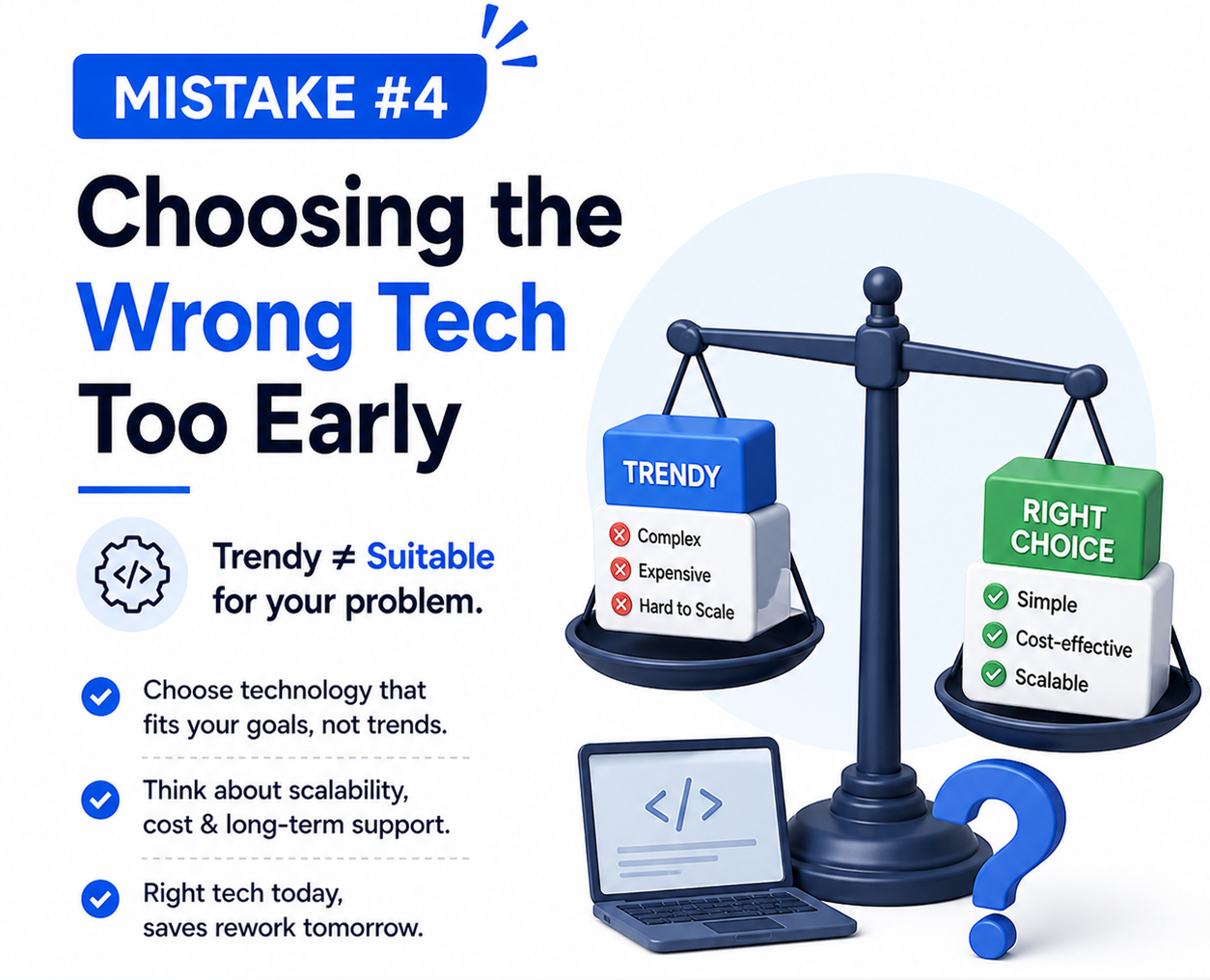
Choosing your development approach too early, or for the wrong reasons, can lock you into decisions that are expensive to reverse later. And it happens more often than you’d expect.
Why This Happens (And Why It Backfires)
When you don’t have a technical background, it’s natural to rely heavily on developers or agencies. They suggest a stack they’re comfortable with, and you go along with it. Or sometimes, founders pick technologies based on trends:
- “Everyone is using AI, so we should too”
- “Let’s use the latest framework”
- “This tech is scalable, so it must be the best”
But here’s the reality:
There is no universally “best” tech stack. There is only the “right fit” for your specific product, stage, and goals.
Choosing the wrong approach early can create problems like:
- Higher development costs
- Slower performance
- Limited scalability
- Difficulty hiring developers later
- Expensive rewrites in the future
For example, building a highly complex native app when you only need a simple MVP can waste both time and money. On the flip side, choosing a quick no-code solution for a product that needs deep customization can limit you as you grow.
Another common mistake is overengineering.
Some founders try to build for scale before they even have users. They invest in complex architectures designed for millions of users… when they don’t yet have 100.
That’s like building a six-lane highway for a street that hasn’t seen traffic yet.
How to Choose the Right Approach (Without Overcomplicating It)
Instead of starting with technology, start with clarity.
Your decisions should be driven by:
- What problem you’re solving
- Who your users are
- How quickly you need to launch
- Your available budget
- Your long-term vision
Once you have this clarity, choosing the right approach becomes easier. For early-stage founders, speed and flexibility matter more than perfection.
In many cases, starting with:
- Cross-platform frameworks
- No-code or low-code tools
- Simple backend architecture
can help you launch faster and validate your idea without heavy investment. If your app gains traction, you can always evolve your tech stack later.
Another important factor is team alignment. The best tech stack is often the one your team can execute efficiently. A great technology in the wrong hands will still lead to poor results.
You should also think about:
- Ease of maintenance
- Availability of developers
- Integration capabilities
- Future scalability (but only to a reasonable extent)
The goal is not to make a perfect decision. The goal is to make a practical and reversible decision.
What Smart Founders Do Differently
Experienced founders don’t rush into technical decisions. They delay them until they have enough clarity about the product. They focus on building a working solution first, not a technically perfect one. Instead of chasing trends, they prioritize:
- Speed to market
- Cost efficiency
- Flexibility to adapt
They also involve technical experts early, but they don’t blindly follow recommendations. They ask questions, understand trade-offs, and make informed decisions. Another key difference is that they plan for evolution, not perfection.
They understand that their app will change over time. So instead of locking themselves into rigid systems, they choose approaches that allow iteration and growth.
And importantly, they avoid overengineering. They build for the present, with a reasonable eye on the future, not an exaggerated one.
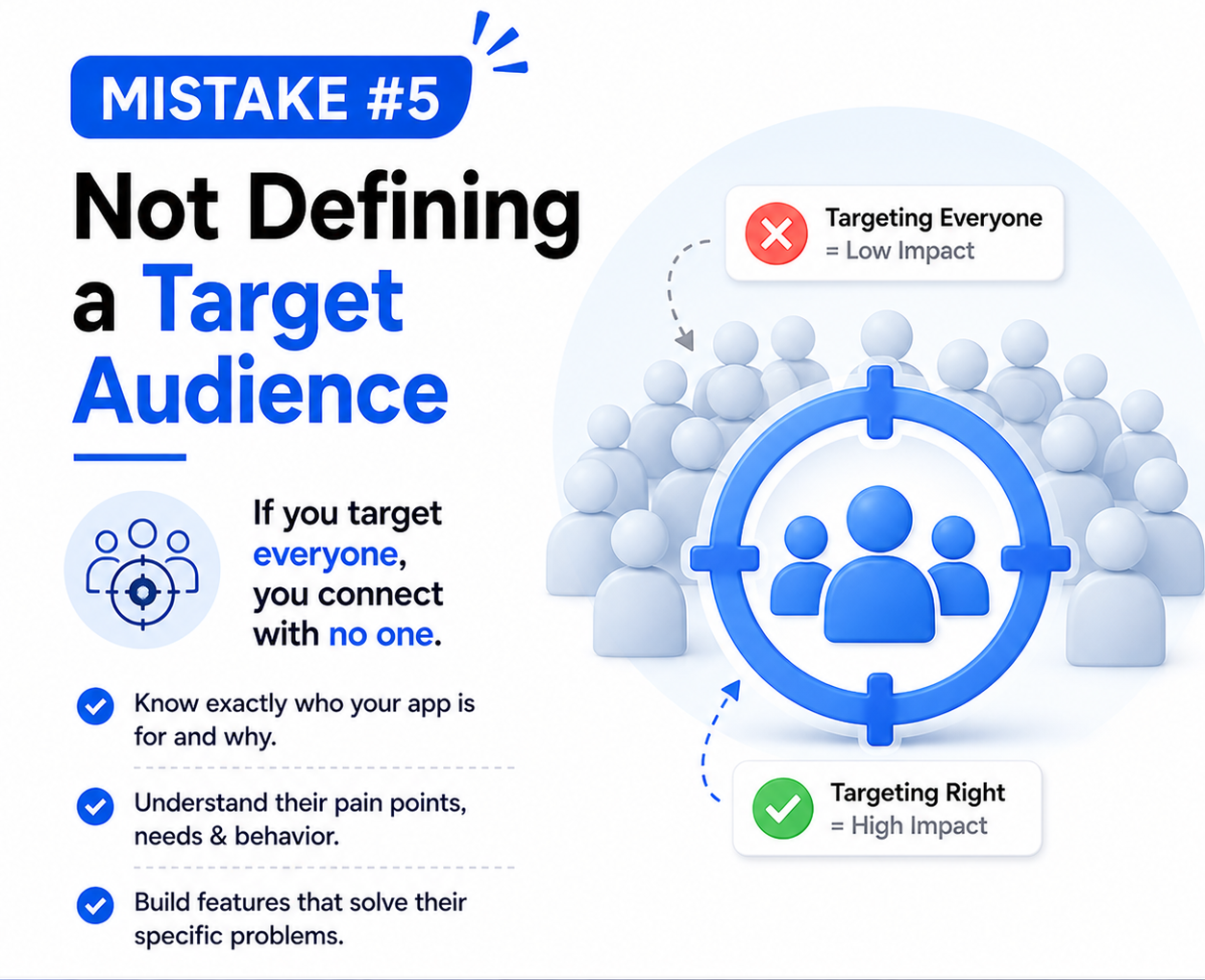
Mistake #5: Not Defining a Clear Target Audience
Here’s a subtle but brutal truth: If your app is for “everyone,” it’s actually for no one.
This mistake doesn’t look dangerous at first. In fact, it often feels like a smart move. Many founders believe that casting a wide net increases their chances of success.
More users, more opportunities… right? Not quite.
When you don’t define a clear target audience, everything becomes vague — your product, your messaging, your features, and ultimately, your growth.
Why This Happens (And Why It Hurts More Than You Think)
Most founders start with an idea, not a user. They focus on what the app does, not who it’s for.
So when asked, “Who is your target audience?” the answer usually sounds like:
- “Anyone who wants to stay fit”
- “People who want to manage their tasks”
- “Businesses that need automation”
These sound logical, but they’re too broad to be useful. Because different users have different needs, behaviors, and expectations. Let’s take a simple example.
If you’re building a productivity app:
- A college student wants simplicity and reminders
- A startup founder wants integrations and analytics
- A corporate manager wants team collaboration features
Now imagine trying to build one app that satisfies all three from day one. You end up with a confusing product that doesn’t deeply satisfy anyone.
And it doesn’t stop at product decisions. A vague audience also breaks your marketing.
Your messaging becomes generic. Your ads don’t connect. Your content feels flat. Users don’t feel like the app was built for them. And when users don’t feel understood, they don’t stay.
How to Define Your Target Audience (The Right Way)
Instead of trying to reach everyone, focus on a specific group with a specific problem.
Start by narrowing things down.
Ask yourself:
- Who is most likely to face this problem?
- What is their daily routine?
- What frustrates them the most?
- What alternatives are they currently using?
Go beyond demographics like age or location. Focus on behavior and intent.
For example, instead of saying:
“People who want to stay fit” You can define:
“Working professionals aged 25–40 who struggle to maintain a consistent workout routine due to time constraints” See the difference?
Now your product decisions become clearer.
- You may prioritize short workouts
- Add scheduling features
- Focus on convenience over complexity
You’re no longer guessing. You’re building with direction. Another powerful approach is creating user personas. Give your ideal user a name, a role, and a scenario. It may sound simple, but it helps you think from the user’s perspective instead of your own assumptions.
And here’s something important:
You don’t need a large audience at the start. You need a focused and engaged audience.
What Smart Founders Do Differently
Experienced founders don’t chase scale immediately. They start narrow and expand later. They identify a core user segment and build specifically for them. This allows them to create a product that feels highly relevant and valuable. Instead of asking, “How do we get more users?” they ask,
“How do we deeply solve the problem for our first 100 users?”
Because if those 100 users love your product, they become your strongest growth engine. Smart founders also listen more than they assume.
They gather feedback early. They observe user behavior. They refine their understanding continuously.
And they aren’t afraid to adjust their target audience if needed. Sometimes, the users you initially thought were your audience turn out not to be the best fit. And that’s okay.
The goal is not to be right from day one. The goal is to get closer to the right audience with each step.
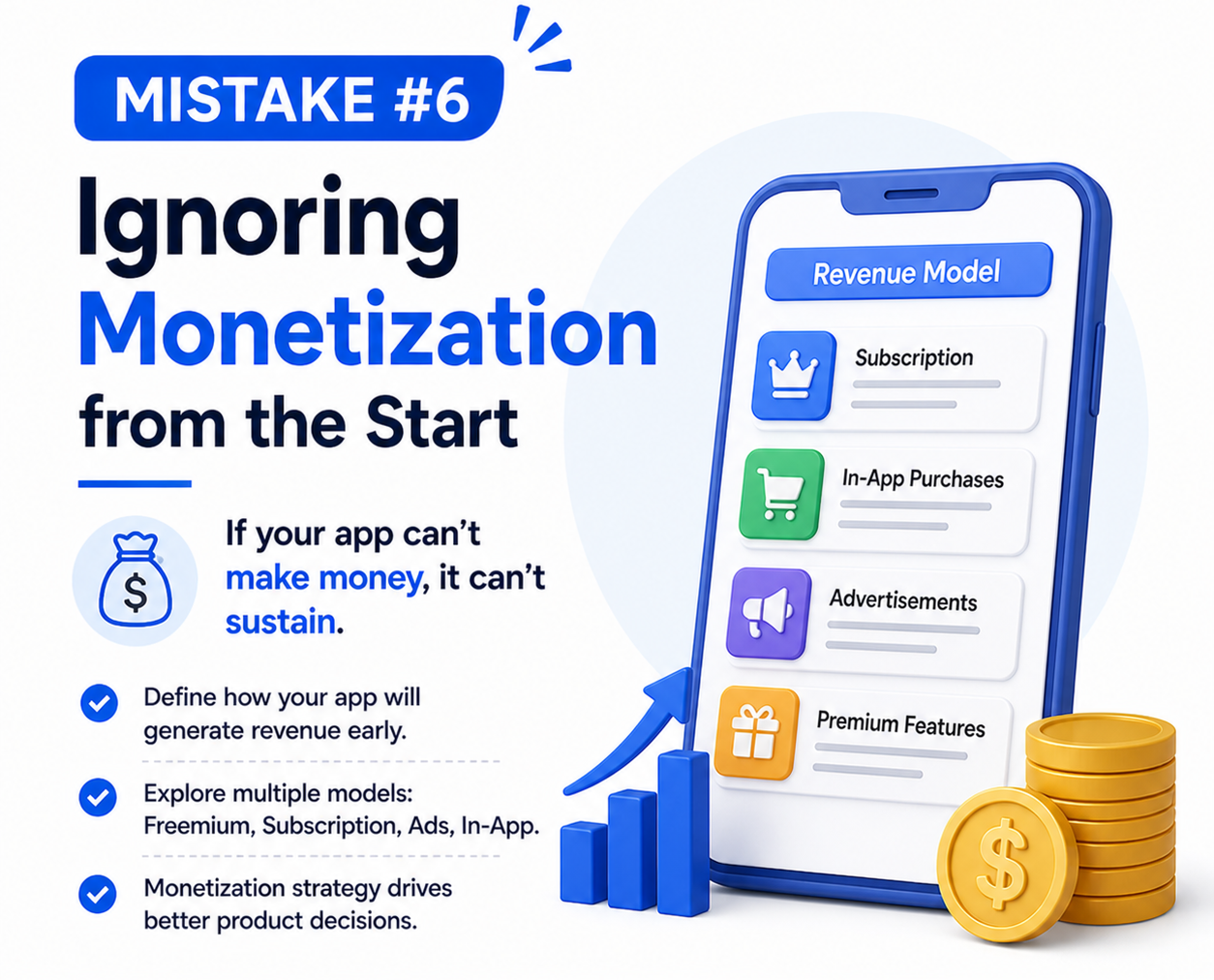
Mistake #6: Ignoring Monetization Strategy Until Too Late
There’s a common belief among founders:
“Let’s build the app first… we’ll figure out monetization later.”
It sounds harmless. Even logical. After all, you want users first, right? But here’s where things get tricky.
If monetization isn’t part of your early thinking, you may end up building a product that’s hard, awkward, or even impossible to monetize later.
And fixing that later? Much harder than doing it right from the start.
Why This Happens (And Why It’s Risky)
Most founders are focused on growth in the beginning.
They think:
- “Let’s get users first”
- “Revenue will come later”
- “We’ll add pricing once people love the product”
But here’s the reality:
Monetization is not just a pricing decision. It’s a product decision.
It affects:
- Feature structure
- User experience
- Value delivery
- Customer expectations
If you ignore it early, you might build features that users expect for free… and later struggle to charge for them. Let’s take a simple example.
You launch an app with all features available for free to attract users. People love it. They start using it regularly.
Now you decide to introduce a paid plan.
Suddenly, you’re asking users to pay for something they’ve been using for free.
What happens?
- Resistance
- Drop in engagement
- Negative feedback
- Users leaving
Not because your app isn’t valuable, but because the expectation was set incorrectly from the beginning.
Another issue is misaligned business models.
For example:
- A subscription model may not work if users don’t engage frequently
- Ads may hurt user experience in a premium product
- One-time payments may limit long-term revenue
Without early planning, you risk building something that doesn’t sustain itself.
How to Think About Monetization from Day One
You don’t need a perfect pricing model from the start. But you do need a clear monetization direction.
Start by asking:
“How will this app make money if it succeeds?” Then explore models that align with your product and audience.
Common monetization models include:
- Subscription (monthly or yearly plans)
- Freemium (basic features free, advanced paid)
- One-time purchase
- In-app purchases
- Ads (for high-volume user bases)
- Commission-based (for marketplaces)
The key is alignment.
Your monetization strategy should match:
- User behavior
- Frequency of usage
- Value delivered
- Market expectations
For example:
If your app solves a recurring problem, subscription makes sense. If it offers a one-time utility, a one-time payment may work better.
Also think about value perception. Users don’t pay for features. They pay for outcomes.
So instead of asking, “What features can we charge for?” ask, “What value are users willing to pay for?”
Another smart move is introducing monetization early, even in a basic form.
This helps you:
- Test willingness to pay
- Set the right expectations
- Avoid friction later
What Smart Founders Do Differently
Experienced founders don’t treat monetization as an afterthought. They integrate it into the product from the beginning. They design their app in a way that naturally supports their revenue model.
For example:
- They structure features around free vs paid tiers
- They highlight premium value clearly
- They create upgrade moments within the user journey
They also test pricing early.
Even simple experiments can reveal:
- What users are willing to pay
- Which features drive conversions
- How pricing impacts retention
Another key difference is flexibility. Smart founders don’t lock themselves into one model permanently. They observe, learn, and adjust. If a pricing model isn’t working, they refine it based on real data.
And importantly, they balance growth with sustainability. They don’t just aim for downloads.
They aim for a business that can survive and scale.
Mistake #7: Choosing the Wrong Development Team
This is the point where many promising ideas quietly collapse. You’ve validated your concept, planned your features, thought about monetization… and now it’s time to build.
So you hire a developer or an agency. Everything looks good in the beginning. The proposal is polished. The pricing feels reasonable. The timeline seems achievable.
And then, somewhere in the process, things start to drift.
- Deadlines slip
- Communication becomes unclear
- Quality issues appear
- Features don’t match expectations
Before you know it, you’re stuck in a loop of revisions, delays, and frustration.
Choosing the wrong development team isn’t just a setback. It can derail your entire product.
Why This Happens (And Why It’s So Costly)
Most founders don’t have deep technical expertise. So when it comes to hiring, they rely on surface-level signals:
- A good-looking portfolio
- Low pricing
- Fast delivery promises
- Confident sales calls
But here’s the problem:
A good pitch is not the same as good execution.
Many teams can sell well. Far fewer can actually deliver consistently. Another common mistake is prioritizing cost over capability.
It’s tempting to go with the lowest quote, especially when you’re managing a tight budget. But low cost often comes with hidden trade-offs:
- Poor code quality
- Lack of scalability
- Minimal testing
- Weak documentation
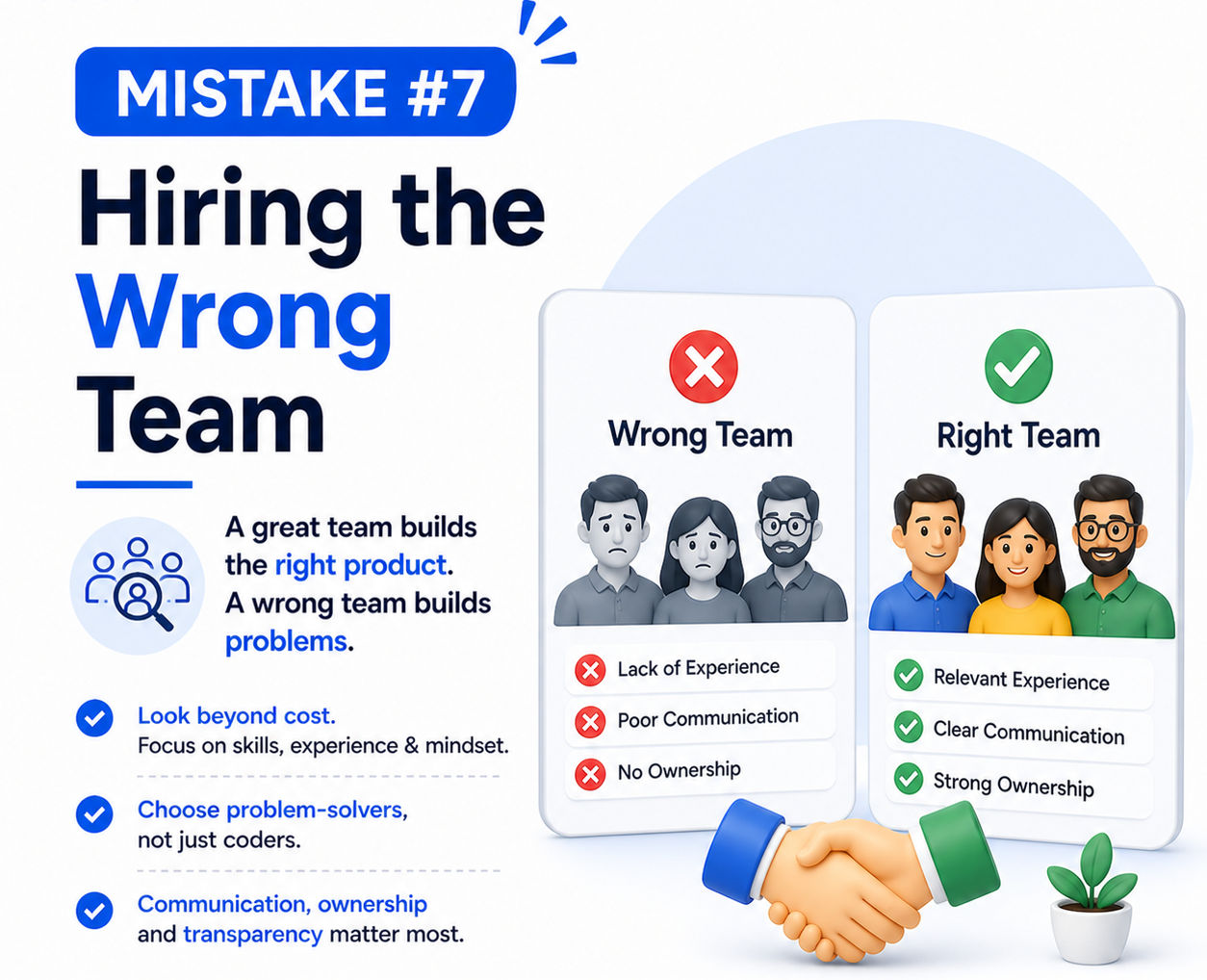
These issues may not show up immediately. But over time, they create technical debt that becomes expensive to fix.
Communication is another major factor.
If your development team doesn’t understand your vision, or if they fail to ask the right questions, you’ll end up with a product that technically works… but doesn’t solve the problem the way you intended.
And then there’s the issue of ownership.
Some teams simply execute tasks without thinking about the bigger picture. They build what you ask for, but don’t challenge assumptions or suggest improvements.
That’s a missed opportunity.
How to Choose the Right Development Team
Hiring the right team is less about finding the “best developers” and more about finding the right partners. Start by looking beyond the portfolio.
Yes, past projects matter. But what matters more is:
- How they approach problem-solving
- How they communicate
- How they handle ambiguity
- How they think about product, not just code
Ask questions that reveal their thinking:
- How would you approach building this MVP?
- What challenges do you see in this idea?
- How would you prioritize features?
- What would you do differently if you were the founder?
The quality of their answers will tell you a lot.
Also, pay attention to how they communicate early on. Are they clear? Structured? Proactive?
Or do you feel like you’re constantly chasing responses? Because communication during hiring is usually the best version you’ll get. It rarely improves later.
Another important factor is transparency.
A good team will:
- Set realistic timelines
- Highlight potential risks
- Clarify what’s included and what’s not
- Explain trade-offs openly
If everything sounds “too perfect,” that’s often a red flag. You should also consider starting with a small test project before committing fully. This gives you a real sense of how the team works.
What Smart Founders Do Differently
Experienced founders don’t treat developers as vendors.
They treat them as partners.
They look for teams that contribute to the product, not just execute instructions.
They prioritize:
- Clear communication
- Proven execution
- Long-term reliability
- Product thinking
They’re also willing to invest a bit more upfront for quality, knowing it saves cost and stress later.
Another thing they do well is setting clear expectations.
They define:
- Scope
- Timelines
- Deliverables
- Communication processes
This reduces confusion and keeps everyone aligned.
Smart founders also stay involved. They don’t disappear after handing over requirements. They review progress, give feedback, and stay connected to the development process.
Because building an app is not a one-time transaction.
It’s an ongoing collaboration.
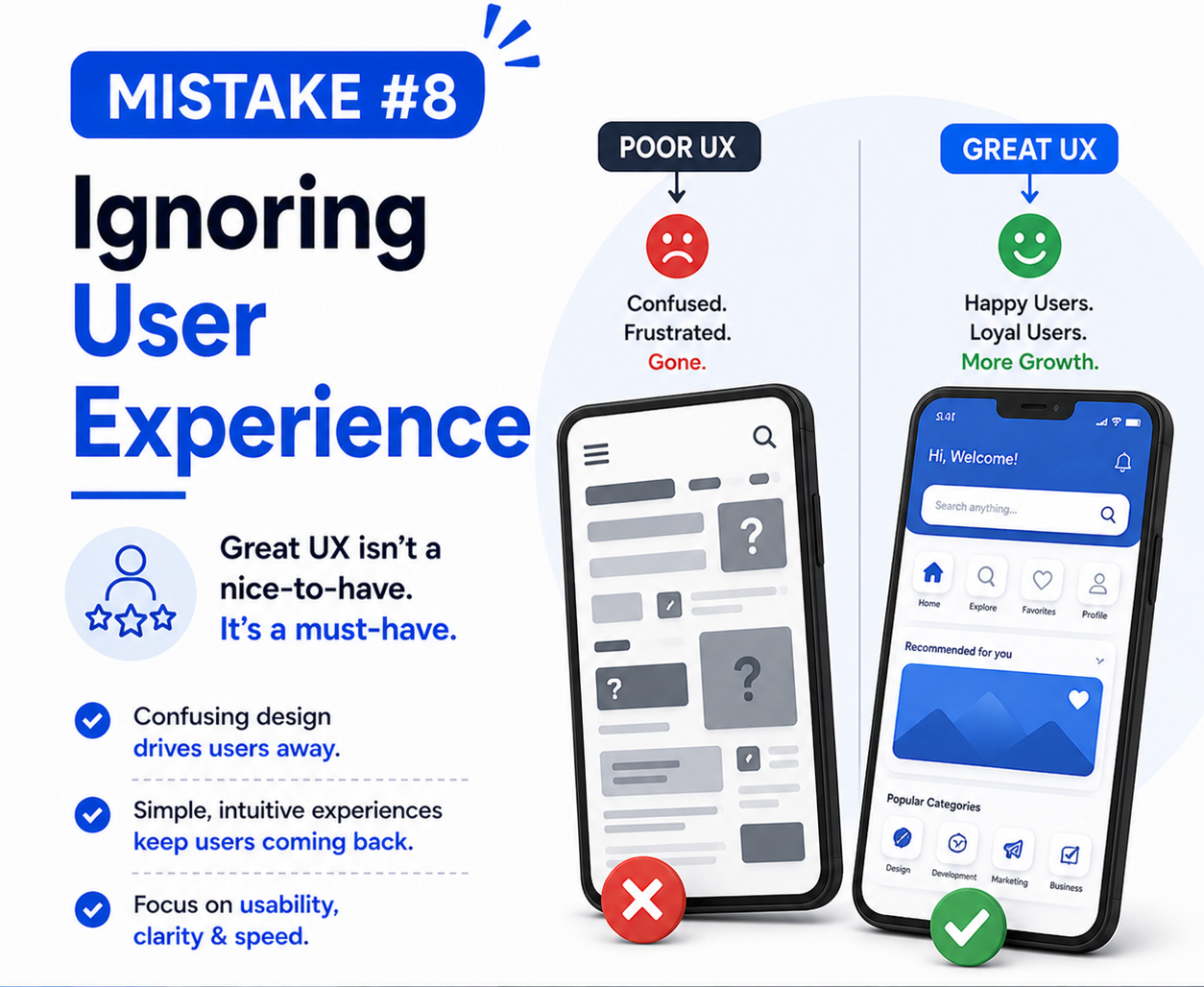
Mistake #8: Ignoring User Experience (UX) in the Early Stage
Here’s something many founders underestimate: You can have a brilliant idea, powerful features, and solid tech…and still fail if your app feels confusing to use. Because users don’t care how advanced your app is.
They care about one thing:
“Is this easy and enjoyable to use?”
If the answer is no, they leave. Fast.
Ignoring user experience early is like building a beautiful store with a locked door. People arrive… and then walk away.
Why This Happens (And Why It’s a Silent Killer)
Most founders prioritize functionality first.
They think:
- “Let’s make sure everything works”
- “We’ll improve design later”
- “UX can be fixed after launch”
It sounds practical, but here’s the problem:
UX isn’t just about design. It’s about how your entire app feels and flows.
And that starts from day one.
When UX is ignored early, you end up with:
- Confusing navigation
- Too many steps to complete simple actions
- Cluttered screens
- Unclear messaging
- Frustrating onboarding
Now imagine a new user opening your app for the first time.
They don’t read manuals. They don’t explore endlessly. They make quick decisions. If they feel lost within seconds, they drop off.
And the worst part? They usually don’t tell you why. You just see low retention, poor engagement, and uninstall rates going up… without clear feedback. That’s why UX issues are dangerous. They’re often invisible until it’s too late.
How to Build a Strong UX from the Start
You don’t need a perfect design from day one. But you do need a clear, simple, and intuitive user journey. Start by thinking from the user’s perspective, not your own.
Ask yourself:
- What is the first thing a user should do after opening the app?
- How quickly can they reach the core value?
- Are there unnecessary steps in the process?
Your goal should be to reduce friction at every step. The first 30–60 seconds matter the most. That’s where users decide whether your app is worth their time. Focus on onboarding experience.
Instead of overwhelming users with information, guide them with clarity.
- Show value quickly
- Keep instructions simple
- Avoid too many choices at once
Another important factor is consistency.
Buttons, colors, navigation patterns — everything should feel predictable. When users don’t have to think about how to use your app, they enjoy using it. Also, test your app with real users early.
Watch how they interact.
- Where do they hesitate?
- Where do they get confused?
- Where do they drop off?
These insights are more valuable than assumptions.
And remember:
Good UX is invisible. Bad UX is unforgettable.
What Smart Founders Do Differently
Experienced founders treat UX as a core part of the product, not an afterthought. They don’t wait until development is complete. They think about user experience from the very beginning. They focus on simplicity first. Instead of adding complexity, they remove friction.
They ask:
“How can we make this easier for the user?”
Not:
“How can we add more here?”
They also prototype before building.
Simple wireframes or clickable prototypes help them visualize the user journey and identify issues early, before writing code. Another key difference is that they prioritize user feedback over personal preference.
Just because something looks good to you doesn’t mean it works for users.mSmart founders observe behavior, test continuously, and refine based on real usage. And most importantly, they understand that UX directly impacts growth.
Better experience leads to:
- Higher retention
- More engagement
- Stronger word-of-mouth
Mistake #9: Skipping Proper Planning and Documentation
Here’s a scene that plays out more often than founders expect: You explain your app idea to the development team. It feels clear in your head. They nod, take notes, and development begins.
A few weeks later, you see the first version… and something feels off. Features aren’t exactly how you imagined. Flows are slightly different. Some things are missing, others are misunderstood.
And then the loop begins:
- “Can we change this?”
- “This isn’t what I meant.”
- “Let’s revise this again.”
Deadlines stretch. Costs increase. Frustration builds on both sides.
All of this usually comes down to one root cause: lack of clear planning and documentation.
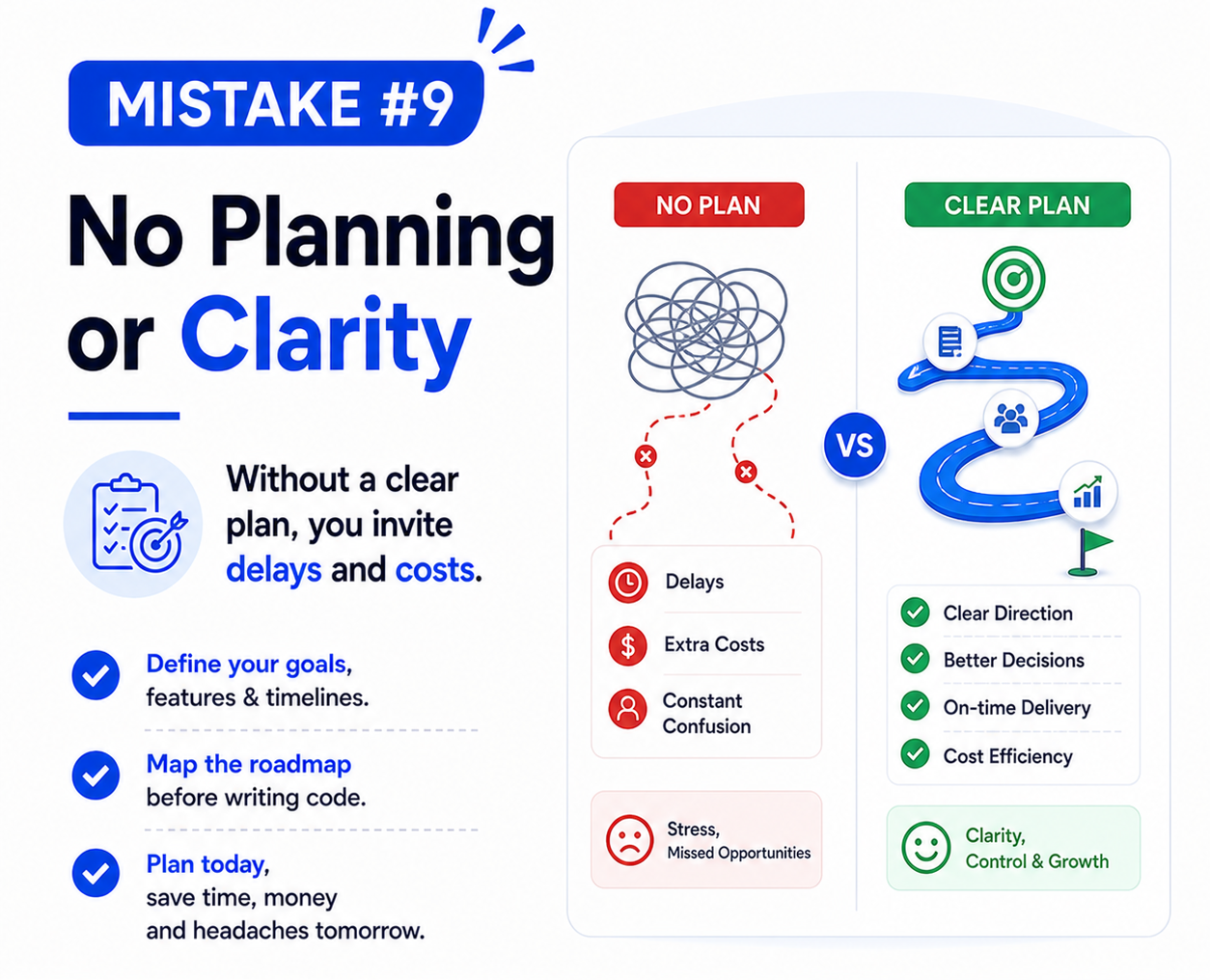
Why This Happens (And Why It Creates Chaos)
Most founders rely on conversations instead of documentation.
They assume:
- “The team understands the idea”
- “We’ll figure things out as we go”
- “Documentation will slow us down”
But here’s the reality:
What’s clear in your mind is not automatically clear to others.
When you skip structured planning, you leave room for interpretation. And in development, interpretation leads to inconsistency.
Different team members may understand the same feature differently.
Designers think one way. Developers implement another way. And you expect something else entirely.
This gap creates:
- Misaligned expectations
- Frequent revisions
- Scope creep
- Increased development time
- Higher costs
Another issue is lack of clarity in priorities. Without proper planning, everything feels equally important. Teams don’t know what to build first, what can wait, and what truly matters. So progress slows down.
And then there’s scalability.
If your app grows, onboarding new developers becomes difficult without documentation. They don’t understand the system, logic, or decisions made earlier.
You end up depending on a few individuals, which creates long-term risk.
How to Plan Your App the Right Way
Planning doesn’t mean writing a 100-page document. It means creating clarity and alignment before development begins. Start with a simple but structured approach.
Define your core idea clearly:
- What problem are you solving?
- Who is it for?
- What is the main outcome for the user?
Then move to feature planning. List your features and break them into:
- Must-have (for MVP)
- Nice-to-have (can come later)
This helps keep development focused and avoids unnecessary complexity.
Next, define user flows.
Think step by step:
- What happens when a user signs up?
- How do they reach the main feature?
- What actions can they take next?
Even simple flow diagrams can prevent major confusion later. You should also document basic requirements for each feature:
- What it does
- How it behaves
- Any conditions or rules
This doesn’t need to be overly technical. It just needs to be clear. Wireframes can also help. Even rough sketches give your team a visual understanding of how the app should look and function.
And finally, establish communication structure.
- How often will updates happen?
- How will feedback be shared?
- Who makes final decisions?
Clarity here prevents delays during development.
What Smart Founders Do Differently
Experienced founders don’t treat planning as a delay. They treat it as an investment. They know that a few extra days spent on clarity can save weeks of rework later. They create just enough documentation to align everyone, without overcomplicating things.
They focus on:
- Clear feature definitions
- Structured user flows
- Prioritized roadmaps
They also ensure that everyone on the team shares the same understanding before development begins. Another key difference is adaptability.
Smart founders don’t create rigid plans. They create flexible frameworks. If something needs to change, they update documentation and keep everyone aligned. This avoids confusion and keeps progress smooth. And importantly, they reduce dependency on assumptions.
Because in app development, assumptions are expensive.
Mistake #10: Treating Launch as the Finish Line Instead of the Starting Point
There’s a moment every founder looks forward to: Launch day. The app is live. It’s on the App Store or Play Store. You’ve spent weeks or months building it. It feels like crossing a finish line. But here’s the twist most founders don’t expect:
Launch isn’t the finish line. It’s the starting point.
And treating it like the end is one of the biggest reasons apps fail to grow.
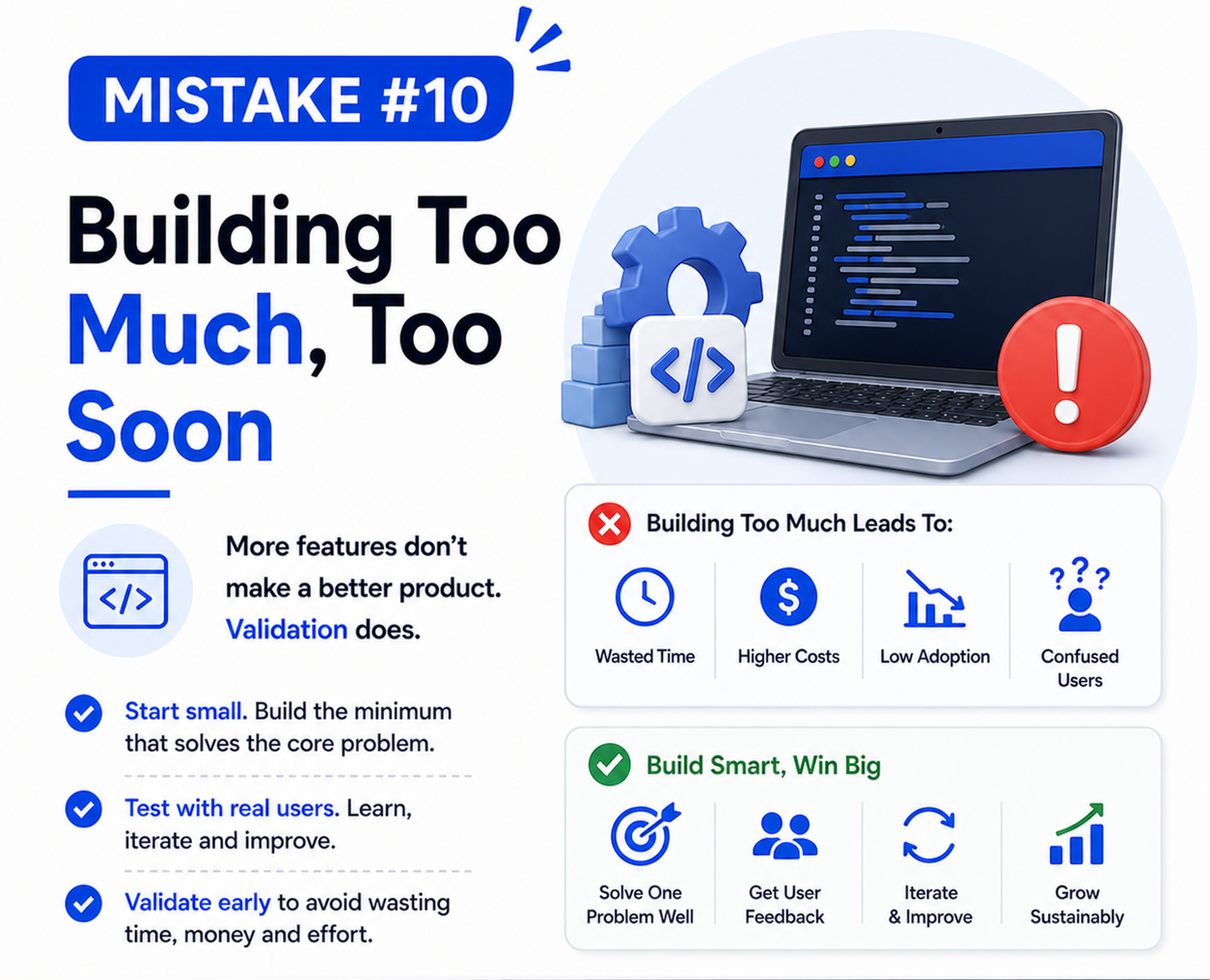
Why This Happens (And Why It Stops Growth Cold)
After a long development cycle, it’s natural to feel like the hard part is over.
You might think:
- “Now users will start coming in”
- “We’ve built a great product, it should grow”
- “Let’s see how it performs”
But in reality, launching your app without a post-launch plan is like opening a store in the middle of nowhere and expecting customers to magically appear.
No matter how good your app is, growth doesn’t happen automatically.
After launch, many founders face:
- Low downloads
- Poor user retention
- Minimal engagement
- Little to no feedback
And without a plan, they don’t know what to fix or improve.
Another common issue is a lack of iteration. Founders expect their first version to perform well. When it doesn’t, they feel stuck. But here’s the truth:
Your first version is just the beginning of learning, not the final product.
How to Plan for Growth After Launch
Instead of asking, “When can we launch?” start asking:
“What happens after we launch?”
You need a clear post-launch strategy that focuses on three key areas: growth, feedback, and iteration.
Start with user acquisition.
How will people discover your app?
You can explore:
- App Store Optimization (ASO)
- Content marketing
- Social media campaigns
- Influencer collaborations
- Paid ads (if budget allows)
Even a simple strategy is better than none.
Next is user engagement.
Once users download your app, what keeps them coming back?
Think about:
- Notifications (used wisely, not excessively)
- Regular updates
- Feature improvements
- Personalized experiences
Then comes feedback.
Early users are your biggest asset.
Encourage them to share:
- What they like
- What confuses them
- What’s missing
This feedback helps you refine your product faster than assumptions ever could.
And finally, iteration.
Your app should evolve continuously.
- Improve what works
- Fix what doesn’t
- Remove what’s unnecessary
Growth comes from consistent improvement, not a perfect first version.
What Smart Founders Do Differently
Experienced founders don’t celebrate launch as the end.
They treat it as the beginning of real work.
They prepare for launch in advance by planning:
- Marketing strategies
- User onboarding improvements
- Feedback collection systems
- Update cycles
They also track key metrics from day one:
- User acquisition
- Retention rates
- Engagement levels
- Conversion rates
These numbers guide their decisions. Another key difference is mindset.
Smart founders don’t expect instant success. They expect learning. They observe how users interact, identify gaps, and improve continuously. They also stay close to their users.
They read reviews, respond to feedback, and build relationships. Because understanding users after launch is just as important as understanding them before development.
Pros and Cons of Launching Without a Strategy
Pros:
- Faster time to market
- Lower initial planning effort
Cons:
- Low user acquisition
- Poor retention and engagement
- Lack of direction after launch
- Missed growth opportunities
- Higher chances of failure
How to Choose the Right Post-Launch Strategy for your Apps
Choosing the right approach depends on your app type, audience, and goals.
Ask yourself:
- Where does my target audience spend time online?
- What channels are most effective for reaching them?
- What type of content or messaging will resonate with them?
If you’re building a consumer app, social media and influencer marketing may work well. If it’s a SaaS product, content marketing, SEO, and email campaigns can be more effective.
Start with one or two channels. Test. Learn. Expand gradually. Avoid trying everything at once.
FAQs
How long should I plan before launching an app?
There is no fixed timeline, but we should never rush the process. In most cases, proper planning can take anywhere from a few weeks to several months depending on the complexity of the app. Before launching, we need to ensure that the idea is validated, meaning real users actually need the solution. We should also define core features clearly instead of trying to build everything at once. Additionally, having a basic marketing and growth strategy in place is important so that the app doesn’t launch without visibility. A well-planned launch saves time, reduces mistakes, and increases the chances of success.
Is it okay to launch with a small number of users?
Yes, and in fact, it is one of the smartest approaches we can take. Starting with a small group of users allows us to test the app in a real environment without overwhelming systems or teams. These early users often provide valuable feedback that helps us identify bugs, usability issues, and missing features. Instead of aiming for perfection, we should focus on learning and improving. Many successful apps started with a limited audience and scaled gradually after refining their product based on real user insights.
How often should I update my app after launch?
We should aim for regular and consistent updates, especially in the early stages. Ideally, updates can be released every 2–4 weeks depending on feedback and development capacity. Early updates should focus on fixing bugs, improving performance, and enhancing user experience. As the app grows, updates can include new features and optimizations. Frequent updates show users that the app is actively maintained, which builds trust and keeps engagement high. However, we should always prioritize quality over speed to avoid introducing new issues.
What is more important: features or user experience after launch?
User experience is far more important. Even if an app has powerful features, users will not stay if the app is confusing, slow, or difficult to navigate. We should focus on making the app simple, intuitive, and smooth to use. A clean design, fast loading time, and easy navigation create a positive impression and encourage users to return. Once the user experience is strong, we can gradually introduce more features. In simple terms, a great experience keeps users, while features only attract them.
Can marketing fix a poorly built app?
No, marketing alone cannot fix a poor product. While marketing can bring users to the app, it cannot force them to stay. If the app has bugs, poor performance, or lacks value, users will leave quickly and may not return. In fact, strong marketing combined with a weak product can harm your reputation faster. We should always focus on building a solid, reliable, and useful app first. Once the product delivers real value, marketing becomes much more effective in driving growth and retention.