
A grocery delivery app in 2026 needs to do more than display products and accept orders. It should help customers find the right products quickly, show accurate stock and prices, provide flexible delivery options, support secure payments, and keep customers informed from checkout to doorstep.
The reason is simple: online grocery shopping has become a regular part of retail rather than a temporary shopping behavior. The USDA found that about one in five people who usually shop for groceries purchased groceries online at least once during the previous month in its nationally representative 2022 data. More recent research from McKinsey found that delivery represented about 63% of online grocery orders in 2025, while 70% of consumers surveyed in March 2026 said delivery was their preferred online grocery fulfillment method.
For founders and businesses planning a new platform, the key question is therefore not simply, “What can the app do?” It is, “Which features solve the most important customer and operational problems?”
The right Grocery Delivery App Features should connect the customer app with inventory, stores, payment systems, delivery operations, and an administration platform. This creates a complete ordering process rather than an app that only works as a digital catalog.
Overview
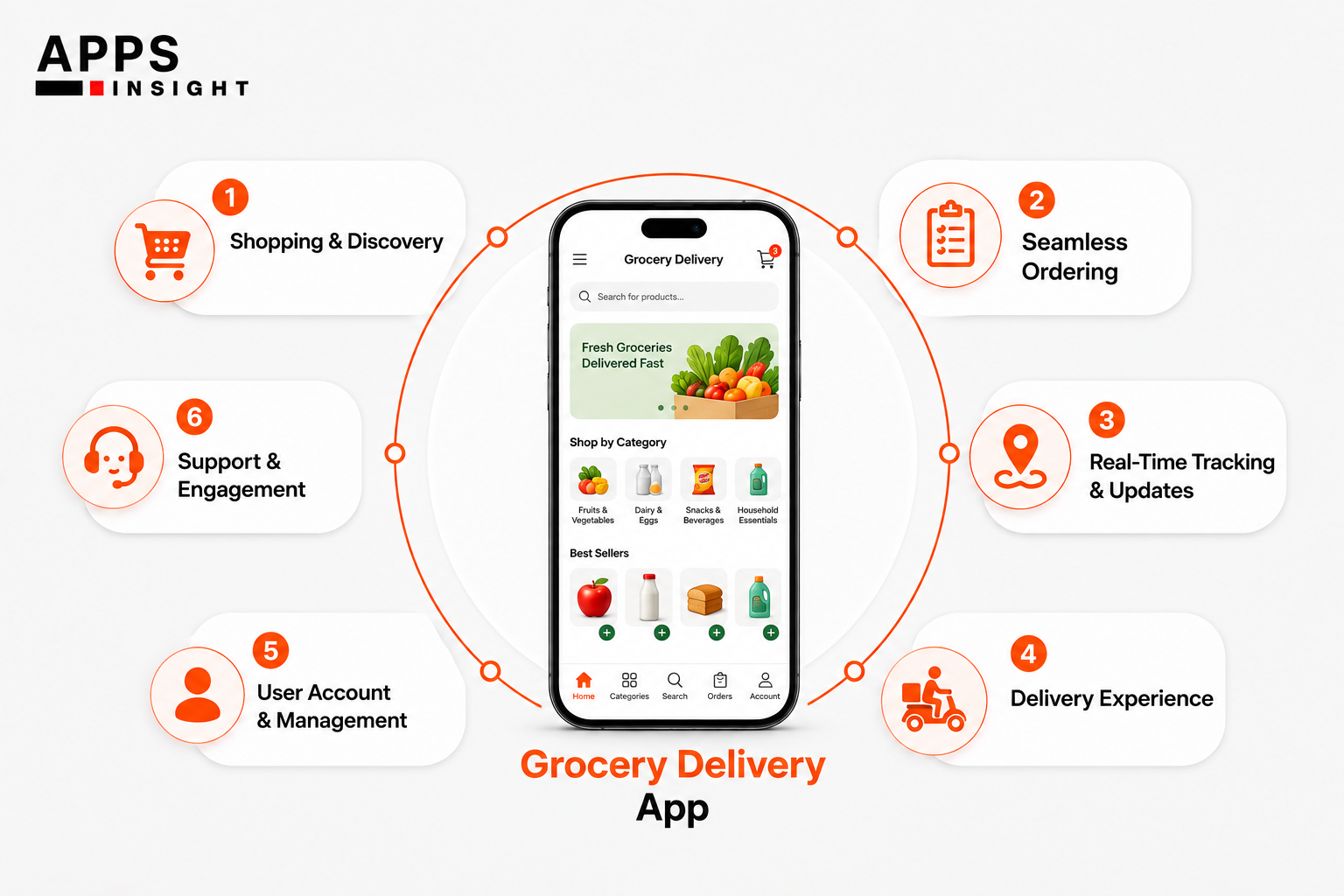
A grocery delivery app in 2026 should combine customer-facing shopping tools with reliable operational technology. Core capabilities include product search and filtering, accurate inventory, shopping lists, secure checkout, flexible delivery slots, real-time tracking, substitution controls, notifications, customer support, accessibility, and food-safety workflows. Behind the app, businesses need inventory synchronization, payment integrations, store and driver management, delivery routing, analytics, and an administration dashboard.
Current industry data shows why these capabilities matter. USDA research found that about one in five U.S. grocery shoppers purchased groceries online at least once in the previous month in its 2022 dataset. McKinsey’s 2026 research found that delivery represented about 63% of online grocery orders in 2025 and that 70% of surveyed consumers preferred delivery. FMI reported that 8.9% of grocery item sales were online in 2025.
The best development strategy is to prioritize a dependable shopping, payment, fulfillment, and delivery workflow first. AI personalization and advanced automation can then be added as the business collects reliable operational and customer data.
1. Easy product discovery and ordering
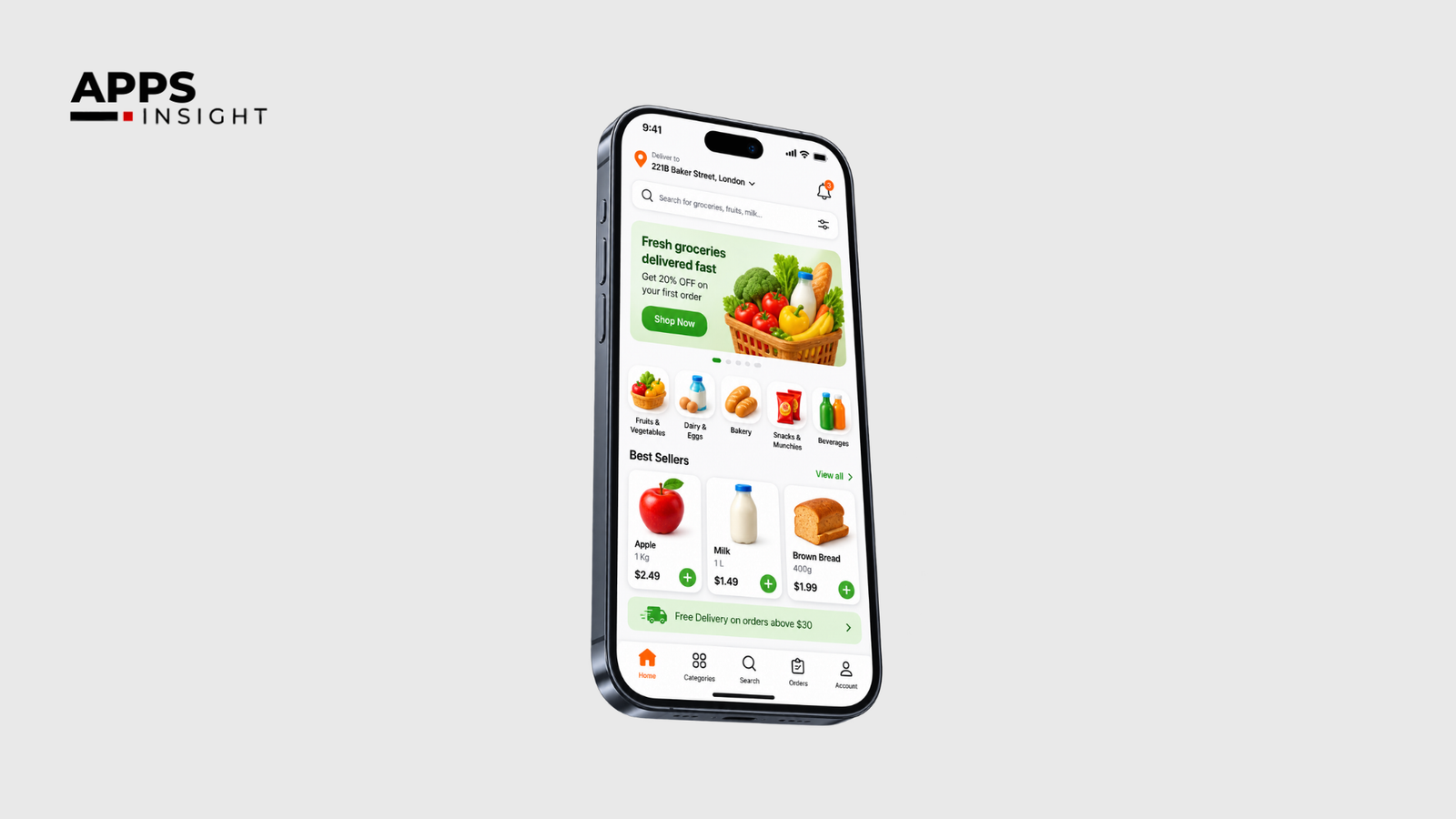
The first priority is making grocery shopping easy. Customers often know what they need but do not necessarily know the exact product name, brand, size, or category.
A good app should provide:
- Product categories and subcategories
- Fast keyword search
- Filters for price, brand, dietary requirements, size, and availability
- Product images and descriptions
- Price per unit where relevant
- Nutrition and ingredient information
- Customer ratings and reviews
- Favorite and recently purchased products
- Shopping lists
- One-tap reordering
- Clear product availability
Search should also understand common variations. For example, a customer searching for “whole milk” should see relevant milk products rather than being forced to browse several categories.
The product page should answer basic questions before checkout: What is the product? How much does it cost? What size is it? Is it currently available? What are the ingredients? When can it be delivered?
This matters because online grocery transactions often contain many individual items. FMI reports that in 2025, 8.9% of all grocery item sales were online, while the average online supermarket transaction was $106, compared with $49.06 for in-store transactions.
A larger basket makes accurate product information especially important. If a shopper has 30 or 40 items in the cart, replacing missing information with assumptions can create frustration at checkout.
Smart substitutions
Grocery inventory changes frequently. A product may be unavailable after the customer places an order. The app should therefore let customers choose a substitution preference:
- Replace with the same brand
- Replace with a similar product
- Replace only if the replacement costs less
- Contact me before replacing
- Do not replace
The picker or store employee can then follow that instruction instead of making an inconsistent decision.
2. Flexible checkout and delivery options
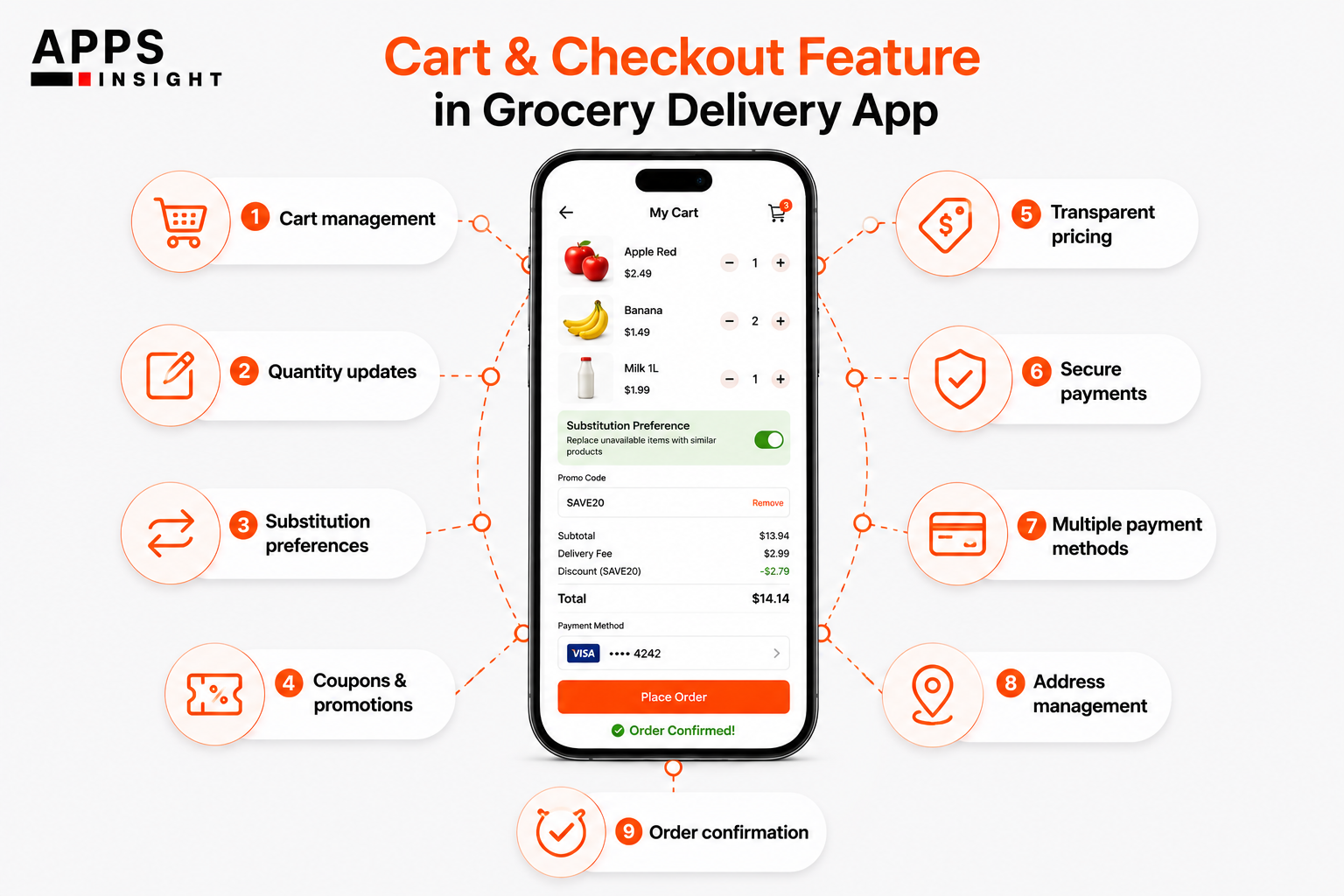
Checkout should be short, transparent, and predictable. Customers should be able to:
- Review products.
- Confirm quantities.
- Select an address.
- Choose a delivery slot.
- Select a payment method.
- Review fees and taxes.
- Place the order.
The final screen should clearly separate product prices, delivery charges, service fees, discounts, taxes, and the final amount. Delivery scheduling is another important part of the experience. A customer may need groceries immediately, later that evening, or on a specific day. The app can support scheduled delivery, same-day delivery, express delivery where operationally possible, and pickup if the business supports it.
The technology behind this feature needs to connect delivery-slot availability with real operational capacity. If 20 delivery slots are shown but only 10 drivers are available, the customer experience will quickly break down.
McKinsey’s 2026 grocery research found that 70% of consumers preferred delivery, with 67% citing time savings, 52% citing scheduling flexibility, and 45% citing convenience for larger orders as reasons.
This suggests that flexibility should be treated as a core product function, not simply a delivery add-on.
3. Real-time order and delivery tracking
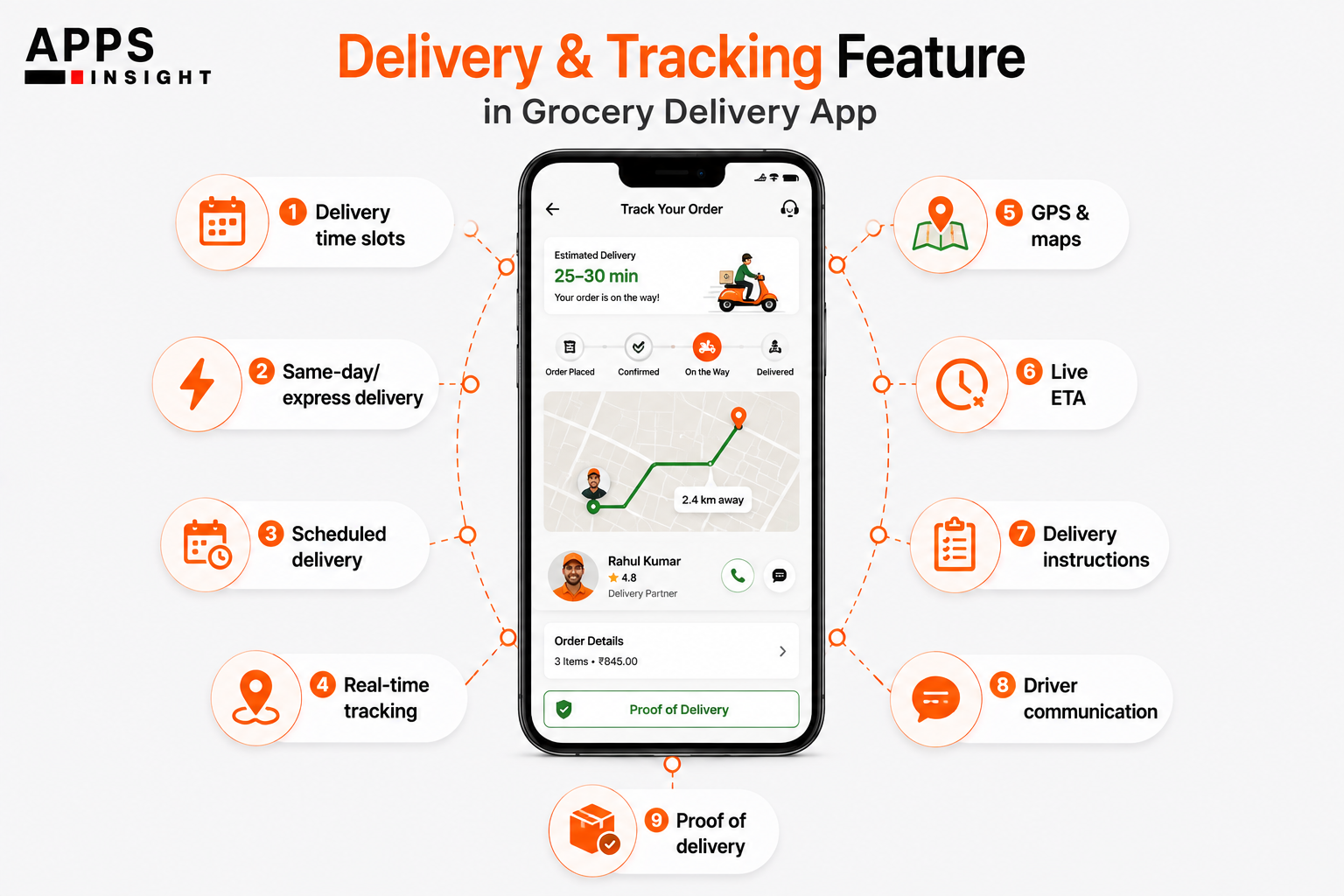
Once an order is placed, customers need visibility. A modern app should show clear order stages such as:
Order confirmed → Being prepared → Ready for pickup → Out for delivery → Delivered
Real-time tracking can then show the driver’s approximate location and estimated arrival time.
For this to work, the system generally needs:
- GPS location data
- Driver-side mobile functionality
- Order status APIs
- Mapping services
- ETA calculations
- Push notifications
- Backend event processing
The customer does not need to see the technical architecture. They need accurate information. For example, if a driver is delayed by traffic, the estimated delivery time should update rather than continuing to show the original ETA.
The driver application should also support navigation, delivery instructions, proof of delivery, customer contact, order verification, and status updates.
For businesses, this creates a second benefit: operational visibility. Managers can see delayed orders, driver workloads, delivery zones, and completed deliveries from an administration dashboard.
4. Accurate inventory and store integration
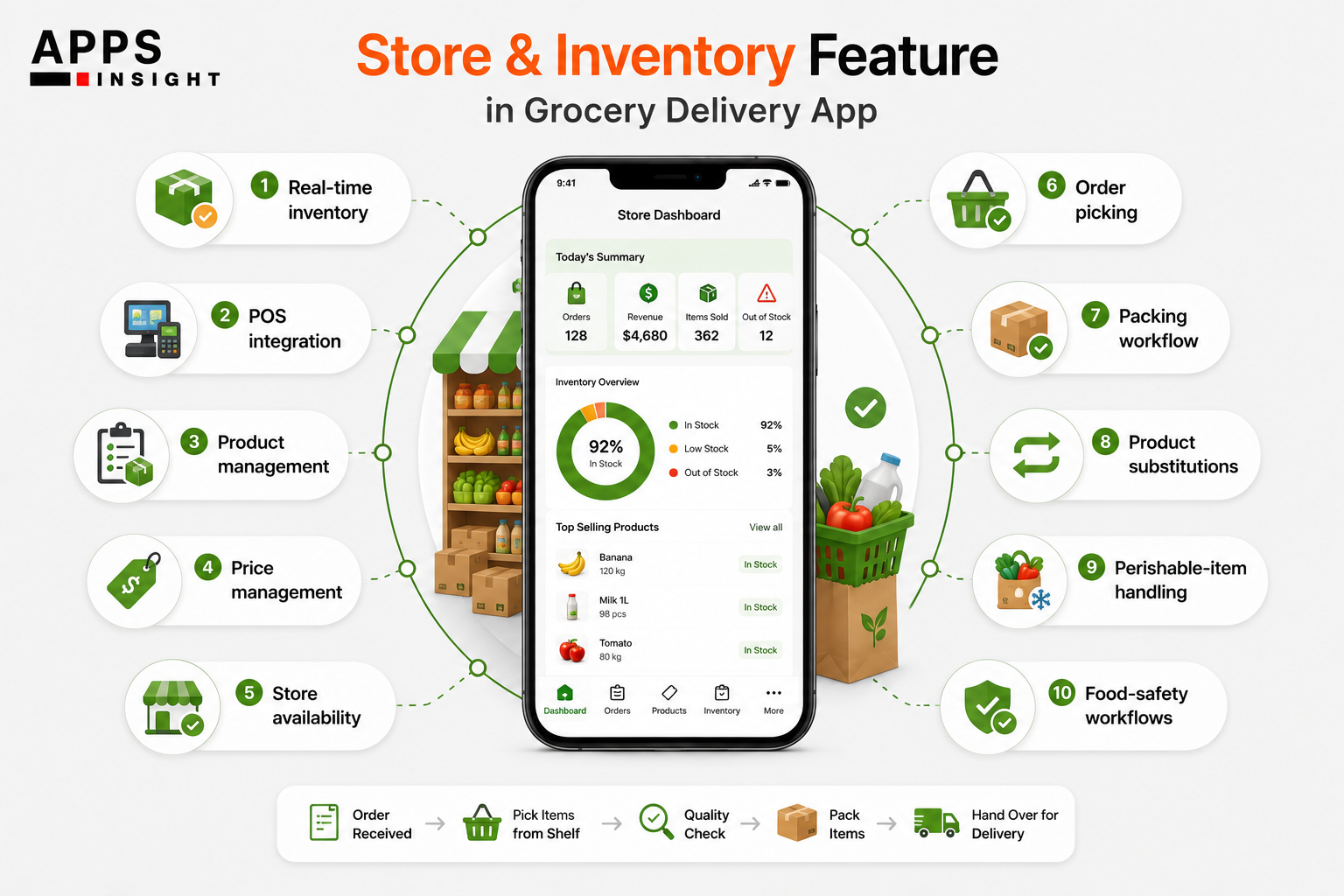
Inventory accuracy is one of the most important technical requirements for grocery delivery. A customer may order a product at 10:00 AM, but that product could sell out in the store before the order is picked. The application therefore needs a connection between the customer-facing catalog and the actual inventory system.
Depending on the business model, the backend may connect with:
- POS systems
- Warehouse management systems
- Inventory databases
- Supplier systems
- Store-level stock records
- Product information management systems
Stock should be updated as frequently as practical. For high-demand products, near-real-time updates can reduce failed orders and unnecessary substitutions.
A useful grocery delivery software architecture should also separate product information from inventory information. The product record may remain constant while price, stock, store availability, and delivery eligibility change. This approach makes the platform easier to operate across multiple stores.
5. Personalization and intelligent search
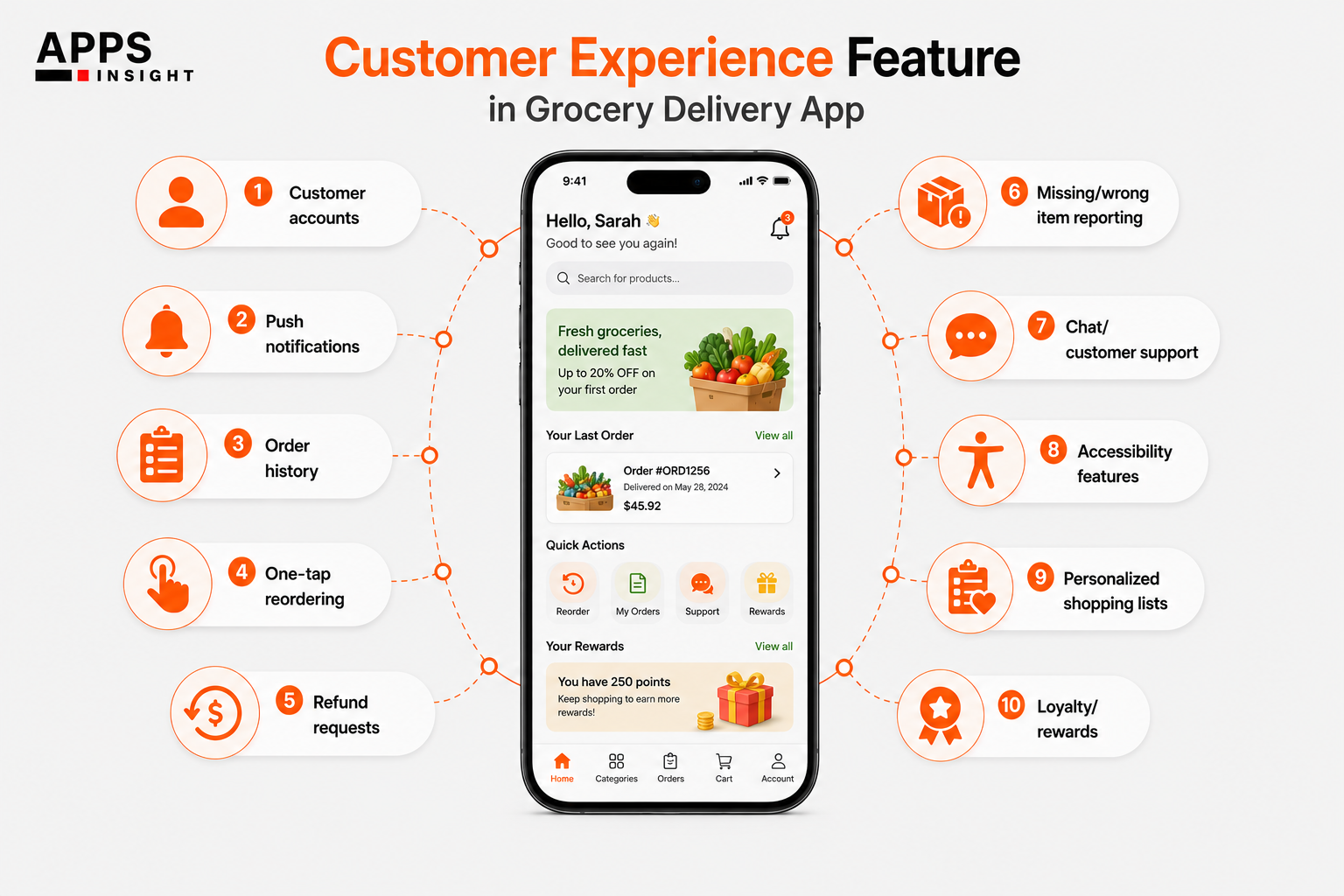
Personalization can help customers complete routine shopping faster.
For example, the app can identify that a customer frequently purchases:
- Eggs
- Milk
- Bread
- Coffee
- Fresh vegetables
It can then provide a “Buy Again” section or allow the customer to create a recurring shopping list.
Recommendation systems can use purchase history, search behavior, category preferences, and product relationships. However, personalization should remain understandable. Customers should know why an item is being recommended and should have control over notifications and personalized content.
AI can also support natural-language search.
Instead of typing “organic low-fat yogurt,” a customer might search:
“Show me low-sugar yogurt under $6.”
The system can interpret the request and return matching products.
A conversational assistant can also answer basic product questions, help create a shopping list, or guide customers to products. It should not make unsupported claims about nutrition, health, allergies, or product ingredients. Product data should remain the primary source for those details.
6. Payments, security, and customer accounts
Payment should support the methods customers already use in the target market. Possible options include:
- Credit and debit cards
- Digital wallets
- Stored payment methods
- Gift cards
- Store credit
- Cash on delivery where appropriate
The application should avoid storing sensitive payment information unnecessarily. Payment processing should be handled through appropriate payment providers and security controls.
PCI DSS requirements are particularly relevant to online commerce. PCI Security Standards Council guidance for PCI DSS v4.0.1 highlights controls around payment-page scripts, authorization, integrity, and detection of unauthorized changes.
Account security should include secure authentication, session management, password recovery, and protection against suspicious activity. For customers, the important point is straightforward: payment should be easy without making security invisible.
7. Accessibility and simple mobile design
Accessibility should be part of the product requirements from the beginning.
A grocery app may be used by people with visual, hearing, mobility, or cognitive disabilities. Buttons should be large enough to tap, text should remain readable, screen-reader labels should be meaningful, and important information should not depend only on color.
W3C’s WCAG 2.2 includes requirements such as minimum target size, accessible authentication, focus visibility, and alternatives to complex gestures. W3C has also published draft guidance specifically explaining how WCAG 2.2 can be applied to native, mobile web, and hybrid mobile applications.
For example, if an app uses a swipe gesture to change product quantities, it should also provide buttons that perform the same action.
Simple design also improves usability for everyone. Customers ordering groceries while commuting, cooking, or managing children benefit from clear navigation and fewer unnecessary steps.
8. Food safety and delivery instructions
Grocery delivery has a physical food-handling component that ordinary ecommerce does not.
The system should allow customers and operators to manage delivery instructions for refrigerated, frozen, and other sensitive products.
Businesses should consider:
- Temperature-sensitive product handling
- Separate handling for frozen products
- Delivery time monitoring
- Packaging requirements
- Driver instructions
- Delivery zone controls
- Failed-delivery procedures
The USDA recommends keeping cold foods at 40°F or below and states that perishable foods should generally not remain at room temperature for more than two hours, or one hour when temperatures exceed 90°F.
The FDA has also published food-safety best practices for online delivery services, with attention to vulnerabilities that can occur during the last mile.
The app itself cannot guarantee food safety, but it can provide the workflows and information needed for better handling.
9. Customer support and order problem resolution
Customers need a simple way to report problems.
Common cases include:
- Missing products
- Wrong products
- Damaged packaging
- Incorrect substitutions
- Late deliveries
- Duplicate charges
- Refund requests
A support feature should connect the complaint to the original order. Customers should not have to explain the complete situation again. The system can provide predefined issue categories, photo uploads, chat support, refund workflows, and order history.
For example, if a customer reports a missing product, the support team should be able to see the item, picker information, delivery details, payment record, and previous communication. This reduces manual investigation and makes resolution more consistent.
10. Admin, store, and driver management
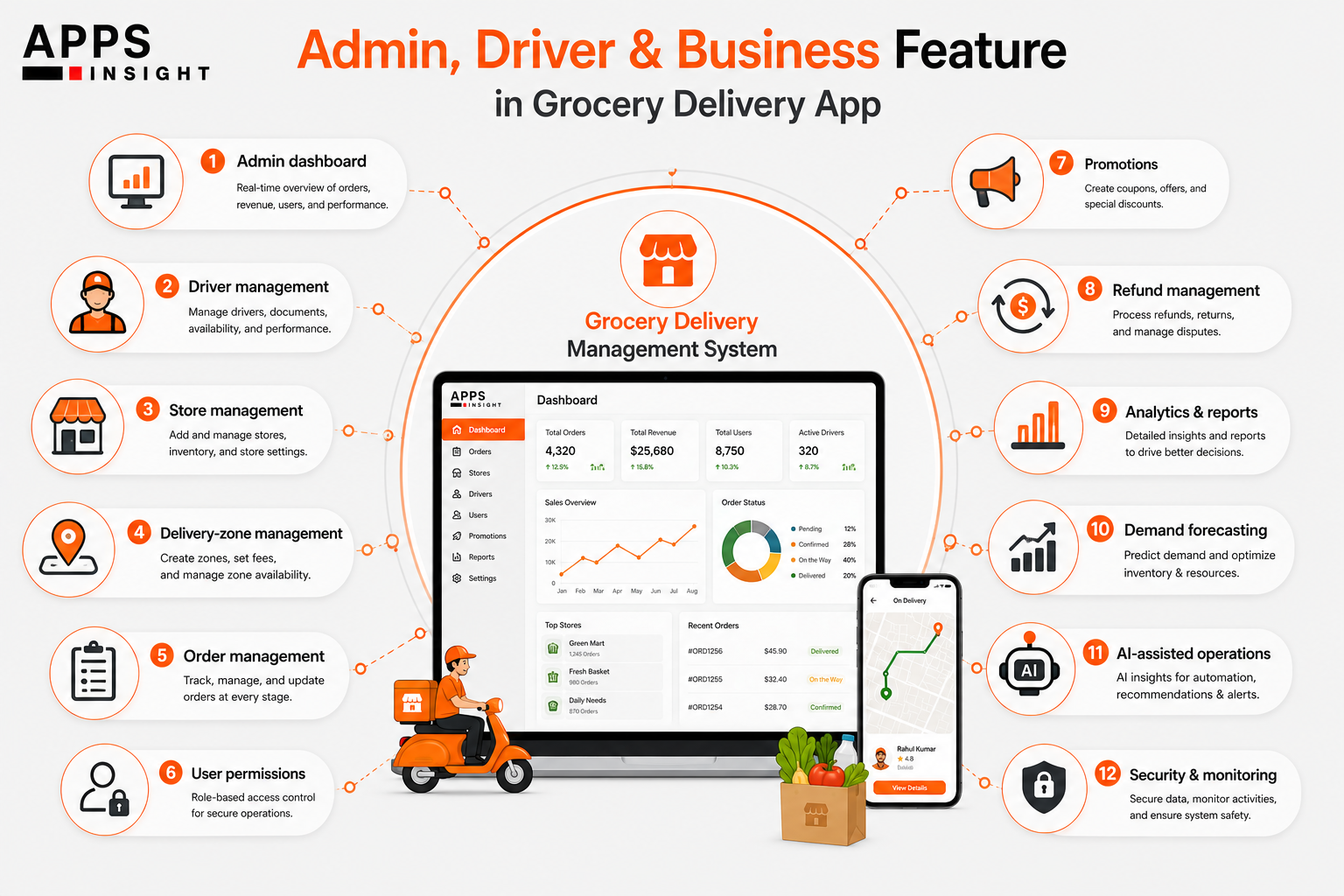
A customer app is only one part of the system. Businesses also need an administration panel where authorized users can manage:
- Products
- Categories
- Prices
- Promotions
- Inventory
- Stores
- Delivery zones
- Orders
- Drivers
- Customers
- Refunds
- Reports
- User permissions
Store staff may need a separate interface for picking and packing orders. Drivers need another interface focused on delivery tasks rather than product browsing. This means a complete platform may include four connected systems:
Customer app + Store/Pickup app + Driver app + Admin dashboard
The backend connects these systems and manages authentication, orders, inventory, payments, notifications, location data, and reporting. For a startup, this architecture can be introduced in stages. A first version does not need every possible automation. It does need a reliable order flow.
11. What should founders prioritize in an MVP?
A practical MVP should focus on features that directly support the transaction. The first release can include:
- Account creation
- Product catalog
- Search and filters
- Cart
- Checkout
- Payment
- Address management
- Delivery scheduling
- Order tracking
- Notifications
- Substitution preferences
- Customer support
- Basic admin management
- Basic driver management
- Inventory synchronization
Advanced AI recommendations, predictive demand forecasting, loyalty programs, subscriptions, voice ordering, and complex automation can be added after the core workflow is stable.
This is important when estimating development budgets. Searches for the Cost of Food Delivery App Development can produce very broad numbers because the final cost depends on platforms, integrations, design, backend architecture, location services, payment systems, dashboards, testing, and ongoing maintenance.
The same principle applies when researching the cost of a pizza delivery app. A simple single-store application and a multi-store marketplace may both be called delivery apps, but their technical requirements are very different.
Businesses should therefore define the operating model before requesting development estimates.
When evaluating Mobile App Development Companies, founders should ask how the team plans to handle inventory synchronization, delivery logic, payment security, third-party integrations, scalability, testing, and post-launch maintenance rather than focusing only on the user interface.
For larger projects, software development companies may also be evaluated based on their ability to build the backend and operational systems alongside the mobile applications.
A business considering custom software firms should similarly compare technical capability, documentation, security practices, integration experience, and support arrangements.
The goal is not to put every available feature into version one. It is to make the basic journey reliable:
Find → Select → Pay → Prepare → Track → Deliver → Resolve
Where grocery apps are heading in 2026
The direction of grocery technology is increasingly connected to omnichannel retail.
FMI reported in April 2026 that online grocery sales were projected to grow at an 11.6% annual rate through 2028, and that nearly 94% of grocery shoppers in 2025 purchased both online and in-store.
That means the future grocery app is not necessarily a replacement for the physical store. It can become another access point to the same retail operation.
A customer might discover a product online, check store availability, order it for delivery, and later visit the store for another purchase.
For founders, this changes the technology priorities. The strongest systems will need accurate shared data across channels rather than separate digital and physical experiences.
AI will also become more useful when connected to reliable business data. It can help with product search, recommendations, demand forecasting, customer support, and operational alerts. But the quality of those features depends on the underlying catalog, inventory, order, and customer data.
That is why the foundation still matters more than adding a long list of advanced features.
Sum up
The most important Grocery Delivery App Features in 2026 are the ones that make the entire grocery journey reliable.
Customers need fast search, accurate product information, transparent checkout, flexible delivery, real-time tracking, secure payments, useful substitutions, accessible design, and responsive support. Businesses need inventory synchronization, store workflows, driver management, analytics, security, and an administration system that connects everything.
The market data supports continued investment in digital grocery. U.S. food spending reached $2.51 trillion in 2025, according to the USDA, while FMI reported that online grocery sales accounted for 8.9% of grocery item sales in 2025.
For a founder planning a new platform, the practical approach is to start with the transaction and operational foundation, then add personalization and automation as real usage data becomes available.
For more related technology research, development company comparisons, and app development information, readers can explore AppsInsight.
FAQs
What features should a grocery delivery app have in 2026?
A grocery delivery app should include product search, filters, accurate inventory, cart and checkout, secure payments, delivery scheduling, real-time order tracking, substitutions, customer support, notifications, and admin, store, and driver management.
What is the most important feature of a grocery delivery app?
Accurate product availability combined with a reliable ordering and delivery process is one of the most important capabilities. Customers need to know that the products they select can actually be fulfilled.
How does real-time tracking work in grocery delivery apps?
Real-time tracking connects the driver application, GPS location, backend order system, mapping service, and customer app. The backend receives driver updates and uses them to show order status and an estimated arrival time.
How can AI be used in grocery delivery apps?
AI can support natural-language product search, recommendations, shopping-list creation, customer support, demand forecasting, and personalized reorder suggestions when it is connected to accurate product and customer data.
What does a grocery delivery app need on the backend?
The backend typically manages users, products, inventory, orders, payments, delivery slots, drivers, locations, notifications, promotions, customer support, analytics, and integrations with stores or external services.
How much does it cost to build a grocery delivery app?
The cost varies according to the number of platforms, features, integrations, design requirements, backend architecture, delivery technology, and administrative tools. A basic single-store app will require less development than a multi-store marketplace with independent drivers, live inventory, routing, payments, and advanced analytics.
Should a grocery delivery app have an AI chatbot?
It can be useful, but it should solve a specific customer problem. An AI assistant can help with product discovery, shopping lists, order questions, and basic support. It should rely on verified product and order data and transfer complex cases to human support.
Is real-time delivery tracking necessary?
For businesses offering home delivery, real-time status and useful delivery estimates are highly valuable. Customers should at minimum receive clear updates when an order is confirmed, prepared, dispatched, and delivered.
What is the difference between a grocery delivery app and a general food delivery app?
A grocery app usually manages larger baskets, many individual SKUs, variable inventory, substitutions, packaged and perishable products, and store-based fulfillment. Restaurant delivery generally focuses on prepared meals with shorter product catalogs and different preparation workflows. A platform modeled as a Food Delivery App Like HungerStation may therefore require significant changes before it can handle grocery operations.
Do grocery apps need both customer and driver applications?
Not always as separate mobile apps, but the underlying system needs different workflows. Customers need shopping and order-management functions, while drivers need navigation, delivery instructions, order status controls, proof of delivery, and communication tools. Store staff may also require a dedicated picking and packing interface.