

Mobile applications are entering a new era where Artificial Intelligence (AI) is no longer a premium feature but a fundamental requirement for success. Businesses that fail to integrate intelligent capabilities into their apps risk losing users to competitors that offer smarter, faster, and more personalized digital experiences.
The numbers highlight this shift. The global market for AI-powered mobile applications was valued at $21.23 billion in 2024 and is expected to surge to $354 billion by 2034. Consumer demand is accelerating just as rapidly.
In 2024 alone, applications featuring AI functionality generated more than 17 billion downloads, accounting for approximately 13% of all app downloads worldwide. Among all categories, AI chatbot applications emerged as the fastest-growing segment, recording an impressive 112% year-over-year growth.
This rapid adoption signals a major transformation in user expectations. Today’s consumers interact with intelligent recommendations, predictive search, personalized content, and conversational AI on a daily basis. As a result, users increasingly expect every mobile application to deliver the same level of intelligence and personalization. Applications that fail to meet these expectations often struggle with lower engagement rates, weaker retention, and higher customer churn.
However, creating a successful AI-powered mobile app involves far more than simply integrating a chatbot or recommendation engine. Organizations must develop a well-defined AI strategy that aligns advanced capabilities with specific business objectives. From selecting the right AI models to designing scalable architectures and ensuring seamless user experiences, building production-ready AI solutions requires careful planning and execution.
Businesses across industries such as logistics, healthcare, fintech, real estate, retail, and eCommerce are leveraging AI-driven mobile solutions to automate processes, improve decision-making, enhance customer experiences, and unlock new revenue opportunities. The most successful organizations focus on implementing AI where it delivers measurable value, ensuring that every intelligent feature contributes directly to business growth, operational efficiency, or customer satisfaction.
As we move into 2026 and beyond, AI is becoming the backbone of modern mobile applications. Companies that embrace mobile AI development, machine learning integration, and intelligent automation today will be better positioned to compete, innovate, and lead in an increasingly AI-driven digital landscape.
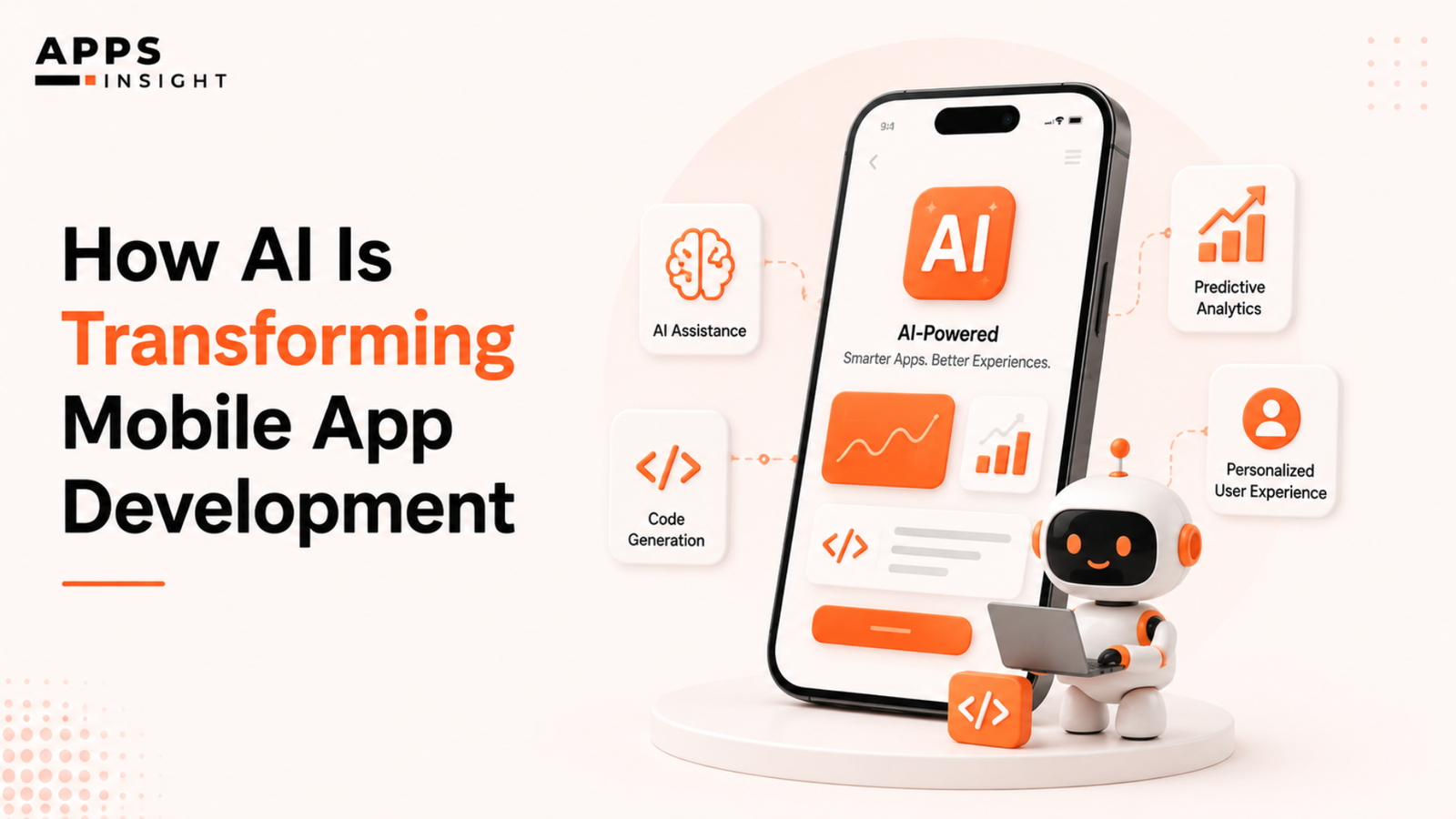
Related Queries
How Much Does It Cost to Add AI Features to a Mobile App?
The cost of adding AI features to a mobile app typically ranges from $5,000 to $100,000+, depending on the complexity of the feature. Basic AI chatbots and recommendation systems may cost $5,000 to $20,000, while advanced features such as computer vision, predictive analytics, voice assistants, or custom AI models can exceed $50,000. Businesses should also consider ongoing expenses for AI APIs, cloud infrastructure, and model maintenance.
How Long Does AI Mobile App Development Take?
AI mobile app development usually takes 3 to 9 months, depending on project complexity. A simple AI-powered chatbot app can be developed in 8 to 12 weeks, while enterprise-grade applications with custom AI models, multiple integrations, and advanced automation may require 6 to 12 months. Proper planning, data preparation, and testing play a major role in determining the final timeline.
What Data Do I Need for AI Mobile App Features?
The data required depends on the AI feature being implemented. For example, recommendation engines need user behavior data, chatbots require conversation datasets, and image recognition systems need labeled images. In general, AI performs best with high-quality, accurate, and relevant data. Businesses can use historical customer data, transaction records, product information, user interactions, or third-party datasets to train and improve AI models. The better the data quality, the more accurate and valuable the AI results will be.
Why AI Has Become a Critical Driver of Mobile App Success
In today’s highly competitive digital landscape, integrating Artificial Intelligence (AI) into mobile applications is no longer a futuristic advantage. It has become a fundamental requirement for businesses that want to attract users, improve engagement, and achieve long-term growth.
Modern users expect personalized experiences, instant support, intelligent recommendations, and seamless interactions. Businesses that fail to meet these expectations risk losing customers to more innovative competitors. As a result, AI-powered mobile apps have emerged as a key strategy for delivering superior user experiences while maximizing business performance.
Organizations that leverage AI in mobile app development consistently report three major business benefits:
1. Increased Revenue Through Enhanced User Engagement
AI enables mobile apps to understand user behavior, preferences, and usage patterns. By delivering personalized content, recommendations, and experiences, businesses can significantly increase engagement, boost conversions, and unlock new revenue opportunities.
2. Lower Operational Costs Through Intelligent Automation
From automated customer support and smart workflows to predictive processes and data-driven decision-making, AI reduces manual effort and improves efficiency. This allows businesses to optimize resources, streamline operations, and lower overall operational costs.
3. Higher Customer Retention Through Personalization
Personalization has become one of the most important factors in user retention. AI helps mobile applications deliver tailored experiences, relevant notifications, and customized recommendations that keep users engaged and encourage long-term loyalty.
As mobile technology continues to evolve, AI-driven mobile applications are no longer just a competitive differentiator. They have become an essential component of digital success, helping businesses drive revenue growth, improve efficiency, and build stronger relationships with their users.
How AI Accelerates Revenue Growth in Mobile App Development
Artificial Intelligence is redefining the way businesses monetize mobile applications. By leveraging intelligent algorithms, real-time data analysis, and automation, AI in Mobile App Development helps companies improve user engagement, increase conversions, and unlock new revenue opportunities.
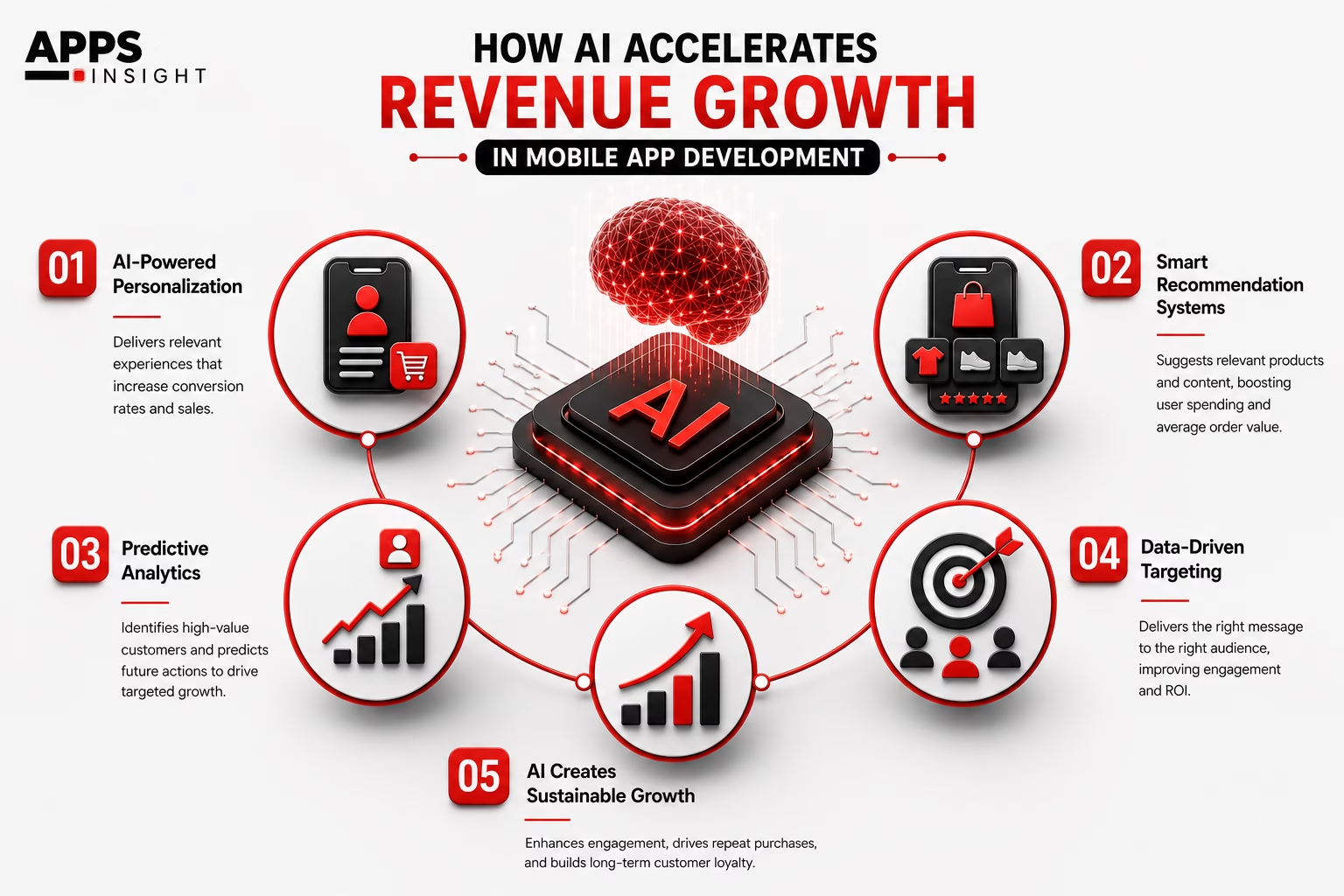
1) AI-Powered Personalization Increases Conversion Rates
One of the biggest advantages of AI is its ability to deliver highly personalized experiences. AI analyzes user behavior, browsing patterns, preferences, and purchase history to provide relevant content and recommendations. When users see exactly what they need at the right time, they are more likely to take action, resulting in higher conversion rates and increased sales.
2) Smart Recommendation Systems Boost User Spending
AI-powered recommendation engines play a crucial role in driving app revenue. These systems suggest products, services, or content based on individual user interests and past interactions. Personalized recommendations encourage users to explore more options, spend additional time within the app, and make larger purchases, ultimately increasing average order value and customer lifetime value.
3) Predictive Analytics Identifies High-Value Customers
With the help of predictive analytics, businesses can identify users who are most likely to make purchases or engage with premium offerings. AI examines historical data and behavioral patterns to predict future actions, enabling companies to create targeted marketing campaigns and personalized promotions. This strategic approach improves customer acquisition, retention, and overall revenue generation.
4) Data-Driven Targeting Enhances Marketing ROI
AI helps businesses optimize their marketing efforts by delivering the right message to the right audience at the right time. Through advanced audience segmentation and behavioral analysis, companies can reduce wasted advertising spend while improving campaign performance. This leads to better engagement rates and a stronger return on investment.
5) AI Creates Sustainable Revenue Growth
By combining personalization engines, recommendation systems, and predictive analytics, AI-powered mobile applications create a seamless user experience that encourages engagement and repeat purchases. As a result, businesses can drive long-term growth, strengthen customer loyalty, and maximize profitability in an increasingly competitive digital marketplace.
Cost Savings Through Intelligent Automation in AI Apps
One of the biggest advantages of implementing AI automation solutions is the significant reduction in operational expenses. By automating repetitive and time-consuming processes, businesses can streamline workflows, minimize manual effort, and improve overall efficiency.
Modern AI-powered customer support systems can independently resolve up to 70–80% of common customer queries, reducing the workload on support teams while ensuring faster response times. At the same time, intelligent document processing solutions can instantly capture, extract, and organize information from images, invoices, forms, and PDF documents, eliminating hours of manual data entry.
In addition, AI-driven fraud detection systems continuously monitor transactions and identify suspicious activities in real time. This proactive approach helps organizations prevent financial losses, strengthen security, and maintain customer trust.
By leveraging artificial intelligence solutions, businesses can lower operating costs, improve productivity, and allocate human resources to higher-value strategic tasks.
Top High-Impact AI Features Transforming Mobile Apps in 2026
Artificial intelligence has moved far beyond basic chatbots and recommendation engines. In 2026, successful mobile applications are leveraging advanced AI capabilities that actively solve user challenges, automate complex processes, and deliver highly personalized experiences.
The most effective AI-powered mobile apps are no longer focused on novelty. Instead, they use intelligent technologies to improve productivity, reduce friction, and create measurable business outcomes.
Here are the AI capabilities generating the greatest value for mobile applications today.
1) AI Copilots: The Future of Intelligent User Assistance
Traditional chatbots are rapidly being replaced by AI copilots, a more advanced form of in-app intelligence designed to guide users through complete workflows.
Unlike chatbots that simply answer questions, AI copilots proactively assist users by recommending next steps, automating repetitive actions, and adapting to individual behavior patterns. Over time, they learn user preferences and make interactions faster and more efficient.
Business Impact:
- Reduces task completion time by 40% to 60%
- Minimizes manual entry errors
- Increases user productivity
- Boosts engagement and retention rates
- Creates a more intuitive app experience
For businesses, AI copilots transform mobile apps into intelligent assistants that help users achieve outcomes rather than merely providing information.
2) RAG-Powered Knowledge Assistants for Accurate Information Delivery
One of the most powerful advancements in AI is Retrieval-Augmented Generation (RAG). This technology combines large language models with organization-specific knowledge sources, allowing mobile apps to deliver accurate, context-aware responses.
Instead of generating generic answers, RAG-powered assistants pull information directly from company documentation, policies, FAQs, training materials, and historical records.
This creates a highly reliable support experience while ensuring information remains relevant and up to date.
Business Impact:
- Cuts customer support costs by up to 70%
- Improves first-contact resolution rates from 40% to 85%
- Delivers faster and more accurate responses
- Reduces dependency on human support teams
- Enhances customer satisfaction
Organizations looking to scale support operations are increasingly adopting RAG-powered AI solutions as a cost-effective and efficient alternative to traditional support models.
3) Predictive Analytics and Hyper-Personalization
Modern mobile applications are becoming increasingly proactive through predictive analytics and AI-driven personalization.
By analyzing user behavior, interaction history, contextual signals, and usage patterns, AI can anticipate user needs before they are explicitly expressed. Rather than requiring users to search for information or features, the app intelligently presents the most relevant content, recommendations, or actions at the right moment.
This predictive approach creates a seamless and highly personalized user journey.
Business Impact:
- Increases user engagement by 25% to 40%
- Improves revenue per user by up to 35%
- Enhances customer loyalty
- Encourages longer session durations
- Delivers more relevant experiences
Users naturally gravitate toward applications that understand their preferences and simplify decision-making.
4) Computer Vision for OCR, Scanning, and Automated Data Capture
Manual data entry remains one of the biggest productivity bottlenecks in mobile applications. Computer Vision AI eliminates this challenge through intelligent document scanning, image recognition, and automated information extraction.
With advanced OCR and visual recognition capabilities, mobile apps can instantly capture information from documents, invoices, receipts, IDs, forms, labels, and physical objects.
This dramatically reduces effort while improving data accuracy.
Business Impact:
- Reduces manual data entry time by up to 90%
- Lowers input errors by approximately 95%
- Accelerates workflows
- Improves operational efficiency
- Enhances user satisfaction
Industries such as healthcare, logistics, finance, insurance, retail, and field services are increasingly relying on Computer Vision AI to streamline mobile processes and eliminate repetitive tasks.
5) Voice AI and Multimodal Experiences
Voice AI and Multimodal Intelligence are powering the next generation of mobile applications.
These systems combine speech recognition, visual understanding, contextual awareness, and natural language processing to create seamless interactions. Users can speak commands while the app simultaneously interprets visual inputs and environmental context.
This creates a more natural experience, particularly in situations where typing is inconvenient or impossible.
Whether users are driving, working in the field, shopping, or performing hands-on tasks, multimodal AI enables efficient interaction without disrupting workflows.
Business Impact:
- Improves mobile task completion rates by 60% to 80%
- Enhances accessibility
- Supports hands-free workflows
- Creates more natural user experiences
- Increases overall app usability
As mobile devices become more intelligent, voice and multimodal capabilities are expected to become standard across leading applications.
The Architecture That Powers Modern AI-Driven Mobile Apps
Building a successful AI-powered mobile application takes far more than connecting to a language model API. While APIs provide access to advanced artificial intelligence capabilities, creating a scalable, reliable, and cost-effective application requires a carefully designed infrastructure that supports real-world usage.
Today’s users expect instant responses, personalized experiences, and flawless performance. Meeting these expectations demands a robust architecture that can process large volumes of requests, maintain data security, and optimize operational costs without sacrificing accuracy.
The reality is simple: many AI applications deliver impressive demonstrations but struggle when exposed to thousands or millions of users. The difference between a prototype and a production-ready solution lies in the architecture behind it.
Why Architecture Matters More Than the AI Model
When organizations invest in AI mobile app development, they often focus on selecting the right AI model. However, the long-term success of the application depends on three critical factors:
- Scalability
- Accuracy
- Cost Efficiency
Every architectural decision affects these outcomes. An application serving a few hundred users can operate with a relatively simple setup. However, when demand grows to hundreds of thousands or even millions of users, infrastructure limitations become immediately visible.
Without a strong foundation, organizations face:
- Slow response times
- Rising AI processing costs
- Inaccurate outputs
- Security vulnerabilities
- Poor user experiences
To avoid these challenges, modern AI applications rely on several interconnected architectural components.

Core Components of a Modern AI Mobile App Architecture
| Component | Purpose | Business Impact |
|---|---|---|
| LLM + RAG + Vector Database | Combines AI models with proprietary business knowledge. | Delivers accurate and context-aware responses based on company data. |
| Backend Logic & Secure Data Pipelines | Controls data movement, business rules, and security measures. | Protects sensitive information while enabling real-time intelligence. |
| On-Device AI Processing | Executes selected AI functions directly on smartphones. | Improves privacy, reduces latency, and enables offline functionality. |
| Caching & Performance Optimization | Stores commonly used AI outputs and query results. | Significantly lowers AI costs while accelerating response times. |
| Monitoring & Observability Systems | Tracks model performance, costs, and user interactions. | Helps identify issues early and continuously improve system quality. |
Each layer plays a crucial role in creating an AI-powered mobile application that remains reliable as user demand grows.
1) LLM + RAG + Vector Database: The Foundation of Intelligent Responses
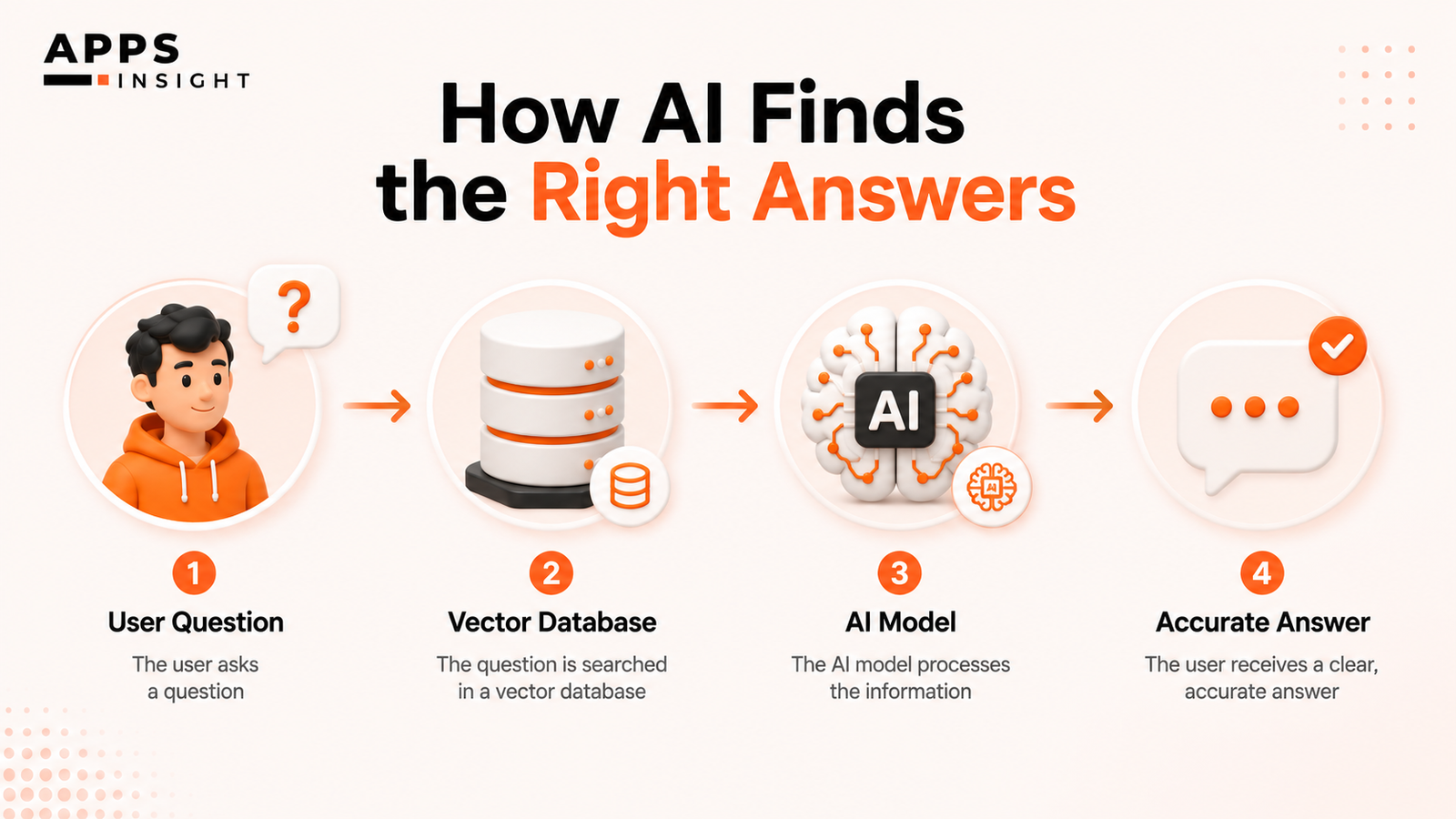
One of the biggest challenges with generative AI systems is hallucination, where models generate information that sounds accurate but is actually incorrect. To overcome this limitation, modern applications use Retrieval-Augmented Generation (RAG).
Instead of relying solely on a language model’s training data, RAG enables the application to retrieve relevant information from proprietary business sources before generating a response.
How RAG Works
The process typically involves:
- User submits a query.
- The query is converted into vector embeddings.
- A vector database searches for relevant content.
- Retrieved information is sent to the language model.
- The AI generates a response grounded in real business data.
This approach dramatically improves response quality and ensures information remains current.
Role of Vector Databases
Specialized vector databases such as Pinecone, Weaviate, and Qdrant store semantic representations of documents, policies, manuals, and knowledge bases.
Document processing pipelines continuously:
- Split content into manageable chunks
- Generate embeddings
- Index new information
- Update existing records
As a result, newly added knowledge becomes immediately accessible to AI systems without retraining the model.
Real-World Example
Consider a logistics mobile application. When a user asks about shipping routes, customs regulations, or carrier restrictions, the system first searches:
- Shipping compliance documents
- Carrier service databases
- Historical delivery performance
- Updated transportation rates
The AI then generates an answer based on this retrieved information, ensuring accuracy and relevance. This architecture allows policy updates, rate changes, and operational modifications to appear instantly in future AI responses.
Looking for? Logistics App Development
2) Backend Logic and Secure Data Pipelines
While AI models generate insights, the backend infrastructure orchestrates everything happening behind the scenes. A sophisticated backend acts as the command center for the entire application.
It manages communication between:
- Mobile devices
- AI services
- Internal databases
- External APIs
- Enterprise systems
At the same time, it ensures compliance, security, and performance requirements are met.
Key Security Requirements
Modern AI application development services must incorporate multiple security layers, including:
- End-to-end encryption
- Secure API gateways
- Role-based access controls
- Authentication systems
- Audit logging
- Request throttling
- Compliance monitoring
Data protection is particularly critical in highly regulated industries. Applications handling healthcare or financial information often need to satisfy strict compliance frameworks while integrating AI-powered functionality.
Real-World Example
Imagine a real estate mobile platform using AI to answer property-related questions. Before sharing information with the AI engine, the backend:
- Verifies user permissions
- Removes sensitive personal information
- Determines which AI model should process the request
- Retrieves information from multiple databases
- Logs interactions for compliance auditing
All of these operations occur within seconds while maintaining a seamless user experience. The result is an AI-powered system that remains secure, compliant, and responsive.
Read once! Top Real Estate AI App Ideas To Boost Your Business
3) On-Device AI: Bringing Intelligence Closer to the User
Recent advancements in mobile hardware have transformed smartphones into powerful AI computing devices. Modern devices now include dedicated neural processing units capable of running optimized machine learning models directly on the device. This approach is known as on-device AI.
Instead of sending every request to cloud servers, selected AI tasks are processed locally.
Benefits of On-Device AI
Organizations increasingly adopt on-device processing because it offers several advantages:
- Reduced Latency: Local processing eliminates network delays and produces faster responses.
- Offline Functionality: Users can continue using AI-powered features even when internet connectivity is unavailable.
- Enhanced Privacy: Sensitive information remains on the device rather than being transmitted to external servers.
Understanding the Trade-Offs
Despite its advantages, on-device AI has limitations. Mobile-optimized models are generally:
- Smaller
- Faster
- Less computationally intensive
However, they cannot always match the reasoning capabilities of large cloud-based AI systems. For this reason, many organizations adopt a hybrid approach. Simple tasks are processed locally, while complex requests are sent to cloud infrastructure.
Real-World Applications
- A healthcare mobile application may perform symptom analysis directly on a user’s smartphone to maximize privacy.
- A supply chain management app can scan package labels inside warehouses without requiring internet connectivity.
- A property management application may analyze property images locally before transmitting summarized results to backend systems.
This balance between local and cloud processing creates a faster and more secure user experience.
4) Caching and Optimization: Reducing Costs Without Sacrificing Performance
AI requests can become expensive at scale. An application handling thousands of daily interactions can quickly generate substantial infrastructure costs if every request is processed from scratch. This is where caching becomes essential.
Caching stores frequently requested information so it can be reused without repeatedly calling expensive AI services. Common optimization techniques include:
- Response caching
- Query caching
- Prompt optimization
- Context reuse
- Semantic search caching
These methods significantly reduce the number of AI model invocations required. Organizations implementing effective caching strategies often achieve:
- 60% to 80% lower AI costs
- Faster response times
- Improved scalability
- Reduced server load
As user volume increases, these savings become even more significant. For many businesses, intelligent caching is one of the most important factors in achieving sustainable AI adoption.
5) Monitoring and Observability: Maintaining AI Performance at Scale
Launching an AI-powered application is only the beginning. To maintain performance over time, organizations need continuous visibility into system behavior. This is where monitoring and observability tools become critical.
Effective AI monitoring tracks:
- Response accuracy
- User satisfaction
- Latency
- Infrastructure utilization
- AI processing costs
- Error rates
- Model performance
By collecting these insights, teams can proactively identify issues before users experience them.
6) Continuous Optimization
Monitoring systems also provide valuable feedback loops that help improve AI outputs over time. Organizations can:
- Refine prompts
- Improve retrieval quality
- Optimize infrastructure
- Reduce costs
- Increase user engagement
Without observability, even the most advanced AI applications eventually become difficult to manage. The success of an AI-driven mobile application is not determined solely by the intelligence of the model it uses. Instead, success depends on how effectively the entire ecosystem works together.
In many cases, the gap between a well-architected AI system and a poorly designed one can be as much as 10 times the operating cost. Applications processing thousands of AI interactions every day without optimization often encounter rapidly increasing expenses that make long-term growth difficult to sustain.
Successful AI-powered mobile applications are built on more than advanced language models. They rely on a sophisticated architecture that combines LLM integration, RAG systems, vector databases, secure backend infrastructure, on-device AI, performance optimization, and continuous monitoring.
Organizations that invest in these foundational elements gain more than intelligent features. They create scalable, accurate, and cost-efficient solutions capable of delivering exceptional user experiences while supporting long-term business growth.
In the evolving landscape of AI mobile app development, architecture is not simply a technical consideration. It is the foundation that determines whether an AI application thrives or struggles at scale.
Why Choose AppsInsight AI App Development Experts for Your AI App Project?

Building an AI-powered application requires much more than hiring developers. It demands the right combination of AI strategy, machine learning expertise, mobile app development skills, data engineering knowledge, and industry-specific experience. Finding all these capabilities in one place can be challenging.
This is where AppsInsight AI App Development Experts can help.
As a trusted platform for discovering top technology partners, AppsInsight features carefully listed AI app development companies, machine learning specialists, generative AI experts, and mobile app development professionals who have extensive experience building intelligent applications across multiple industries.
Access to Verified AI Development Expertise
Instead of spending weeks searching for the right development partner, businesses can explore a curated list of experienced app developers who specialize in:
- Generative AI App Development
- ChatGPT Integration
- AI Chatbot Development
- Machine Learning Solutions
- Predictive Analytics Applications
- Computer Vision Development
- Natural Language Processing (NLP)
- Custom AI Software Development
- Enterprise AI Solutions
- AI Mobile App Development
These experts understand how to transform AI concepts into scalable, production-ready applications.
End-to-End AI App Development Support
The AI development experts listed on AppsInsight help businesses throughout the entire development lifecycle, including:
- AI strategy and consultation
- Product discovery and planning
- AI model selection and integration
- Custom mobile app development
- Backend architecture design
- Vector database implementation
- RAG system development
- Security and compliance planning
- Performance optimization
- Deployment and ongoing maintenance
This comprehensive approach ensures your AI application is built for long-term success rather than short-term experimentation.
Industry-Specific AI Development Experience
Different industries require different AI solutions. The experts featured on AppsInsight have experience developing AI applications for:
- Healthcare
- Finance
- Real Estate
- Retail & E-commerce
- Logistics & Supply Chain
- Education
- Travel & Hospitality
- Manufacturing
- Insurance
- Enterprise Software
Their industry knowledge helps businesses avoid common mistakes and accelerate project delivery.
Build Scalable and Cost-Efficient AI Applications
One of the biggest challenges in AI app development is controlling operational costs while maintaining performance. The AI development experts listed on AppsInsight focus on building solutions that leverage:
- LLM Integration
- Retrieval-Augmented Generation (RAG)
- Vector Databases
- Cloud Infrastructure
- On-Device AI
- AI Cost Optimization
- Performance Monitoring Systems
This ensures applications remain scalable, accurate, and cost-effective as user demand grows.
Final Thoughts: Find the Right AI Development Partner Faster
Choosing the wrong development partner can result in delays, budget overruns, and poor product performance. AppsInsight simplifies the selection process by helping businesses connect with experienced AI app development companies that match their project goals, industry requirements, and budget expectations.
Whether you’re building an AI chatbot, virtual assistant, recommendation engine, predictive analytics platform, or a fully AI-powered mobile application, the experts listed on AppsInsight can help bring your vision to life.
Start Building Your Next AI App with Confidence
The future belongs to intelligent applications that deliver personalized, data-driven experiences. By partnering with experienced AI App Development Experts listed on AppsInsight, businesses can accelerate innovation, reduce development risks, and launch AI-powered solutions that drive real business value.
If you’re planning your next AI project, exploring the network of expert AI app developers, machine learning specialists, and AI software development companies on AppsInsight is the smartest place to start.

FAQs
How Much Does AI App Development Cost in 2026?
The cost of AI app development in 2026 typically ranges from $30,000 to $500,000+, depending on complexity. A basic AI chatbot app may cost $30,000 to $60,000, while advanced AI-powered platforms with computer vision, predictive analytics, or custom LLM integrations can exceed $250,000. Key cost factors include AI models, cloud infrastructure, app features, integrations, and ongoing training.
How to Build an AI-Powered Mobile App for Your Business?
Building an AI-powered mobile app starts with identifying a business problem that AI can solve. The process includes defining use cases, selecting AI technologies, designing the app, training or integrating AI models, developing the backend infrastructure, testing performance, and launching the application. Businesses that follow a structured AI development roadmap often reduce development risks by over 40%.
What Are the Best AI Features to Add to a Mobile App?
The most valuable AI features in 2026 include AI chatbots, personalized recommendations, voice assistants, predictive analytics, image recognition, fraud detection, smart search, and automated content generation. Studies show personalized AI recommendations can increase user engagement by up to 80% and improve conversion rates significantly.
How to Hire an AI App Development Company?
When hiring an AI app development company, evaluate its portfolio, AI expertise, industry experience, client reviews, and technical capabilities. Look for experience in Machine Learning, Generative AI, ChatGPT integration, and mobile app development. Companies with proven AI project success rates typically deliver faster deployments and better ROI.
What Is the ROI of AI in Mobile App Development?
AI-powered mobile apps can generate significant returns through automation, personalization, and operational efficiency. Research shows businesses implementing AI solutions can increase productivity by up to 40% while reducing operational costs by 20% to 30%. The actual ROI depends on the industry, user adoption, and AI use case.
How Do Businesses Use Generative AI in Mobile Apps?
Businesses use Generative AI to power virtual assistants, customer support chatbots, personalized content creation, automated recommendations, document generation, and intelligent search experiences. In 2026, more than 70% of enterprises are expected to use Generative AI in at least one customer-facing application.
What Are the Top AI App Development Trends in 2026?
Key AI app development trends include Generative AI integration, on-device AI processing, multimodal AI, AI-powered personalization, voice-driven interfaces, predictive analytics, and AI agents. These technologies are helping businesses create smarter, faster, and more personalized mobile experiences.
How Can AI Help Startups Build Better Mobile Apps?
AI helps startups automate customer support, personalize user experiences, analyze customer behavior, and accelerate product development. Startups using AI-powered automation can reduce operational expenses by up to 30% while improving customer satisfaction and engagement from day one.
How to Integrate ChatGPT into a Mobile App?
Integrating ChatGPT into a mobile app involves connecting the application to an LLM through APIs, designing conversational workflows, implementing backend security, and optimizing prompts for business-specific use cases. Many businesses combine ChatGPT with Retrieval-Augmented Generation (RAG) to provide accurate responses based on their own data.
How to Choose the Best AI App Development Company in 2026?
The best AI app development company should have expertise in AI strategy, LLM integration, Machine Learning, mobile app development, and cloud infrastructure. Businesses should review case studies, technical capabilities, development processes, and post-launch support before making a decision. A strong AI development partner can reduce project risks and accelerate time-to-market by several months.


BestEon
July 31, 2026 at 12:41 amBeautiful message shared
Holistycznehoryzonty
July 31, 2026 at 2:37 amThis content made me stop scrolling and really think about what matters most in life