
The app development ecosystem is evolving at an unprecedented pace, driven by innovations that enhance performance, security, and user engagement. In 2026, mobile app developers must be aware of the latest App Development Technologies to create applications that are scalable, adaptive, and future-ready.
From AI integration and cloud-native architectures to AR/VR experiences, 5G connectivity, and blockchain, these technologies are reshaping how apps are built, deployed, and experienced.
By understanding these advancements, developers can design smarter, faster, and more resilient applications that meet the growing demands of users and stand out in an increasingly competitive digital landscape.
1) Artificial Intelligence and Machine Learning Integration
Artificial intelligence (AI) and machine learning (ML) are becoming integral to modern applications, enabling smarter decision-making, predictive capabilities, and personalized experiences. These technologies are among the most transformative App Development Technologies in 2026, empowering developers to build adaptive and intelligent apps.
Predictive Analytics
AI models analyze historical and real-time data to forecast user behavior, system performance, or market trends. Applications can proactively offer recommendations, optimize workflows, and enhance engagement.
Intelligent Automation
Machine learning automates repetitive tasks, such as data entry, content tagging, or process management. This reduces manual effort, improves efficiency, and minimizes human error.
Personalized Experiences
AI-driven personalization tailors app content, interface, and interactions based on user behavior and preferences. Users enjoy customized recommendations, adaptive UI, and context-aware features.
AI-Driven Testing
AI can automatically generate test cases, detect anomalies, and optimize testing workflows. This ensures higher-quality applications with faster release cycles and reduced manual testing effort.
2) Progressive Web Apps (PWAs)
Progressive Web Apps combine the best of web and mobile applications, providing fast, reliable, and engaging experiences. In 2026, PWAs continue to be a vital App Development Technology as they offer offline capabilities, responsive design, and improved user engagement without requiring full native app development.
Offline Functionality
PWAs can work seamlessly without an internet connection by caching essential resources. This ensures uninterrupted user experiences, making apps reliable even in low-connectivity regions.
Responsive Design
PWAs automatically adjust their layout and interface according to the device screen size. Whether accessed via desktop, tablet, or smartphone, users enjoy a consistent and visually appealing experience.
Push Notifications
PWAs support push notifications, allowing apps to engage users in real time. Notifications can deliver updates, reminders, or promotional content, increasing retention and interaction rates.
Fast Loading Times
PWAs are optimized for performance, loading quickly even on slower networks. Fast load times improve user satisfaction, reduce bounce rates, and enhance overall app usability.
3) Cross-Platform Development Frameworks
Cross-platform frameworks enable Cross-platform developers to write a single codebase that runs on multiple platforms, including iOS, Android, and the web. This approach reduces development time, lowers costs, and ensures consistent functionality, making it a key App Development Technology in 2026.
Flutter and Dart
Flutter, using the Dart language, allows Flutter developers to create visually rich apps with native-like performance. Its hot-reload feature accelerates development, while a single codebase works across multiple platforms.
Read once! Mobile App Development Frameworks
React Native
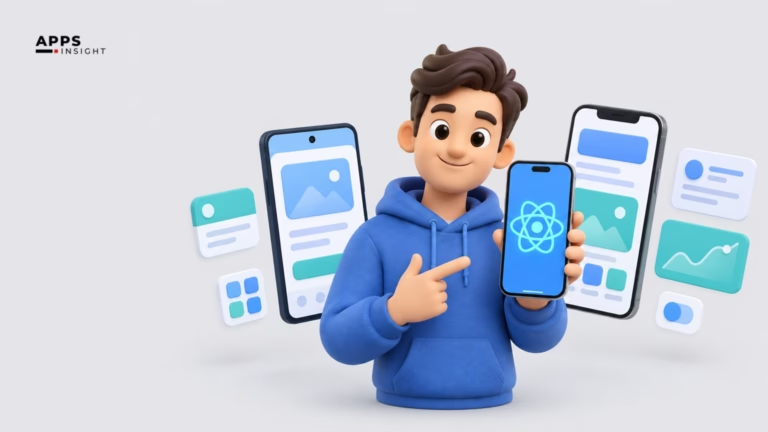
React Native enables building mobile apps using JavaScript and React. It provides near-native performance and allows developers to share code between iOS and Android, reducing development effort.
Xamarin
Xamarin allows developers to build cross-platform apps using C#. Its integration with the .NET ecosystem provides access to native APIs, making it easier to create robust applications efficiently.
Unified Codebase Management
Cross-platform frameworks maintain a single codebase for multiple platforms. This simplifies updates, bug fixes, and feature deployment, ensuring consistent user experiences across devices.
4) 5G Technology and High-Speed Connectivity
5G technology is transforming mobile app experiences by offering faster speeds, lower latency, and higher network reliability. In 2026, 5G is a crucial App Development Technology that enables real-time interactions, immersive media, and seamless IoT integrations.
Enhanced App Performance
With 5G, apps can handle larger amounts of data and support high-quality media without lag. This improves responsiveness, reduces buffering, and ensures smooth performance for demanding applications.
Real-Time Streaming
5G enables seamless live streaming of video, audio, and interactive content. Apps like video conferencing platforms, gaming, and live broadcasting benefit from high-speed, low-latency data transfer.
Low-Latency Gaming
Mobile and cloud gaming apps leverage 5G to provide near-instant response times. This ensures multiplayer experiences are smooth, competitive, and immersive without delays or interruptions.
IoT Integration
5G supports massive IoT device connectivity, allowing apps to interact with multiple sensors, smart devices, and wearables in real time. This enhances applications in smart homes, healthcare, and industrial automation.
5) Augmented Reality (AR) and Virtual Reality (VR)
AR and VR technologies are redefining how users interact with digital content by blending virtual elements with the real world or creating fully immersive environments. In 2026, these technologies are among the most impactful App Development Technologies, offering applications in gaming, retail, education, and training.
Immersive User Experiences
AR and VR enable apps to deliver highly engaging experiences that captivate users. For example, VR can immerse users in virtual simulations, while AR overlays information or interactive elements onto the physical world, creating dynamic and memorable interactions.
AR Shopping Applications
AR allows users to virtually try products before purchasing, such as placing furniture in a room or testing cosmetic products. This enhances customer confidence, reduces return rates, and transforms the retail experience.
VR Training Simulations
VR is increasingly used for training in healthcare, aviation, and industrial settings. Trainees can practice complex procedures in safe, controlled virtual environments, improving learning outcomes and minimizing risk.
Interactive Learning
AR and VR applications make education more interactive by visualizing abstract concepts or historical events. Students can explore 3D models, engage with simulations, and learn in a hands-on manner, enhancing retention and understanding.
6) Cloud-Native App Development
Cloud-native development enables applications to leverage cloud infrastructure for scalability, reliability, and faster deployment. In 2026, this approach is a vital App Development Technology, allowing developers to build modular, resilient apps that can adapt to changing demands and traffic patterns.
Microservices Architecture
Cloud-native apps are often built using microservices, breaking functionality into small, independent services. This allows faster updates, easier maintenance, and better scalability compared to monolithic applications.
Serverless Computing
Serverless architectures eliminate the need to manage server infrastructure, automatically scaling based on demand. Developers can focus on code and functionality while reducing operational costs and complexity.
Auto-Scaling and Load Balancing
Cloud-native apps can dynamically adjust resources to meet traffic demands. Auto-scaling ensures smooth performance during peak usage, while load balancing distributes requests efficiently across servers.
Continuous Deployment
Integration with cloud platforms enables continuous deployment pipelines. Updates, bug fixes, and new features can be rolled out rapidly without downtime, improving user experience and app reliability.
7) Internet of Things (IoT) Integration
IoT integration is transforming applications by connecting devices, sensors, and systems to collect and act on real-time data. In 2026, IoT-enabled apps are a key App Development Technology, enhancing automation, monitoring, and user interaction across industries.
Smart Device Connectivity
IoT apps connect and communicate with smart devices like wearables, home appliances, and industrial sensors. This connectivity allows seamless control, remote monitoring, and automation, improving efficiency and user convenience.
Real-Time Data Collection
IoT devices generate continuous streams of data that apps can analyze instantly. Real-time insights enable applications to respond proactively, optimize operations, and deliver personalized experiences.
Predictive Maintenance
By analyzing sensor data, IoT apps can predict equipment failures before they occur. This reduces downtime, saves costs, and improves operational reliability for industries like manufacturing and transportation.
IoT Security Measures
Security is critical for IoT-connected apps, as they handle sensitive data and control devices remotely. Implementing strong encryption, authentication, and monitoring ensures safe interactions and protects against cyber threats.
8) Blockchain and Decentralized Applications
Blockchain technology is revolutionizing app development by providing secure, transparent, and decentralized solutions. In 2026, blockchain is a crucial App Development Technology for applications involving finance, supply chain, healthcare, and identity management.
Smart Contracts
Smart contracts automate agreements and transactions without intermediaries. These self-executing contracts reduce costs, increase efficiency, and ensure that terms are enforced reliably.
Secure Transactions
Blockchain ensures that all transactions are tamper-proof and recorded in a transparent ledger. This increases trust and security for apps handling payments, digital assets, or sensitive data.
Decentralized Storage
Decentralized storage solutions distribute data across multiple nodes, reducing dependency on a single server. This improves reliability, prevents data loss, and enhances privacy for users.
Transparent Operations
Blockchain provides a transparent record of all activities, enabling audits, compliance, and accountability. Apps built on blockchain can offer verifiable histories of transactions, supply chains, or digital interactions.
9) Low-Code and No-Code Platforms
Low-code and no-code platforms are transforming app development by enabling faster prototyping, simplified deployment, and broader accessibility. These platforms allow developers and non-technical users alike to build functional applications, making them a key App Development Technology in 2026.
Rapid Prototyping
Low-code/no-code tools allow teams to quickly create working app prototypes without writing extensive code. This accelerates idea validation, reduces development costs, and helps stakeholders visualize concepts before full-scale development.
Drag-and-Drop Interfaces
These platforms provide intuitive drag-and-drop functionality for designing UI elements, workflows, and integrations. Users can build complex applications visually, minimizing technical barriers and improving efficiency.
Integration with Existing Systems
Low-code/no-code platforms often include pre-built connectors for databases, APIs, and third-party services. This allows seamless integration with legacy systems and modern tools, reducing development complexity.
Democratization of App Development
By enabling non-developers to contribute to app creation, these platforms broaden participation and collaboration. Organizations can leverage the collective expertise of diverse teams, accelerating innovation and reducing dependency on specialized developers.
10) Cybersecurity Enhancements
As apps become more complex and connected, cybersecurity is a critical focus in 2026. Advanced App Development Technologies now include AI-driven threat detection, robust authentication methods, and automated compliance tools to protect sensitive data and maintain user trust.
AI-Powered Threat Detection
Machine learning algorithms monitor app activity to identify unusual patterns or potential attacks. This proactive detection helps prevent breaches before they impact users or systems.
Multi-Factor Authentication
Enhanced authentication methods, including biometrics, OTPs, and hardware tokens, ensure only authorized users access apps. This reduces the risk of unauthorized access and strengthens data security.
Data Encryption Techniques
Sensitive data is encrypted both in transit and at rest, preventing unauthorized access or tampering. Advanced encryption standards protect user privacy and maintain regulatory compliance.
Security Compliance Automation
Automated tools help apps meet industry and government regulations by monitoring, reporting, and enforcing security policies. This reduces manual effort and ensures consistent adherence to compliance standards.
11) Voice and Conversational Interfaces
Voice and conversational interfaces are transforming user interactions by enabling natural language communication with apps. This technology is a key App Development Technology in 2026, allowing more intuitive, accessible, and personalized user experiences.
Voice-Enabled Apps
Voice recognition allows users to interact with apps hands-free, improving convenience and accessibility. Applications range from smart assistants to voice-controlled home automation and productivity tools.
Natural Language Processing
NLP enables apps to understand, interpret, and respond to human language accurately. It powers features like sentiment analysis, context-aware responses, and conversational understanding in real time.
Chatbots and Virtual Assistants
AI-driven chatbots provide instant support, answer queries, and assist in transactions. Virtual assistants enhance productivity by automating tasks such as scheduling, reminders, and information retrieval.
Contextual Understanding
Advanced conversational interfaces consider user context, including location, history, and preferences. This allows apps to provide relevant suggestions, anticipate needs, and deliver a personalized experience.
12) Edge Computing
Edge computing enables data processing directly on devices or near the source rather than relying solely on centralized cloud servers. In 2026, this App Development Technology is essential for reducing latency, enhancing privacy, and supporting real-time applications across industries.
Reduced Latency
Processing data closer to the source minimizes delays caused by data transmission to distant servers. Applications like autonomous vehicles, industrial automation, and live streaming benefit from faster, real-time responses.
Local Data Processing
Edge computing allows sensitive data to be processed locally, enhancing security and privacy. Users can benefit from AI-powered features without transmitting personal or confidential information over networks.
Enhanced Privacy
By keeping data on the device or edge node, applications reduce exposure to cyber threats and comply with privacy regulations. This approach is crucial for healthcare, finance, and personal apps handling sensitive information.
IoT Device Support
Edge computing is particularly valuable for IoT devices, which generate massive amounts of data. Local processing enables immediate decision-making, reduces bandwidth usage, and improves overall system efficiency.
13) Quantum Computing Applications
Quantum computing is emerging as a transformative App Development Technology, enabling applications to solve highly complex problems that are beyond the reach of classical computers. In 2026, developers are exploring quantum algorithms for optimization, simulation, and advanced analytics.
Complex Problem Solving
Quantum computers process vast combinations simultaneously, making them ideal for solving optimization problems in logistics, finance, and material science. Apps can leverage this power for faster and more accurate decision-making.
Optimization Algorithms
Quantum algorithms help identify the best solutions from large datasets, improving efficiency in areas like supply chain management, traffic routing, and resource allocation.
Simulation and Modeling
Quantum computing enables precise simulations of molecular interactions, chemical reactions, and physical systems. This supports drug discovery, material research, and scientific experimentation.
Enhanced Computational Power
Quantum computers can perform calculations exponentially faster than classical systems for certain tasks. Applications that require large-scale data processing or complex mathematical computations benefit significantly.
14) Wearable Technology Integration
Wearable devices are increasingly connected to apps, providing real-time monitoring, feedback, and insights. In 2026, integrating wearables is a vital App Development Technology, enhancing health, fitness, and lifestyle applications while enabling personalized user experiences.
Health Monitoring Apps
Wearables track vital signs such as heart rate, blood pressure, and sleep patterns. Apps use this data to provide actionable insights, early warnings, and health recommendations for users.
Fitness and Lifestyle Tracking
Apps connected to wearables monitor physical activity, calories burned, and exercise routines. Users receive personalized guidance and progress tracking, boosting engagement and motivation.
Real-Time Notifications
Wearables enable instant notifications from apps, including messages, reminders, or alerts. This improves user interaction and ensures timely responses to important events.
Personalized Insights
Data collected from wearables helps apps deliver tailored recommendations for diet, exercise, and wellness. Users benefit from actionable guidance that adapts to their lifestyle and goals.
15) AR Cloud and Spatial Computing
AR Cloud and spatial computing are redefining app experiences by creating persistent, real-world-connected digital layers. In 2026, these technologies are key App Development Technologies for immersive, interactive, and collaborative applications across entertainment, retail, education, and industrial sectors.
Persistent AR Experiences
AR Cloud enables apps to maintain digital content anchored to real-world locations over time. Users can interact with virtual objects consistently across sessions and devices.
Real-World Mapping
Spatial computing allows precise mapping of physical environments, enabling apps to overlay accurate digital information. This improves navigation, gaming, and interactive learning experiences.
Collaborative AR Applications
Multiple users can interact with the same augmented environment simultaneously. Apps support shared experiences, teamwork, and remote collaboration in real-time.
Enhanced Interactive Environments
AR and spatial computing create dynamic and context-aware environments where users can manipulate digital elements intuitively. Applications include immersive shopping, training simulations, and location-based entertainment.
Final Say
The app development landscape in 2026 is being reshaped by a diverse set of cutting-edge App Development Technologies. From AI and machine learning integration to AR/VR, blockchain, 5G, and edge computing, these technologies enable developers to build smarter, faster, and more secure applications.
Incorporating low-code/no-code platforms, wearable technology, and spatial computing ensures apps remain accessible, personalized, and future-ready.
By understanding and adopting these innovations, app developers can create applications that not only meet user expectations but also remain competitive in an increasingly dynamic digital environment.
Staying ahead with these technologies is crucial for building apps that are resilient, adaptive, and capable of delivering enhanced user experiences.
FAQs
What are the key App Development Technologies to watch in 2026?
Key technologies include AI and ML integration, PWAs, cross-platform frameworks, 5G, AR/VR, cloud-native development, IoT integration, blockchain, low-code/no-code platforms, cybersecurity enhancements, voice interfaces, edge computing, quantum computing, wearable technology, and AR cloud/spatial computing.
How does 5G impact app development?
5G enables faster data transfer, low-latency performance, and enhanced connectivity. Apps can deliver real-time streaming, immersive experiences, and seamless IoT integration, improving both user experience and functionality.
Why is AI integration important in modern apps?
AI allows apps to provide personalized experiences, predictive analytics, intelligent automation, and efficient testing. It enhances user engagement, optimizes processes, and supports smarter decision-making.
What are the benefits of low-code and no-code platforms?
These platforms enable rapid prototyping, simplified development, and broader participation by non-technical users. They reduce time-to-market, lower costs, and allow teams to focus on innovation rather than coding complexities.
How do edge computing and IoT improve app functionality?
Edge computing processes data locally, reducing latency and enhancing privacy. Combined with IoT, it allows real-time data collection, predictive maintenance, and immediate decision-making, leading to smarter and more responsive applications.