

IoT is one of the best technologies that has changed the fortune of various sectors like businesses, education, agriculture, manufacturing, etc in various great manners. The ability to collect data and transfer it without human intervention makes IoT a great tool to drive digital transformation across various sectors. To make IoT properly used, it requires the proper implementation of IoT systems.
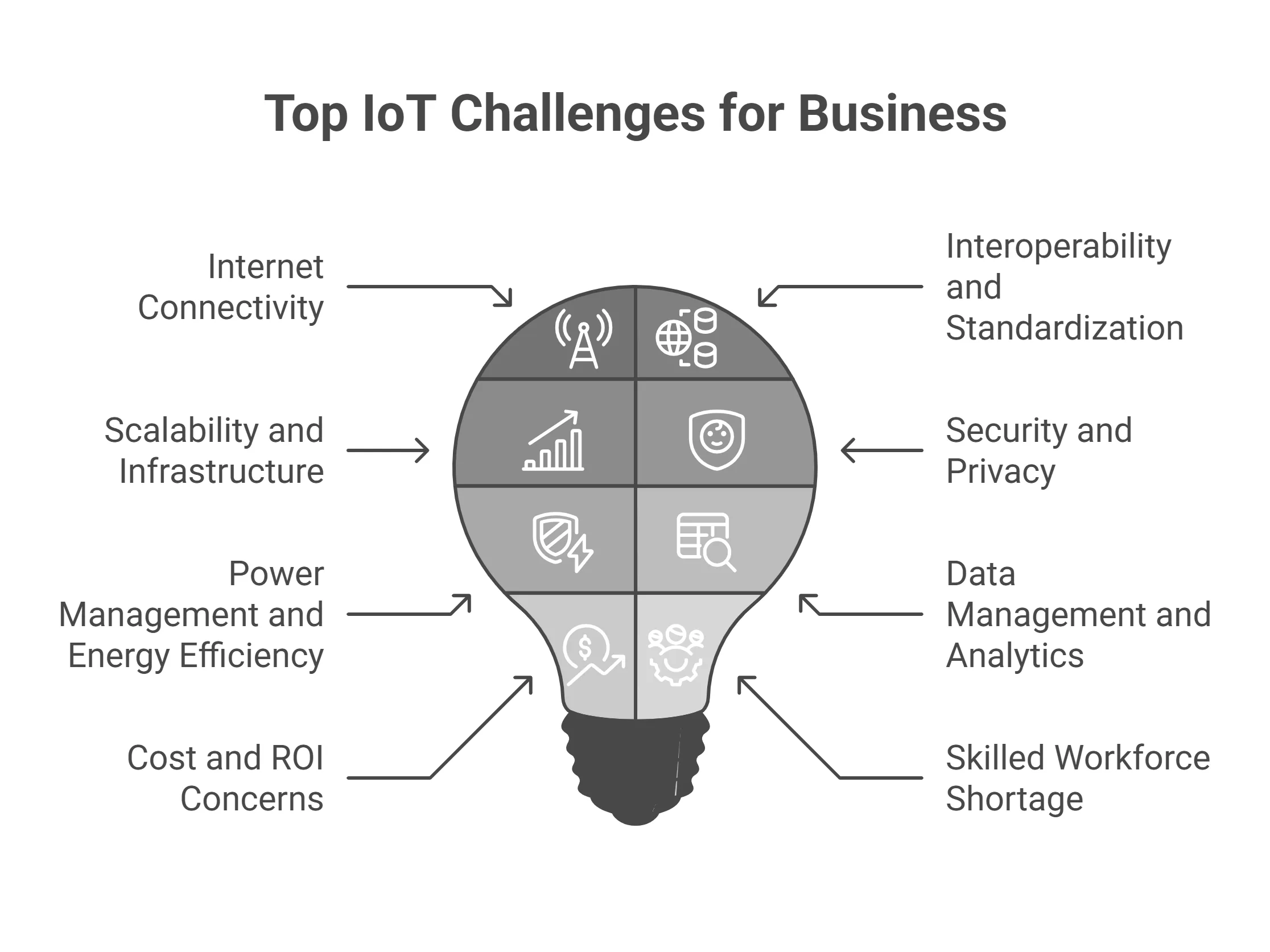
Without the right techniques and processes, it is not possible to implement an IoT system in the right manner, which may result in a waste of your investment. Working with top IoT solutions providers can help you overcome challenges such as security and privacy issues, interoperability and standardization, scalability and infrastructure, power management and energy efficiency, cost and ROI concerns, regulatory and compliance issues, skilled workforce shortage, and much more.
These are the top IoT challenges that should be addressed with the right techniques to enable successful IoT implementation.
The right implementation of the IoT system in 2025 can make businesses successful with its many applications and benefits. The data collection, management, and transfers make this technology a great technology that can integrate with other technologies like AI and cloud to enhance productivity.
By tackling the IoT integration challenges and IoT implementation challenges in 2025, businesses can enhance their efficiency, supply chain management, monitoring of the operations, data insights availability, sensing ability, and much more, which overall helps to stay ahead in the competition.
Amazing Statistics About IoT Solutions
The global Internet of Things (IoT) market size was USD 64.80 billion in 2024, estimated at USD 76.97 billion in 2025, and is anticipated to reach around USD 356.23 billion by 2034, expanding at a CAGR of 18.56% from 2025 to 2034.
By 2025, over 25% of all cyberattacks against businesses are expected to be IoT-based due to the proliferation of connected devices.
With an estimated 30.9 billion IoT devices globally by 2025, vulnerabilities in poorly secured devices (e.g., those using default passwords like “123456” or no password, which accounted for 17% of IoT attacks in 2018) increase risks of data breaches and botnet attacks like DDoS.
The lack of interoperability affects 30% of IoT hardware value, as devices running different software versions lead to performance issues and security vulnerabilities.
Read once! IoT Smart City Trends To Watch In 2025
What Are IoT Implementation Challenges In 2025?
IoT refers to the technology that generally creates a network of connected devices over the internet. It also collects the data and transfers it from one system to another without or with minimal human intervention.
The key abilities or potential of IoT are sensing, monitoring, and collecting data with the help of various IoT devices. Since the IoT system needs a better infrastructure and complex implementation methods, this creates many implementation challenges.
The challenges could be due to various reasons, such as non-technical or professional handling, bad implementation techniques, scope creep during implementation, internet connectivity issues, and much more. There are other IoT challenges that we will see later to understand in detail.
We have listed! Top IoT Solutions For Industrial Safety
Top IoT Challenges While Implementing Systems In 2025
There are various key IoT challenges while implementing systems in 2025. Here are a few top IoT challenges mentioned below.
1) Internet Connectivity
Internet connectivity could be a key challenge with the IoT implementation. The IoT devices and system runs on the internet connection, and bad internet connectivity for any reason could affect the whole system. This can be for various reasons like geographical locations, router quality, network services, and much more.
To mitigate the internet connectivity issues, identify the right location where the internet reaches the right speed. Also, enhance the quality of the router and develop a well-managed infrastructure.
2) Interoperability And Standardization
The IoT system ecosystem or solutions involve various devices, systems, and standards that have to be perfect to avoid any inefficiency. Any alteration in device standardization and protocols could lead to interoperability issues that affect the whole IoT system.
To avoid this challenge, make sure that each and every device follows all the necessary protocols and standards. This overall enhances the solution’s efficiency and prevents interoperability challenges.
3) Scalability And Infrastructure
Scalability could be another challenge among the top IoT challenges in 2025. Sometimes, the data management and collection increase rapidly, which requires scaling the IoT system infrastructure.
The IoT system can produce inaccuracies and fluctuations when managing millions of data networks together. Also, the scalability of infrastructure leads to more investment that may not be possible for many businesses. To prevent scalability challenges, try to make an investment in segments and avoid overloading of data management.
4) Security And Privacy Challenge
The IoT system deals with data collection and network management. This often leads to cyberattacks, data breaches, hacking of the systems, unauthorized access, and much more that overall affect or damage the whole IoT system. The integration of legacy systems with the IoT poses various security risks.
To enhance the security and privacy of IoT and data, it is important to implement all security measures and various advanced security systems such as authentication, authorization, and encryption.
5) Power Management And Energy Efficiency
Operating the IoT devices and systems requires a power supply. Many IoT devices run on batteries that would be challenged to charge the battery again and again. Also, the big IoT system or solution requires a power supply that could also be a challenge to provide a continuous power supply.
This takes a lot of cost and also affects sustainability. To manage power and energy efficiency, use renewable sources of energy, and implement batteries that can last long without charging.
6) Data Management And Analytics Challenges
The large volume of data managed with the IoT system could create various challenges in storing, processing, quality assurance, and minimizing latency. Also, analytics with the AI integration can be affected, as AI cannot process a vast amount of data at once.
This results in crashes of the IoT system that waste the overall investment. To manage data more efficiently, it is important to segment the data into various parts and analyze them one by one. This prevents data management challenges and provides better analytics.
7) Cost And ROI Concerns
The IoT implementation requires a lot of costs for its infrastructure. Many businesses face challenges when it comes to cost factors as they cannot afford much cost. Also, the initial investment in IoT software, hardware, etc, could not guarantee a better return on investment, which creates trust issues for the businesses.
This may interrupt the implementation of IoT for many small businesses. To avoid costs and ROI concerns, make a budget and list of requirements, then implement only the IoT solutions that come within budget and are required in reality.
8) Skilled Workforce Shortage
Skilled professional shortage is another key challenge among the top IoT challenges in 2025. Implementation, management, and upgradation of IoT solutions or systems require skilled professionals. But there are a few skilled professionals who are hard to find. This creates a challenge for the IoT implementation and results in downtime.
To avoid this, provide training to the employees on IoT management and hire IT consulting firms to manage all IoT aspects efficiently.
Understanding the Cost of Implementing IoT Systems in 2025
The cost of implementing IoT solutions in 2025 varies widely based on complexity, number of devices, and required features, ranging from a few thousand dollars for basic setups to millions for large-scale, enterprise solutions.
A basic IoT app might cost $30,000 – $80,000, while more complex solutions can exceed $200,000, potentially reaching a million dollars or more for large-scale implementations, according to a guide from Shiv Technolabs and Euristiq. Ongoing maintenance, including updates, bug fixes, and security patches, can cost 15-25% of the initial development cost annually.
Sum up

The industrial Internet of Things is evolving quickly, and billions of IoT devices are being deployed across a variety of industries, such as manufacturing, logistics, and healthcare. New concerns about security procedures and audits to guarantee the security of IoT devices emerge as IoT solutions proliferate.
To safeguard both their new and existing IoT devices, IoT makers must put safety first and create suitable plans. Overall, with the right planning, execution, and techniques, the IoT challenges can be mitigated, which surely helps to enhance the digital transformation for various businesses.
User Generated Queries
What common problems should I expect when implementing IoT systems?
Common challenges include security risks, data privacy concerns, device compatibility issues, network connectivity problems, and managing the large volume of data generated. Additionally, you may face difficulties with scalability, power management, and meeting regulatory compliance. Planning and working with experienced IoT providers can help mitigate these risks.
How can I ensure my IoT devices are secure from cyber threats?
To secure IoT devices, implement strong encryption protocols, regularly update device firmware, and usesecure authentication methods. Network segmentation and continuous monitoring also help detect unusual activity early. Working with trusted vendors who prioritize security can further reduce vulnerabilities.
Will my existing systems work well with new IoT technology?
Compatibility depends on the technologies and standards your current systems use. Many IoT solutions are designed for easy integration, but it’s essential to evaluate your infrastructure and choose IoT platforms that support interoperability. Consulting with IoT experts can help ensure smooth integration.
How do I scale my IoT solution as my business grows?
Scalability requires flexible infrastructure like cloud platforms and modular IoT architectures. Start with scalable hardware and software, and plan your network to handle increased data traffic. Regularly review and optimize your system to support new devices and expanded operations without performance loss.
What’s the typical cost involved in setting up IoT systems?
Costs vary based on the scale, complexity, and type of devices used. Typical expenses include hardware, software licenses, network infrastructure, integration, and ongoing maintenance. Small setups may start with a few thousand dollars, while large-scale industrial implementations can run into millions. A clear plan and phased deployment help manage costs effectively.