
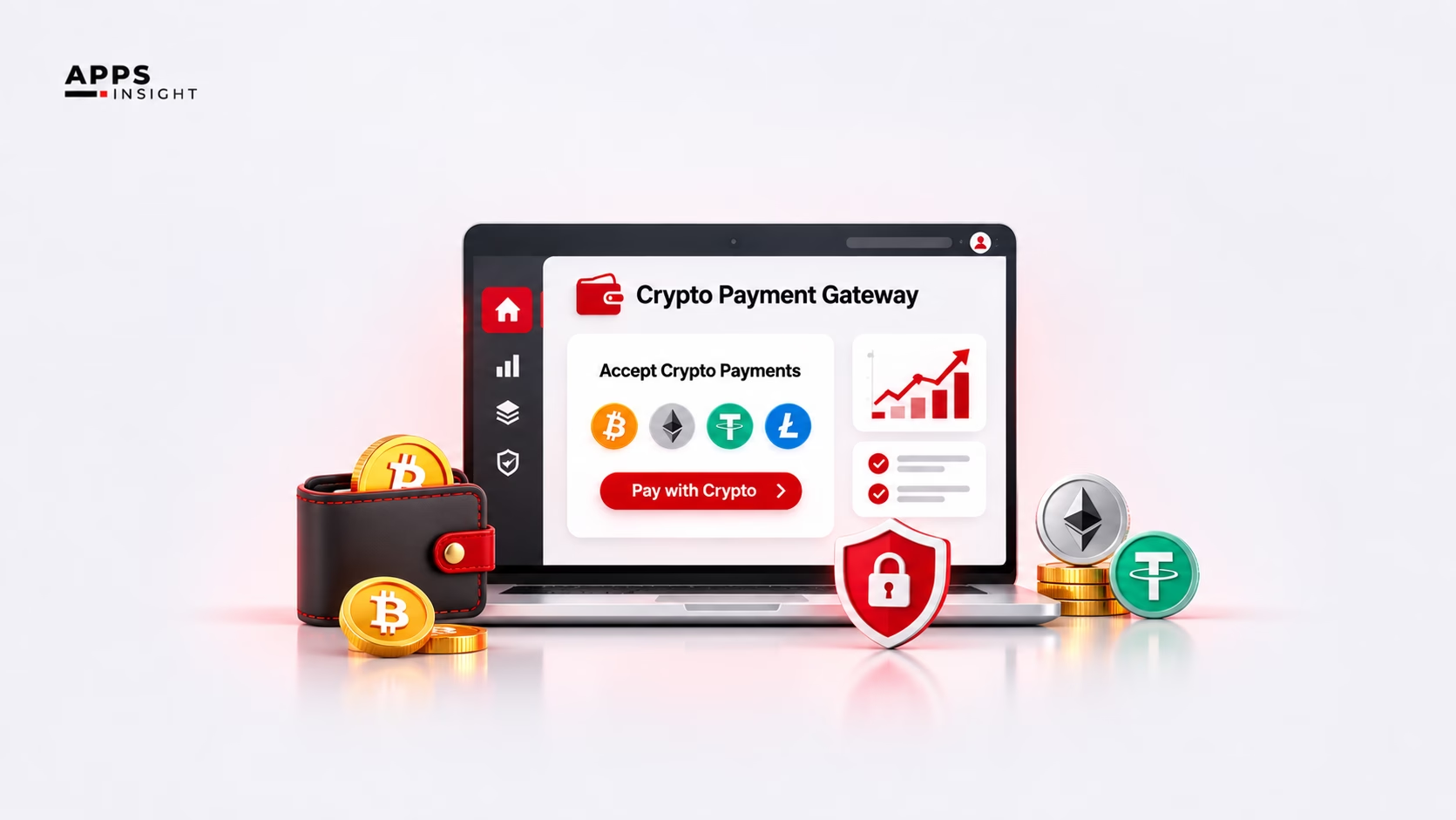
Businesses that want to accept cryptocurrency payments need more than a digital wallet. They need a payment system that can generate payment requests, connect with blockchain networks, verify transactions, manage funds, and provide accurate payment records. This is where a crypto payment gateway becomes useful.
To build a crypto payment gateway, businesses need to plan six main components: payment processing, blockchain integration, wallet management, transaction verification, security, and merchant management. The development process usually starts with business requirements, followed by architecture planning, UI/UX design, backend and blockchain development, testing, and deployment.
But how does the entire process work? Which technologies are required? What features should the platform include, and how much development effort is involved?
These are important questions for startup founders, fintech companies, and business owners considering cryptocurrency payment infrastructure. The demand for digital assets also provides a reason to examine this technology.
According to Crypto.com’s 2025 Crypto Market Sizing Report, the estimated number of global cryptocurrency owners increased from 659 million in 2024 to 741 million in 2025, representing 12.4% growth.
This does not mean all cryptocurrency owners use crypto for everyday purchases. However, it shows the scale of the potential user base businesses may consider when planning digital payment services.
In this guide, we explain how to develop a payment gateway from the ground up, including its working process, essential features, technology stack, security requirements, development cost, and common challenges. The information will help you understand what is involved before starting a project.
Quick Answers
What is required to develop a crypto payment gateway?
You need a payment processing engine, blockchain connectivity, wallet infrastructure, transaction monitoring, merchant dashboard, security controls, and settlement functionality.
How long does development take?
A basic platform may take around 2–3 months, a medium-complexity solution 4–6 months, and a larger enterprise platform 6–12 months or longer.
Which cryptocurrencies should a payment gateway support?
Bitcoin, Ethereum, USDT, and USDC are common options to evaluate. The final selection should depend on customer demand, network fees, transaction speed, and business requirements.
Is blockchain integration necessary?
Yes. The gateway needs access to blockchain data to monitor transactions, verify payments, and determine whether a payment has received the required network confirmations.
Is custom development better than using an existing gateway?
Custom development provides more control over features, integrations, and infrastructure. An existing provider is often more practical for businesses that only need basic cryptocurrency payment acceptance.
How to Build a Crypto Payment Gateway: Development Process Overview
Developing a payment gateway involves creating a system that connects customers, merchants, wallets, and blockchain networks. The platform acts as an intermediary between a customer’s payment and the merchant’s payment management system. It handles payment requests, tracks blockchain transactions, verifies the amount received, and communicates the result to the merchant.
A typical payment process works as follows:
- Customer selects a cryptocurrency: The customer chooses a supported digital currency at checkout.
- Payment request is created: The gateway generates a payment address, amount, QR code, and payment reference.
- Customer sends funds: The customer transfers the required cryptocurrency from a wallet.
- Blockchain transaction is detected: The gateway monitors the relevant network for incoming transactions.
- Payment is verified: The system checks the transaction hash, destination address, amount, and confirmation status.
- Merchant receives confirmation: The gateway sends a notification to the merchant’s website or application.
- Funds are settled: Depending on the platform’s configuration, the merchant receives cryptocurrency or a converted fiat equivalent.
For example, consider an online store selling a product for $200. A customer chooses to pay using USDT. The gateway creates a payment request with the correct receiving address and network. Once the transaction is detected and meets the required confirmation conditions, the merchant’s dashboard displays the payment as completed.
One important detail is that a transaction appearing on a blockchain does not always mean the payment is final. The gateway must account for network confirmations, incorrect networks, underpayments, overpayments, and expired payment requests.
Step-by-Step Crypto Payment Gateway Development Process
Building a payment platform requires a planned development process. Each stage contributes to the reliability, security, and usability of the final product.
Step 1: Define the Business Model and Requirements
Before writing code, decide what type of payment gateway the business wants to operate. There are different business models to consider:
- Merchant payment gateway: Allows individual businesses to accept cryptocurrency payments.
- Payment service provider: Offers payment processing services to multiple merchants.
- White-label gateway: Provides a customizable platform that businesses can operate under their own brand.
- Enterprise payment infrastructure: Supports complex payment workflows, large transaction volumes, and multiple business integrations.
The business model determines the platform’s technical requirements.
For example, a small online store may only need Bitcoin and stablecoin payments, while a payment service provider may require merchant onboarding, automated settlements, transaction reporting, and advanced administration. At this stage, define the target market, supported currencies, payment methods, settlement preferences, expected transaction volume, and operating jurisdictions.
Step 2: Select Supported Cryptocurrencies and Networks
The next step is deciding which cryptocurrencies the gateway will support.
Common choices include:
- Bitcoin (BTC): A widely recognized cryptocurrency with its own blockchain.
- Ethereum (ETH): A blockchain network that supports smart contracts and token transactions.
- Tether (USDT): A stablecoin available across multiple blockchain networks.
- USD Coin (USDC): A stablecoin designed to maintain a value linked to the US dollar.
It is important to distinguish between a cryptocurrency and the network used to transfer it.
For example, USDT can operate on Ethereum and Tron, among other networks. Sending a token to an incompatible network or address can result in payment problems or loss of funds.
Each supported network needs its own transaction detection, address validation, fee estimation, and confirmation logic.
Chainalysis reported that the Asia-Pacific region experienced 69% year-over-year growth in on-chain cryptocurrency value received in its 2025 Global Crypto Adoption Index. India ranked first in the overall country index.
For businesses targeting this region, the findings provide useful market context. However, regional adoption rankings should not be treated as direct evidence of merchant payment demand.
Step 3: Plan the Platform Architecture
Architecture planning defines how different parts of the payment gateway communicate with each other. A typical architecture contains the following components:
- Frontend: The customer checkout page, merchant dashboard, and administrative interface.
- Backend: Handles payment requests, business logic, merchant accounts, transaction records, and notifications.
- Blockchain integration layer: Connects the platform to supported blockchain networks through nodes or third-party APIs.
- Wallet infrastructure: Manages receiving addresses, transaction signing, fund storage, and withdrawals according to the selected custody model.
- Payment engine: Tracks payment status, validates amounts, handles confirmation rules, and manages payment expiration.
- Database: Stores merchant information, payment references, transaction records, and system configurations.
- Security layer: Protects user accounts, sensitive data, API access, and wallet operations.
A modular architecture is useful because businesses can add additional blockchain networks or payment features without rebuilding the complete system.
Step 4: Develop the Payment Processing Engine
The payment engine is the central component of the platform.
It manages the complete payment lifecycle, from creating a payment request to updating its final status.
Its responsibilities include:
- Generating unique payment requests.
- Calculating the required cryptocurrency amount.
- Creating receiving addresses or payment instructions.
- Tracking transaction IDs.
- Checking payment amounts.
- Managing pending and confirmed transactions.
- Handling expired or incomplete payments.
- Sending payment status notifications.
For example, if a customer sends less USDT than the requested amount, the gateway should not automatically mark the payment as complete. It should identify the shortfall and follow a predefined underpayment policy.
The payment engine should also use idempotent processing. This means that receiving the same blockchain event or payment notification more than once should not create duplicate merchant credits.
Step 5: Integrate Blockchain Networks and Wallets
Blockchain connectivity allows the platform to read transaction information and interact with supported networks.
Ethereum applications commonly use JSON-RPC to communicate with blockchain nodes. Through this interface, applications can retrieve blockchain data and submit transactions.
Developers can use dedicated blockchain nodes or infrastructure providers that offer APIs and transaction monitoring services. Wallet infrastructure is equally important. The platform needs a secure method of managing payment addresses, private keys, and withdrawals.
Crypto wallet integration can be implemented through third-party wallet providers, self-hosted wallet infrastructure, or a combination of both.
For custodial platforms, private-key security requires particular attention. Businesses should consider hardware security modules, multi-signature controls, restricted signing permissions, and secure key backups where appropriate.
For non-custodial models, users retain control over their assets, but the gateway still needs reliable payment verification and transaction management.
Step 6: Build the Frontend and Merchant Dashboard
The frontend provides the interface through which customers and merchants interact with the gateway.
A customer-facing checkout page should be simple and display:
- Supported cryptocurrencies.
- Payment amount.
- Receiving address.
- QR code.
- Selected blockchain network.
- Payment expiration time.
- Transaction status.
The merchant dashboard should provide more detailed information, including payment history, settlement records, account activity, and transaction reports.
An administrative dashboard can help platform operators manage merchant accounts, review suspicious transactions, monitor payment activity, and manage system settings.
The interface should also be responsive so that customers can complete payments using mobile phones, tablets, and desktop devices.
Step 7: Add Payment APIs and Third-Party Integrations
Businesses often need to connect their payment gateway with existing applications.
For this reason, API development should be part of the initial architecture.
Common API functions include:
- Creating payment requests.
- Retrieving payment status.
- Managing merchant accounts.
- Receiving transaction notifications.
- Initiating permitted refunds.
- Accessing settlement records.
Webhooks can notify merchant applications when a payment is detected, confirmed, expired, or failed.
For example, an online store can use a webhook to automatically update an order from pending to paid after the gateway confirms the required transaction conditions.
Developers should authenticate API requests, validate webhook signatures, prevent replay attacks, and maintain reliable event logs.
Step 8: Test, Audit, and Deploy the Platform
Testing is essential before launching a payment gateway because financial transactions require accurate processing.
The QA team should test:
- Successful and failed payments.
- Incorrect wallet addresses.
- Wrong blockchain networks.
- Underpayments and overpayments.
- Delayed blockchain confirmations.
- Duplicate notifications.
- Refund workflows.
- Network interruptions.
- Unauthorized access attempts.
- High transaction volumes.
Security testing should include vulnerability assessments, penetration testing, access-control reviews, and smart contract audits if custom contracts are used.
The platform can then be deployed using cloud infrastructure with appropriate monitoring, backups, recovery plans, and incident response procedures.
A successful deployment is not the end of development. The team must continue monitoring blockchain integrations, software updates, network changes, and transaction performance.
Essential Crypto Payment Gateway Features for Businesses
The required functionality depends on the target users and the type of platform being developed. However, several capabilities are important for most payment gateways.
1. Multi-Currency Support
The platform should allow customers to pay using the supported cryptocurrencies selected by the business.
The development team should plan for asset validation, network selection, exchange rate handling, and transaction monitoring.
2. Real-Time Transaction Tracking
The gateway should track incoming transactions and display accurate payment statuses.
This helps merchants identify pending, confirmed, expired, and failed payments without checking blockchain explorers manually.
3. Wallet Management
The platform needs secure receiving addresses, withdrawal controls, and wallet monitoring.
For custodial systems, key management and transaction authorization must be carefully designed.
4. Automatic Currency Conversion
Some merchants prefer receiving fiat currency rather than holding cryptocurrency.
The gateway can connect to supported exchanges or liquidity providers to convert incoming assets, subject to provider availability and applicable regulations.
5. Merchant Management
Businesses need tools to manage accounts, payment records, settlement preferences, and API credentials.
For platforms serving multiple merchants, role-based permissions and merchant-level reporting are important.
6. Refund and Settlement Management
Blockchain transactions generally cannot be reversed after confirmation. Therefore, refunds usually require a separate outgoing transaction.
The platform should provide refund approval workflows, transaction references, settlement reports, and withdrawal records.
7. Reporting and Notifications
The gateway should provide transaction reports, payment alerts, and settlement notifications. These features help merchants reconcile payments and identify operational issues.
Technology Stack for Cryptocurrency Payment Gateway Development
The technology stack should be selected according to the business model, blockchain networks, transaction volume, and development team’s expertise.
A possible technology stack includes:
| Development component | Technologies |
|---|---|
| Frontend | React.js, Next.js |
| Backend | Node.js, Python |
| Database | PostgreSQL, MongoDB |
| Blockchain connectivity | Web3 libraries, JSON-RPC APIs |
| Smart contracts | Solidity, when required |
| Cloud infrastructure | AWS, Google Cloud |
| API development | REST APIs, webhooks |
| Monitoring | Cloud monitoring and centralized logging |
| Security | Encryption, MFA, secure key management |
Not every platform needs every technology listed above.
For example, a gateway that accepts direct wallet transfers may not need custom smart contracts. Similarly, a business can use a blockchain API provider instead of operating its own nodes.
The technology choices should support reliability, maintainability, and future expansion rather than simply following popular development trends.
Security and Regulatory Requirements
Security and compliance should be considered from the planning stage because a payment gateway may process financial transactions and handle sensitive customer information.
Important security controls include:
- Multi-factor authentication.
- Encryption of sensitive data.
- Secure private-key storage.
- Role-based access control.
- Withdrawal approval workflows.
- Transaction monitoring.
- Rate limiting and API authentication.
- Regular security audits.
- Backup and disaster recovery.
Regulatory requirements depend on the services offered and the countries where the platform operates.
For example, a business that only provides non-custodial payment software may have different obligations from a business that holds customer assets, exchanges cryptocurrencies, or transfers funds on behalf of customers.
The Financial Action Task Force (FATF) provides guidance for virtual asset service providers concerning customer due diligence, record keeping, suspicious transaction reporting, and the Travel Rule.
Founders should obtain jurisdiction-specific legal advice before launching. Technical compliance features cannot replace the required registrations, licences, or legal assessments.
Crypto Payment Gateway Development Cost and Timeline
The crypto payment gateway development cost depends on the platform’s complexity, supported networks, security requirements, and third-party integrations.
The following figures are indicative planning estimates for custom development, not fixed market quotations.
| Platform type | Estimated development cost | Estimated timeline |
|---|---|---|
| Basic gateway | $30,000–$60,000 | 2–3 months |
| Mid-level gateway | $60,000–$150,000 | 4–6 months |
| Advanced gateway | $150,000–$250,000 | 6–9 months |
| Enterprise platform | $250,000–$400,000+ | 9–12+ months |
The cost to build a crypto payment gateway increases when the platform requires multiple blockchain integrations, advanced wallet infrastructure, automatic fiat conversion, complex merchant management, or regulatory controls.
Development budgets generally cover:
- Business analysis and planning.
- UI/UX design.
- Frontend development.
- Backend engineering.
- Blockchain and wallet integration.
- API development.
- Quality assurance.
- Security testing.
- Deployment.
Businesses should also plan for recurring expenses such as cloud hosting, blockchain API subscriptions, monitoring, security reviews, software maintenance, and customer support.
A basic MVP can help a startup test its payment model before investing in enterprise-level functionality.
Common Challenges in Crypto Payment Gateway Development
Even with a well-defined architecture, payment gateway development involves technical and operational challenges.
Blockchain confirmation delays: Different networks have different confirmation mechanisms and transaction speeds. Developers should implement network-specific confirmation policies and clearly display pending statuses.
Incorrect network selection: Customers may accidentally select the wrong network when transferring tokens. The checkout interface should clearly identify the supported asset and network before payment.
Price volatility: Cryptocurrency exchange rates can change between payment creation and transaction confirmation. The gateway should define quote validity periods and price calculation rules.
Security risks: Unauthorized withdrawals, compromised API credentials, and private-key exposure can result in financial losses. Strong access controls, secure signing infrastructure, and independent security testing are important.
Transaction reconciliation: Payment events may arrive late or more than once. The platform should use unique transaction identifiers, idempotent processing, and periodic reconciliation.
Regulatory differences: Rules vary across jurisdictions and business models. Compliance requirements should be assessed before selecting the platform’s custody and settlement model.
Addressing these issues during development can reduce operational problems after launch.
Should You Build a Custom Platform or Use an Existing Solution?
Not every business needs to develop a complete payment gateway from scratch.
An existing provider may be sufficient for a company that only wants to accept cryptocurrency payments on its website. However, a fintech business planning to offer payment services to multiple merchants may need greater control over its infrastructure.
A custom platform provides control over:
- Supported cryptocurrencies and networks.
- Merchant onboarding.
- Payment processing workflows.
- Settlement methods.
- APIs and integrations.
- Security architecture.
- Reporting and administration.
An existing provider can reduce initial development work, but the business may have limited control over pricing, supported assets, provider policies, and technical features.
For example, companies researching a crypto payment gateway like BitPay can compare its available merchant services with the requirements of a custom platform.
When evaluating external vendors, founders should also distinguish between Crypto Payment Gateway Development Companies and cryptocurrency exchange developers. These providers may offer related blockchain expertise, but payment processing and exchange infrastructure have different functional requirements.
For additional research into the adjacent exchange-development market, see AppsInsight’s guide to Cryptocurrency Exchange Development Companies (2026).
Sum up
Developing a cryptocurrency payment gateway requires a combination of blockchain connectivity, payment processing, wallet management, security, and merchant-facing functionality.
The process begins with defining the business model and selecting supported cryptocurrencies. Developers then plan the architecture, build the payment engine, integrate blockchain networks and wallets, develop the frontend, connect APIs, and complete security testing before deployment.
The right approach depends on what the business wants to achieve. A startup may begin with a limited payment system, while a payment service provider may need advanced merchant management, settlement automation, and stronger operational controls.
Businesses should also evaluate the long-term costs of infrastructure, security, maintenance, and regulatory compliance before making a development decision.
AppsInsight can help businesses explore their technical requirements and understand the planning involved in custom cryptocurrency payment gateway software development. The most suitable solution is one that meets actual payment needs, protects transactions, and can be maintained as the business grows.
Frequently Asked Questions
How do I start building a crypto payment gateway?
Start by defining your target customers, business model, supported cryptocurrencies, settlement requirements, and operating jurisdictions. Then plan the platform architecture, choose the technology stack, and begin development with essential payment functionality.
How much does it cost to develop a crypto payment gateway?
A basic custom platform may cost approximately $30,000–$60,000. Mid-level solutions can cost $60,000–$150,000, while complex enterprise systems can exceed $400,000. These are indicative estimates and vary according to project requirements.
Which blockchain is best for a payment gateway?
There is no single best blockchain for every payment gateway. Bitcoin, Ethereum, and networks supporting stablecoins can be evaluated based on transaction fees, speed, security, liquidity, and customer preferences.
Do crypto payment gateways need smart contracts?
Not necessarily. A gateway that monitors direct cryptocurrency transfers may not require custom smart contracts. Smart contracts become relevant when the platform needs on-chain payment logic, escrow, automated token transfers, or other programmable functions.
Can a crypto payment gateway convert cryptocurrency into fiat?
A gateway can integrate with supported exchanges or liquidity providers to convert cryptocurrency into fiat currency. Availability depends on the provider, supported assets, banking arrangements, and applicable regulations.
How can businesses make a crypto payment gateway secure?
Businesses should implement secure wallet and private-key management, encryption, multi-factor authentication, withdrawal approvals, transaction monitoring, API protection, regular audits, and incident recovery procedures.
What is the difference between a crypto wallet and a payment gateway?
A crypto wallet allows users to store, send, and receive digital assets. A payment gateway provides additional payment processing functionality, including merchant checkout, transaction verification, payment status updates, reporting, and settlement management.