
The startup ecosystem has evolved into a fast-moving, digital-first landscape where technology is no longer optional—it is the backbone of every scalable, future-ready business. New ventures today must enter markets where customers expect instant access, seamless app experiences, personalized services, and consistent digital touchpoints.
As a result, applications have become essential tools for establishing credibility, engaging users, and differentiating from competitors. Whether a startup operates in ecommerce, logistics, healthcare, education, fintech, or on-demand services, having a robust digital platform is critical for achieving early traction, optimizing operations, and demonstrating value to investors.
At the same time, startups cannot afford to settle for generic or rigid software that limits their innovation potential. They need technology that aligns precisely with their mission, business model, and long-term vision. This is where custom app development becomes a strategic advantage—allowing founders to shape digital solutions around their unique goals instead of being constrained by pre-built templates.
A well-crafted custom application empowers startups to scale flexibly, maintain strong user experiences, adapt quickly to market changes, and build a digital presence that reflects their brand identity. With this foundation in mind, the next section will explore why startups need strong digital foundations and how the right technology sets the stage for rapid, sustainable growth.
Why Startups Need Strong Digital Foundations
Startups face a fast-paced, competitive, and often unpredictable market environment. Establishing a strong digital foundation is not merely a technical consideration—it is a strategic necessity that impacts growth, efficiency, customer experience, and long-term viability.
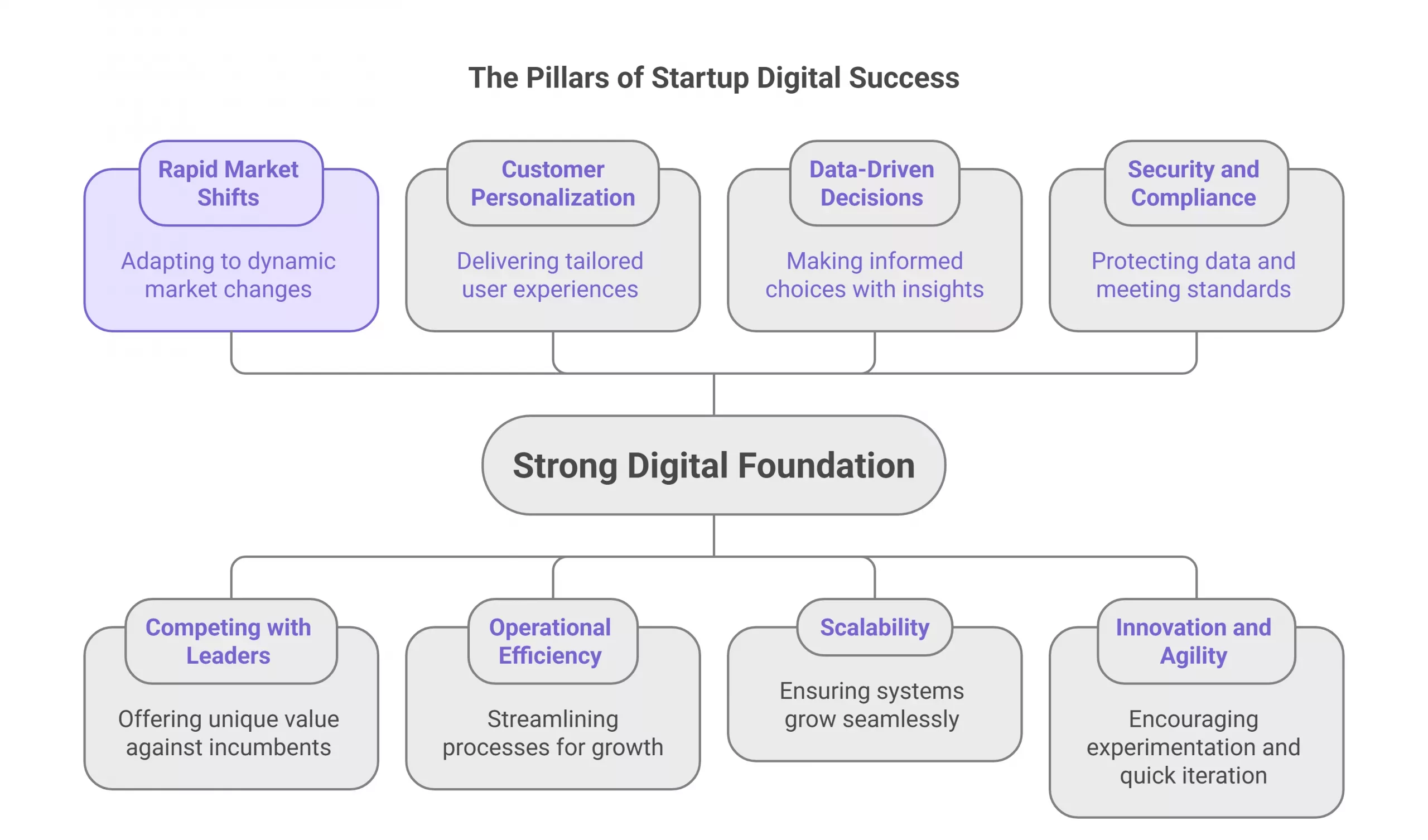
Early-stage businesses must manage limited resources while aiming to scale quickly, making digital infrastructure a core driver of operational effectiveness. A well-planned foundation empowers startups to respond to market shifts, leverage data, enhance customer engagement, and build scalable systems that grow alongside the business.
1. Rapid Market Shifts and Technological Demands
Startups operate in dynamic markets where consumer preferences, technology trends, and competitive landscapes can change overnight. Without adaptable digital systems, startups risk falling behind more agile competitors. A strong digital foundation allows businesses to quickly implement new features, integrate emerging technologies, and pivot strategies without major disruptions.
2. Competing With Established Market Leaders
Entering a market dominated by well-established companies requires more than just a strong idea. Startups need technology that enables efficiency, high performance, and superior user experiences. A robust digital infrastructure allows young businesses to compete effectively, offering unique value propositions that rival incumbents despite having fewer resources.
3. Customer Expectations of Personalization
Modern consumers expect seamless, personalized experiences across all digital touchpoints. Startups must deliver relevant content, intuitive interfaces, and proactive services to retain users. A strong digital foundation facilitates data collection and analysis, allowing startups to understand user behavior and provide highly customized experiences that build loyalty.
4. Operational Efficiency and Automation
As startups grow, manual processes and fragmented systems can become significant bottlenecks. Strong digital systems enable automation, process integration, and real-time tracking of business operations. This reduces human error, frees up resources for strategic initiatives, and ensures consistency as the startup scales.
5. Data-Driven Decision Making
Access to accurate, timely, and relevant data is critical for making informed decisions. Startups with robust digital foundations can track user behavior, monitor KPIs, and optimize business strategies based on insights rather than assumptions. Data-driven decision-making enhances market responsiveness, resource allocation, and overall business performance.
6. Scalability for Future Growth
Startups often begin with limited infrastructure but anticipate rapid expansion. A strong digital foundation ensures that systems, processes, and applications can scale seamlessly as the user base grows, avoiding costly redesigns or disruptions. Scalability is essential for handling higher traffic, more transactions, and increasing complexity without compromising performance.
7. Enhancing Security and Compliance
With increased digital operations comes the responsibility to safeguard sensitive information and comply with regulatory standards. Strong digital foundations include robust security protocols and compliance measures, protecting customer data, building trust, and avoiding legal or financial penalties.
8. Supporting Innovation and Agility
A well-built digital foundation provides the flexibility for startups to experiment with new features, business models, and technologies. This agility encourages innovation, allowing startups to test, learn, and iterate quickly in response to market feedback, giving them a competitive edge over less nimble competitors.
Custom App Development vs. Off-the-Shelf Solutions
Custom app development gives startups the ability to create software tailored to their unique goals, while off-the-shelf solutions offer pre-built functionality that may not align perfectly with business needs.
Understanding the differences, benefits, and limitations of each approach is critical when deciding the best path for startup technology investment. The table below breaks down the comparison in detail.
| Subheading | Description | Key Points / Implications for Startups |
|---|---|---|
| 1. Definition of Off-the-Shelf Solutions | Pre-built software applications designed to serve a broad market with standard functionalities. These are ready-made and typically quicker to implement. | – Quick deployment – Limited customization – Often lower initial cost – May require process adaptation to fit the tool |
| 2. Definition of Custom App Development | Software built specifically for a startup’s requirements, business model, and operational needs. Every feature and workflow is tailored. | – Complete control over features – Aligns with business strategy – Scalable as the business grows – Higher upfront investment |
| 3. Flexibility and Adaptability | Off-the-shelf solutions offer limited flexibility and may restrict innovation. Custom apps provide full adaptability to evolving business requirements. | – Custom apps can integrate new features without constraints – Off-the-shelf tools may require workarounds or additional tools for changes |
| 4. Time-to-Market Considerations | Off-the-shelf software allows immediate deployment but may need adjustments. Custom apps require longer development but result in a precise fit. | – Off-the-shelf: fast setup but generic functionality – Custom apps: longer timeline but tailored solution that reduces future inefficiencies |
| 5. Cost Perspective | Off-the-shelf solutions usually have lower upfront costs but may incur subscription fees and hidden integration expenses. Custom apps require higher initial investment but can save costs in the long term. | – Off-the-shelf: cheaper initially, potential extra costs for add-ons – Custom apps: higher upfront cost, lower ongoing limitations |
| 6. User Experience and Branding | Pre-built software often has generic interfaces. Custom apps can provide a unique UX/UI aligned with the startup’s brand identity. | – Better user engagement with custom interfaces – Off-the-shelf may feel generic and fail to differentiate the brand |
| 7. Integration with Other Systems | Off-the-shelf solutions may have limited API compatibility or require additional plugins. Custom apps can integrate seamlessly with existing workflows and systems. | – Custom apps support smooth workflow automation – Off-the-shelf may need extra tools or manual processes |
| 8. Security and Compliance | Custom apps allow startups to implement strict security protocols and regulatory compliance measures. Off-the-shelf tools offer standard security, which may not cover niche requirements. | – Custom apps: tailored security, regulatory adherence – Off-the-shelf: general protection, may not meet specialized needs |
| 9. Long-Term Scalability | Off-the-shelf software may struggle to support significant growth or new business models. Custom apps are built to scale efficiently as user base, data, and functionality grow. | – Custom apps reduce future redevelopment costs – Off-the-shelf may require switching platforms as business scales |
Strategic Advantages of Choosing Custom App Development
For startups, choosing custom app development over off-the-shelf solutions can be a game-changer. While the initial investment may be higher, the long-term benefits often outweigh the costs. Custom apps are designed to fit the startup’s unique business model, growth trajectory, and customer expectations.
They provide flexibility, scalability, and a competitive edge that generic solutions cannot match. Below, we explore the strategic advantages in detail.
1. Full Control Over Features and Functionalities
App creation firms allows startups to determine exactly which features and functionalities are included. Unlike pre-built software, which often forces businesses to adapt to its limitations, custom apps are built around the startup’s workflows, processes, and goals. This ensures that every feature adds real value and aligns with the startup’s objectives.
Benefits include:
- Prioritization of features that directly impact growth
- Avoiding unnecessary tools or functions that increase complexity
- Ability to add, remove, or modify features as the business evolves
2. Alignment With Business Model
Every startup has a unique value proposition and business strategy. Swiss app development allows software to reflect this uniqueness, supporting innovative business approaches that may not fit into standard platforms. By aligning technology with the business model, startups can improve operational efficiency and enhance the customer journey.
Benefits include:
- Seamless integration with core business processes
- Support for innovative revenue models or service offerings
- Greater consistency between product, service, and digital platform
3. Enhanced User Experience (UX)
A well-designed custom app focuses on user experience tailored to the target audience. Startups can implement intuitive navigation, personalized content, and interactive features that engage users effectively. This attention to UX improves customer retention, satisfaction, and long-term loyalty.
Benefits include:
- Personalized interface and features that match user needs
- Optimized flow to reduce friction and increase conversions
- Opportunity to stand out in crowded markets with a unique digital experience
4. Increased Security and Data Protection
Data security is critical, especially for startups handling sensitive user or financial information. Custom apps allow developers to implement advanced security protocols tailored to the startup’s specific requirements. Unlike generic software, which may provide basic protections, custom apps can ensure compliance with industry regulations and mitigate risks of data breaches.
Benefits include:
- Custom encryption and secure data storage
- Regulatory compliance (e.g., GDPR, HIPAA, PCI DSS)
- Reduced risk of vulnerabilities common in widely-used off-the-shelf apps
5. Seamless Scalability for Future Growth
Startups often begin with small user bases but plan for rapid expansion. Custom applications are designed to scale efficiently, supporting increasing numbers of users, transactions, and data without major overhauls. This avoids the limitations of off-the-shelf software, which may require switching platforms or incurring significant redevelopment costs as the business grows.
Benefits include:
- Flexibility to add new modules and features
- Handling higher traffic and larger datasets efficiently
- Future-proof architecture designed for long-term growth
6. Competitive Differentiation in Crowded Markets
In highly competitive sectors, startups need to differentiate themselves to survive and thrive. Custom apps allow businesses to offer unique features, exclusive services, or innovative user experiences that competitors cannot easily replicate. This differentiation can become a key factor in attracting and retaining customers.
Benefits include:
- Unique functionalities tailored to target audiences
- Brand identity reinforced through digital experience
- Ability to introduce innovative solutions faster than competitors
7. Improved Operational Efficiency
Custom apps can integrate seamlessly with internal systems, automating workflows and reducing manual effort. By streamlining operations, startups can focus on strategic initiatives, reduce errors, and increase overall productivity.
Benefits include:
- Integrated systems for smooth data flow
- Reduced manual interventions and operational costs
- Faster decision-making based on real-time insights
8. Long-Term Cost Benefits
Although the initial cost of custom app development may be higher, the long-term benefits often result in significant savings. Startups avoid recurring subscription fees for multiple off-the-shelf tools, reduce inefficiencies caused by software limitations, and eliminate the cost of switching platforms as business requirements evolve.
Benefits include:
- Lower operational and maintenance costs over time
- Avoidance of unnecessary third-party software
- Strategic investment that grows with the business
Want to know? How Much Does it Cost to Develop an Android App?
How Custom Apps Drive Growth and Innovation
Custom app development is not just about building software; it is a strategic tool that allows startups to grow faster, adapt to market changes, and innovate continuously. Unlike generic solutions, custom apps are tailored to the unique needs of a startup, enabling businesses to implement features, processes, and insights that directly impact growth and innovation.
By leveraging custom applications, startups can improve customer experiences, streamline operations, and create new opportunities for market differentiation. The following subheadings explain how custom apps act as growth engines for startups.
1. Creating a Unique Value Proposition
A strong value proposition is essential for startups to stand out in competitive markets. Custom apps allow startups to offer unique features, personalized experiences, or exclusive services that pre-built solutions cannot provide. By building software that aligns with the startup’s brand, mission, and target audience, companies can deliver distinct benefits that attract and retain users.
Key Points:
- Tailored functionality that directly addresses customer pain points
- Unique features that competitors cannot replicate easily
- Reinforcement of brand identity and credibility through custom experiences
2. Enhancing Customer Engagement and Retention
Customer engagement is the cornerstone of sustainable growth. Custom apps allow startups to design interfaces, notifications, and experiences that resonate with users. Features such as personalized dashboards, reward systems, and tailored recommendations keep users active and loyal, leading to higher retention rates.
Key Points:
- Personalized UX/UI enhances user satisfaction
- In-app analytics enable real-time engagement tracking
- Loyalty and referral programs can be integrated seamlessly
3. Supporting Innovative Business Approaches
Startups often experiment with new business models or revenue streams. Custom apps provide the flexibility to test and implement innovative approaches without being restricted by pre-built software limitations. Whether it’s integrating new services, subscription models, or interactive features, custom apps can adapt to evolving strategies.
Key Points:
- Ability to test new monetization models quickly
- Agile adaptation to changing market demands
- Integration of emerging technologies like AI or AR to enhance offerings
4. Streamlining Operations and Improving Efficiency
Custom apps are not only outward-facing; they also improve internal operations. By automating workflows, integrating different systems, and centralizing data, startups can reduce errors, minimize manual effort, and free up resources for strategic initiatives. Efficient operations translate into faster delivery of products or services, supporting growth.
Key Points:
- Automated workflows reduce repetitive tasks
- Integration with ERP, CRM, or analytics tools for centralized control
- Improved team productivity and decision-making speed
5. Unlocking Data-Driven Insights
Data is one of the most powerful tools for startup growth. Custom apps can capture user behavior, transaction patterns, and operational metrics to generate actionable insights. These insights inform product development, marketing strategies, and customer service enhancements, allowing startups to make decisions backed by real data.
Key Points:
- Custom dashboards for monitoring key performance indicators (KPIs)
- Predictive analytics to forecast trends and customer behavior
- Enhanced decision-making through real-time, actionable insights
6. Facilitating Market Expansion
Startups aiming to scale globally need apps that can adapt to new markets, languages, currencies, and regulations. Custom apps can be designed to support multi-region operations, localization, and compliance requirements, enabling businesses to expand without technical limitations.
Key Points:
- Multi-language support for international audiences
- Compliance with regional laws and payment systems
- Scalable architecture to handle increased user traffic and transactions
7. Encouraging Continuous Innovation
Custom apps are inherently flexible, allowing startups to iterate and introduce new features as they grow. This continuous innovation fosters a culture of experimentation, keeping the product competitive and relevant. The ability to quickly implement new ideas gives startups a strategic edge over competitors tied to rigid platforms.
Key Points:
- Agile architecture allows rapid feature rollout
- Feedback loops from users can be implemented efficiently
- Supports long-term product evolution and market relevance
Read once! Best Mobile Apps: Native App vs Hybrid App vs Web Apps?
Common Challenges Startups Face, and How Custom Development Solves Them
Startups often operate under constraints that make growth and operations particularly challenging. Limited budgets, tight timelines, and competitive pressures can hinder the ability to scale effectively. Many of these challenges are directly linked to technology and software choices.
Custom app development offers solutions tailored to overcome these obstacles, allowing startups to maximize efficiency, improve user experiences, and future-proof their operations.
Below, we explore common startup challenges and how custom development addresses them.
1. Budget Restrictions and Smart Tech Spend
Startups typically have limited financial resources and must prioritize investments carefully. While off-the-shelf solutions may appear cheaper upfront, they often come with hidden costs such as subscriptions, add-ons, or the need to adapt workflows. Custom development allows startups to invest strategically in features that provide real value and avoid unnecessary expenditure.
How Custom Apps Help:
- Prioritizes essential features to optimize development costs
- Reduces long-term expenses associated with multiple software licenses
- Eliminates the need for expensive workarounds or additional tools
2. Time-to-Market Pressure
Launching quickly is crucial for startups to capture market share and validate ideas. Off-the-shelf solutions may be ready to deploy but often fail to meet unique business needs, requiring extra adjustments. Custom apps can be developed in a focused, phased manner that aligns with business priorities, balancing speed with precision.
How Custom Apps Help:
- Agile development allows MVP (Minimum Viable Product) launches
- Custom features are aligned with business goals from the start
- Iterative updates ensure speed without compromising quality
3. Performance, Downtime, and App Reliability
Many startups struggle with software that crashes, slows down under load, or fails to meet user expectations. Off-the-shelf tools may not be optimized for specific business models, limiting performance. Custom apps are designed with the startup’s operational needs in mind, ensuring reliability even as usage grows.
How Custom Apps Help:
- Optimized architecture ensures smooth performance under high traffic
- Scalable infrastructure accommodates growth without downtime
- Proactive monitoring and maintenance reduce operational disruptions
4. Feature Overload vs. Feature Necessity
Startups often face confusion between essential features and unnecessary add-ons, which can bloat off-the-shelf software. Feature overload complicates workflows, confuses users, and slows down operations. Custom apps allow startups to include only what is necessary, improving efficiency and user satisfaction.
How Custom Apps Help:
- Tailored feature set matches actual business processes
- Eliminates clutter and unnecessary complexity
- Enhances usability and reduces training time for users
5. Security and Compliance Constraints
Handling sensitive data or operating in regulated industries presents significant challenges for startups. Off-the-shelf solutions may provide standard security, but they rarely meet specialized compliance requirements. Custom apps enable startups to implement security protocols and regulatory measures that protect data and meet industry standards.
How Custom Apps Help:
- Encryption and secure access controls tailored to business needs
- Compliance with local and international regulations (GDPR, HIPAA, etc.)
- Reduced risk of data breaches or regulatory penalties
6. Integration with Existing Systems
Startups often use multiple tools for operations, marketing, sales, and customer management. Off-the-shelf software may not integrate seamlessly, creating data silos and inefficiencies. Custom apps can be built to integrate smoothly with existing systems, centralizing operations and improving workflow efficiency.
How Custom Apps Help:
- API integration for seamless data exchange
- Unified dashboards for real-time insights
- Streamlined internal processes and automated workflows
7. Maintaining Competitive Advantage
Many startups struggle to differentiate themselves due to limited flexibility in existing tools. Off-the-shelf solutions can restrict innovation and adaptation. Custom apps empower startups to build unique features that competitors cannot replicate easily, supporting long-term growth and market positioning.
How Custom Apps Help:
- Tailored features and workflows create unique offerings
- Supports innovation and experimentation with new services
- Enhances brand identity through differentiated user experience
We have listed! Key App Development Technologies
The Development Process: How Startups Can Approach Custom App Creation
Creating a custom app is not just about coding; it is a strategic journey that requires careful planning, iterative development, and continuous refinement. For startups, approaching app development methodically ensures that the final product aligns with business goals, user expectations, and market demands.
Each stage of development—from understanding requirements to post-launch improvements—plays a critical role in determining the app’s success. Below, we break down the essential steps in the development process and explain how startups can leverage each stage for maximum impact.
1. Discovery & Requirement Analysis
The first step in custom app development is understanding what the startup truly needs. This involves analyzing business goals, target audience, market trends, and competitive landscape. Startups must clearly define the problem the app will solve, the core features it should have, and the expected outcomes.
Key Activities:
- Conducting stakeholder interviews and brainstorming sessions
- Defining functional and non-functional requirements
- Identifying user personas and customer pain points
- Evaluating competitors’ apps to find gaps and opportunities
Why It Matters:
- Ensures that development aligns with strategic goals
- Avoids unnecessary features that add cost and complexity
- Sets a clear roadmap for the development team
2. Product Strategy and Roadmapping
Once requirements are defined, startups need a product strategy that outlines the app’s vision, objectives, and success metrics. A roadmap is then created, detailing milestones, development phases, and timelines. This phase prioritizes features for MVP (Minimum Viable Product) and sets expectations for iterative releases.
Key Activities:
- Defining short-term and long-term product goals
- Mapping out features into development phases
- Identifying KPIs to measure app performance and user engagement
Why It Matters:
- Provides clarity for the development team and stakeholders
- Helps manage resources and timelines efficiently
- Ensures a focused approach toward delivering value quickly
3. UI/UX Wireframes and Prototyping
User experience (UX) is critical for adoption and engagement. Wireframes and prototypes visualize the app’s interface and user flow before development begins. This stage allows startups to test usability, gather feedback, and refine the design for maximum effectiveness.
Key Activities:
- Creating wireframes to map out app screens and user flows
- Developing interactive prototypes to simulate real app usage
- Conducting usability testing with potential users
Why It Matters:
- Reduces design flaws and improves user satisfaction
- Provides stakeholders with a clear vision of the final product
- Saves development time and costs by identifying issues early
4. Agile Development and Iteration Cycles
Custom app development is most effective when following an agile methodology. Agile allows startups to build the app in iterative cycles, incorporating feedback and making improvements continuously. This approach ensures the product evolves according to real-world needs rather than assumptions.
Key Activities:
- Breaking development into sprints with defined goals
- Regularly reviewing progress and adjusting features
- Collaborating closely between developers, designers, and stakeholders
Why It Matters:
- Accelerates development without sacrificing quality
- Incorporates user feedback early and often
- Reduces risk of building features that do not add value
5. Testing and Quality Assurance (QA)
A high-quality app requires rigorous testing to identify bugs, performance issues, and security vulnerabilities. QA ensures the app works seamlessly across devices, platforms, and user scenarios. For startups, this phase prevents negative user experiences and protects the brand’s reputation.
Key Activities:
- Conducting functional, performance, and usability testing
- Identifying and fixing bugs or errors before launch
- Security and compliance testing to protect sensitive data
Why It Matters:
- Delivers a stable, reliable app to users
- Enhances customer trust and satisfaction
- Reduces post-launch maintenance costs and technical debt
6. Deployment and Launch Strategy
Launching the app requires careful planning to ensure maximum visibility and adoption. Startups must consider distribution channels, marketing campaigns, and support mechanisms during deployment. A well-executed launch can significantly impact early traction and user acquisition.
Key Activities:
- Deploying the app on relevant platforms (App Store, Google Play, Web)
- Coordinating marketing, onboarding, and PR efforts
- Monitoring initial user feedback and usage analytics
Why It Matters:
- Maximizes initial user engagement and retention
- Provides insights for immediate improvements
- Establishes the app’s market presence effectively
7. Continuous Improvement, Optimization, and Scaling
Custom app development doesn’t end at launch. Startups must continuously monitor performance, gather user feedback, and iterate on features. This ensures the app remains relevant, competitive, and scalable as the user base grows and market conditions change.
Key Activities:
- Tracking user behavior and analytics to identify improvement areas
- Updating features based on feedback and market trends
- Scaling infrastructure to handle increased users, transactions, or data
Why It Matters:
- Maintains high user satisfaction and engagement
- Supports long-term growth and business scalability
- Keeps the app technologically current and competitive
How to Choose the Right Development Partner
For startups, building a custom app is only half the battle; selecting the right development partner is equally critical. A reliable partner ensures the app is delivered on time, meets quality standards, scales efficiently, and aligns with the startup’s vision.
Choosing the wrong team can lead to delays, poor performance, or a product that fails to meet user expectations. Below are key considerations and steps to find the ideal development partner.
1. Assess Technical Expertise and Skillset
Startups must evaluate whether a potential development partner has the technical knowledge and experience required for the project. This includes proficiency in the programming languages, frameworks, and tools necessary to build a robust and scalable app.
Key Considerations:
- Experience with similar projects or industries
- Knowledge of cross-platform development (iOS, Android, Web)
- Ability to implement advanced features like AI, analytics, or APIs
Why It Matters:
- Ensures the partner can handle the technical demands of the project
- Reduces risks of delays or low-quality code
- Provides confidence that the team can innovate as needed
2. Evaluate Portfolio and Past Startup Experience
A proven track record is an important indicator of reliability. Startups should review a partner’s past projects, paying attention to the complexity, design quality, and functionality of their apps. Experience working with startups is particularly valuable, as these projects often require agility and creative problem-solving.
Key Considerations:
- Case studies and portfolio examples
- Success stories with early-stage businesses
- Client testimonials and references
Why It Matters:
- Demonstrates ability to deliver results under startup constraints
- Provides insights into the partner’s workflow and communication style
- Reduces uncertainty about the quality of the final product
3. Assess Communication and Collaboration
Effective communication is essential for smooth development. Startups should ensure the partner has clear processes for reporting progress, gathering feedback, and addressing concerns promptly. Collaborative teams help bridge the gap between business vision and technical implementation.
Key Considerations:
- Frequency and channels of communication
- Transparency in project management and updates
- Willingness to collaborate on design, strategy, and feedback
Why It Matters:
- Prevents misunderstandings and misaligned expectations
- Ensures continuous progress and faster issue resolution
- Builds trust and a strong working relationship
4. Consider Cost Structure and Budget Alignment
Budget constraints are a reality for most startups. While cost should not be the only factor, understanding a partner’s pricing model is crucial. Startups should evaluate whether the partner provides transparent estimates and flexible options that align with their financial capacity.
Key Considerations:
- Fixed-price vs. hourly or milestone-based pricing
- Inclusion of maintenance, updates, and post-launch support
- Hidden costs for additional features or integrations
Why It Matters:
- Ensures the project is financially feasible
- Prevents unexpected expenses during development
- Aligns expectations on deliverables and scope
5. Evaluate Project Management Approach
The development methodology a partner uses significantly impacts the quality and timeliness of delivery. Agile methodologies, for example, allow iterative development, continuous testing, and rapid adaptation, which are ideal for startups that need flexibility and quick results.
Key Considerations:
- Use of Agile or Scrum development practices
- Regular sprint reviews and progress tracking
- Ability to incorporate feedback during development
Why It Matters:
- Enhances flexibility and responsiveness to changing requirements
- Ensures milestones and deadlines are met
- Improves overall quality of the product
6. Check for Post-Launch Support and Maintenance
Custom apps require ongoing support to fix bugs, implement updates, and ensure compatibility with new devices or platforms. Startups should confirm whether the development partner offers long-term maintenance and support plans.
Key Considerations:
- Availability of technical support after launch
- Update and upgrade services included in the contract
- Scalability and adaptation support for future growth
Why It Matters:
- Reduces risk of app downtime or performance issues
- Ensures the app evolves as the startup grows
- Provides peace of mind for long-term investment
7. Cultural Fit and Alignment With Vision
A development partner should understand the startup’s mission, values, and vision. Cultural alignment ensures smooth collaboration, shared goals, and a better understanding of the business objectives that the app is meant to achieve.
Key Considerations:
- Understanding of startup’s target audience and market
- Alignment with company values and work culture
- Passion for innovation and problem-solving
Why It Matters:
- Fosters better collaboration and communication
- Leads to a product that truly reflects the startup’s vision
- Enhances commitment and accountability throughout development
We have listed! Small Business App Ideas For Startups To Launch
Future of Custom App Development for Startups
The world of technology is evolving at an unprecedented pace, and startups must stay ahead of trends to remain competitive. Custom app development is no exception—emerging technologies, changing consumer behaviors, and innovative business models are reshaping how apps are designed, built, and scaled.
Understanding these trends allows startups to make forward-looking decisions, build future-ready applications, and leverage technology as a long-term strategic advantage. Below, we explore the key areas shaping the future of custom app development for startups.
1. AI, Automation, and Intelligent Apps
Artificial intelligence (AI) and automation are transforming the capabilities of custom apps. Startups can integrate AI-driven features such as predictive analytics, personalized recommendations, chatbots, and automated workflows. Intelligent apps improve decision-making, enhance user engagement, and reduce operational costs.
Key Points:
- AI can analyze large datasets to predict user behavior and market trends
- Automation reduces manual tasks and increases operational efficiency
- Intelligent features create personalized, adaptive user experiences
Implications for Startups:
Startups adopting AI-powered apps can differentiate themselves by offering smarter, more responsive solutions that scale efficiently and adapt to changing user needs.
2. Low-Code Development vs. Custom App Development Trends
Low-code and no-code platforms are gaining popularity due to faster development cycles and reduced costs. However, for startups with unique business models, custom app development remains essential to ensure full flexibility, scalability, and control. The future will likely see a hybrid approach where low-code accelerates prototypes while full custom development builds long-term solutions.
Key Points:
- Low-code is ideal for rapid prototyping or MVPs
- Custom apps provide deep customization and scalability
- Startups may combine both for faster validation without sacrificing long-term growth
Implications for Startups:
Understanding when to use low-code versus full custom development allows startups to balance speed, cost, and long-term strategic goals.
3. Cloud-Native and Microservices Architectures
Modern startups are increasingly adopting cloud-native and microservices architectures to improve app performance, scalability, and reliability. Cloud-native apps run efficiently on distributed cloud infrastructure, while microservices break apps into modular components that can be updated independently.
Key Points:
- Cloud-native apps provide flexibility and scalability without hardware limitations
- Microservices allow startups to update specific app features without affecting the whole system
- Easier integration with third-party services and APIs
Implications for Startups:
Leveraging these architectures ensures that apps can grow with the startup, handle increasing demand, and incorporate new features without downtime or major redevelopment.
4. Focus on Mobile-First and Cross-Platform Experiences
As mobile usage continues to dominate, startups must prioritize mobile-first design while ensuring cross-platform compatibility. Users expect seamless experiences across devices—phones, tablets, and desktops—which necessitates responsive design and cross-platform development tools.
Key Points:
- Cross-platform frameworks like Flutter, React Native, and Xamarin streamline development
- Mobile-first design enhances user engagement and retention
- Consistent user experience across devices strengthens brand identity
Implications for Startups:
Startups that deliver high-quality mobile experiences can attract and retain users more effectively, reaching broader audiences with fewer technical limitations.
5. Enhanced Security and Compliance Measures
With increasing digital adoption comes heightened risk of cyberattacks and stricter regulatory requirements. Future custom apps will need advanced security measures such as end-to-end encryption, biometric authentication, and compliance with data protection laws worldwide.
Key Points:
- Security is no longer optional; it is a differentiator
- Compliance with global regulations ensures legal safety and trust
- Advanced security features improve customer confidence and reduce risk
Implications for Startups:
Prioritizing security and compliance from the start builds trust, prevents costly breaches, and positions startups as responsible digital innovators.
6. Adaptation to Changing Consumer Behavior
Consumer expectations continue to evolve, with increasing demand for personalization, immediacy, and immersive experiences. Future custom apps will need to anticipate these changes by integrating real-time analytics, interactive interfaces, and adaptive features that evolve with user preferences.
Key Points:
- Apps must be data-driven and user-centric
- Integration of AR/VR or gamification can enhance engagement
- Real-time feedback loops allow continuous optimization
Implications for Startups:
Startups that proactively adapt to consumer behavior can stay ahead of competitors and create apps that are both relevant and engaging.
Looking for? Best Lead Generation Software For B2B And Startups
Final words
Investing in custom app development is no longer an optional strategy for startups—it is a critical component of sustainable growth, innovation, and competitive differentiation. Throughout this blog, we’ve explored how custom apps empower startups to build technology that aligns precisely with their business models, operational needs, and customer expectations.
Unlike off-the-shelf solutions, which often limit flexibility and scalability, custom apps provide startups with complete control over features, user experience, security, and long-term adaptability. This strategic investment not only enhances operational efficiency but also strengthens brand identity, user engagement, and market positioning.
By prioritizing custom app development, startups can address common challenges such as budget constraints, time-to-market pressure, and integration issues while simultaneously unlocking growth opportunities through data-driven insights, automation, and innovation.
Furthermore, forward-looking technologies like AI, cloud-native architectures, microservices, and mobile-first design ensure that custom apps remain scalable, secure, and responsive to evolving market trends and consumer behavior. Startups that use these principles are better equipped to respond to rapid market shifts, deliver personalized experiences, and differentiate themselves in crowded industries.
In essence, a well-executed custom application is more than just a software product—it is a strategic asset that fuels growth, fosters innovation, and positions startups for long-term success. By carefully selecting the right development partner, following a structured development process, and continuously iterating based on feedback, startups can transform their vision into a powerful digital platform that drives business outcomes.
Investing in custom app development is an investment in the future—one that enables startups to scale efficiently, remain agile, and maintain a competitive edge in an increasingly digital-first world.
For you! Mistakes When Hiring An Outsourcing App Development
Frequently Asked Questions (FAQs)
What is custom app development and why is it important for startups?
Custom app development is the process of designing and building software applications specifically tailored to a business’s unique requirements, workflows, and goals. For startups, this approach is crucial because it allows them to create a product that aligns perfectly with their business model, target audience, and growth strategy.
Unlike off-the-shelf solutions, custom apps provide flexibility, scalability, and control over features, enabling startups to innovate, improve user experiences, and differentiate themselves from competitors.
How does custom app development differ from off-the-shelf solutions?
Off-the-shelf solutions are pre-built software products designed to meet the needs of a broad audience, with limited customization options. In contrast, custom app development creates software from scratch or tailors existing frameworks to meet specific startup requirements. While off-the-shelf solutions are faster to deploy and may cost less upfront, custom apps offer long-term advantages such as tailored features, better security, scalability, and seamless integration with other systems—essential factors for startups aiming to grow efficiently and sustainably.
What are the main benefits of investing in a custom app for a startup?
Investing in a custom app offers several strategic benefits: it allows startups to build unique functionalities, enhance user experience, and improve operational efficiency. Custom apps also enable startups to scale as their user base grows, maintain high levels of security and compliance, and gather actionable data for informed decision-making. Ultimately, a custom app acts as a strategic asset that supports innovation, strengthens brand identity, and provides a competitive edge in the market.
How long does it typically take to develop a custom app for a startup?
The timeline for developing a custom app varies depending on complexity, features, and the development approach. Typically, a Minimum Viable Product (MVP) can take anywhere from 8 to 16 weeks to develop, while a full-featured app may take several months.
Factors such as app design, backend architecture, integration requirements, and iterative feedback cycles influence the timeline. Working with an experienced development partner and following an agile methodology can help startups accelerate the process without compromising quality.
How can startups ensure their custom app is scalable and future-ready?
Startups can ensure scalability and future readiness by focusing on several key aspects during development. These include building a modular architecture, integrating cloud-native solutions, implementing microservices for flexibility, and designing a user-friendly interface that can adapt as the user base grows.
Additionally, continuous monitoring, updates, and iterative improvements are essential to accommodate evolving business needs, new technologies, and changing consumer expectations. By prioritizing these practices, startups can develop apps that remain robust, efficient, and competitive in the long term.