


Artificial intelligence is transforming how businesses manage their finances. In fact, over 70% of finance leaders plan to adopt AI-driven tools by 2025 to cut costs and boost efficiency. This shift means that tasks like invoicing, expense tracking, and financial reporting are now faster, more accurate, and less stressful.
What makes AI Accounting Software Tools so powerful is their ability to handle the time-consuming, repetitive tasks that often lead to human error. Instead of manually reconciling bank statements or chasing overdue invoices, businesses can let AI do the heavy lifting while they focus on strategy, growth, and decision-making.
From small startups looking for affordable bookkeeping solutions to large enterprises managing complex global operations, AI-powered accounting is becoming a non-negotiable part of running a modern business. And as competition grows, having the right tool can be the difference between simply staying afloat and achieving long-term success.
What Is AI Accounting Software?
AI Accounting Software Tools are financial platforms that combine traditional bookkeeping functions with artificial intelligence. Instead of just recording transactions, these tools learn from patterns, predict future outcomes, and help business owners make better financial decisions. They go beyond spreadsheets and manual entries by automating everyday tasks such as data entry, invoice processing, and bank reconciliation.
One of the biggest advantages of using AI in accounting is its ability to improve accuracy. Small errors in bookkeeping can add up quickly, but AI-driven systems minimize mistakes by matching transactions automatically and flagging inconsistencies. These tools also offer real-time insights into cash flow, expenses, and profitability—something traditional accounting software could never do as efficiently.
For businesses, this means more than just saving time. It means gaining confidence in financial data, reducing compliance risks, and making informed decisions that can drive growth. In 2025 and beyond, AI Accounting Software Tools are expected to become the new standard in financial management.
Why Businesses Need AI Accounting Software Tools
Running a business means dealing with numbers every single day—whether it’s managing expenses, tracking invoices, or forecasting future cash flow. Doing this manually is not only time-consuming but also risky, as even small errors can lead to big financial consequences. That’s where AI Accounting Software Tools come in.
These tools take over repetitive tasks like transaction categorization, invoice matching, and expense tracking, so your team can focus on strategy rather than paperwork. By reducing manual effort, they also lower the chances of costly mistakes.
For small businesses, this means fewer sleepless nights worrying about missed invoices or mismatched accounts. For larger enterprises, it means scaling operations without hiring entire departments just to manage financial data.
Another major reason businesses need AI-driven accounting is compliance. With financial regulations getting stricter every year, AI tools help ensure records are accurate, audit-ready, and aligned with accounting standards. On top of that, they provide real-time dashboards and predictive insights, helping business owners plan ahead rather than just react to financial challenges.
In short, adopting AI in accounting isn’t just about efficiency—it’s about building a smarter, more reliable foundation for growth.
How AI Accounting Software Tools Work
At first glance, accounting software might look like it simply organizes numbers, but AI takes things a step further. AI Accounting Software Tools learn from financial data, detect patterns, and automate processes that once required hours of manual work. Here’s how they typically work:
- Data Entry Automation: Instead of typing in every transaction, AI tools capture data automatically from receipts, invoices, and bank feeds. Optical Character Recognition (OCR) and machine learning categorize entries with minimal errors.
- Expense Management & Reconciliation: AI instantly matches transactions from your bank with recorded expenses. This eliminates manual reconciliations and ensures books are always accurate and up to date.
- Invoicing & Billing Automation: These tools generate invoices, send reminders, and even predict which clients might pay late. This keeps cash flow steady without constant manual follow-up.
- Predictive Analytics: By analyzing trends, AI tools forecast revenue, expenses, and cash flow. This gives business owners an early warning system to prevent financial surprises.
- Compliance & Audit Support: AI automatically checks entries against accounting standards and creates audit-ready trails, making compliance easier and reducing the risk of penalties.
Together, these features turn accounting software into a proactive financial assistant rather than just a record-keeping system.
Top 10 AI Accounting Software Tools for small to Mid-Sized Businesses
1) QuickBooks Online (with Intuit Assist): Best AI Accounting Software
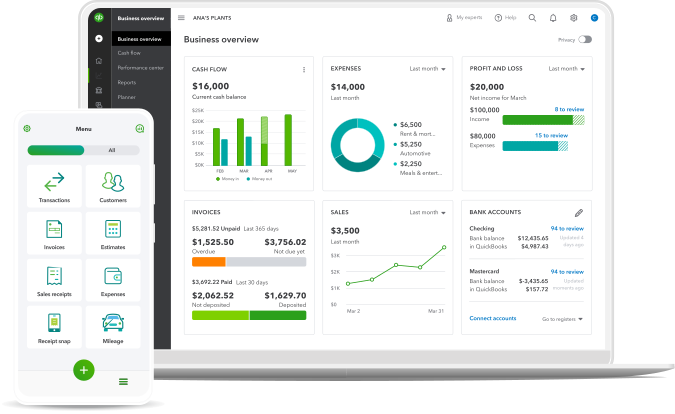
QuickBooks Online is one of the most recognized names in accounting software, and its integration of Intuit Assist—an AI-powered financial assistant—takes it to the next level. Designed especially for startups and small businesses, QuickBooks combines ease of use with advanced automation.
Intuit Assist helps business owners understand their cash flow, categorize expenses, and even forecast upcoming financial needs. Instead of just crunching numbers, it acts like a virtual advisor that provides insights based on your real-time financial data.
For small business owners juggling multiple responsibilities, QuickBooks reduces manual bookkeeping by syncing bank feeds and automating reconciliation. It also offers a wide range of integrations with payment processors, payroll services, and third-party apps.
With its real-time dashboards, businesses can make quick decisions backed by accurate, up-to-date numbers. Whether you’re tracking expenses, preparing taxes, or sending invoices, QuickBooks Online with AI features ensures you’re working smarter, not harder.
Key Features:
- AI-powered Intuit Assist for financial insights
- Automated bank reconciliation and transaction categorization
- Customizable invoices and recurring billing
- Real-time reporting and dashboards
- Integrations with hundreds of third-party apps
Best For:
Startups and small businesses that need robust yet easy-to-use accounting software with AI-driven insights.
Rating:
⭐ 4.7 / 5
We have listed! Logistics Management Software
2) Xero: Popular AI Bookkeeping Software
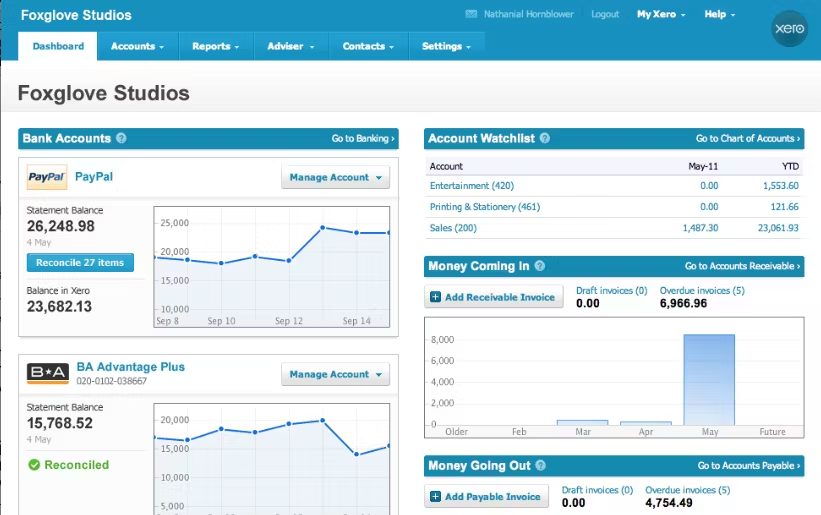
Xero has established itself as a cloud-first accounting platform, and its AI-powered features make it especially appealing for growing businesses and international teams. The software automates critical tasks such as bank reconciliation, transaction categorization, and invoice management. What sets Xero apart is its ability to handle multiple users seamlessly, making it ideal for teams that need to collaborate across different locations.
One of Xero’s strongest advantages is its extensive ecosystem of over 1,000 third-party integrations. Whether you need payroll, inventory management, or CRM, there’s likely an app that connects directly to your Xero account. The AI engine also makes reconciliation faster by learning from past transactions, reducing the need for repetitive manual input. With its clean, intuitive interface, Xero offers small and mid-sized businesses a powerful way to manage finances without the steep learning curve of enterprise-level tools.
Key Features:
- AI-driven bank transaction matching and reconciliation
- Customizable invoicing with automated reminders
- Cloud-based, accessible from anywhere with multi-user support
- Over 1,000 third-party integrations for scalability
- Real-time financial dashboards and reporting
Best For:
Cloud-first small to mid-sized businesses and international teams that prioritize collaboration, automation, and integrations.
Rating:
⭐ 4.6 / 5
Also listed! Employee Time-Tracking Apps
3) FreshBooks: AI-powered accounting Tool
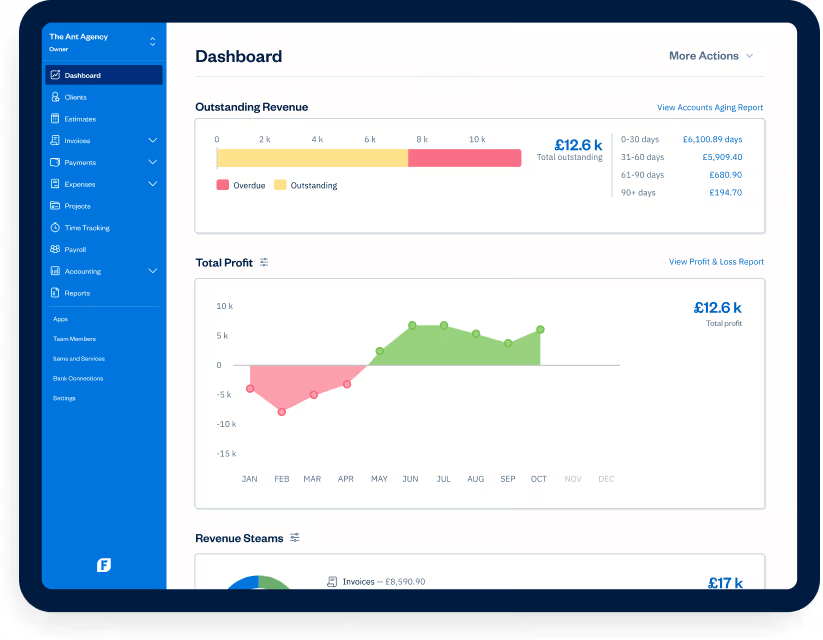
FreshBooks is designed with freelancers, consultants, and service-based businesses in mind, making it one of the most user-friendly AI Accounting Software Tools on the market.
The platform focuses on simplifying everyday financial tasks like invoicing, expense tracking, and time management. Its AI features help automate repetitive bookkeeping work, such as categorizing expenses and sending invoice reminders, so entrepreneurs can spend less time on paperwork and more time serving clients.
Another strength of FreshBooks is its intuitive interface. Even if you have no accounting background, you can easily navigate the software, create professional-looking invoices, and track billable hours. The AI engine also provides insights into spending patterns, helping you understand where money is going and how to optimize cash flow.
For small teams or solo business owners, this kind of clarity can be a game-changer. Plus, FreshBooks integrates with popular payment gateways, project management tools, and tax apps, giving you a complete financial management hub.
Key Features:
- AI-enhanced invoicing with automated reminders
- Expense categorization and spending insights
- Time tracking and project-based billing
- Easy-to-use dashboard for non-accountants
- Integrations with payment processors and business apps
Best For:
Freelancers, consultants, and agencies who prioritize simple invoicing, time tracking, and expense management.
Rating:
⭐ 4.5 / 5
Looking for? Free CRM For Small Business
4) Zoho Books: Top Accounting Software with AI
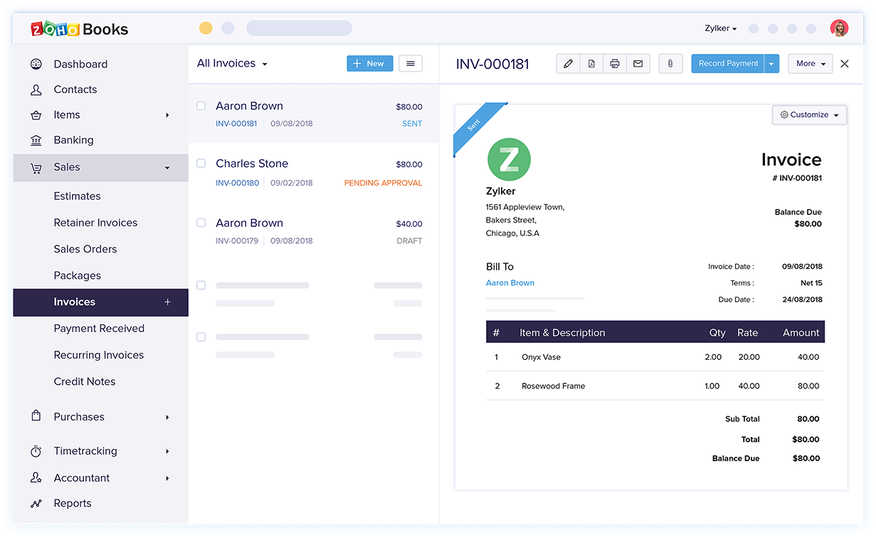
Zoho Books is part of the larger Zoho business suite, which makes it a great choice for companies already using Zoho’s CRM, HR, or project management tools. As one of the most affordable AI Accounting Software Tools, it combines powerful automation with accessibility.
The platform uses AI-driven categorization and reconciliation to streamline bookkeeping tasks, ensuring that expenses and transactions are automatically sorted with minimal manual intervention.
Because it’s cloud-based, Zoho Books makes collaboration easy. Multiple team members can access the system, assign roles, and track progress in real time. It also allows you to customize workflows—like setting automated reminders for invoices or creating approval processes for expenses.
With features such as real-time reconciliation, bank feeds, and automated reporting, Zoho Books reduces the burden of day-to-day accounting while giving you visibility into your financial health. For small businesses, its affordability and integration within the Zoho ecosystem make it a standout option.
Key Features:
- AI-driven expense categorization and reconciliation
- Automated bank feeds and transaction matching
- Customizable workflows for invoicing and approvals
- Seamless integration with Zoho’s full business suite
- Real-time dashboards and financial reports
Best For:
Small businesses and existing Zoho users who want an affordable, all-in-one financial management system.
Rating:
⭐ 4.4 / 5
5) Wave: AI in Accounting and Finance
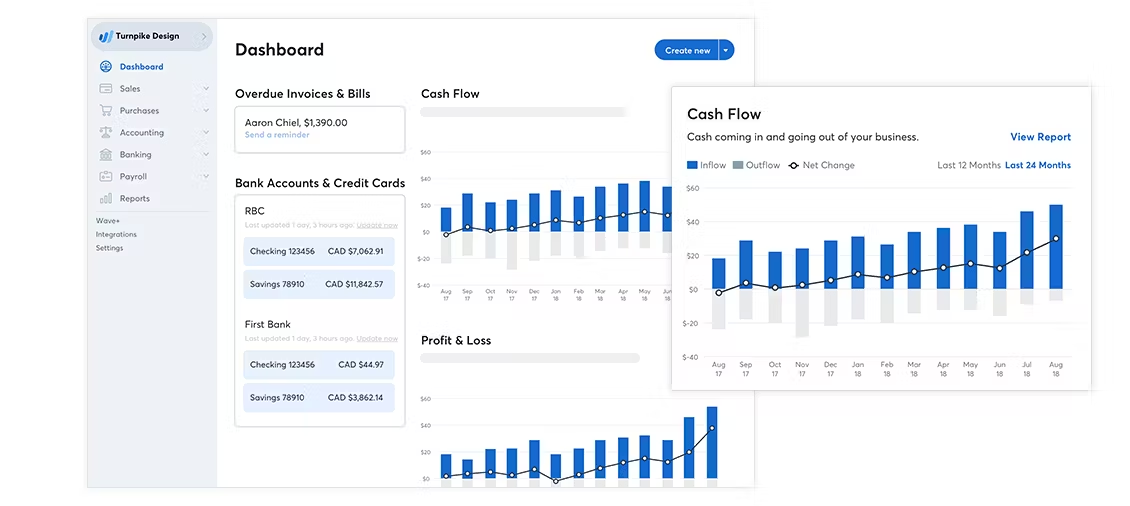
Wave is one of the most popular free AI Accounting Software Tools designed for freelancers, solopreneurs, and very small businesses. Unlike many competitors, it offers essential accounting functions like invoicing, expense tracking, and financial reporting at no cost.
Its AI-powered automation makes it possible to scan receipts, categorize transactions, and reconcile bank feeds with minimal effort. For entrepreneurs who don’t want to invest heavily in software early on, Wave delivers a solid foundation for managing day-to-day finances.
Despite being free, Wave doesn’t compromise on usability. The platform has a clean, intuitive interface that makes it easy for non-accountants to manage bookkeeping. It also generates comprehensive financial reports, giving users a clear picture of cash flow and profitability.
While it may not scale as well as premium tools like QuickBooks or Xero, Wave remains an excellent entry point for businesses starting their financial journey. Its optional paid add-ons—such as payroll and payment processing—make it flexible enough to grow with you.
Key Features:
- Free core accounting functions (invoicing, expense tracking, reporting)
- AI-enabled receipt scanning and categorization
- Automated bookkeeping with bank feeds
- Easy-to-use interface for non-accountants
- Optional paid add-ons like payroll and payments
Best For:
Startups, freelancers, and solopreneurs who need basic accounting features without the cost.
Rating:
⭐ 4.3 / 5
Accounting Software for Larger or Specialized Businesses
6) Vic.ai: AI-based financial management tool
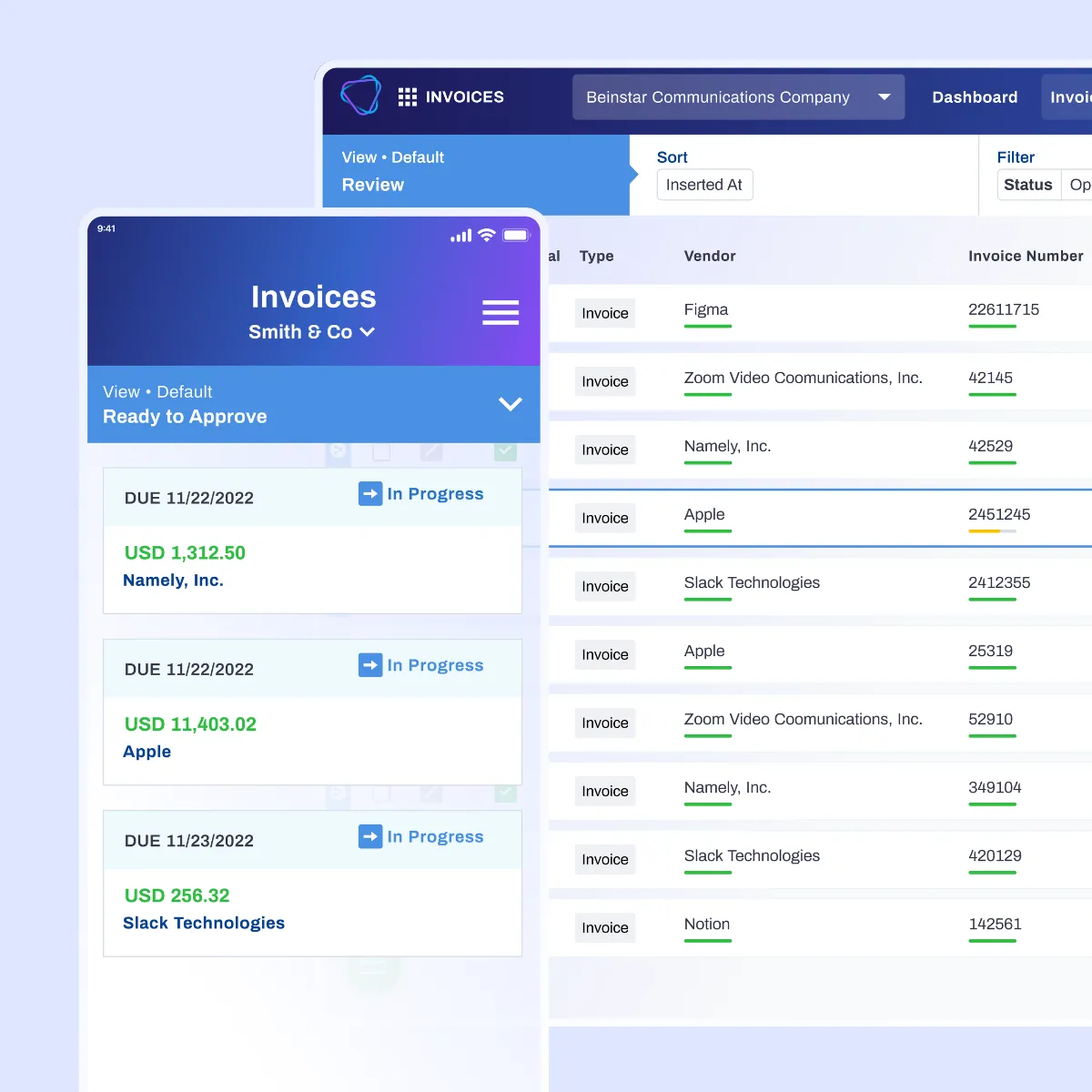
Vic.ai is not your typical accounting platform—it’s a specialized AI-driven tool designed to revolutionize accounts payable (AP) for mid-to-large enterprises. Unlike general-purpose AI Accounting Software Tools, Vic.ai focuses specifically on processing invoices with machine learning. It captures, analyzes, and approves invoices automatically, reducing human involvement and accelerating the payment cycle.
For companies dealing with thousands of invoices each month, this level of automation saves enormous time and cuts down on errors.
What sets Vic.ai apart is its ability to learn from historical data. The platform improves over time, predicting coding for expenses and matching invoices to purchase orders with increasing accuracy. It also provides real-time analytics, offering cost insights and benchmarking that help CFOs make better financial decisions.
By reducing manual intervention, Vic.ai enables finance teams to focus on higher-value tasks like strategy and planning instead of chasing paperwork. For enterprises seeking efficiency, scalability, and cost control, it’s a powerful solution.
Key Features:
- Automated invoice capture and approval workflows
- Machine learning for continuous accuracy improvement
- Purchase order matching to prevent duplicate or false entries
- Real-time cost analytics and benchmarking
- Scalable solution for high-volume AP environments
Best For:
Mid-to-large enterprises with heavy invoice volumes looking to streamline accounts payable and reduce processing costs.
Rating:
⭐ 4.5 / 5
We have listed! Warehouse Management Software
7) Sage Intacct: Best Accounting automation software
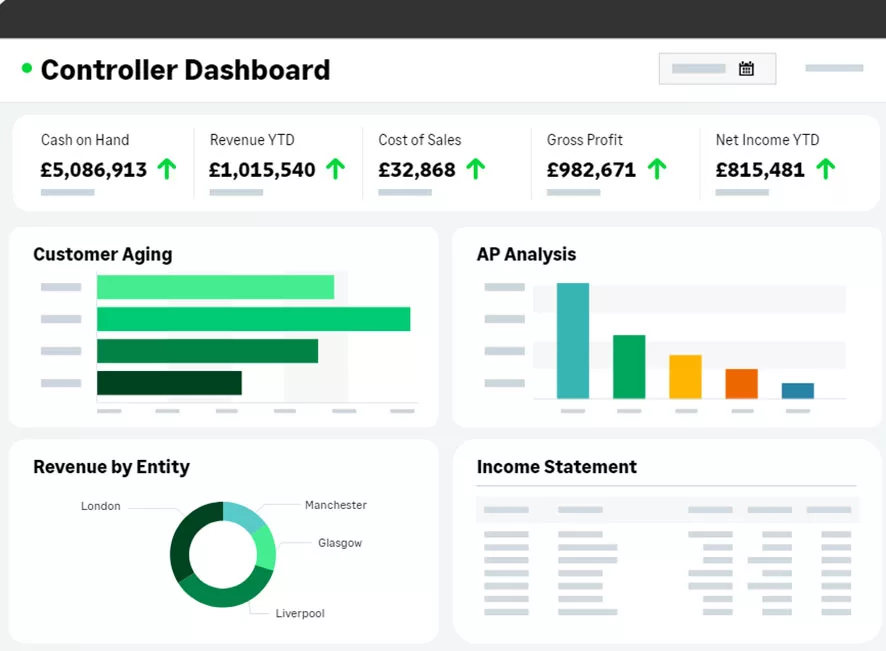
Sage Intacct is a cloud-based financial management platform built for growing mid-sized to large enterprises. What makes it stand out among AI Accounting Software Tools is its ability to handle complex accounting needs like multi-entity consolidation, advanced reporting, and compliance management.
The AI-powered general ledger automates repetitive tasks while also offering predictive insights, making it easier for CFOs and finance teams to stay ahead of potential risks.
The software is known for its scalability. Whether a business is managing multiple subsidiaries, handling intercompany transactions, or preparing for expansion into global markets, Sage Intacct provides the infrastructure to keep finances in order. Its dashboards give real-time visibility into financial health, while built-in analytics support smarter decision-making.
The platform also integrates seamlessly with other enterprise tools such as Salesforce, making it a strong choice for organizations that need robust and connected financial operations.
Key Features:
- AI-powered general ledger for automation and predictive insights
- Multi-entity and multi-currency consolidation
- Advanced financial reporting and analytics
- Scalable for growing enterprises
- Seamless integration with Salesforce and other enterprise apps
Best For:
Mid-sized to large enterprises with complex accounting structures that need scalability, compliance support, and detailed financial controls.
Rating:
⭐ 4.6 / 5
8) Zeni: AI-enabled Bookkeeping Solution
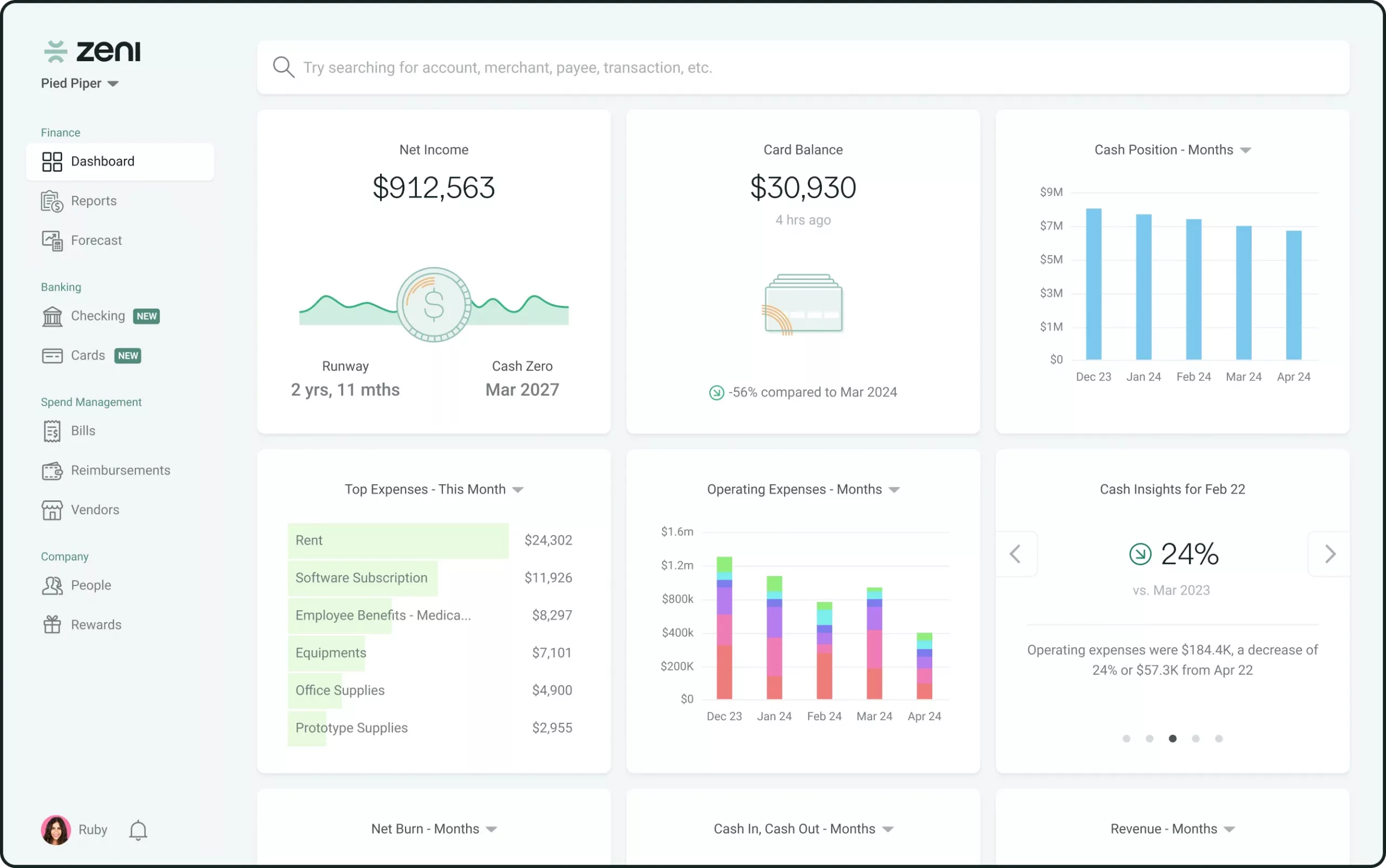
Zeni is a modern AI-driven platform that blends automation with human expertise, making it a favorite among fast-growing startups and venture-backed companies. Unlike most AI Accounting Software Tools, Zeni provides not just software but also full-service bookkeeping and financial management.
Its AI engine handles day-to-day accounting—like expense categorization, reconciliation, and reporting—while human finance experts oversee the process, ensuring accuracy and compliance.
One of Zeni’s standout features is its AI Audit Bot, which constantly checks records for compliance and accuracy, reducing the risk of errors during audits. Startups particularly value its real-time dashboards, which track cash flow, burn rate, and runway—vital metrics for companies managing investor funds.
By giving founders CFO-level insights without requiring an in-house finance team, Zeni allows startups to focus on scaling their business while staying financially sound. For companies that want an all-in-one financial partner, Zeni is a powerful solution.
Key Features:
- AI Audit Bot for compliance monitoring
- Automated bookkeeping and transaction categorization
- Real-time dashboards for cash flow, burn rate, and runway
- Human expert oversight alongside AI automation
- Comprehensive financial statements and reporting
Best For:
Fast-growing startups and venture-backed companies that need full-service financial management without hiring an in-house team.
Rating:
⭐ 4.7 / 5
9) Oracle NetSuite: AI Finance Software
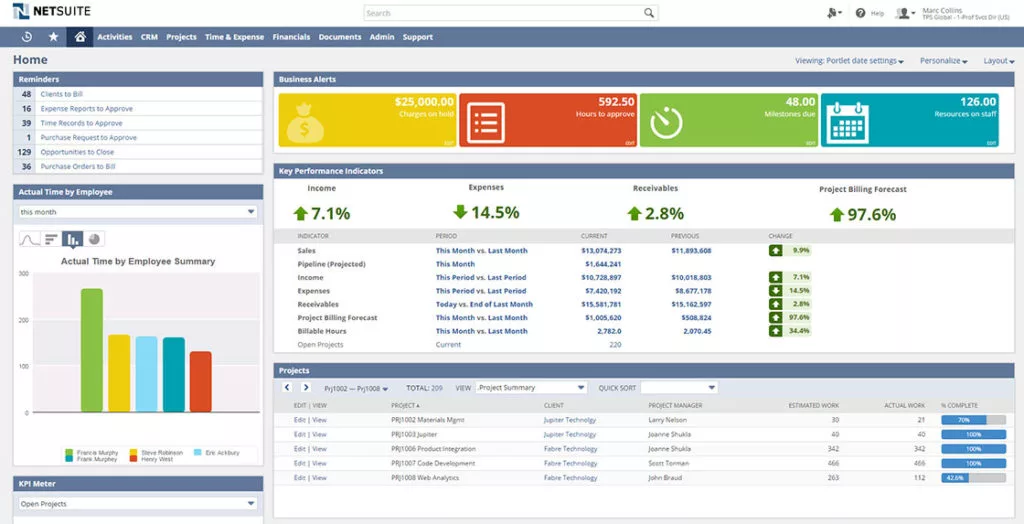
Oracle NetSuite is one of the most comprehensive enterprise resource planning (ERP) platforms available, and its AI-powered financial management features make it a top choice for large organizations. Unlike smaller AI Accounting Software Tools, NetSuite integrates accounting with inventory, CRM, HR, and supply chain management, creating a unified system for running complex businesses.
This all-in-one approach ensures that financial data is seamlessly connected with every other department.
What makes NetSuite especially powerful is its predictive analytics and advanced reporting capabilities. Businesses can forecast revenue, manage budgets, and plan scenarios with greater confidence. It also automates billing, revenue recognition, and compliance workflows—critical for companies operating across multiple regions and industries.
While NetSuite requires more investment and expertise to implement than other tools, the payoff is a highly scalable solution that supports growth and global expansion. For enterprises with complex financial needs, it remains one of the strongest platforms in the market.
Key Features:
- AI-driven predictive analytics and scenario planning
- Automated billing and revenue recognition
- Unified ERP system (accounting, CRM, supply chain, HR)
- Advanced reporting and budgeting tools
- Scalable for multinational enterprises
Best For:
Medium to large enterprises that need a robust, unified ERP platform with AI-powered financial management and scalability.
Rating:
⭐ 4.8 / 5
Looking for? Best Free Inventory Management Software
10) Trullion: Best Accounting automation Platform
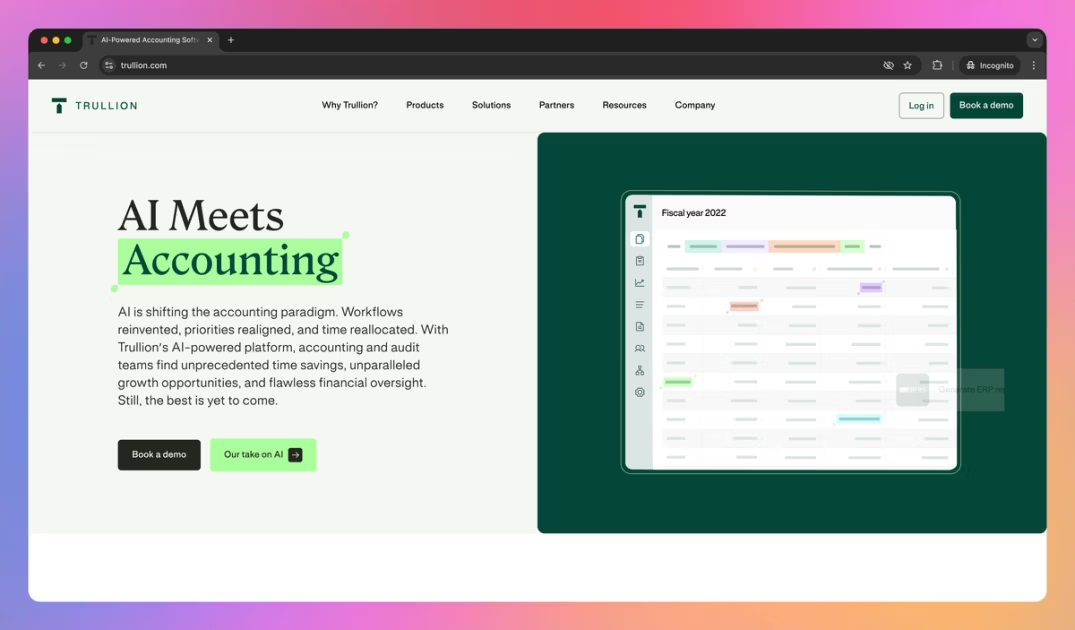
Trullion is a specialized AI accounting platform that focuses on lease and revenue recognition—two of the most complex areas of modern accounting. Unlike general-purpose AI Accounting Software Tools, Trullion is built to ensure compliance with accounting standards such as ASC 842, IFRS 16, and GASB.
By using AI to extract data directly from contracts and financial documents, it eliminates the need for manual entry and reduces the risk of misreporting.
The platform is especially valuable for companies with large portfolios of contracts or leases, such as real estate, retail, or enterprise businesses. Its AI engine automatically generates audit-ready trails, compliance reports, and real-time insights into financial obligations.
This not only saves time but also gives finance teams confidence in their reporting accuracy. For organizations where regulatory compliance is non-negotiable, Trullion delivers peace of mind alongside powerful automation.
Key Features:
- AI-driven data extraction from contracts and leases
- Automated compliance with ASC 842, IFRS 16, and GASB
- Real-time revenue and lease recognition
- Automated audit trails for transparency
- Detailed compliance and financial reporting tools
Best For:
Enterprises with numerous contracts and leases that need accurate, automated compliance and audit-ready reporting.
Rating:
⭐ 4.5 / 5
Comparison of the 10 Best AI Accounting Software Apps
Choosing the right accounting software can feel overwhelming, especially with so many options available. To make it easier, here’s a side-by-side comparison of the best AI Accounting Software Tools in 2025. This table highlights each tool’s ideal user, pricing level, standout AI feature, and rating, so you can quickly see which one fits your business needs.
| Software | Best For | Price Level | Key AI Feature | Rating |
|---|---|---|---|---|
| QuickBooks Online | Startups & small businesses | Moderate | Intuit Assist for cash flow insights | ⭐ 4.7 |
| Xero | Cloud-first small to mid-sized businesses | Moderate | AI bank transaction matching | ⭐ 4.6 |
| FreshBooks | Freelancers & service-based businesses | Low | AI-enhanced invoicing & expense tracking | ⭐ 4.5 |
| Zoho Books | Small businesses & Zoho ecosystem users | Low | AI-driven categorization & workflows | ⭐ 4.4 |
| Wave | Freelancers & solopreneurs on a budget | Free | AI-enabled receipt scanning | ⭐ 4.3 |
| Vic.ai | Mid-to-large enterprises with heavy AP volume | High | Machine learning for invoice processing | ⭐ 4.5 |
| Sage Intacct | Mid-to-large enterprises with complex accounting | High | AI-powered general ledger | ⭐ 4.6 |
| Zeni | Fast-growing startups & venture-backed companies | High | AI Audit Bot & CFO-level insights | ⭐ 4.7 |
| Oracle NetSuite | Medium to large enterprises | Very High | Predictive analytics & ERP integration | ⭐ 4.8 |
| Trullion | Compliance-heavy enterprises with many leases | High | AI-driven contract & lease recognition | ⭐ 4.5 |
How to Choose the Right AI Accounting Software Tool
With so many options available, picking the best fit from today’s AI Accounting Software Tools comes down to understanding your business’s size, budget, and long-term needs. Not every platform is designed for every type of company, so here are a few things to consider before making your decision:
1. Company Size and Complexity
Freelancers and startups usually do well with tools like Wave or FreshBooks, which focus on simplicity. Larger enterprises managing multiple entities may need Sage Intacct or Oracle NetSuite for advanced reporting and compliance.
2. Budget vs. Features
If you’re just starting out, free or low-cost options like Wave or Zoho Books can handle the basics. If you’re ready to invest in scalability, higher-tier platforms like Vic.ai or Zeni deliver deeper automation and real-time insights.
3. Integration Needs
Think about how the tool will work with your existing systems. For example, Xero integrates with over 1,000 third-party apps, while Zoho Books works seamlessly within the broader Zoho ecosystem.
4. Industry-Specific Requirements
If your company manages complex leases or contracts, Trullion is a better fit than a general tool. Similarly, Vic.ai is ideal for businesses drowning in invoices.
5. Trial and Usability
Most providers offer free trials or demos. Take advantage of these to test how intuitive the interface is and how well the AI features actually deliver in real-world use.
Ultimately, the “best” tool is the one that makes your accounting easier, faster, and more accurate—while also supporting your business growth.
Must see! Most Popular AI Apps For Daily Use
That’s all
Artificial intelligence is no longer a futuristic concept in finance—it’s already transforming how businesses manage money. From automating bank reconciliations to predicting cash flow trends, the best AI Accounting Software Tools are giving companies of all sizes the power to save time, reduce errors, and make smarter financial decisions.
What once took hours of manual effort can now be completed in minutes, and with far greater accuracy.
For small businesses, tools like QuickBooks, Xero, and FreshBooks simplify day-to-day bookkeeping while keeping costs manageable.
Larger enterprises benefit from platforms like Oracle NetSuite, Sage Intacct, and Vic.ai, which can handle complex financial operations at scale.
And for companies in niche areas, Trullion and Zeni provide specialized insights that traditional software simply can’t match.
The takeaway is clear: adopting AI in accounting isn’t optional anymore—it’s a competitive advantage. As we move into 2025 and beyond, the companies that embrace these tools will be the ones that make faster decisions, maintain compliance effortlessly, and ultimately achieve stronger growth.
If this article helped you explore accounting automation, your next step might be diving deeper into AI-powered financial forecasting tools, which take business planning and decision-making to an even higher level.
Looking for? Workforce Management Software (Free/ Paid)
FAQs About AI Accounting Software Tools
How much does it cost to use AI Accounting Software Tools?
The cost varies depending on the tool and business size. For freelancers or very small businesses, free options like Wave can cover basic needs. Mid-range solutions like QuickBooks or Xero typically start at around $30–$70 per month, while enterprise tools such as Oracle NetSuite or Sage Intacct can cost hundreds to thousands per month depending on users, modules, and integrations. Custom implementations often involve setup fees, training, and ongoing support, so it’s important to budget accordingly.
Can AI Accounting Software Tools replace human accountants?
Not entirely. While AI automates repetitive tasks such as categorization, reconciliation, and invoicing, human accountants are still needed for strategic planning, interpretation of financial data, and compliance oversight. Think of AI as the assistant that handles the heavy lifting, while accountants and CFOs focus on higher-value decisions. The best results come when businesses combine AI tools with professional financial expertise.
What are the main ways AI accounting software helps businesses make money?
Indirectly, AI saves money by reducing errors, cutting down on manual labor, and preventing compliance issues. More importantly, AI Accounting Software Tools boost profitability by providing real-time insights. For example, they can forecast cash flow, highlight unnecessary spending, and even predict late payments from clients. By spotting issues early, companies can take corrective action that directly improves the bottom line.
How secure are AI Accounting Software Tools for sensitive financial data?
Security is a top priority for all leading providers. Most platforms use bank-grade encryption, multi-factor authentication, and regular security audits. Enterprise-grade tools like Oracle NetSuite and Sage Intacct go a step further by offering compliance with industry standards such as SOC 2 and GDPR. However, it’s always smart to review a vendor’s security policies, ask about data storage, and train your team to follow best practices like strong passwords and role-based access.
Which AI Accounting Software Tool is best for small businesses?
For small businesses or startups, QuickBooks Online, Xero, and Zoho Books are excellent choices. They balance affordability, ease of use, and strong automation features. If budget is very tight, Wave offers a free entry point with enough AI-powered features to manage invoicing and expenses. Each of these tools is designed to help small teams save time while keeping their financials organized and compliant.
What are the future trends for AI in accounting software?
Looking ahead, expect AI to move from automation toward predictive and advisory roles. Future AI Accounting Software Tools will not only process transactions but also:
- Provide intelligent financial forecasts.
- Offer scenario planning (e.g., “What happens if sales drop 10%?”).
- Detect fraud and anomalies faster.
- Integrate with AI-driven tax and payroll systems.
- Support voice and natural language commands for real-time financial queries.