

A fitness app like Strava can cost about $40,000 to $350,000 or more to develop, depending on its features, platforms, integrations, design, backend architecture, and level of complexity. A basic MVP may fall around $40,000–$80,000, a mid-level Strava-style product can cost $80,000–$180,000, while an advanced platform with AI, extensive wearable integrations, social functionality, and scalable infrastructure can exceed $180,000.
The important point is that a Strava-like product is more than a workout tracker. It combines GPS, maps, health data, analytics, social networking, cloud infrastructure, subscriptions, and sometimes machine learning. Each layer adds development and maintenance work.
Strava itself shows how large this type of platform can become. As of June 2026, the company said it had more than 195 million athletes across more than 185 countries. That scale is not necessary for a new product, but it illustrates why founders should separate an initial MVP from the full platform they may eventually want to build.
How much does it cost to develop a fitness app like Strava?
The budget depends primarily on what you want the first version to do.
| App type | Estimated development cost | Typical timeline |
|---|---|---|
| Basic fitness MVP | $40,000–$80,000 | 3–5 months |
| Mid-level Strava-style app | $80,000–$180,000 | 5–8 months |
| Advanced fitness platform | $180,000–$350,000+ | 8–12+ months |
These are planning ranges rather than fixed quotations. Actual pricing changes with team location, technology choices, platform count, integrations, design requirements, testing, and project scope.
Current market data also shows why app estimates can vary considerably. Clutch’s July 2026 pricing research reports that reviewed mobile app projects commonly fall between $10,000 and $49,999, while its data puts the average reviewed project cost at about $90,780. It also reports typical app development company rates of $25–$49 per hour. Clutch notes that features, UX complexity, and backend requirements are major factors behind the final price.
For a Strava-style product, the higher end of the range becomes more relevant because GPS tracking, real-time activity processing, social functionality, and third-party integrations require substantially more backend and testing work than a simple workout logging application.
What makes a Strava-like fitness app expensive?
The biggest cost difference comes from the technology underneath the interface. A user may see a simple screen showing distance, pace, calories, and a route on a map. Behind that screen, the application may need to collect location updates, process them, calculate performance metrics, store activity records, synchronize data, display maps, handle poor connectivity, and protect sensitive information.
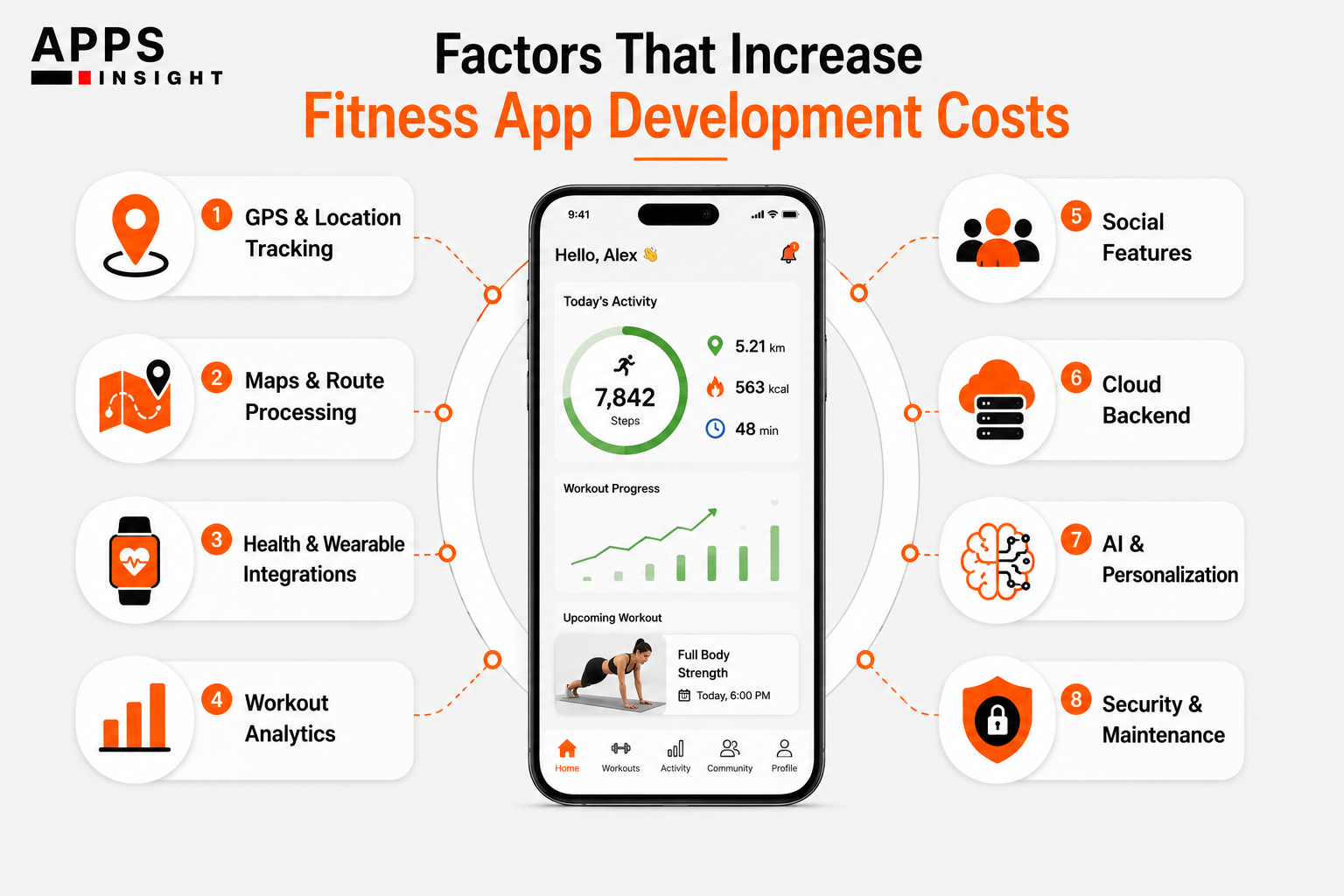
GPS tracking is one of the more demanding components. During an outdoor workout, the application needs to collect location information without unnecessarily draining the phone battery. It also needs to handle inaccurate GPS readings, interruptions, permissions, and changes in network connectivity.
Apple’s HealthKit documentation illustrates the technical work involved. A workout route can contain location, altitude, speed, course, and accuracy information. Apple also notes that a route may contain thousands of locations, which means applications may need to process the information in batches rather than assuming all data arrives at once.
A Strava-like product may therefore require:
- User registration and profiles
- GPS activity tracking
- Route recording and maps
- Distance, pace, speed, elevation, and calorie calculations
- Workout history
- Personal performance statistics
- Social feeds
- Likes, comments, follows, and sharing
- Clubs and challenges
- Leaderboards
- Push notifications
- Wearable integrations
- Apple Health and Google Health Connect integrations
- Subscription management
- Payment processing
- Cloud storage
- Admin and moderation tools
- Analytics
- Security and privacy controls
The social layer can also increase the budget. The product is no longer simply recording workouts. It becomes a community platform where users create content, interact with other people, follow athletes, join groups, and receive notifications.
That makes it closer to the technical requirements of Growing Social Media Platforms than a basic step counter.
Feature-by-feature development cost
The following estimates can help a founder understand where the budget goes.
| Feature | Estimated cost |
|---|---|
| Registration and user profiles | $3,000–$7,000 |
| GPS activity tracking | $8,000–$20,000 |
| Maps and route functionality | $7,000–$18,000 |
| Workout analytics | $6,000–$15,000 |
| Social feed and interactions | $8,000–$20,000 |
| Clubs, challenges and leaderboards | $7,000–$18,000 |
| Wearable and health integrations | $8,000–$25,000+ |
| Push notifications | $2,000–$5,000 |
| Subscription and payments | $4,000–$10,000 |
| Admin dashboard | $5,000–$12,000 |
| Testing and security | $6,000–$15,000 |
These ranges should not be added mechanically to determine a project quote. Some work overlaps, and the same backend services can support several features.
For example, user profiles, activity history, social feeds, and leaderboards may all rely on the same account and database architecture. On the other hand, adding wearable integrations can introduce separate APIs, permissions, device-specific testing, and data synchronization requirements.
Health integrations also need careful planning. Apple requires permission before an application accesses HealthKit data, and workout routes require both HealthKit and location permissions.
For founders comparing different fitness app solutions, this is an important distinction: two applications can have similar screens but very different development costs because their underlying integrations and data requirements are different.
How much does an MVP cost compared with a full platform?
A sensible MVP does not need every feature found in Strava. A basic MVP could focus on one activity, such as running or cycling. It could include registration, GPS tracking, route visualization, workout history, basic statistics, user profiles, and simple sharing.
That type of product could reasonably fall in the $40,000–$80,000 planning range. A mid-level product could add:
- iOS and Android support
- Multiple sports
- Social feed
- Following and followers
- Challenges
- Leaderboards
- Wearable integrations
- Health-platform integrations
- Subscription plans
- Advanced analytics
- Admin moderation
That moves the estimate toward $80,000–$180,000. An advanced platform could go further with machine learning, real-time recommendations, extensive device support, sophisticated analytics, large-scale social infrastructure, and a highly optimized backend. That is where a budget of $180,000–$350,000+ becomes more realistic.
This phased approach is often more practical than trying to reproduce every feature on the first release. It allows the team to test whether users actually want the core product before spending heavily on advanced functionality.
How does AI affect fitness app development cost?
AI is an optional layer, not a requirement for launching a fitness app.
The AI in a fitness app can be used for personalized training suggestions, performance predictions, workout recommendations, activity analysis, conversational fitness assistance, or identifying patterns in a user’s training history.
Strava provides a useful example. Its Performance Predictions feature uses a machine-learning model that analyzes more than 100 data points about a runner and information about how similar runners perform. Strava said the feature updates after new runs and estimates race times for distances including 5K, 10K, half marathon, and marathon.
Adding a similar capability involves more than connecting an AI API.
A development team may need to work on:
- Data collection: determining which workout information can be used.
- Data preparation: cleaning and organizing historical activity data.
- Model selection: deciding whether to use an existing model, machine-learning service, or custom model.
- Recommendation logic: defining how predictions or suggestions should be generated.
- Backend processing: running calculations and storing results.
- Testing: checking whether recommendations are consistent and useful.
- Monitoring: tracking model performance after launch.
If an AI feature is not central to the product’s value proposition, it can be postponed until the core tracking and engagement experience has been validated.
Technology choices that influence the budget
The platform decision is another major cost factor. A founder can build for:
- iOS only
- Android only
- iOS and Android separately
- Both platforms using cross-platform development
Native development can provide strong platform-specific control, which can matter when working with device sensors, background location, Apple Watch, or advanced platform APIs.
Cross-platform development can reduce duplicated work when the application has largely shared functionality. Clutch’s current pricing guide reports similar listed hourly ranges for Android, iOS, and hybrid/cross-platform development, while also noting that the right choice depends on the target audience, timeline, features, and available resources.
The backend is equally important. A fitness application needs somewhere to store accounts, workouts, routes, performance records, social activity, subscriptions, and other data.
The architecture may include:
- Application programming interfaces
- Cloud servers
- Databases
- Object storage
- Authentication services
- Notification systems
- Analytics
- Monitoring
- Content moderation
- Payment services
Using established APIs can reduce development time, but third-party services may introduce recurring usage charges. This is particularly relevant for maps, location services, communications, payments, and AI.
How much does it cost to maintain a fitness app?
Development is only the initial expense. After launch, a fitness app may require ongoing spending for cloud infrastructure, database storage, monitoring, bug fixes, security updates, operating-system compatibility, customer support, API usage, and new features.
GPS-heavy applications can create substantial data volumes. Apple’s documentation notes that workout routes can contain thousands of location points and may need to be processed in batches. At larger user volumes, storing and processing this activity data becomes an infrastructure consideration rather than simply a development task.
A practical maintenance budget might be around 15%–25% of the initial development cost per year for routine maintenance and improvements, although this is only a planning rule. Actual costs depend on usage, team structure, infrastructure, support requirements, and how frequently the product changes.
For example, a $100,000 application might require a maintenance and improvement budget of roughly $15,000–$25,000 annually as a starting planning assumption. A fast-growing application with millions of activities could require significantly more because infrastructure and engineering requirements increase with usage.
The business model matters too. A subscription-based product needs payment management, subscription status synchronization, renewal handling, cancellations, receipts, and customer support. These requirements are different from those found in Fintech App Development Companies, but the underlying lesson is similar: transactions introduce additional technical and compliance considerations.
What development team should you hire?
There is no single type of team that is automatically best. The right choice depends on the product’s complexity, budget, timeline, and internal technical resources.
An in-house team provides direct control but requires salaries, recruitment, management, and infrastructure.
Freelancers can be useful for limited work, prototypes, or specific technical tasks. However, coordinating several independent specialists can become difficult when the product includes mobile development, backend engineering, UI/UX, QA, cloud infrastructure, and integrations.
Software development companies can provide a broader team under one engagement. A buyer should evaluate their experience with location tracking, health data, wearable devices, backend architecture, security, and apps with social functionality.
When researching Mobile App Development Companies, don’t compare providers only by hourly rate. A lower rate does not automatically mean a lower total project cost. A team that understands GPS, background processing, data synchronization, and wearable APIs may complete complex work more efficiently than a cheaper team without that experience.
The same applies when reviewing Best Fitness App Development Companies. Ask for evidence of comparable projects and request a breakdown of the proposed scope rather than accepting a single large number.
A useful proposal should explain:
- Features included
- Platforms included
- Technology stack
- Third-party integrations
- Development milestones
- Testing process
- Security approach
- Post-launch support
- Infrastructure assumptions
- What is excluded from the quote
That makes competing proposals easier to compare.
How can founders reduce development costs?
The simplest way to reduce the initial budget is to reduce the first release’s scope. Start with the feature that solves the main user problem. For a running application, that might be:
Track → Save → Analyze → Share
The first version does not necessarily need advanced AI, ten sports, dozens of wearable integrations, complex clubs, or a sophisticated recommendation engine.
A phased roadmap could look like this:
Phase 1: Registration, GPS tracking, workout history, basic analytics, profile, and sharing.
Phase 2: Social feed, following, challenges, leaderboards, and subscriptions.
Phase 3: Wearable integrations, advanced analytics, multiple sports, and richer community features.
Phase 4: AI-based predictions, personalized recommendations, and advanced training tools.
This approach reduces technical risk because each stage has a clear purpose. It also prevents a common budgeting mistake: paying for features before knowing whether users will use them.
A founder can also reduce costs by selecting a suitable technology stack, reusing backend services, using established APIs, designing a consistent component system, and choosing cross-platform development where it makes technical sense.
The objective should not be to build the cheapest possible application. It should be to avoid spending money on functionality that has not yet been validated.
Why Strava’s scale matters
Strava’s current scale provides useful context for understanding why a mature fitness platform requires more infrastructure than an MVP.
Strava said it had more than 195 million athletes in over 185 countries as of June 2026. In another 2025 announcement, the company said that users recorded nearly 1 billion runs during 2024.
Those numbers represent enormous quantities of activity information. They also show why a fitness application needs to be designed with future growth in mind. A database that works for 10,000 users may need architectural changes when the platform reaches millions of users.
The wider market also shows significant consumer activity. Statista reports that health and wellness apps recorded 3.6 billion downloads worldwide in 2024, up 6% from the previous year. The same source reports approximately $3.88 billion in health and fitness in-app purchase revenue in 2024.
For founders evaluating Health Apps, these figures indicate a large market, but they should not be interpreted as a guarantee that a particular product will succeed. Product-market fit, retention, usability, pricing, and differentiation still determine whether an application can build a sustainable user base.
The scale of the category also explains why applications appearing among trending apps in the USA can range from simple trackers to complex ecosystems connecting mobile devices, wearables, communities, and subscription services.
How long does it take to build an app like Strava?
The development timeline generally depends on the same variables that affect price.
A basic MVP can take around 3–5 months.
A mid-level application with social features, health integrations, subscriptions, and advanced analytics may require 5–8 months.
A more advanced platform can take 8–12 months or longer.
A typical process includes:
Discovery and planning: 2–4 weeks
UI/UX design: 3–6 weeks
Core development: 3–8 months
Testing and quality assurance: performed throughout development, followed by final testing
Launch preparation: usually several weeks
These stages can overlap. For example, developers may start building the backend while designers finalize later screens.
The timeline can increase when requirements change during development. Adding a new wearable platform, changing the activity model, introducing a new social system, or supporting another operating system can affect both engineering and testing.
Final cost estimate of Fitness App
For most founders, the following range is a useful starting point:
| Product scope | Budget | Timeline |
|---|---|---|
| Basic fitness tracking MVP | $40,000–$80,000 | 3–5 months |
| Strava-style mid-level app | $80,000–$180,000 | 5–8 months |
| Advanced fitness platform | $180,000–$350,000+ | 8–12+ months |
The cost to develop a fitness app is therefore driven less by the word “fitness” and more by what the application actually needs to do.
A GPS tracker with a profile and workout history is a relatively contained product. A platform combining GPS, maps, health data, wearable integrations, social networking, subscriptions, AI, and large-scale analytics is a much larger software system.
Before requesting proposals, founders should define the first release in terms of specific features, supported platforms, integrations, target users, and expected usage. This gives development teams enough information to produce a meaningful estimate.
It is also worth reviewing comparable agencies, technology providers, app reviews, and development resources before selecting a partner. AppsInsight provides research and analysis of app development providers and maintains directories covering technology companies and software services, which can be useful when researching potential vendors.
In short, a realistic initial budget for a Strava-like fitness application is $40,000–$80,000 for an MVP, $80,000–$180,000 for a more complete product, and $180,000–$350,000+ for an advanced platform. The best starting point is not to copy every feature of an established product. Define the core user problem, build the smallest reliable version that addresses it, measure how people use it, and then invest in the features that the data supports.
FAQs
How much does it cost to develop a fitness app like Strava?
A Strava-like fitness app can cost approximately $40,000–$350,000+, depending on features, platforms, integrations, AI, backend complexity, and scalability requirements.
How long does it take to build an app like Strava?
A basic MVP may take 3–5 months, while a mid-level application can take 5–8 months and an advanced platform can require 8–12 months or more.
What features does a Strava-like fitness app need?
Core features usually include GPS tracking, maps, workout recording, performance analytics, user profiles, social interactions, activity history, notifications, health or wearable integrations, and an admin system.
How much does it cost to maintain a fitness app?
Routine maintenance may be planned at roughly 15%–25% of the original development cost per year, although actual expenses depend on users, infrastructure, third-party APIs, support requirements, and ongoing feature development.
What factors affect fitness app development costs?
The main factors are feature complexity, number of platforms, GPS and mapping requirements, health and wearable integrations, backend architecture, AI functionality, UI/UX complexity, security, testing, developer rates, and expected user scale.