
The cost to develop an AI-powered diet planner app generally ranges from $30,000 to $150,000 or more, depending on the app’s features, AI capabilities, integrations, and your development team’s location. A basic MVP with core functionalities such as meal planning, calorie tracking, and AI-based recommendations typically costs between $30,000 and $50,000. In contrast, a feature-rich solution with advanced AI, computer vision for food recognition, wearable device integration, personalized nutrition insights, and automated grocery ordering can easily exceed $150,000.
The demand for personalized health and nutrition solutions has grown rapidly over the past few years. People are no longer satisfied with generic diet charts or one-size-fits-all fitness plans. Instead, they expect intelligent systems that understand their bodies, habits, preferences, allergies, and long-term health goals. This shift has fueled the rise of AI-powered diet planner apps, which use machine learning and data-driven insights to craft highly individualized meal plans, offer real-time support, and help users stay consistent on their wellness journey.
AI-powered nutrition platforms combine food science, behavioral psychology, and predictive analytics to deliver an experience that feels more like having a personal dietitian in your pocket. With growing interest in weight management, fitness tracking, and preventive healthcare, these apps have moved from being “good-to-have” tools to essential lifestyle companions.
Why Businesses Are Investing in AI Nutrition and Fitness Apps?
Businesses, startups, and health-tech innovators are increasingly shifting toward AI-driven diet planning apps because of their high market potential and long-term scalability. AI-based wellness products offer features that traditional apps simply cannot match—automated guidance, dynamic meal generation, adaptive recommendations, and continuous progress monitoring.
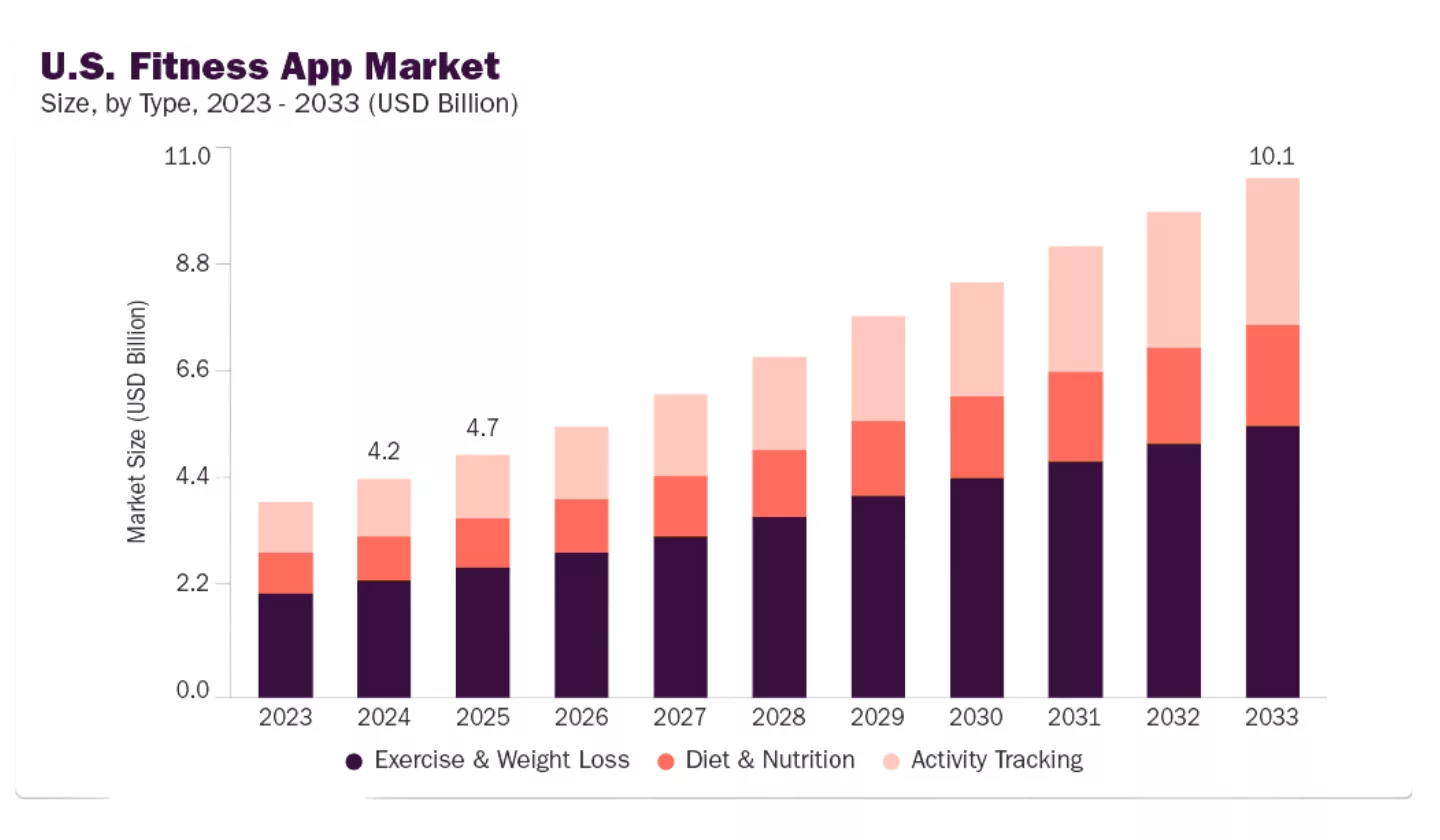
The market growth reflects this shift. As shown in the chart, the U.S. fitness app market is expected to grow from around $4.2 billion in 2024 to over $10 billion by 2033, driven by rising demand for exercise, diet, and activity-tracking apps. This surge highlights how consumer interest in AI-driven wellness solutions is expanding every year.
As consumers prioritize personalized health, entrepreneurs see an opportunity to tap into a market that rewards accuracy, convenience, and real-time engagement. AI-powered diet planning also enables brands to create recurring revenue streams through subscription models, AI coaching modules, integrated fitness plans, and premium customizations.
As a result, investing in an AI-driven diet planner app not only benefits end users but also provides businesses a strong foundation for growth in the rapidly expanding digital health landscape.
We have listed! Most Downloaded Apps In USA
What Is an AI-Powered Diet Planner App?
An AI-powered diet planner app is a smart nutrition and wellness platform that uses artificial intelligence, machine learning, and predictive data modeling to create hyper-personalized diet plans for users. Unlike traditional diet apps that rely on static meal charts, AI-based nutrition systems dynamically adapt to the user’s ongoing habits, preferences, and health changes.
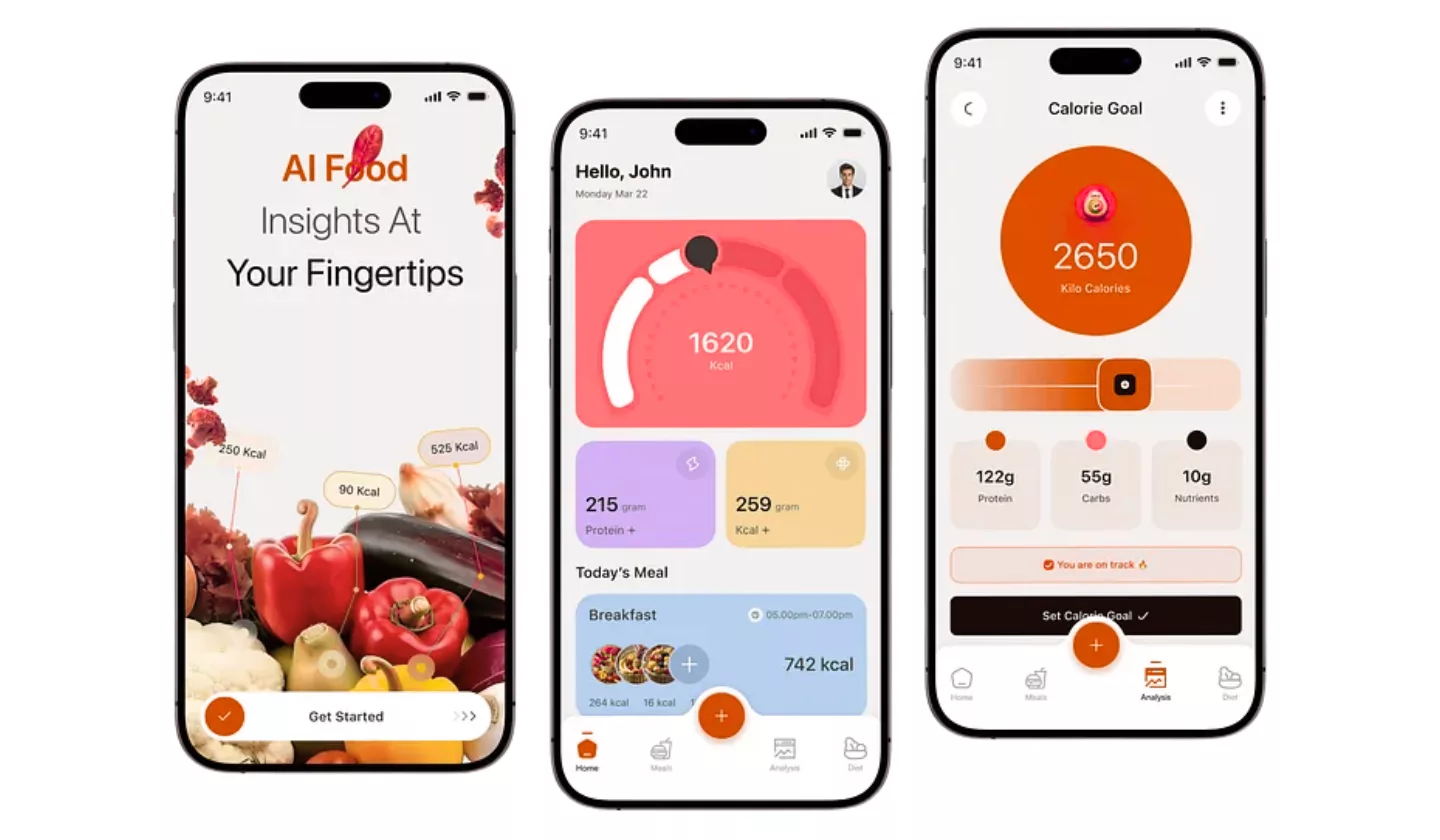
This makes the entire experience more accurate, engaging, and tailored to real-world lifestyles.
The core functions include gathering user health information, analyzing nutritional needs, tracking daily food intake, and generating personalized meal recommendations automatically.
The app doesn’t just provide food suggestions—it studies the user’s behavior over time, identifies patterns in eating habits, and delivers customized guidance throughout the day. This makes the app function like an always-available smart dietitian who adjusts recommendations in real time.
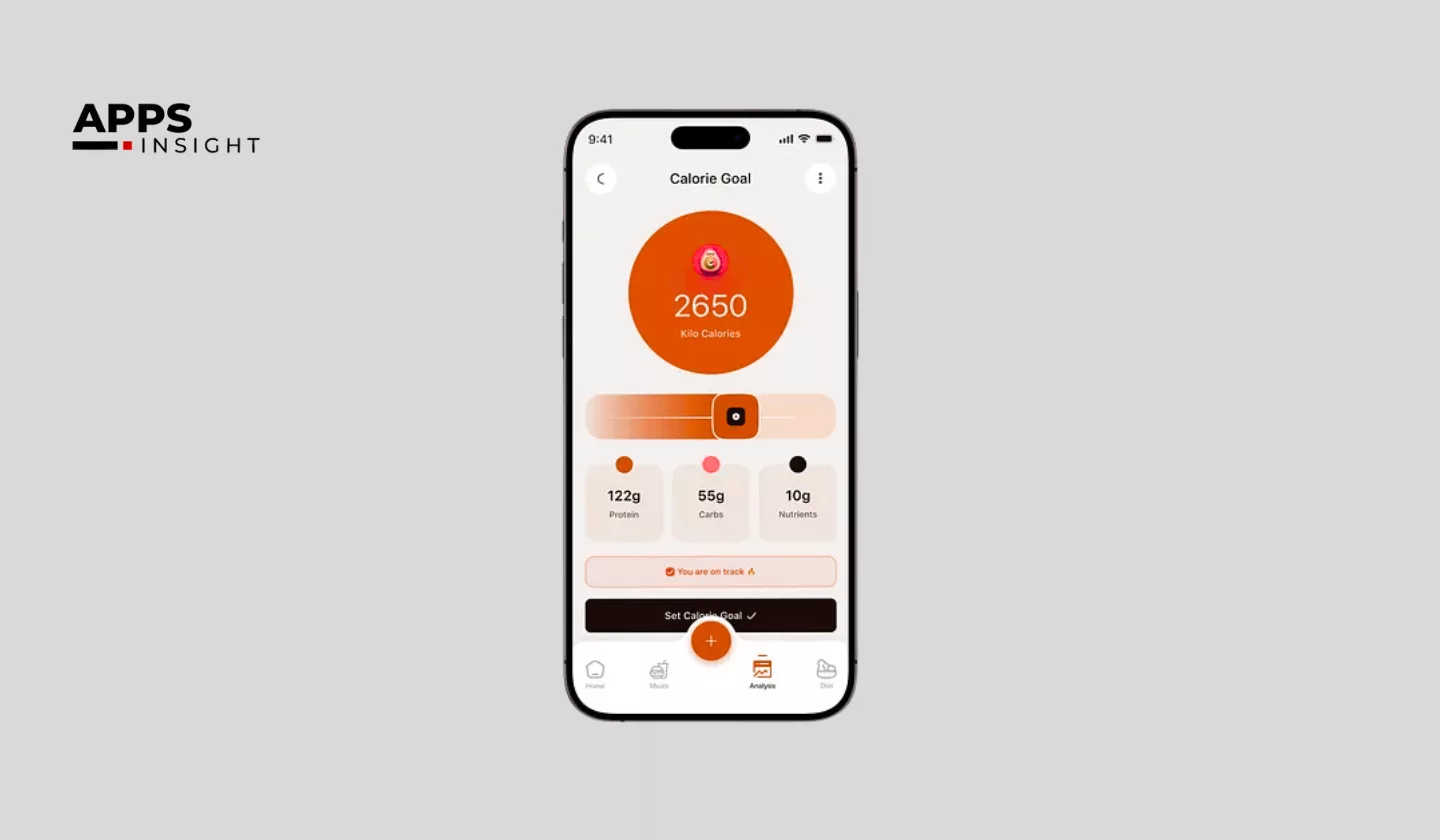
Other essential functions also involve macro and calorie tracking, seamless integration with fitness devices, meal logging through images or text, and predictive analytics that estimate potential progress. Together, these functions turn the app into a complete health companion that supports weight loss, muscle gain, medical diets, and general wellness goals.
How AI Personalizes Diet and Wellness Journeys?
AI plays a transformative role in personalizing a user’s diet journey. Instead of offering generalized tips, it uses multiple layers of data to deeply understand what the user needs at any given moment. AI models analyze factors such as age, weight, body composition, activity levels, food preferences, allergies, nutritional deficiencies, medical conditions, and lifestyle routines. This holistic data approach makes the recommendations far more relevant than traditional diet plans.
Machine learning algorithms constantly refine the user’s plan by observing their daily patterns. For example, if a user regularly skips breakfast, the AI adjusts meal suggestions accordingly. If the user’s activity levels increase, the AI recalculates nutritional requirements. This dynamic feedback loop ensures that users always receive updated recommendations aligned with their actual habits.
Generative AI takes personalization even further by creating new meal combinations, suggesting creative recipes, and simplifying decision-making for the user. Computer vision features allow quick food logging through photos, removing friction from daily tracking. Predictive analytics can estimate when users may fall off track and provide motivational nudges or alternative strategies.

Essential Features of an AI Diet Planner App
User Profile & Health Assessment
A strong AI-powered diet planner app begins with a comprehensive user onboarding process. This includes collecting essential details such as age, height, weight, gender, activity level, dietary preferences, allergies, medical conditions, fitness goals, and lifestyle habits.
AI uses this data as the foundation for generating precise nutritional recommendations. A well-designed assessment allows the system to understand a user’s metabolic needs, dietary limitations, and personal priorities—ensuring all future suggestions are accurate and personalized.
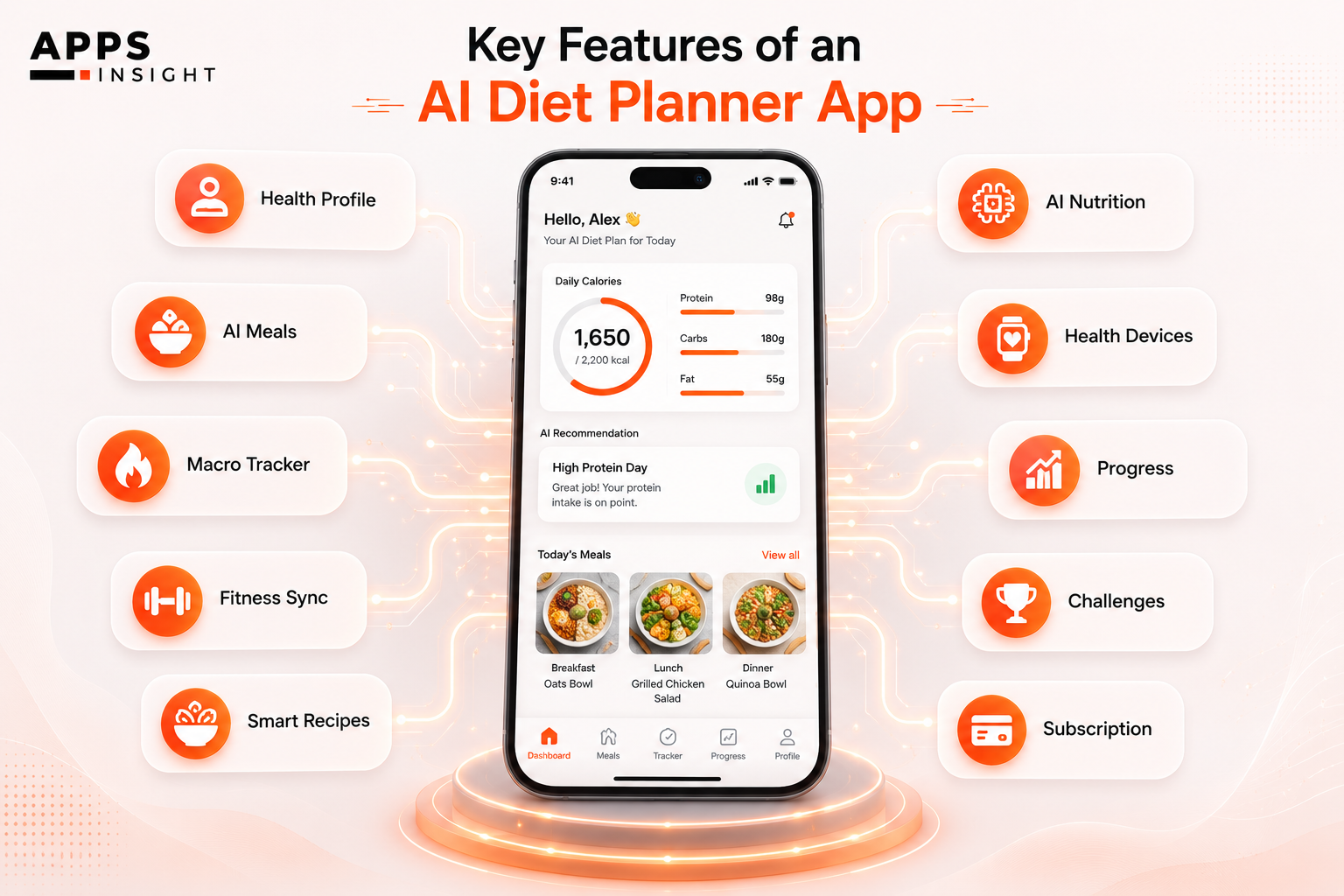
AI-Powered Meal Recommendations
One of the core features that sets AI diet planners apart is their ability to offer intelligent meal suggestions. Instead of generic charts, the app dynamically generates meals based on daily calorie requirements, macros, nutrient balance, and user preferences.
These recommendations evolve as the user logs more meals or updates their habits. The AI continuously learns, adjusting portion sizes, ingredients, and meal timings. This ensures users receive recommendations tailored to their cravings, restrictions, and long-term goals.
Calorie & Macro Tracking
Accurate food tracking is essential for effective diet management. An AI-driven planner automates this process by estimating calorie counts, macronutrient ratios, and micronutrient levels based on logged meals. It can suggest adjustments if the user is overeating or falling short of goals.
With AI enhancements, the app can recognize patterns—such as consistent overconsumption of carbs or protein deficiency—and provide corrective suggestions that guide users back on track.
Fitness Activity Integration
Diet and fitness go hand in hand, and integrating physical activity tracking ensures more precise nutrition plans. AI-powered apps sync with wearables and fitness devices like Fitbit, Apple Watch, or Google Fit. This helps the system analyze calorie expenditure, daily steps, workout intensity, and sleep quality. Based on increased or decreased activity, the AI recalculates meal needs, adjusts macros, and provides real-time dietary corrections.
Recipe Suggestions & Meal Logging
Users often struggle with deciding what to eat. AI solves this by recommending recipes that match dietary goals, personal tastes, and available ingredients. These recommendations help users maintain variety while staying within nutritional boundaries.
Meal logging becomes easier with automated suggestions, search options, and ingredient-level breakdowns. The richer the logging data, the smarter the AI becomes.
AI Chat Assistant for Nutrition Guidance
An AI-driven chat assistant acts like a round-the-clock nutrition coach, answering questions, suggesting recipe alternatives, guiding the user through cravings, and offering motivational tips. Powered by natural language understanding, it gives instant responses based on user data and goals.
Whether users need advice on dining out, dealing with hunger spikes, or understanding nutrient labels, the AI assistant provides quick and personalized guidance.
Wearable & Health Device Integrations
Modern users expect seamless connectivity, and wearable integration enhances accuracy. Devices like smart scales, glucose monitors, and heart-rate trackers allow the app to gather deeper insights.
Through this data, AI can detect early trends—like water retention, blood sugar fluctuations, or reduced sleep quality—and adjust diet plans accordingly. This holistic view enables a more precise and medically aligned diet experience.
Progress Tracking Dashboard
A user-friendly dashboard helps users visualize their journey through charts, graphs, and trend reports. AI highlights patterns such as improved calorie control, faster metabolism, or nutrient imbalances.
These insights reinforce positive habits and help users understand how small actions influence long-term progress. The app may also provide weekly or monthly summaries to encourage consistency.
Gamification & Habit Formation Tools
To improve engagement, many AI diet planner apps incorporate gamified interactions such as daily goals, streaks, challenges, badges, and rewards. These keep users motivated and consistent. AI tracks behavior patterns and suggests achievable goals, making habit formation more enjoyable and easier to maintain.
Subscription, Payment & Monetization Features
Monetization features ensure scalability for businesses. These include subscription tiers, premium AI coaching, meal plan upgrades, recipe bundles, or integration packages.
With secure payment gateways and flexible billing cycles, users can choose plans that match their needs. The key is to ensure transparency and seamless checkout to maximize conversions and retention.
Advanced AI Features That Increase App Cost
Building an AI-powered diet planner app becomes significantly more sophisticated—and costly—when advanced intelligence features are integrated to enhance accuracy, automation, and personalization.
1) Machine Learning-Based Nutrition Models
ML-driven nutrition models analyze thousands of data points to understand user behavior, dietary responses, and metabolic patterns. These models continuously evolve, allowing the app to deliver more precise meal suggestions and performance insights over time.
2) Predictive Analytics for Weight & Health Goals
Predictive algorithms forecast user progress based on historical data, daily habits, and nutritional adherence. They help estimate weight changes, energy levels, and potential health risks, enabling the app to create more effective long-term plans.
3) Computer Vision Food Recognition
Computer vision enables users to log meals simply by snapping a photo. The AI identifies food items, estimates portion sizes, and calculates nutritional values instantly. This feature increases accuracy and convenience but requires advanced training datasets and image processing models.
4) AI Chatbots Using LLMs
LLM-powered AI assistants provide real-time guidance, answer nutrition questions, offer personalized tips, and support users through cravings and diet challenges. This conversational intelligence improves user engagement but increases computational and development costs.
5) Personalized Meal Generation Using Generative AI
Generative AI models create ingredient-level meal plans tailored to the user’s mood, preferences, pantry items, and nutritional goals. This goes beyond static meal suggestions and provides creative, fully customized recipe options.
6) Real-Time Behavioral Coaching Algorithms
These algorithms track patterns like late-night snacking, inconsistent meal timing, or nutrient gaps and deliver timely nudges or behavioral recommendations. With continuous monitoring, the app becomes proactive in guiding users toward healthier habits.
Breakdown of AI Diet Planner App Development Cost
Below, we’ve broken down the complete and accurate cost structure to help you understand exactly what goes into developing a high-quality AI diet planner app. This cost breakdown will give you a clear idea of what to budget for in 2026 and how each feature impacts the total investment.
Cost by App Complexity
| App Complexity Level | Description | Estimated Cost Range |
|---|---|---|
| Basic App | Includes essential features like meal logging, calorie tracking, basic recommendations, and simple UI | $15,000 – $30,000 |
| Moderate App | Adds AI-based recommendations, user analytics, recipe suggestions, and wearable integration | $30,000 – $60,000 |
| Advanced App | Full AI automation with ML models, computer vision, behavior prediction, and generative meal planning | $60,000 – $150,000+ |
Cost by Features and Integrations
| Feature / Integration | Description | Estimated Cost |
|---|---|---|
| User profile & onboarding | Health assessment, goals, preferences | $1,500 – $3,000 |
| AI meal recommendations | Machine learning–based dynamic meal suggestions | $5,000 – $12,000 |
| Calorie & macro tracking | Database integration, nutritional analysis | $2,500 – $6,000 |
| Fitness activity integration | Sync with Google Fit, Apple Health, Fitbit | $3,000 – $8,000 |
| AI chatbot assistant | LLM-driven nutrition guidance | $8,000 – $20,000 |
| Recipe & meal database | Structured recipes with nutrients | $3,000 – $7,000 |
| Behavior prediction algorithms | Real-time habit tracking, nudges | $10,000 – $25,000 |
| Payment & subscription module | Stripe/PayPal integration | $1,500 – $4,000 |
| Admin dashboard | User analytics, content management | $4,000 – $10,000 |
Cost by Technology Stack
| Component | Technologies Used | Estimated Cost Contribution |
|---|---|---|
| Frontend | React Native / Flutter | $5,000 – $15,000 |
| Backend | Node.js / Django / Laravel | $5,000 – $20,000 |
| Database | MongoDB / PostgreSQL / MySQL | $1,000 – $4,000 |
| AI/ML infrastructure | TensorFlow, PyTorch, OpenAI APIs | $10,000 – $40,000 |
| Cloud hosting | AWS, Azure, Google Cloud | $2,000 – $7,000 annually |
Cost by UI/UX Design
| Design Level | Description | Estimated Cost |
|---|---|---|
| Basic UI | Simple layouts, limited screens | $1,500 – $4,000 |
| Standard UI/UX | Custom UI, user flows, interactive dashboard | $4,000 – $10,000 |
| Premium UI/UX | High-end animations, branded aesthetics | $10,000 – $20,000 |
Cost by Backend and AI Infrastructure
| Component | Description | Estimated Cost |
|---|---|---|
| AI model development | Training, tuning, and personalization logic | $8,000 – $25,000 |
| API integrations | Nutrition APIs, fitness APIs, model APIs | $2,000 – $6,000 |
| Food recognition system | Computer vision dataset + model | $10,000 – $25,000 |
| Real-time data pipelines | User behavior monitoring, streaming data | $5,000 – $12,000 |
Cost by Development Region
| Region | Hourly Rate | Impact on Total Cost |
|---|---|---|
| USA / Canada | $80 – $150/hr | Highest |
| Europe (UK/Germany) | $60 – $120/hr | High |
| Eastern Europe | $30 – $60/hr | Moderate |
| India / Southeast Asia | $20 – $40/hr | Budget-friendly |
Cost of Third-Party APIs and AI Tools
| API / Tool Category | Example Tools | Estimated Cost |
|---|---|---|
| Nutrition database APIs | Edamam, Nutritionix | $100 – $400/month |
| Fitness tracking APIs | Fitbit, Google Fit | $50 – $300/month |
| AI chatbot APIs | OpenAI, Dialogflow | $0.01 – $0.06 per 1K tokens |
| Cloud monitoring tools | AWS CloudWatch | $50 – $150/month |
Yearly Maintenance and Update Cost
| Maintenance Category | Description | Estimated Cost per Year |
|---|---|---|
| Bug fixes & updates | Routine patches, performance enhancements | $5,000 – $10,000 |
| Server & hosting | Cloud usage, bandwidth | $2,000 – $7,000 |
| Feature updates | New features and improvements | $8,000 – $20,000 |
| AI model retraining | Improving predictions over time | $5,000 – $15,000 |
Detailed Cost Estimation of AI Diet Planner App (Feature-Wise)
Building an AI-powered diet planner app involves multiple feature categories. Each feature contributes to the overall development time, complexity, and budget. Below is a clear, structured breakdown of the estimated costs, helping you understand where most of your investment will go. These estimates are based on standard development rates for mobile app projects in 2025.
1. Core Features Cost Breakdown
| Feature | Description | Estimated Cost |
|---|---|---|
| User Profile & Onboarding | Personal info input, health assessment, preferences, allergies | $1,500 – $3,000 |
| Calorie & Macro Tracking | Nutritional database integration + daily tracking UI | $2,500 – $6,000 |
| Recipe Suggestions & Food Database | Browsing recipes, nutrient breakdown, ingredient tagging | $3,000 – $7,000 |
| Fitness Activity Integration | Sync with Fitbit, Apple Health, Google Fit | $3,000 – $8,000 |
| Payment & Subscription System | Payment gateway + billing cycles | $1,500 – $4,000 |
| Admin Dashboard | User monitoring, analytics, content tools | $4,000 – $10,000 |
2. AI Features Cost Breakdown
| AI Feature | Description | Estimated Cost |
|---|---|---|
| AI Meal Recommendations | ML-based personalized meal suggestions | $5,000 – $12,000 |
| LLM-Based AI Chatbot | Nutrition Q&A, personalized guidance | $8,000 – $20,000 |
| Predictive Analytics Models | Weight forecasting + health predictions | $6,000 – $15,000 |
| Food Recognition (Computer Vision) | Photo-based meal detection + portion size | $10,000 – $25,000 |
| Generative AI Meal Creator | Custom recipe generation based on goals | $8,000 – $18,000 |
| Behavioral Prediction Algorithms | Habit detection + motivation nudges | $10,000 – $25,000 |
3. Additional Modules Cost Breakdown
| Additional Module | Description | Estimated Cost |
|---|---|---|
| Gamification System | Badges, streaks, challenges | $2,000 – $6,000 |
| Wearable Device Integration | Smart scales, smartwatches, body analyzers | $3,000 – $8,000 |
| Community/Social Features | Groups, forums, leaderboards | $4,000 – $9,000 |
| Multi-Language Support | Localization & translations | $1,000 – $5,000 per language |
| Offline App Mode | Cached meal plans + local recipe storage | $3,000 – $7,000 |
4. Team Structure & Hourly Rates
| Role | Responsibilities | Hourly Rate |
|---|---|---|
| Project Manager | Planning + execution oversight | $20 – $60/hr |
| UI/UX Designer | App flow & user experience | $15 – $40/hr |
| Frontend Developer | React Native/Flutter development | $20 – $50/hr |
| Backend Developer | APIs, authentication, integrations | $25 – $60/hr |
| AI/ML Engineer | Model training + AI pipelines | $40 – $120/hr |
| QA Tester | Bug fixing & performance testing | $15 – $40/hr |
| DevOps Engineer | Cloud setup + deployments | $30 – $80/hr |
Development Process and Timeline of Diet Planner App
Discovery and Requirement Analysis
The development of an AI-powered diet planner app begins with a detailed discovery phase. During this stage, the product team collaborates closely with stakeholders to understand the business goals, user expectations, and target market.
This process includes competitive research, feature prioritization, feasibility assessments, and defining the overall project scope. Clear documentation is prepared, outlining user personas, system workflows, technical requirements, and expected outcomes.
This phase typically takes 1–2 weeks and helps ensure that the final product aligns with both market needs and technological capabilities.
UI/UX Design
Once the requirements are finalized, the design team creates wireframes for every screen in the app. These wireframes represent the skeletal layout, showing how each function will appear and interact. After approval, high-fidelity prototypes are crafted to define the app’s visual identity, color palettes, typography, icons, layouts, and branding elements.
Additionally, interactive prototypes help stakeholders visualize user journeys, meal logging flows, dashboard views, and AI interaction screens.
This stage usually requires 2–4 weeks, depending on the design complexity and number of iterations.
Backend and Frontend Development
Development begins with building the foundation of the app. Frontend developers work on creating intuitive interfaces using frameworks such as React Native or Flutter. They ensure seamless navigation, responsive layouts, and smooth interactions.
Simultaneously, backend developers create the server infrastructure, APIs, authentication system, databases, and third-party integrations. They manage user accounts, meal data, AI model connections, analytics, and subscription systems. The best app development team ensures that the backend is scalable, secure, and optimized for handling large amounts of health and nutrition data.
This phase typically spans 6–12 weeks, depending on the features and overall app size.
AI/ML Model Development
This is the most complex and crucial stage for an AI diet planner app. Machine learning engineers begin by collecting and curating datasets related to nutrition, meal patterns, food images, user behaviors, and health analytics. They train models for meal recommendations, behavior prediction, food recognition, and generative recipe creation.
Models are evaluated for accuracy, speed, and relevance to various user groups. Continuous testing and tuning are necessary to ensure the AI adapts to real-world behaviors. After training, ML pipelines are integrated with the backend so the app can deliver personalized insights in real time.
Depending on the complexity, this stage can take 6–14 weeks.
Testing and Quality Assurance
The QA team examines each feature to identify bugs, inconsistencies, or performance issues. Testing includes functional testing, usability testing, security validation, compatibility checks, and load testing.
AI-specific testing ensures that predictions, recommendations, and insights remain accurate and unbiased across diverse user profiles. The team also validates camera-based features like food recognition and checks the accuracy of logged nutritional data.
This phase takes 2–4 weeks and continues iteratively alongside development.
Deployment
Once all features are tested and approved, the app is prepared for deployment. This involves setting up cloud servers, configuring databases, and integrating monitoring tools to track performance. The app is then submitted to app stores (Google Play and Apple App Store), following their respective compliance and review guidelines.
Deployment generally takes 1 week, depending on app store approval times.
Post-Launch Optimization
After the app is live, ongoing optimization is essential to ensure long-term success. The top mobile development team monitors user feedback, app performance, crashes, and AI accuracy.
Updates are released to improve user experience, add new features, or enhance the precision of AImodels.
This stage is continuous, but the initial stabilization period usually lasts 4–8 weeks after launch.
| Development Phase | Timeline (Weeks) |
|---|---|
| Discovery & Requirement Analysis | 1–2 weeks |
| UI/UX Design | 2–4 weeks |
| Backend & Frontend Development | 6–12 weeks |
| AI/ML Model Development | 6–14 weeks |
| Testing & Quality Assurance | 2–4 weeks |
| Deployment | 1 week |
| Post-Launch Optimization | 4–8 weeks (initial) |
Future Trends in AI-Powered Meal Planning App Development
The landscape of AI-driven health and nutrition technology is evolving rapidly, and upcoming trends will significantly enhance how diet planning apps operate and deliver value. Below are the most influential future trends that will shape next-generation nutrition apps.
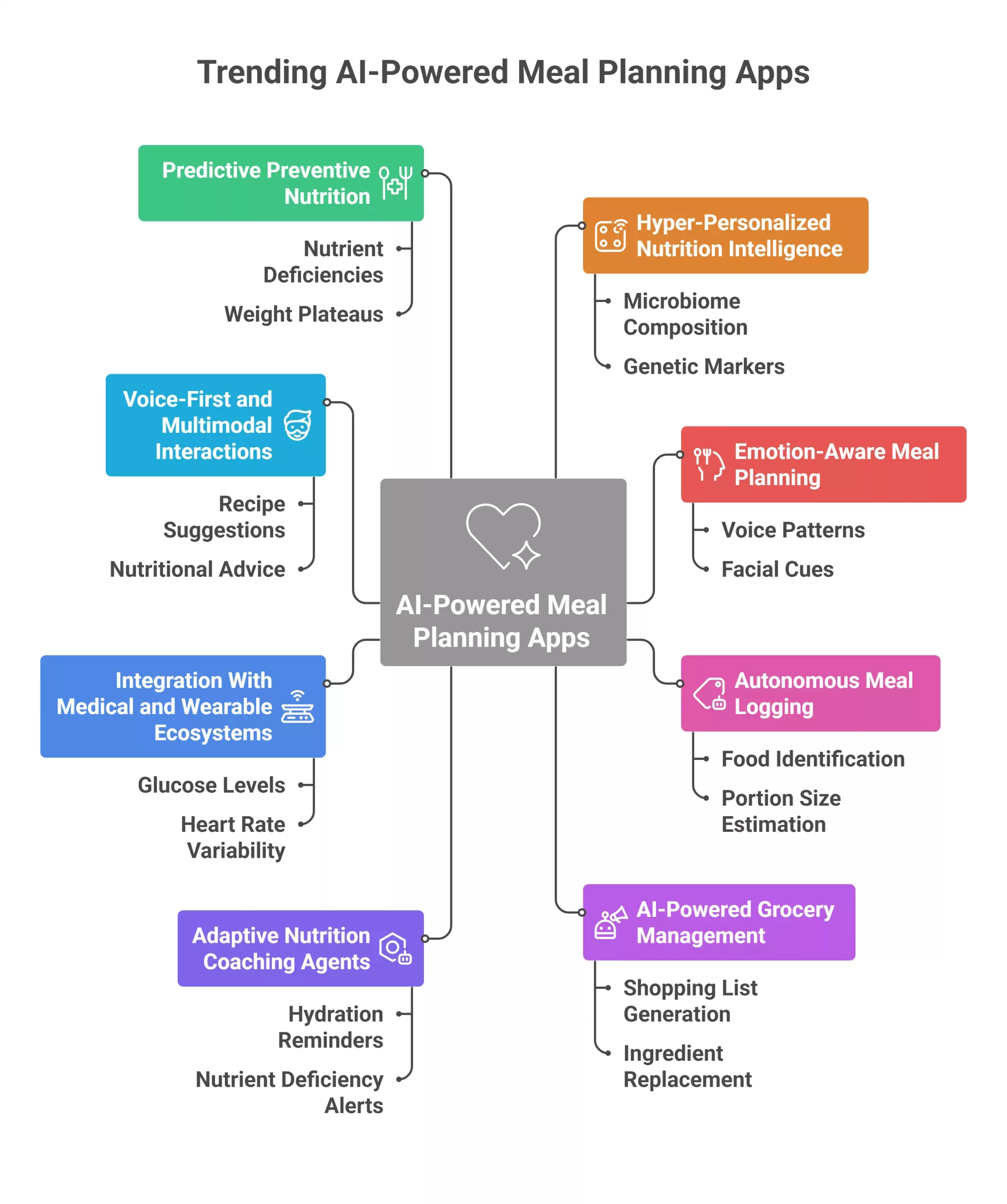
Hyper-Personalized Nutrition Intelligence
As AI models grow more sophisticated, personalization will move far beyond generic dietary suggestions. Future systems will integrate data such as microbiome composition, genetic markers, metabolic rate fluctuations, and hormonal cycles to create nutrition plans that evolve in real time. This deeper personalization allows apps to offer highly precise recommendations tailored to each user’s biological makeup.
Emotion-Aware Meal Planning
Next-generation diet apps will use emotional analytics derived from voice patterns, facial cues, journaling sentiment, and screen interaction behavior. These insights will help AI predict emotional eating triggers, stress-driven cravings, and motivation dips. By recognizing mood states, the app can intervene with calming exercises, alternative meal suggestions, or supportive messages at just the right moment.
Autonomous Meal Logging With Vision AI
Computer vision will replace manual meal logging completely. Users will simply point their camera at a dish, and the AI will identify foods, estimate portion size, analyze ingredients, and calculate calories instantly. Over time, the system learns a user’s unique meal patterns, improving accuracy and eliminating friction in tracking habits.
AI-Powered Grocery Management
AI diet apps will integrate directly with grocery delivery platforms. Based on weekly meal plans, the app will automatically generate shopping lists, replace missing ingredients with healthier alternatives, and allow one-tap purchasing. Predictive inventory analysis will notify users before they run out of essential items, ensuring seamless meal preparation and fewer nutritional compromises.
Adaptive Nutrition Coaching Agents
Future apps will include autonomous AI agents capable of handling multiple coaching functions simultaneously, hydration reminders, nutrient deficiency alerts, sleep-nutrition correlations, and metabolic profile updates. These agents will behave more like personal digital nutritionists who learn continuously from user behavior and environmental factors.
Integration With Medical and Wearable Ecosystems
As health tech regulations and interoperability advance, AI diet apps will connect deeply with medical systems and wearable health devices. The app will track vitals such as glucose levels, heart rate variability, body temperature shifts, and respiration patterns—adjusting diet plans instantly when abnormalities arise. This blurs the line between wellness and clinical nutrition support.
Voice-First and Multimodal Interactions
Future diet planners will rely heavily on hands-free voice interfaces. Users can ask for recipe suggestions, nutritional advice, or meal alternatives while cooking or shopping. Combined with AR displays, users may receive visual overlays showing healthier ingredient swaps or step-by-step cooking guidance directly in their environment.
Predictive Preventive Nutrition
Using multi-week trend analysis, AI will predict risks like nutrient deficiencies, weight plateaus, metabolic slowdowns, or diet-fatigue phases before they occur. The app will adjust the user’s diet plan proactively, providing smooth progress without major setbacks.
Sum up
Building an AI-powered diet planner app requires a thoughtful blend of advanced technologies, behavioral science, user-centric design, and ongoing innovation. Consumers increasingly seek personalized, convenient, and scientifically-backed nutrition guidance. AI-driven solutions have become one of the most promising offerings in the health-tech space.
Throughout this guide, you’ve seen how multiple layers, machine learning models, food-recognition systems, predictive analytics, habit-tracking engines, integration with wearables, and behavioral coaching algorithms come together to create a truly intelligent diet planning system.
As the industry advances, future diet planner apps will become even more tailored, proactive, emotion-aware, and deeply integrated into users’ day-to-day lives. From hyper-personalized nutrition to voice-assisted coaching and predictive preventive insights, these emerging capabilities will redefine how people approach healthy living.
Whether you’re a startup, a fitness brand, or a healthcare provider, investing in the right technologies and a well-structured development roadmap can help you build a standout solution that transforms user health journeys.
With the demand for intelligent nutrition platforms rising steadily, there has never been a better time to enter the market with an AI-powered diet planner app that offers unmatched personalization, convenience, and real-world impact.

FAQs
What factors influence the AI diet planner app development cost?
Several factors determine the overall development cost, including feature complexity, AI model training, food recognition technology, integration with wearables, backend infrastructure, platform choice, and customization needs. Apps with advanced capabilities—like real-time coaching, predictive analysis, and computer vision—require more engineering hours and data resources, which increases the cost compared to basic diet planning apps.
How long does it take to build an AI-powered meal Planning Apps?
The development timeline typically ranges from 4 to 8 months, depending on the scope and depth of features. A basic MVP with essential meal planning and AI suggestions can be developed in a few months, while a full-scale product with AI coaching, vision-based meal logging, and multi-platform support requires extensive planning, testing, and iteration.
Do I need custom AI models or can I use pre-trained models?
Both options are possible. Pre-trained models can help speed up development and reduce costs, making them ideal for startups validating an idea quickly. However, custom AI models are preferred for apps that require high accuracy, unique nutrition insights, or proprietary personalization algorithms. Custom models deliver better performance but come with higher development and training expenses.
Can an AI-powered diet planner integrate with fitness and wearable devices?
Yes, modern diet planner apps can integrate with devices such as Apple Watch, Fitbit, Garmin, and other smart health trackers. These integrations enhance accuracy by pulling data like steps, calories burned, heart rate, sleep quality, and activity trends. The AI uses this data to provide more precise meal plans and real-time dietary adjustments, improving the overall user experience.
How does AI improve user engagement in diet planner apps?
AI boosts engagement by offering personalized, timely, and behavior-aware recommendations. It identifies user habits, predicts potential diet lapses, offers encouragement at the right moments, and sends reminders aligned with the user’s goals.
Interactive features such as auto meal logging, chatbot support, clarity in nutrition insights, and adaptive meal suggestions help users stay motivated and consistent in their health journey.