


Corporate private aviation can help businesses manage complex travel schedules, reach regional destinations, and transport executive teams more efficiently. However, selecting the right charter provider requires more than comparing aircraft availability and flight prices.
For procurement departments, corporate travel managers, executive assistants, and finance teams, private aviation procurement involves evaluating charter providers against consistent safety, operational, financial, and service standards.
Companies must determine whether a provider can meet their travel requirements, identify the actual flight operator, provide transparent pricing, and respond effectively when unexpected changes occur.
A structured procurement process helps organizations reduce unnecessary expenses, improve accountability, and establish reliable relationships with aviation providers.
At Hera Flight, corporate customers can explore personalized private jet charter solutions designed around their business travel requirements.
What Is Private Aviation Procurement?
Private aviation procurement is the process companies use to research, evaluate, select, and manage providers of business aviation services.
It may involve individual charter bookings, recurring corporate travel arrangements, jet card memberships, or longer-term aviation service agreements.
Unlike standard airline purchasing, private charter procurement typically requires evaluating an entire aircraft and its operating arrangements rather than purchasing individual passenger seats.
How Corporate Charter Procurement Works
The process generally includes establishing travel requirements, identifying qualified providers, assessing safety and regulatory compliance, comparing proposals, reviewing contracts, and monitoring service performance.
The National Business Aviation Association (NBAA) provides an Aircraft Charter Consumer Guide covering provider screening, safety considerations, and requests for proposals.
Why Procurement Standards Matter
A poorly defined selection process can result in inconsistent pricing, unclear service responsibilities, unsuitable aircraft, and avoidable booking complications.
Formal procurement guidelines help businesses compare providers using consistent criteria.
Charter Operators vs. Charter Brokers: Understanding the Difference
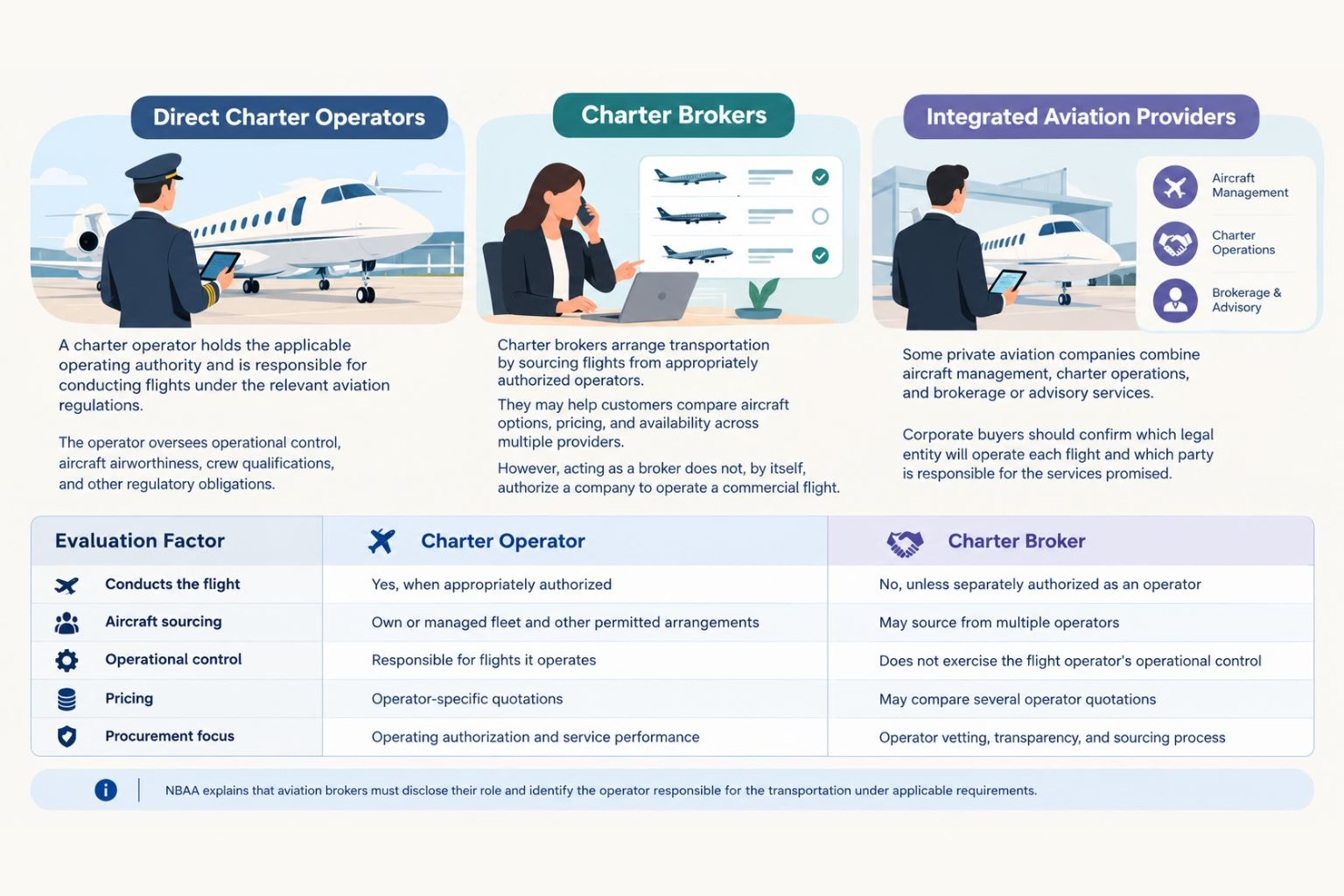
Before comparing providers, companies should understand how private aviation services are delivered.
Direct Charter Operators
A charter operator holds the applicable operating authority and is responsible for conducting flights under the relevant aviation regulations.
The operator oversees operational control, aircraft airworthiness, crew qualifications, and other regulatory obligations.
Charter Brokers
Charter brokers arrange transportation by sourcing flights from appropriately authorized operators.
They may help customers compare aircraft options, pricing, and availability across multiple providers.
However, acting as a broker does not, by itself, authorize a company to operate a commercial flight.
Integrated Aviation Providers
Some private aviation companies combine aircraft management, charter operations, and brokerage or advisory services.
Corporate buyers should confirm which legal entity will operate each flight and which party is responsible for the services promised.
| Evaluation Factor | Charter Operator | Charter Broker |
|---|---|---|
| Conducts the flight | Yes, when appropriately authorized | No, unless separately authorized as an operator |
| Aircraft sourcing | Own or managed fleet and other permitted arrangements | May source from multiple operators |
| Operational control | Responsible for flights it operates | Does not exercise the flight operator’s operational control |
| Pricing | Operator-specific quotations | May compare several operator quotations |
| Procurement focus | Operating authorization and service performance | Operator vetting, transparency, and sourcing process |
NBAA explains that aviation brokers must disclose their role and identify the operator responsible for the transportation under applicable requirements.
8 Criteria Companies Should Use to Evaluate Private Jet Charter Providers
1. Regulatory Authorization
The first priority is verifying that the actual operator is authorized to perform the proposed commercial charter flight.
In the United States, most on-demand commercial jet charter operations fall under FAA Part 135.
The FAA recommends asking to review the operator’s air carrier or operating certificate and verifying aircraft authorization.
2. Safety Standards and Independent Audits
Companies should review the operator’s safety management practices, crew qualifications, maintenance oversight, and relevant independent assessments.
Third-party organizations such as ARGUS, WYVERN, and the Air Charter Safety Foundation offer different forms of safety evaluation.
These assessments may support procurement due diligence but do not replace regulatory authorization.
3. Aircraft Availability and Suitability
Providers should offer aircraft appropriate for the company’s expected passenger numbers, flight distances, baggage requirements, and destination airports.
A large fleet or sourcing network is valuable only if suitable aircraft are available when needed.
4. Pricing Transparency
Procurement teams should understand the complete quoted price, including applicable taxes, airport expenses, aircraft positioning, and potential additional charges.
5. Scheduling Flexibility
Corporate travel often involves last-minute meeting changes.
Companies should evaluate how providers handle revised departure times, additional destinations, and itinerary modifications.
6. Geographic Coverage
A provider should demonstrate the ability to support the company’s common routes and operating regions.
International travel may require additional permits, documentation, and service coordination.
7. Customer Support and Communication
Reliable communication is essential for coordinating executive schedules, airport transfers, and unexpected changes.
Companies should confirm escalation contacts and support arrangements.
8. Contract Terms and Financial Reliability
Procurement teams should review cancellation provisions, payment requirements, insurance arrangements, liability terms, and procedures for aircraft substitution.
Financial reliability matters because charter bookings may involve substantial advance payments.
How Companies Verify Charter Provider Safety
Safety evaluation should be a mandatory procurement requirement rather than a negotiable preference.
Confirm the Actual Flight Operator
The company arranging the booking may not be the company operating the aircraft.
Corporate buyers should identify the certificated operator and obtain sufficient information to verify the proposed aircraft.
Review Available Safety Documentation
Relevant documentation may include operating certificates, insurance evidence, independent audit reports, and information about the operator’s safety programs.
The FAA warns that unauthorized commercial charter operations can create serious safety risks.
Evaluate Crew and Aircraft Standards
Procurement teams may request information about pilot qualifications, training practices, aircraft maintenance programs, and operational oversight.
Understand the Limits of Safety Ratings
A third-party safety rating is not a guarantee that an incident cannot occur.
Companies should evaluate the scope, validity, and currency of each assessment.
NBAA’s guidance recommends considering independent audits, operator experience, insurance, aircraft suitability, and other relevant safety information.
How to Compare Private Jet Charter Pricing
Charter procurement should focus on the complete cost of a trip rather than the advertised hourly rate.
Two providers may quote different amounts because they use different aircraft, routing assumptions, or pricing structures.
Key Charter Cost Components
| Cost Component | What Procurement Teams Should Check |
|---|---|
| Aircraft charter rate | Flight hours and pricing method |
| Repositioning | Flights needed to position aircraft |
| Airport fees | Landing, parking, and handling |
| Crew expenses | Applicable overnight or extended-trip charges |
| Fuel surcharges | Inclusion and adjustment conditions |
| Ground transportation | Included or separately arranged |
| Catering | Standard service or additional charges |
| International fees | Applicable permits, handling, and related expenses |
| Cancellation fees | Refund provisions and deadlines |
| Schedule changes | Repricing and additional service charges |
Hera Flight’s booking guidance also identifies international fees, de-icing, minimum usage requirements, positioning charges, and other potential expenses that travelers should clarify before confirming a charter.
Compare Equivalent Proposals
Every provider should quote the same route, passenger count, departure window, and service requirements.
Otherwise, a lower quote may reflect a different itinerary rather than better value.
Evaluate Total Door-to-Door Expenses
Companies should also consider ground transportation, hotel stays, employee travel time, and other expenses related to completing the business trip.
Creating a Private Aviation Request for Proposal (RFP)
A standardized request for proposal allows procurement teams to gather comparable information from potential providers.
Information to Include in the RFP
The document should specify expected routes, annual flight frequency, passenger numbers, aircraft requirements, service expectations, and commercial terms.
| RFP Section | Required Information |
|---|---|
| Company travel profile | Common routes and annual booking frequency |
| Aircraft requirements | Passenger capacity, range, cabin preferences |
| Regulatory compliance | Operator identity and applicable authorization |
| Safety evaluation | Relevant audits and safety documentation |
| Pricing | Itemized or clearly defined total costs |
| Scheduling | Booking lead times and modification procedures |
| Service requirements | Ground transfers, catering, support contacts |
| Contract terms | Payment, cancellation, insurance, liability |
| Reporting | Invoices, trip records, and performance summaries |
Establish Clear Response Requirements
Providers should answer the same questions in a consistent format.
This reduces the need for procurement teams to interpret incomplete or conflicting proposals.
Include Realistic Travel Scenarios
Instead of requesting only generic hourly rates, companies can ask providers to price representative trips.
Examples may include a regional executive round trip, a multi-city corporate itinerary, or a larger group charter.
NBAA has published charter guidance that includes provider-screening questions and a request-for-proposal approach for evaluating charter options.
Sample Private Jet Charter Provider Evaluation Scorecard
A weighted scorecard can help companies compare qualified providers objectively.
Important: Regulatory authorization and mandatory safety requirements should be pass-or-fail conditions. A high commercial score should never compensate for failure to satisfy these requirements.
| Evaluation Criterion | Suggested Weight |
|---|---|
| Safety practices and independent assessments | 25% |
| Aircraft availability and suitability | 20% |
| Total pricing and transparency | 20% |
| Scheduling flexibility | 15% |
| Customer support | 10% |
| Contract terms and reporting | 10% |
| Total | 100% |
Illustrative procurement framework. Weights should reflect each company’s travel priorities. Mandatory legal and safety requirements must be satisfied before numerical scoring.
Example: Comparing Three Qualified Providers
After verifying regulatory authorization and mandatory requirements, a company could assign ratings from 1 to 5.
| Evaluation Criterion | Provider A | Provider B | Provider C |
|---|---|---|---|
| Safety and audits | 5 | 4 | 5 |
| Aircraft suitability | 4 | 5 | 3 |
| Pricing transparency | 4 | 3 | 5 |
| Scheduling flexibility | 5 | 4 | 3 |
| Customer support | 4 | 5 | 4 |
| Contracts and reporting | 4 | 4 | 4 |
The example demonstrates how different providers can offer distinct advantages.
A company prioritizing extensive route coverage may prefer one provider, while another organization may place greater emphasis on pricing transparency or scheduling support.
Procurement teams should document the reasoning behind the final selection.
Contract Terms Corporate Buyers Should Review
A charter agreement determines the commercial obligations between the customer and the relevant provider.
Aircraft Substitution
The agreement should explain what happens if the originally selected aircraft becomes unavailable.
Companies should understand whether substitutions require approval and how pricing may change.
Cancellations and Schedule Changes
Review cancellation deadlines, refund conditions, weather-related provisions, and additional charges.
Insurance and Liability
Corporate buyers should review appropriate insurance documentation and contractual responsibilities with qualified advisors.
Payment and Deposits
Confirm payment schedules, refund procedures, and the party receiving funds.
Banking instructions should be independently verified before transferring significant amounts.
Broker and Operator Disclosures
If a broker arranges the flight, procurement teams should understand the broker’s role and the identity of the operating carrier.
NBAA discusses broker disclosures concerning operator identity, insurance, pricing, and commercial relationships.
Managing Risk When Selecting Charter Providers
Procurement responsibilities continue after a provider is selected.
Companies should establish procedures for operational changes, schedule disruptions, and unusual travel requirements.
Weather and Airport Restrictions
Private flights remain subject to weather, airport conditions, and air traffic limitations.
Providers should explain how alternative airports or revised schedules are evaluated.
Aircraft Technical Problems
The company should understand procedures for aircraft replacement and the potential consequences for scheduling and pricing.
Corporate Traveler Security
Sensitive passenger information, itineraries, and business documents should be handled according to appropriate confidentiality requirements.
Escalation and Business Continuity
Procurement and travel teams should identify responsible contacts who can authorize additional expenses or revised transportation arrangements.
Measuring Charter Provider Performance After Booking
A procurement process should include ongoing performance reviews.
| Performance Indicator | What to Measure |
|---|---|
| Confirmed itinerary accuracy | Whether arrangements matched approved requirements |
| Communication responsiveness | Timeliness and clarity of operational updates |
| Invoice accuracy | Alignment between contract and final charges |
| Aircraft suitability | Whether the selected aircraft met approved needs |
| Service quality | Traveler feedback and documented issues |
| Disruption management | How operational changes were communicated and resolved |
| Documentation quality | Completeness of invoices and trip records |
Performance reviews should distinguish problems within a provider’s control from external factors such as weather or airport restrictions.
Quarterly Supplier Reviews
Companies with frequent charter activity may benefit from quarterly reviews of travel spending, service quality, and operational issues.
Annual Contract Evaluation
Organizations should periodically assess whether their travel requirements, preferred routes, and budget priorities have changed.
Maintaining Alternative Qualified Providers
Some companies maintain more than one vetted aviation provider to support different routes or aircraft requirements.
This can provide additional sourcing flexibility, although aircraft availability is never guaranteed.
Common Mistakes in Private Aviation Procurement
Selecting the lowest quote without verifying the operator. Pricing should never substitute for regulatory due diligence.
Comparing different aircraft or itineraries. Proposals must reflect equivalent requirements.
Ignoring repositioning charges. Aircraft positioning may materially affect total cost.
Relying only on advertised safety claims. Companies should seek relevant, verifiable documentation.
Overlooking cancellation provisions. Schedule changes can create unexpected financial obligations.
Failing to define service expectations. Ground transportation, catering, and other arrangements should be clarified before booking.
Using inconsistent approval procedures. A formal process helps maintain financial accountability.
Not reviewing supplier performance. A provider suitable for one itinerary may not remain the best option for every future trip.
How Hera Flight Supports Corporate Private Aviation Procurement
Hera Flight offers private jet charter services for businesses and executive travelers.
Its published charter services include one-way, round-trip, and multi-city booking options, along with personalized flight planning and aircraft selection.