


Statable Analytics
Privacy-friendly Google Analytics alternative: no cookies, no consent banner, EU-hosted
Paid Subscription$930-day trial
- Web app
- API / SDK
- WordPress plugin

AI support quality scoring, policy findings and recurring customer signals with conversation evidence
AI support quality scoring, policy findings and recurring customer signals with conversation evidence CraftCX review: a closed AI ticket is not proof of a good answer An AI support agent can close a conversation and still leave the customer doing the work.
Evidence-linked AI support scoring, recurring signals and policy findings create a useful review loop. Worth a controlled pilot, not a production accuracy or compliance endorsement. Settle the 250-conversation marketing allowance versus 100 in the terms, plus deletion and cancellation wording, before importing data.
An AI support agent can close a conversation and still leave the customer doing the work. That is the problem CraftCX addresses. It adds a review layer to the helpdesk you already use, measuring answer quality, customer effort and human handoffs, while grouping recurring product problems from the same conversations. It is not another bot to place in front of customers.
My editorial view is that CraftCX has a sensible structure for teams that have already put AI into support and now need to understand the results. Its strongest idea is keeping scores, policy findings and customer signals tied to the conversations behind them. Its weakest point in this desk review is the distance between useful documentation and verified performance. I have not connected a helpdesk, sent customer records, measured scoring accuracy or checked a paid account.
An AI support agent can close a conversation and still leave the customer doing the work. That is the problem CraftCX addresses. It adds a review layer to the helpdesk you already use, measuring answer quality, customer effort and human handoffs, while grouping recurring product problems from the same conversations. It is not another bot to place in front of customers.
My editorial view is that CraftCX has a sensible structure for teams that have already put AI into support and now need to understand the results. Its strongest idea is keeping scores, policy findings and customer signals tied to the conversations behind them. Its weakest point in this desk review is the distance between useful documentation and verified performance. I have not connected a helpdesk, sent customer records, measured scoring accuracy or checked a paid account. Early-access buyers should also settle inconsistencies in the public commercial and data-handling terms before importing a support archive.
Reviewed by Ashley Richmond. This is a source-based editorial assessment dated October 1, 2026, not a first-hand account of running CraftCX in production. I inspected its current official product, pricing, company and legal pages, its help documentation and API/MCP reference, plus the official site’s product screenshots. I did not sign up, upload transcripts or policy documents, authorize integrations, create API tokens, connect an AI client, request a demo, or independently audit its security. The screenshots are vendor-supplied interface examples, not results from an AppsInsight customer-data test.
CraftCX describes itself as observability and intelligence tooling for AI-powered support. It reviews conversations for quality, extracts recurring customer needs and problems, checks AI conversations against a team’s policies, and keeps severe or repeated issues in an incident queue. The existing helpdesk and AI agent remain the systems handling customer interactions.
The official company page names CraftCX LLC in California, USA, founded in 2025 by Jason Dugdale and Kenji Hayward. It says Jason worked in support engineering and support operations at Front, and Kenji spent eight years building and leading Front’s support team and now leads support at Perplexity. Those are the vendor’s biographical statements, not an independently verified employment history. The terms describe a remote-first California limited-liability company with no physical office premises. California is its stated principal business location, not a verified street-office address. The company page explicitly calls the product early access with open sign-up. I found no sufficiently grounded team-size figure to publish.
That background explains the product’s focus, but experience is not evidence that an AI evaluator gets every difficult case right. A buyer still needs to test the product on its own support language, policies, escalation paths and customer population.
AXIS stands for AI Experience Impact Score. The documentation assigns each eligible conversation a 1-5 rating for Resolution Accuracy, Interaction Effort and Handoff Smoothness, then averages those three dimensions. Resolution Accuracy asks whether the AI answered correctly or routed the customer appropriately. Interaction Effort examines repeated information, unclear answers and unnecessary steps. Handoff Smoothness looks at whether a transfer preserved the context a human needs.
The dimensions are more useful than a single attractive headline number. A conversation with a good answer but excessive back-and-forth needs a different fix from one with an incorrect answer or a poor escalation. I would read the explanations and source transcript before deciding which knowledge-base article, instruction or routing rule to change. An average can obscure a weak dimension; it cannot prove that a customer actually got the result they needed.
Timing and coverage matter. The current AXIS guide says a score is created after the helpdesk marks an eligible conversation complete, with timing dependent on the events CraftCX receives. A conversation can remain unscored when there is not enough usable data. The product is not a universal live monitor of every message, and an absent score is not evidence that an interaction was fine. The FAQ also says AXIS criteria are standardized rather than customizable. Policy Monitoring is the separate route for checking the rules particular to your business.
The documented workflow is to inspect a low-scoring conversation, identify its weakest dimension, change the relevant knowledge, instructions or handoff, and compare later scores for the same conversation type. That is a useful review loop. It is not an independently established causal experiment. Changing customer mix, transcript completeness, agent settings or completion rules can change the score distribution even without a better support experience.
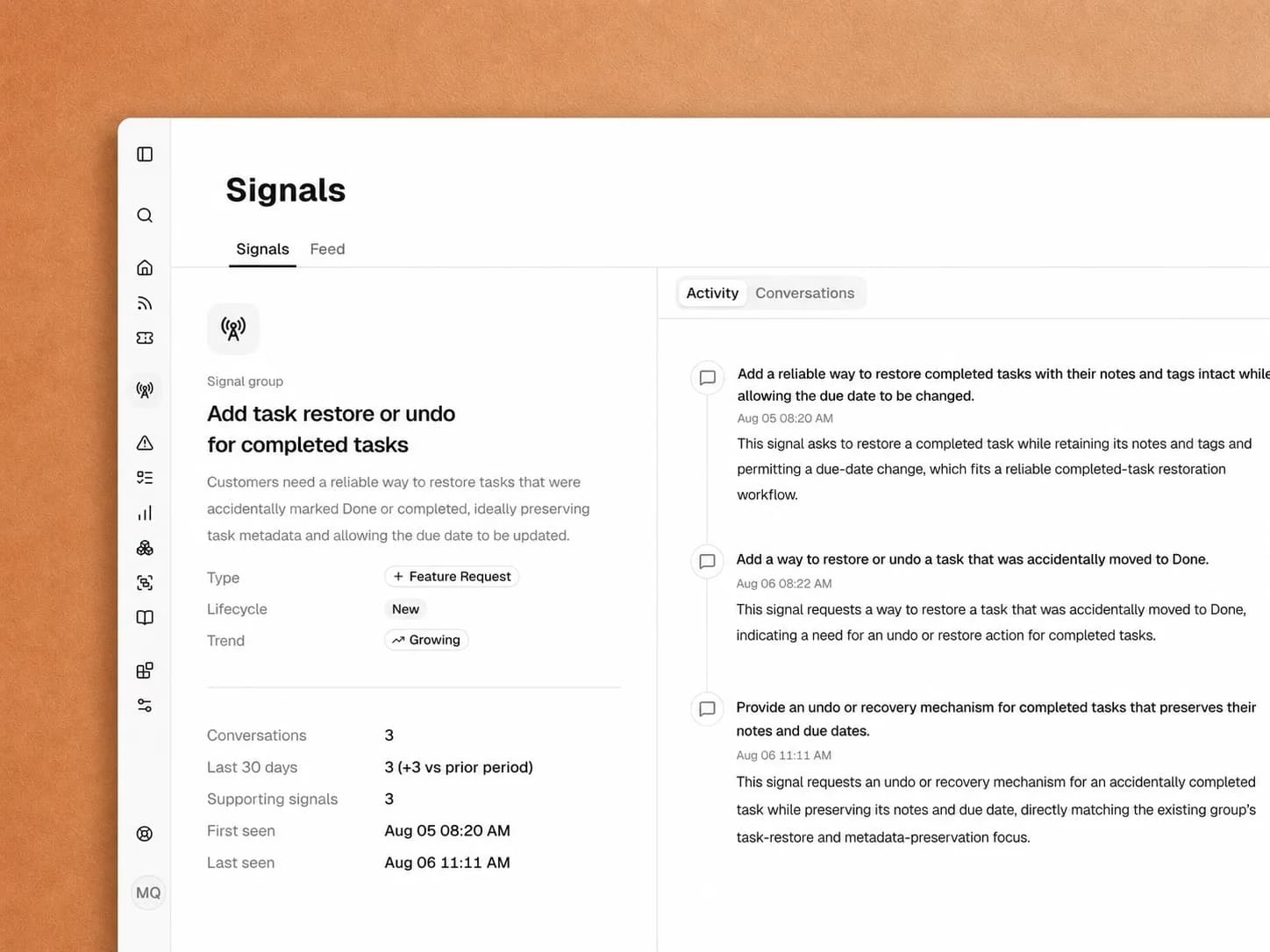
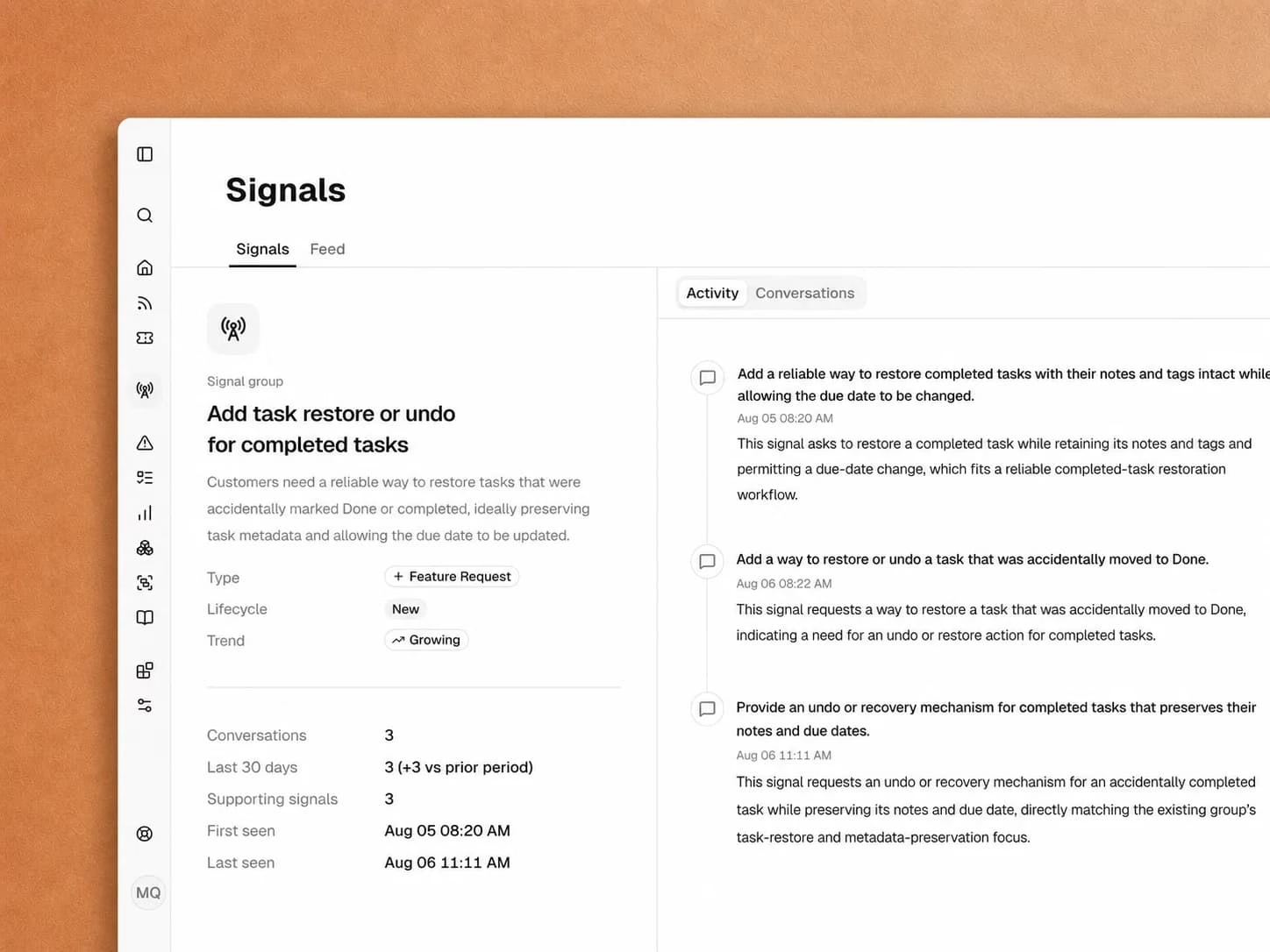
Customer Intelligence looks for observations such as bugs, feature requests, documentation gaps, usability issues and billing problems. Signals groups related observations into themes so a support or product team can see repeated needs rather than isolated tickets. The current documentation describes lifecycle and trend information, supporting conversations, and counts for the current and previous 30-day periods.
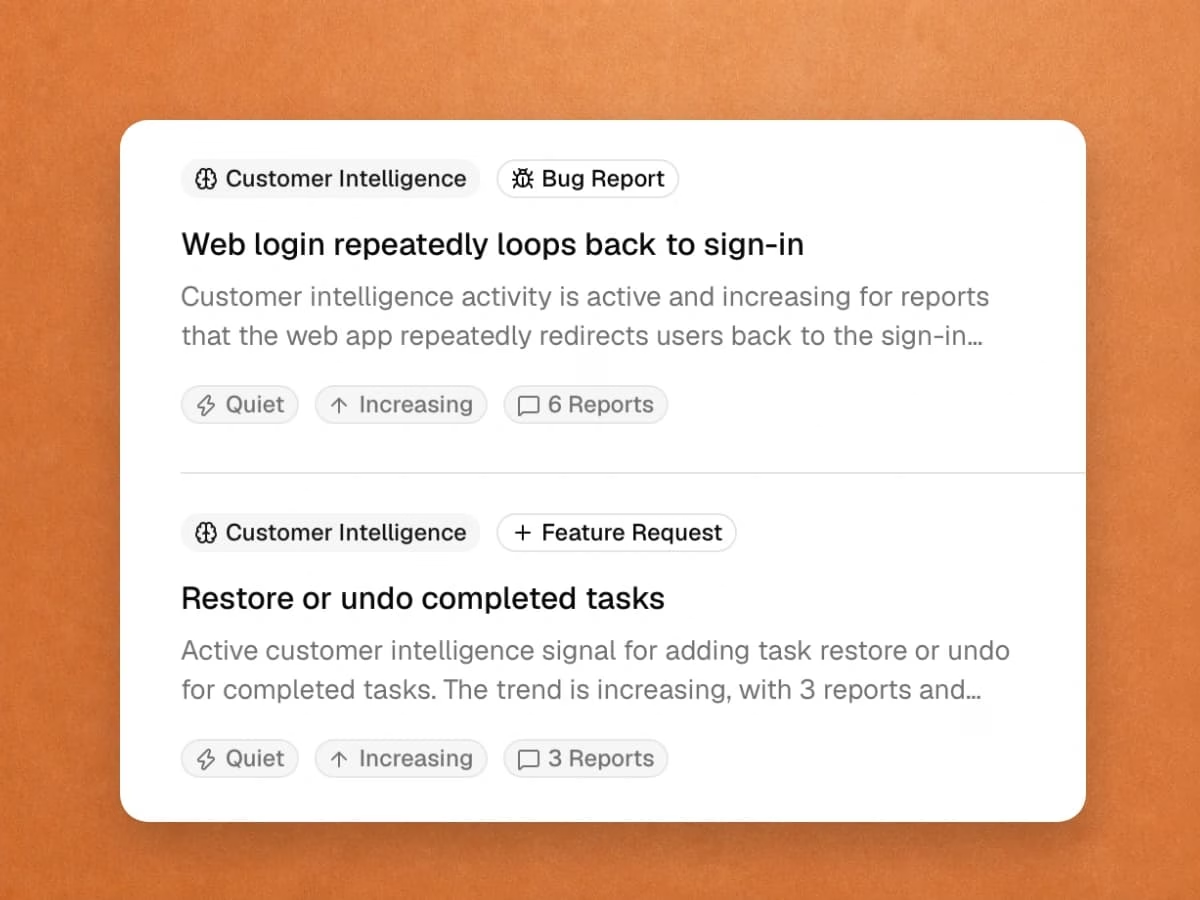
The official interface examples make that workflow concrete. One view groups requests to restore or undo completed tasks and shows the observations behind the group. Another lists a repeated sign-in-loop bug and a task-restoration feature request with report counts. These screenshots show how the vendor presents evidence; the displayed counts are illustrative product data, not proof that CraftCX found those issues in an independent test.
I like the decision path here: identify a recurring theme, narrow it by type or lifecycle, open the group and read the conversations before handing a finding to the product team. A summary without that last step can misrepresent what customers asked for. Similar wording can hide different causes, while different wording can describe the same problem. I did not test clustering precision, duplicate handling, multilingual performance or whether a small but serious problem rises above high-volume requests.
Volume should inform prioritization, not settle it. A payment failure affecting a few important accounts may deserve attention before a popular cosmetic request. CraftCX can provide the supporting evidence; the team’s judgment about impact, severity and the right owner is still required.
Policy Monitoring evaluates eligible AI-handled conversations against rules you define. The guide allows policy sources to be uploaded as PDF or Word documents or connected through Notion. CraftCX extracts draft rules, and the team reviews and activates the rules it wants evaluated. That review is important. An ambiguous source policy can become an ambiguous machine rule.
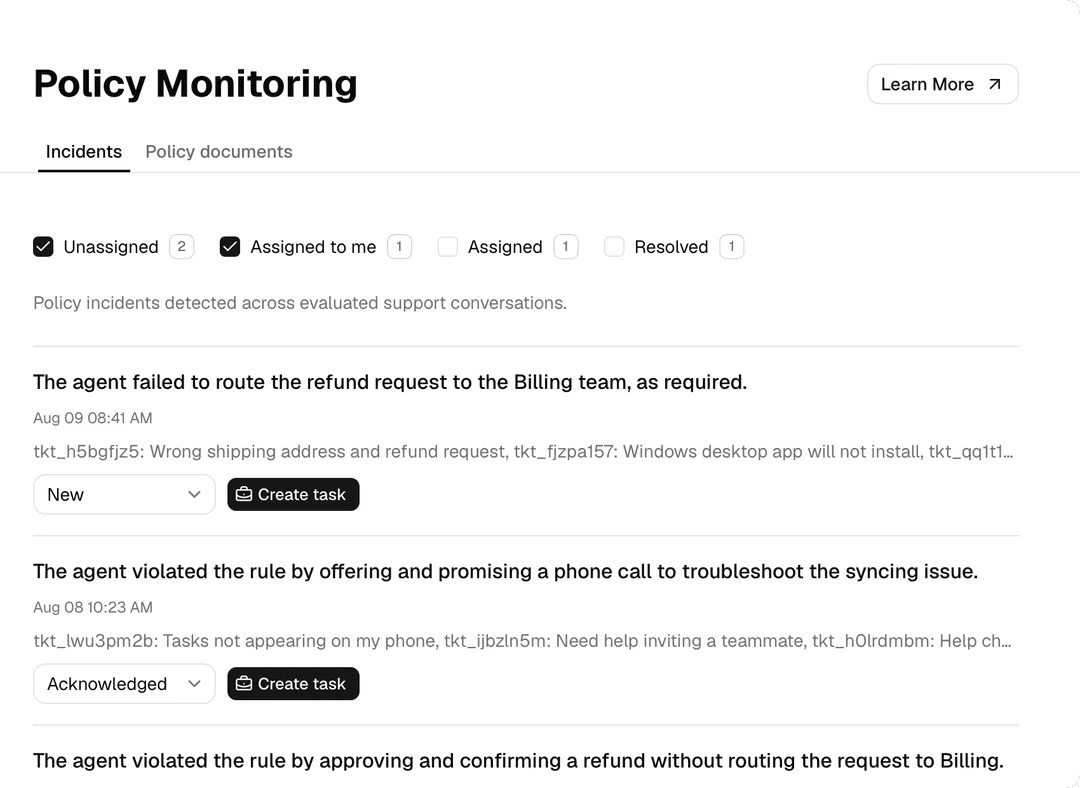
A suspected deviation includes relevant messages, policy citations, severity, reason codes and a confidence rationale. Teams can acknowledge a finding, mark it as needing a fix, resolve it or mark it as a false positive. Owners and due dates are documented. A conversation may have a respectable AXIS score and still violate an active business rule, which is why these checks should not be treated as interchangeable.
The documentation explicitly says human-only conversations are not evaluated by Policy Monitoring. Do not assume it is a staff-performance scoring system or a comprehensive audit of the entire helpdesk. It also does not prove compliance with a law, security standard or contractual requirement. A model flag can miss a breach or misread an acceptable exception. Read the messages and the source rule before changing agent behavior or taking action against a person.
Severe findings and recurring deviations can become incidents. The incident queue gives the shared problem an owner, due date and recorded status changes, with views for assigned, unassigned and resolved work. The docs say incidents are created by CraftCX rather than manually. Resolving one preserves it in the resolved view; a later occurrence can create a new incident. This is documented investigation tracking, not proof that the underlying issue has been fixed in the helpdesk or AI agent.
CraftCX publishes native integration support for Front, Gorgias, HubSpot and Intercom. Custom sources can send conversation data through the API. A source’s appearance in an API message label does not by itself establish a native helpdesk connector, so I have not expanded the native list to every provider mentioned in the API schema.
The Front guide illustrates the real work behind setup. It asks the team to authorize Front with Shared Resources access, generate a webhook, configure a Front rule to send conversation events, and select the AI tool. It documents optional backfill for recent tickets. The suggested event varies with the workflow: Front Chat with AI Answers uses a different recommended rule from other providers, where handoff or completion events may be appropriate. Backfill and webhook rules can move historical or future support data into CraftCX; they should be scoped and reviewed before activation.
The API reference documents sending conversational message data from any source for scoring and analysis, with author types and identifiers for contacts, teammates, AI, system events and unresolved mixed transcripts. Authentication guidance requires a bearer token managed in Settings. There are documented routes for creating AI agent records and retrieving evaluation exports. I have read the reference, not made a request or established throughput, reliability or endpoint-level permissions in a customer account.
Custom ingestion needs someone who can preserve author identity, timestamps, completion state and relevant transcript context. A technically successful import can still be a poor evaluation input. I would treat implementation difficulty as medium: native connections reduce the work, but event choice, data minimization and validation still need an accountable operator.
The remote MCP endpoint is https://mcp.craftcx.com/mcp. CraftCX’s current guide describes OAuth authorization limited to one organization and explicitly read-only access. It lists compatible clients including Cursor, Claude, Codex, VS Code and OpenCode. This is not a claim that CraftCX is a standalone general-purpose assistant, nor that every AI client has an identical experience.
The listed scopes are conversations:read, findings:read, signals:read and supportPerformance:read. Tools appear only when their matching scope has been approved. Documented capabilities include searching conversations and signal groups, retrieving a full conversation, examining findings and incidents, and analyzing aggregate support performance. This can put support evidence inside a coding or assistant session without repeated dashboard switching.
Read-only does not mean no disclosure risk. A full-conversation retrieval can place customer messages, scores and findings in the connected client’s context. The buyer needs to approve the organization and scopes and understand the client’s own data-handling terms. CraftCX’s OAuth scope restrictions do not establish what a separate AI provider does with retrieved content. I did not approve OAuth consent, retrieve private support data or test the MCP tools. No write-capable fix, ticket reply or issue-creation automation is established by the documented read-only server.
The current direct pricing page advertises the first 250 monitored conversations free, no credit card required, followed by $0.05 per monitored conversation, with no commitment or monthly minimum. It says unlimited users and describes API, MCP and real-time monitoring access. Volume pricing is available by contacting the team. Those are public marketing terms, not a checkout quote or a tested invoice.
There is an important inconsistency. The live Terms of Service, effective May 23, 2025, still describe the first 100 conversations as the free trial. They say fees accrue for each conversation analyzed, are billed monthly in arrears, and continue until cancellation. They also allow termination for convenience on 30 days’ written notice. The current about page repeats the no-monthly-minimum and no-commitment pitch. The marketing page and contract are not aligned on the trial allowance or how frictionless cancellation is.
My listing therefore treats the initial allowance as a usage-limited trial rather than an ongoing free plan. There is no verified fixed number of trial days. Monthly and annual subscription-price fields stay blank because the published unit is a monitored conversation, not a seat-month. Starting price also remains blank. Before buying, ask CraftCX which free allowance your account receives, what counts as one billable monitored/analyzed conversation, how repeated processing and backfill are counted, and what cancellation notice applies to your order.
The terms say a customer can request a prorated refund of fees paid within 60 days of the relevant charge. That is a documented contract clause, not a guarantee of an automatically applied full refund or a tested refund process. Custom volume agreements may have their own conditions. No discount code, fixed enterprise quote or service-credit promise was verified.
The privacy policy dated March 19, 2026 identifies CraftCX as a controller for its direct business and account data and generally a processor for customer-submitted support data. It covers messages, ticket metadata, internal notes, attachments or linked content, integration payloads, derived scores and summaries, and technical usage information such as IP addresses, diagnostics and analytics. The customer organization is responsible for choosing what to submit and for its end-user privacy notices.
The policy says CraftCX does not sell personal data and does not use customer-submitted service data to train its own general-purpose models. That wording must not be shortened to “no AI provider ever trains on your data.” The policy allows AI systems and service providers to process submitted content and allows human review for support, debugging, reliability, quality and investigations. The subprocessor list includes OpenAI and Google AI for AI workloads, alongside Vercel, PlanetScale, Trigger.dev, Polar, PostHog, Google Analytics, Sentry and Cloudflare for other service functions. The listed primary regions are USA; the policy permits processing in the United States and other countries where providers operate.
There are two further points to settle in writing. The terms say all Customer Data is encrypted at rest and promise permanent deletion 30 days after termination at the customer’s written request. The newer privacy policy qualifies encryption as applying where supported by infrastructure and providers, describes deletion or de-identification within a reasonable wind-down period, and allows backups or archives to persist for an additional limited period. These statements do not establish one unconditional deletion deadline across raw transcripts, derived data, backups, billing records and every provider.
The terms refer to a Data Processing Addendum, but I did not retrieve and verify a complete DPA through the inspected public pages. I also found no source-grounded basis here to claim an independently verified SOC 2 or ISO certification, an EU-only hosting option, zero retention, guaranteed redaction, a specific uptime commitment or a security audit. The terms expressly offer commercially reasonable efforts without a specific uptime or response-time guarantee.
For a pilot, choose a small, approved set of conversations rather than an unrestricted archive. Confirm subprocessors, provider retention and training settings, the DPA, deletion/export procedures and access controls with your security or privacy owner. Regulated or unusually sensitive support data needs a stronger review than a no-credit-card signup page.
I would start with a known sample: straightforward successes, wrong answers, difficult handoffs, policy exceptions, sparse transcripts and conversations that a human reviewer has already assessed. Verify which conversations qualify for scoring and whether completion events arrive as expected. Compare each AXIS dimension and explanation against the transcript, rather than scoring the tool by how attractive the dashboard looks.
For Signals, check whether a group contains genuinely related issues, whether important low-volume problems remain visible, and whether the supporting evidence justifies the summary. For Policy Monitoring, verify extracted rules before activation and measure false positives and missed deviations on known cases. Check whether an incident owner can find the evidence and whether the operational team can act without copying sensitive messages into unnecessary channels.
Finally, check export and billing behavior before expanding the data flow. A successful small import does not prove that historical backfill, large attachments, multiple languages or long conversations will behave the same way. None of those pilot checks was performed for this review. They are the work that would move this recommendation from a promising desk assessment to a confident operational endorsement.
CraftCX earns a 3.5/5 editorial rating and 21/30 on this source-based assessment: product quality 6/10, ease of use 3/5, feature depth 4/5, innovation 4/5, value 3/3 and recommendation confidence 1/2. Quality is constrained by the absence of runtime accuracy or reliability evidence. Ease reflects webhook, consent and policy-setup work, not a measured onboarding time. Feature depth reflects the documented combination of scoring, signals, findings, incidents, API and read-only MCP. Value reflects the public usage unit and no-minimum marketing, conditional on resolving the contract inconsistencies. Confidence remains low enough to require a controlled pilot.
I would shortlist it for support, product and AI teams already operating automated support who want to review outcomes with evidence. I would not choose it as a replacement helpdesk, a bot builder, a human-agent appraisal system or a compliance sign-off tool. The best reason to try CraftCX is the connection between a problem and the conversations explaining it. The best reason to pause before sending a large archive is that the contract and privacy details still need a clearer, agreed answer.
Current product and company context: CraftCX home, About, Integrations, Pricing, Policy Monitoring and MCP. Direct current HTML was checked for price and legal claims because one extracted pricing representation was stale. The 250-vs-100 allowance difference remains present in the current official pages.
Workflow and technical sources: AXIS scoring, Signals, Policy guide, Incidents, Front setup, API authentication, Conversation ingestion and MCP permissions. These establish documented workflows, not independent test results.
Legal and data sources: Terms, Privacy and Subprocessors. The listing’s official logo and three distinct UI examples come from the vendor’s own site: a signal-detail view, customer-intelligence cards and policy-incident view. The policy screenshot’s wording can reflect an earlier interface state than today’s documentation. No Product Hunt imagery, third-party media or unrelated WordPress-library image was used. Product Hunt supplied discovery context, not an independent accuracy, security or performance benchmark.
Ashley Richmond desk review dated October 1, 2026. Inspected current official direct product, pricing, company and legal pages, help/API/MCP documentation and vendor UI images. No signup, helpdesk connection, transcript or policy upload, API request, MCP consent, accuracy test, reliability test, billing test or security audit. Preserved the 250 pricing vs 100 terms trial conflict and retention/encryption differences. Vendor screenshots are examples, not independent results.
Current early-access documentation covers Signals groups, policy findings and incidents, read-only OAuth MCP and the conversation API. No dated release or changelog was verified.
| Pricing | Usage-based |
|---|---|
| Free plan | No |
| Free trial | Yes |
| Pricing page | View pricing |
| Platforms | Web app, API / SDK |
| API | Yes |
| Company | CraftCX LLC |
| Apps Insight Score | 44/100 |
| Implementation | Medium |
| Learning curve | Intermediate |
Editorial points are assigned by AppsInsight editors and cannot be purchased or influenced.
| Feature | CraftCX | Statable Analytics | Databox | Mentionmind |
|---|---|---|---|---|
| Rating | 3.5 / 5 | 4.2 / 5 | 4.2 / 5 | 3.8 / 5 |
| Pricing | Usage-based | Paid Subscription | Free+Paid | Paid Subscription |
| Starting price | — | $9 | $0 | $19/mo |
| Free plan | Included | Included | Included | Included |
| Free trial | Yes | Yes (30 days) | Yes (14 days) | No |
| Platforms | Web app, API / SDK | Web app, API / SDK, WordPress plugin | Web app, API / SDK | Web app |
| Best for | Support teams already operating AI agents,Product teams reviewing recurring customer issues,AI teams comparing answer and handoff quality | Site owners, agencies and small SaaS teams in or selling to the EU who want clear traffic reports without cookie banners or the complexity of GA4. | Agencies and marketing or revenue teams that need KPIs from many tools in one place, with an AI analyst answering questions from the same data. | Founders, indie makers and small marketing teams who want affordable brand monitoring, competitor tracking and lead generation from social conversations - especially on Reddit, X and LinkedIn. |
CraftCX vs Statable Analytics CraftCX vs Databox CraftCX vs Mentionmind
Privacy-friendly Google Analytics alternative: no cookies, no consent banner, EU-hosted

Agentic analytics platform that connects your data, metrics and AI so you can analyze, report and…
Goal-driven social listening: AI filters mentions from 7 platforms so you only see what matters

Review document columns before extraction, then export structured tables to Excel, CSV or SQL.

Compare social page content and export engagement reports
Find investors, source startups and study venture markets using deal-based matching and intelligence.

AI competitor reports with live web search and weekly change alerts

The finance copilot you and your accountant share: connect QuickBooks, Xero, Square and more, ask anything,…
Privacy-friendly Google Analytics alternative: no cookies, no consent banner, EU-hosted
Agentic analytics platform that connects your data, metrics and AI so you can analyze, report and…
No reviews yet. Be the first to review this app.
Already have an account? Log in to track your reviews.