

Thinking about building an AI agent and wondering what the investment might look like? You’re in good company. From startup founders to product leaders exploring agentic AI for the first time, one of the biggest questions is always the same: how much does AI agent development actually cost?
As AI powers everything from workflow automation to smart virtual assistants, pricing can range dramatically. A basic rule-based agent will cost far less than a sophisticated learning system that adapts over time. In this guide, we’ll explore the different types of AI agents, break down their cost ranges, and walk through real-world scenarios so you can clearly see what aligns with your goals and budget.
But cost is only part of the equation. The development path you choose matters just as much. Should you create your AI agent internally, rely on low-code platforms, or partner with a specialized AI agent development company? We’ll dive into each option, including timelines, ongoing maintenance, and scalability considerations. If outsourcing is on your radar, you’ll also learn how professional AI agent development services can simplify the entire process, from idea to launch, while ensuring high performance and reliability.
By the end, you’ll have a clear, practical roadmap for building smarter, investing wisely, and scaling with confidence.
AI Agent Development Cost: What Each Type Really Costs

AI agents come in many shapes and sizes, differing in complexity, functionality, and overall objectives. Some are built to follow fixed rules, while others are designed to learn, adapt, and evolve with experience.
In the same way, the cost of building an AI agent depends largely on its intelligence level, required features, system integrations, and technical depth. The AI agent business ideas you pursue also play a key role in how effectively these technologies can be transformed into innovative, real-world solutions.
Below is a clear breakdown of AI agent development costs across three stages: basic, mid-level, and advanced.
Simple Reflex Agent Development Cost
| Feature | Description |
|---|---|
| AI Agent Development Cost | $2,000–$10,000 |
| Used For | Sensors, automation, decision triggers |
| Example | Thermostat, motion-sensor lights, basic chatbots |
| Improvement | Enhanced speed, better sensor integration, minimal hardware requirements |
Model-Based Reflex Agent Development Cost
| Feature | Description |
|---|---|
| AI Agent Development Cost | $8,000–$25,000 |
| Used For | Smart devices, robotics, manufacturing automation |
| Example | Robot vacuum, factory line automation, intelligent traffic systems |
| Improvement | Improved environmental modeling and decision logic |
Goal-Based Agent Development Cost
| Feature | Description |
|---|---|
| AI Agent Development Cost | $15,000–$50,000 |
| Used For | Navigation, logistics, autonomous planning |
| Example | Delivery drones, warehouse sorting bots, autonomous rovers |
| Improvement | Smarter pathfinding, dynamic goal re-evaluation |
Utility-Based Agent Development Cost
| Feature | Description |
|---|---|
| AI Agent Development Cost | $25,000–$70,000 |
| Used For | Financial forecasting, recommendation engines, e-commerce |
| Example | AI financial advisor, Amazon product suggestions |
| Improvement | Multi-criteria decision-making, personalization engines |
Learning Agent Development Cost
| Feature | Description |
|---|---|
| AI Agent Development Cost | $40,000–$150,000+ |
| Used For | NLP chatbots, recommendation systems, fraud detection |
| Example | ChatGPT, Netflix recommendation engine, language translation tools |
| Improvement | Continual learning, predictive accuracy, advanced language understanding |
Agentic AI (Advanced AI Agent) Development Cost
| Feature | Description |
|---|---|
| Cost of Agentic AI | $100,000–$500,000+ |
| Used For | End-to-end task automation, autonomous research, multi-app coordination |
| Example | AutoGPT, Devin AI, browser-integrated planning bots |
| Improvement | Long-term planning, web browsing, tool execution, human-like reasoning |
Note: These prices vary based on data requirements, complexity, integration, and whether you’re building from scratch or using APIs.
10 Key Factors That Impact the Cost of Custom AI Agent Development
Creating an AI agent involves multiple components that directly shape the overall AI agent software development cost. While factors such as system complexity, customization level, data volume, integration needs, model training, and ongoing maintenance are commonly discussed, there are several other important elements within AI agent development services that also influence the total investment.
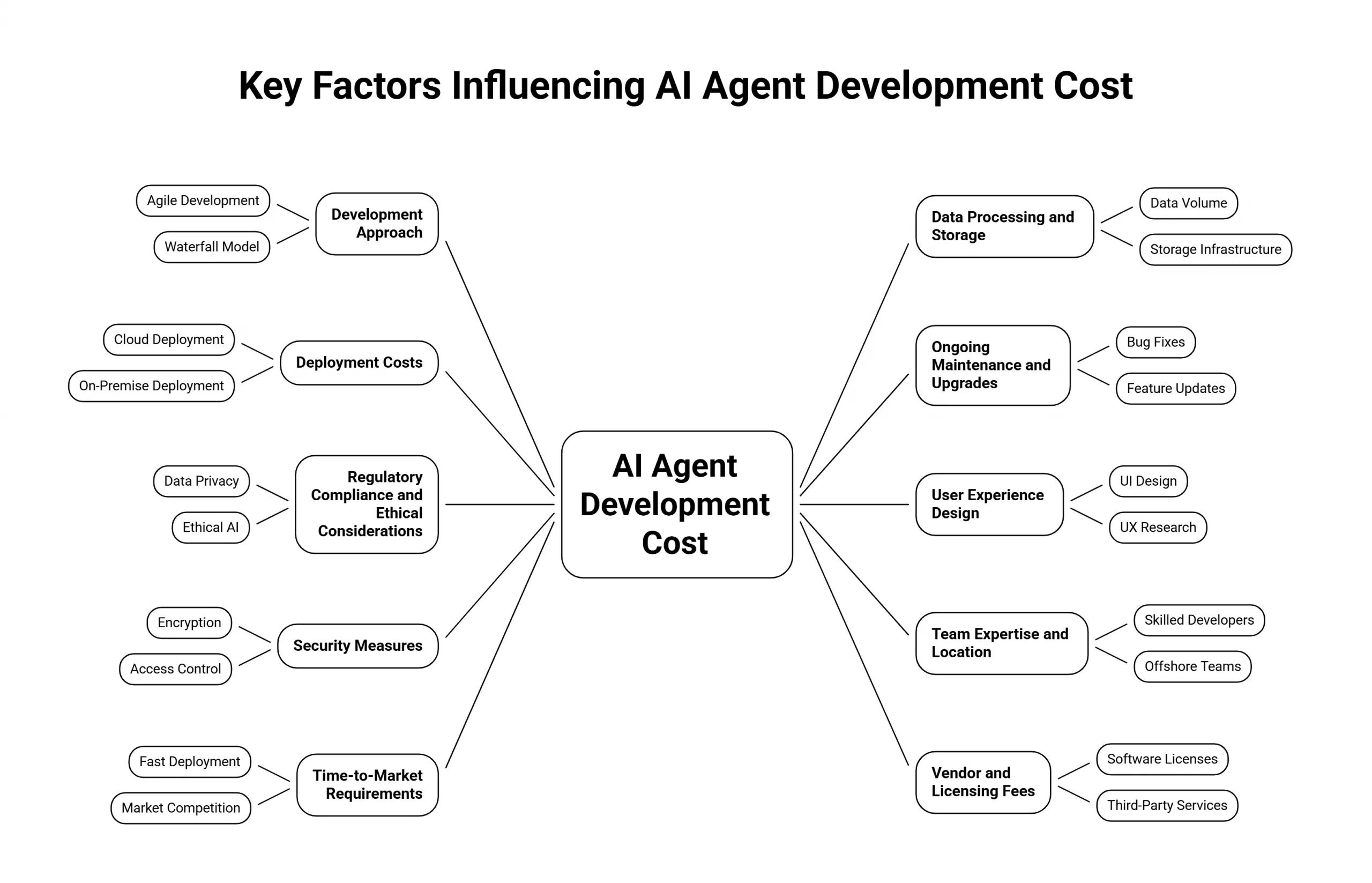
Below is a broader breakdown of these cost-driving factors:
1) Development Approach
The method you choose to build AI agent software plays a major role in shaping both the overall budget and long-term performance. Each approach comes with its own balance of flexibility, speed, and investment.
- Building from Scratch: Developing a fully custom AI agent means designing models, training algorithms, and creating workflows specifically for your business needs. This offers complete control over features, data handling, and scalability. However, it requires significant time, skilled AI engineers, high computing resources, and ongoing maintenance. As a result, this route usually comes with higher upfront and operational costs, but delivers highly tailored solutions for complex use cases.
- Using Open-Source Models: Many businesses speed up development by leveraging pre-trained models such as GPT-style architectures, BERT-based frameworks, or other community-supported AI tools. These models already understand language, patterns, and decision-making structures, reducing training time and infrastructure requirements. While this approach is more budget-friendly and faster to deploy, customization may be limited compared to fully custom-built systems. Additional tuning and integration work may still be needed to meet specific business goals.
- AI-as-a-Service (AIaaS) Platforms: Cloud-based AI platforms from major providers offer ready-made AI tools, APIs, and scalable infrastructure. These services often follow a pay-as-you-go or subscription pricing model, making them attractive for startups and growing businesses. They eliminate the need for heavy hardware investment and simplify deployment. However, long-term usage fees, data dependency, and reduced control over core AI architecture can influence total costs over time.
- Additional Considerations: Beyond development style, factors like data preparation, security compliance, ongoing training, system updates, and user integration also impact total spending. A cheaper development path upfront may lead to higher operational costs later if scalability or customization becomes a challenge.
Choosing between a fully custom AI agent, open-source frameworks, or cloud-based AI services should depend on your project’s complexity, long-term vision, performance expectations, and financial limits. The right approach balances cost efficiency with flexibility, scalability, and business impact.
2) Data Processing and Storage Requirements
The type, volume, and speed of data an AI agent handles play a major role in shaping overall development and operational costs. Since artificial intelligence systems thrive on data, the more complex the data environment becomes, the higher the infrastructure investment required.
Small Datasets: When AI agents are trained on limited and well-structured datasets, storage needs remain minimal, and processing demands are easier to manage. This typically results in lower hardware, cloud usage, and maintenance costs, making it suitable for simpler applications or pilot projects.
Large Datasets: As data volumes grow, so does the need for powerful servers, scalable cloud infrastructure, and advanced data pipelines. Massive datasets often require distributed storage systems, high-performance computing resources, and continuous monitoring, all of which significantly increase expenses.
Real-Time Data Processing: AI agents that operate in real-time, such as smart city systems, chatbots, or autonomous platforms, need instant data ingestion and analysis. This requires high-speed processors, low-latency networks, and optimized architectures, pushing costs higher compared to batch-processing systems.
Storage Solutions: Businesses can choose between on-premises infrastructure or cloud-based platforms like AWS, Microsoft Azure, and Google Cloud.
- On-premises storage may offer long-term control but involves high upfront investments in hardware, maintenance, and security.
- Cloud storage provides scalability and flexibility but comes with recurring subscription and usage-based charges.
Hybrid models are also becoming popular, combining both approaches for cost efficiency and performance optimization.
Data Security and Compliance: Handling sensitive or regulated data often requires additional security layers, encryption, backup systems, and compliance measures (such as GDPR or industry standards), further adding to processing and storage costs.
A well-planned data strategy that balances performance, scalability, and security with actual business needs is essential to keep AI agent software development costs under control. Investing wisely in the right infrastructure from the start can prevent unnecessary expenses as AI systems scale over time.
3) Deployment Costs
The setup where artificial intelligence agent software runs plays a major role in shaping both the upfront investment and the long term operational expenses. Each deployment model comes with its own financial implications, technical requirements, and scalability considerations.
On-Premises Deployment
This approach involves hosting the AI system on your own physical servers and infrastructure. It usually requires a large initial spend on hardware, networking equipment, security systems, and IT staff for maintenance and updates. While on-premises environments offer higher control over data, privacy, and system customization, the ongoing costs for power, cooling, upgrades, and troubleshooting can be substantial. This option is often chosen by organizations with strict compliance or data sovereignty needs.
Cloud Deployment
Cloud-based deployment allows AI agents to run on third-party servers provided by cloud service platforms. It follows a pay-as-you-use pricing model, which helps reduce heavy upfront investment. Businesses can easily scale resources up or down based on demand, making it ideal for growing projects or fluctuating workloads. However, over time, continuous usage, storage, and data transfer fees can add up, especially for high-volume AI applications.
Hybrid Deployment
Hybrid environments blend on-premises systems with cloud services. Sensitive data or critical operations can remain in-house, while cloud resources handle heavy processing and scalability. This offers flexibility and better workload distribution but often increases complexity. Integration costs, security management, and system synchronization can raise the total cost to build artificial intelligence agent software.
Additional Cost Factors to Consider
- Infrastructure upgrades as AI workloads grow
- Data storage and backup expenses
- Security and compliance investments
- Performance optimization tools
- Monitoring and maintenance services
Choosing the right deployment model is essential to balancing cost efficiency, system control, scalability, and long term performance when building AI agent software. A well-planned strategy can prevent unexpected expenses while supporting future growth.
4) Ongoing Maintenance and Continuous Upgrades
Building an AI agent is not a one-time investment. To keep it performing efficiently, securely, and in line with evolving business needs, ongoing maintenance and regular upgrades play a critical role in balancing the overall cost to develop an AI agent.
- Bug Fixes and Security Updates: As with any software system, AI agents can encounter technical issues, vulnerabilities, or performance bottlenecks over time. Routine patches and fixes help eliminate bugs, strengthen cybersecurity, and ensure smooth operation without interruptions.
- AI Model Re-Training and Optimization: AI systems rely heavily on data patterns that constantly evolve. Periodic re-training allows the AI agent to stay accurate, learn from new data, adapt to changing user behavior, and improve decision-making capabilities. This ongoing refinement directly impacts the quality and reliability of AI-driven outputs.
- Scalability and Feature Enhancements: As usage increases or business requirements expand, AI agents often need to scale their infrastructure and incorporate new functionalities. This may involve upgrading cloud resources, adding integrations, enhancing automation workflows, or introducing smarter algorithms to support growing demand efficiently.
- Performance Monitoring and System Optimization: Continuous monitoring helps identify inefficiencies, latency issues, and areas for improvement. Proactive optimization ensures faster responses, better resource utilization, and consistent user experience.
- Compliance and Technology Updates: AI regulations, data privacy standards, and underlying technologies evolve over time. Keeping the AI agent compliant with new laws and compatible with the latest platforms helps avoid risks and ensures long-term sustainability.
Strategically planning for ongoing maintenance, improvements, and scalability is essential to preserving the AI agent’s effectiveness, security, and long-term value. Without continuous support, even the most advanced AI systems can quickly become outdated or inefficient.
5) Regulatory Compliance and Ethical Considerations
Adhering to legal frameworks and ethical standards significantly shapes the overall cost of custom AI agent development. Organizations must ensure that their AI solutions align with regional and global regulations to avoid legal risks and reputational damage.
- Data Privacy Regulations: Building AI systems that comply with regulations such as GDPR, CCPA, and other data protection laws often requires advanced data handling processes, consent management systems, and secure storage infrastructures. These additional technical layers demand more development time and specialized expertise.
- Ethical AI Practices: Designing AI agents that are transparent, unbiased, and fair involves implementing monitoring tools, bias detection mechanisms, and explainable AI models. This ensures that decisions made by the AI remain accountable and trustworthy. Regular audits and testing also add to ongoing costs.
- Critical Consideration: Addressing regulatory and ethical requirements early in the development process helps prevent future compliance issues, reduces legal exposure, and builds long-term trust with users and stakeholders.
6) User Experience Design
An AI agent’s success largely depends on how easily users can interact with it. A well-designed interface improves engagement, satisfaction, and long-term adoption, though it can increase development complexity and costs.
- User-Centric Design: Investing in thorough user research, wireframes, prototypes, and usability testing ensures that the AI agent aligns with real user behaviors and expectations. A smooth experience minimizes friction and enhances productivity.
- Accessibility Features: Adding support for screen readers, voice commands, adjustable fonts, color contrast settings, and multilingual interfaces makes the AI agent usable for a wider audience. While these enhancements require extra design and development effort, they significantly improve inclusivity.
- Performance Optimization: Ensuring fast response times and seamless navigation across devices also requires backend optimizations and continuous testing, contributing to development investment.
- Critical Consideration: Strong UX design drives higher engagement, better retention, and positive brand perception, ultimately maximizing the return on AI investment.
7) Security Measures
Safeguarding AI agents against cyber threats is non-negotiable, especially when dealing with sensitive data and automated decision-making systems. Strong security frameworks directly influence development scope and budget.
Data Encryption: Using advanced encryption protocols for data at rest and in transit protects confidential information from unauthorized access. This includes secure APIs, encrypted databases, and secure cloud environments.
Threat Detection Systems: Integrating AI-driven monitoring tools, intrusion detection systems, and real-time alerts helps identify suspicious activity early. Regular security patches and vulnerability assessments further strengthen protection.
Authentication and Access Control: Implementing multi-factor authentication, role-based permissions, and secure login systems adds additional layers of safety but requires more development resources.
While security investments may increase initial costs, they prevent data breaches, system downtime, and potential legal penalties, saving organizations substantial losses in the long run.
8) Team Expertise and Location
The experience level of your development team and their geographical base play a major role in determining the overall cost of an artificial intelligence agent.
- Skilled and Experienced Developers: Working with highly experienced AI engineers, data scientists, and system architects often comes with higher hourly rates. However, their expertise helps avoid costly mistakes, speeds up development, improves system performance, and ensures scalability. In many cases, investing in seasoned professionals leads to better long-term value and lower maintenance costs.
- Geographical Differences: Development costs vary widely across regions. Teams based in North America or Western Europe generally charge more due to higher living costs and operational expenses. Meanwhile, development hubs in Asia, Eastern Europe, and Latin America often offer competitive pricing while maintaining strong technical capabilities.
- Team Structure Matters Too: A well-balanced team that includes AI specialists, backend developers, UI/UX designers, and QA engineers can streamline workflows and reduce rework, which ultimately controls costs.
Choosing the right mix of expertise and location allows businesses to optimize the cost to develop an AI agent while maintaining performance, security, and reliability.
9) Time-to-Market Requirements
How quickly you want your artificial intelligence agent software launched can significantly influence the total development cost.
- Accelerated Timelines: Fast-track development often requires larger teams, overtime work, parallel development streams, and faster infrastructure setup. While this shortens delivery time, it increases labor and operational expenses.
- Standard or Flexible Timelines: Allowing adequate time for planning, development, testing, and optimization helps teams work efficiently, reduce errors, and allocate resources more strategically. This often results in lower costs and higher product quality.
- Iterative vs. One-Time Build: Some businesses prefer phased development where features are released gradually. This approach spreads costs over time and allows improvements based on real-world feedback.
Aligning development timelines with business objectives, budget, and available resources is essential for maintaining cost control without sacrificing performance.
10) Vendor and Licensing Fees
Third-party tools, frameworks, and service providers can add another layer to artificial intelligence agent software development costs.
- Licensing Expenses: Many AI platforms, cloud services, data processing tools, and machine learning frameworks operate on subscription or usage-based pricing models. These recurring fees can accumulate significantly over time.
- External Vendors and Specialists: Businesses often rely on outside vendors for services like data labeling, AI model training, cybersecurity, cloud hosting, or system integrations. While these services improve functionality and speed, they also increase overall costs.
- Hidden or Long-Term Costs: Some licenses may scale as your system grows, meaning costs rise with higher data volumes, user traffic, or computational demands.
Thoroughly reviewing vendor contracts, understanding pricing structures, and selecting scalable solutions helps avoid unexpected expenses in the long run
When building artificial intelligence agent software, it’s important to understand that costs go far beyond writing code.
The entire process is shaped by:
- Data collection and processing requirements
- System integration with existing platforms
- Cloud infrastructure and deployment strategies
- Security protocols and compliance measures
- Continuous monitoring, updates, and performance optimization
Every technical decision has financial consequences.
From selecting custom-built models versus pre-trained solutions to choosing on-premise or cloud deployment, each choice affects both initial investment and long-term operational costs.
The more advanced, personalized, and scalable the AI agent software, the higher the investment required to build and maintain it.
However, this investment often translates into improved automation, better decision-making, enhanced user experiences, and long-term business growth.
Hidden Factors That Influence the Cost of Building an AI Agent (Often Overlooked)
Launching your AI agent is only the beginning of the journey. Behind the scenes, several technical processes continue long after deployment, quietly increasing the overall investment. Many of these costs don’t appear in the initial development phase but become essential as your AI system grows, handles more users, and adapts to real-world scenarios.
From ongoing model optimization and infrastructure scaling to performance monitoring and security upgrades, these hidden elements play a major role in maintaining a reliable and efficient AI agent. As user interactions increase, your system may require additional computing resources, improved data storage, regular updates, and continuous training to ensure accuracy and relevance.
There are also expenses tied to compliance, privacy protection, and integration with other platforms or tools, which often surface later in the lifecycle. Ignoring these factors can lead to unexpected budget overruns and performance challenges.
Let’s explore the lesser-known costs involved in developing and maintaining AI agent software that many businesses don’t account for upfront.
Latency Challenges
When an AI agent takes too long to respond, user experience quickly starts to suffer. Slow responses often require technical optimizations such as intelligent response caching, load balancing, or keeping certain components of the AI model active at all times. While these solutions improve speed, they also increase infrastructure usage, leading to higher cloud hosting, server, and GPU processing costs. Over time, maintaining ultra-fast performance becomes a recurring operational investment rather than a one-time fix.
Cold Start Delays
Many AI agents experience noticeable delays when handling the first request after being idle. This happens because the system needs time to initialize resources or load models into memory. To minimize this friction, businesses often deploy warm-start environments or continuously running containers in the background. Although this ensures quicker responses, it also means paying for computing resources 24/7, which can significantly raise monthly cloud expenses even during low-traffic periods.
Managing Incorrect or Misleading Outputs
AI agents can sometimes provide answers that sound confident but are factually wrong or contextually inappropriate. Preventing these issues requires additional layers of validation such as rule-based checks, human-in-the-loop reviews, fallback responses, or improved training datasets. In many cases, teams also fine-tune or retrain models regularly to improve reliability. All of this adds extra development time, testing cycles, and long-term maintenance efforts after deployment.
Supporting Multiple Input Formats
When an AI agent is expected to handle more than just text such as voice commands, images, PDFs, or scanned documents, the system becomes more complex. Each input type typically needs its own specialized model or processing pipeline, like speech-to-text engines or computer vision tools. This increases integration work, quality testing, and infrastructure usage, ultimately driving up development costs and ongoing system maintenance.
Monitoring Performance Over Time
AI models don’t stay perfect forever. As user behavior evolves and new types of data appear, accuracy can gradually decline. To prevent this, continuous monitoring systems are required to track performance, detect anomalies, and flag drops in quality. Many teams also build custom dashboards, automated alerts, and retraining pipelines to keep the AI updated. These processes demand dedicated tools, engineering resources, and consistent operational attention.
Additional Hidden Operational Costs
Beyond these technical challenges, AI agents often bring other ongoing expenses such as API usage fees, security compliance, data storage, backup systems, logging infrastructure, and customer support tooling. When combined, these smaller costs can quietly scale into thousands of dollars every month without being immediately noticeable.
| Operational Area | Typical Monthly Cost | Explanation |
|---|---|---|
| LLM/API Token Usage | $1,000 – $5,000+ | Each prompt or message processed through APIs like OpenAI, Cohere, or Anthropic incurs per-token fees. |
| Cloud Infrastructure | $500 – $3,000 | Hosting the AI agent with autoscaling, GPUs, and persistent storage drives up cloud bills. |
| Monitoring & Observability | $200 – $1,000 | Real-time tracking tools like Prometheus, Datadog, or custom dashboards are needed to maintain uptime and track drift. |
| Security & Access Control | $300 – $2,000 | Implementing role-based access, end-to-end encryption, and audit logging to meet compliance. |
| Data Storage | $50 – $500 per TB | Usage grows as more user interactions, training logs, and outputs get stored over time. |
| Technical Support | $200 – $2,000 | Whether in-house or vendor-backed, ongoing engineering time adds up. |
| Prompt Tuning/Model Updates | $500 – $3,000 (monthly/quarterly) | Regular tuning for better accuracy, new features, and adapting to new data trends. |
AI Agent Development Costs Through Real-World Examples
Grasping the true cost of building an AI agent becomes far clearer when you look at how real companies bring these systems to life. Some agents are lightweight assistants built for specific tasks, while others are massive, intelligent ecosystems handling millions of interactions every day.
The overall investment usually depends on factors like:
- Model size and training complexity
- Data volume and quality
- Infrastructure and cloud computing needs
- Security and safety alignment
- Integration with existing platforms and tools
- Ongoing maintenance and improvement
Let’s walk through real-world AI agents across industries to understand how costs scale in practice.
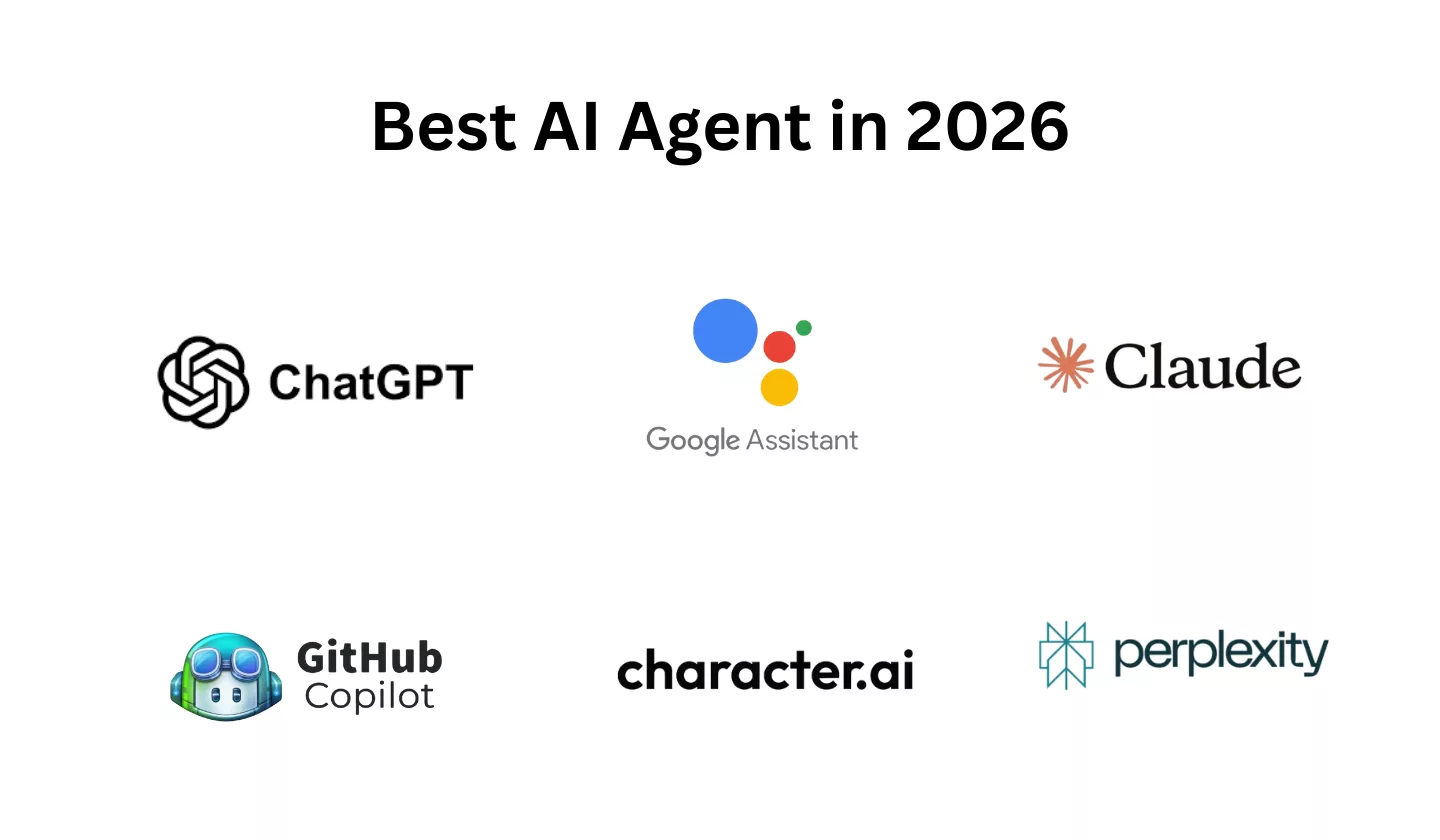
1. ChatGPT by OpenAI

ChatGPT is a large language model trained on massive datasets and refined using reinforcement learning. It handles open-ended conversations, code generation, content creation, research assistance, and customer service automation across industries.
Estimated Cost: $500,000 to several million dollars
Why it costs so much:
- Training extremely large neural networks
- High-performance GPU and cloud infrastructure
- Continuous updates and safety testing
- Serving millions of users in real time
AI agents at this level are closer to full platforms than simple bots. Most startups never build something this large initially. Instead, they create focused agents that solve one business problem first, then scale.
2. GitHub Copilot by GitHub

Copilot acts like a virtual programming partner. It predicts code, suggests entire functions, and explains logic directly inside development environments such as VS Code.
Estimated Cost: $50,000 (MVP) to $500,000+
What influences the cost:
- Amount of training data (open-source codebases)
- Support for multiple programming languages
- Real-time response performance
- Integration with IDEs and developer workflows
AI agents built for professional productivity usually require higher accuracy and faster response times, which increases development and infrastructure expenses.
3. Google Assistant by Google
Google Assistant is a voice-driven AI agent that answers questions, controls smart devices, sets reminders, navigates maps, and performs tasks across phones, speakers, cars, and wearables.
Estimated Cost: $100,000 to $500,000+
Cost drivers include:
- Speech recognition systems
- Natural language understanding
- Device integration APIs
- Large knowledge databases
Voice-enabled AI agents tend to cost more because they require both language intelligence and advanced audio processing technology.
4. Character.ai by Character.AI
Character.ai allows users to interact with custom AI personalities, historical figures, fictional characters, and role-playing companions that can remember conversations over time.
Estimated Cost: $40,000 to $300,000
What shapes the budget:
- Memory systems for long conversations
- Persona behavior tuning
- Real-time chat performance
- User interface and experience design
Entertainment-focused AI agents often emphasize personality realism and long-term memory, which adds complexity beyond basic chatbots.
5. Claude by Anthropic

Claude is a conversational AI designed with a strong focus on safety, reliability, and helpfulness. It supports writing, coding, analysis, and research while minimizing harmful outputs.
Estimated Cost: $100,000 to $400,000+
Where the money goes:
- Training large models similar to GPT-style systems
- Safety alignment and ethical testing
- Cloud infrastructure for scaling usage
- Continuous monitoring
When AI agents are built for enterprise or sensitive use cases, extra investment goes into security, compliance, and responsible AI frameworks.
6. Perplexity AI by Perplexity AI
Perplexity AI blends chatbot-style conversations with live web search. Instead of showing long lists of links, it delivers summarized answers with sources.
Estimated Cost: $150,000 to $250,000
Key cost components:
- Real-time search integration
- Natural language summarization models
- Source validation systems
- Fast response infrastructure
AI agents that combine external data sources with conversational intelligence often require more engineering work than standalone chatbots.
Where to Find the Best AI Agent Development Companies in 2026
In 2026, finding the right AI agent development company goes far beyond simple Google searches. Businesses now rely on specialized tech review platforms, industry directories, client testimonials, and case studies to evaluate expertise, reliability, and real-world performance.
One of the smartest ways to discover top-performing firms is through trusted B2B review platforms that curate and rank AI development providers based on verified projects, service quality, and customer feedback. These platforms save time by filtering out unproven vendors and showcasing companies with a strong track record in building scalable, secure, and innovative AI agents.
Among these platforms, AppsInsight stands out as a growing hub for exploring leading AI agent development companies across various industries. It offers expert-curated lists, in-depth company profiles, and transparent reviews that help businesses compare providers based on experience, technology stack, and client satisfaction. Rather than spending weeks researching, you can quickly identify trusted partners who align with your project goals.
FAQs
How much does it usually cost to build a custom AI agent for a small business?
Custom AI agent development costs can differ significantly based on functionality, integrations, and overall complexity. For small businesses, simpler AI agents, such as FAQ chatbots, appointment schedulers, or basic workflow automation tools, typically start around $10,000 to $50,000.
As requirements grow more advanced, including features like real-time data integrations, contextual decision-making, multi-channel support, and continuous learning, development costs often rise to $50,000 to $150,000 or more.
For large-scale businesses or highly autonomous AI systems designed to handle complex operations, pricing can easily move beyond the six-figure range.
In short, the more intelligence, customization, and scalability you need, the higher the investment, but the long-term efficiency gains often justify the cost.
How to Reduce AI Agent Development Costs?
Building a powerful AI agent doesn’t have to drain your budget. The real secret lies in smart planning. When you know where to invest strategically and where to simplify, you can lower costs without sacrificing performance or scalability.
Start with a single high-impact use case
Many teams overspend by trying to create an all-in-one AI system from day one. Instead, focus on one specific process that delivers clear value and measurable results. A smaller, well-defined scope keeps development lean and ensures resources are spent on what truly matters.
Leverage open-source and ready-made tools
Using proven frameworks like TensorFlow, PyTorch, LangChain, and LlamaIndex can dramatically reduce development time and expenses. These tools are widely tested, flexible, and integrate easily into existing workflows, helping you avoid costly custom builds.
Build an MVP before scaling
Launching a Minimum Viable Product allows you to validate ideas quickly, gather real user feedback, and fine-tune functionality early. This approach prevents expensive rework later and ensures you’re investing in features that bring real business value.
Optimize token consumption
For AI agents powered by large language models, efficient prompts can significantly cut usage costs. Simple, concise instructions reduce token count while maintaining clarity. Even small improvements can lead to major savings over time.
Use scalable cloud infrastructure
Platforms like AWS, Azure, and Google Cloud offer flexible, pay-as-you-go resources. Many businesses reduce infrastructure expenses by as much as 70 to 75 percent by moving away from rigid proprietary systems.
Additional cost-saving strategies include:
• Applying model quantization to reduce compute needs
• Running lightweight agents on edge devices to lower cloud usage
• Using transfer learning instead of training models from scratch
• Combining affordable models for simple tasks with advanced models for complex reasoning
In the end, cutting costs isn’t about building less. It’s about building smarter. Focus on real outcomes, reuse proven tools, and scale gradually as your AI agent proves its value.