

Mobile apps are today a necessity to connect more with the world in a digital manner. Every business, organization, and sector is moving towards the development of mobile apps for the successful drive of digital transformation. Not having a mobile app in 2025 leads to various problems and setbacks for businesses, such as bad customer engagement, lack of a specific platform, limited market opportunities, difficulty adapting to changing requirements, missed sales opportunities, competitive disadvantages, and much more.
Many businesses with mobile apps are experiencing rapid growth. However, simply developing a mobile app is not enough. To truly stand out and drive success, your app must include the top features for mobile app success that set your business apart from the competition.
Without embedding features of a successful mobile app, it raises many issues like ROI concerns, bad user engagement, an unstructured interface, a lack of systemic functions, and much more. In this article, we will discuss the top features for mobile app success.
The top features make a mobile application better and useful in various ways. These Features are just like the lifeline for the mobile application. Leading brands and even the top mobile app development companies focus on essential features that every app should have — a user-friendly interface, strong security measures, offline functionality, push notifications, personalization, search and navigation, seamless payment integration, fast loading, regular updates, analytics and user insights, and profile management. These elements play a vital role in making a mobile application perfect for different conditions and user requirements.
Key Features Driving Mobile App Success in 2025
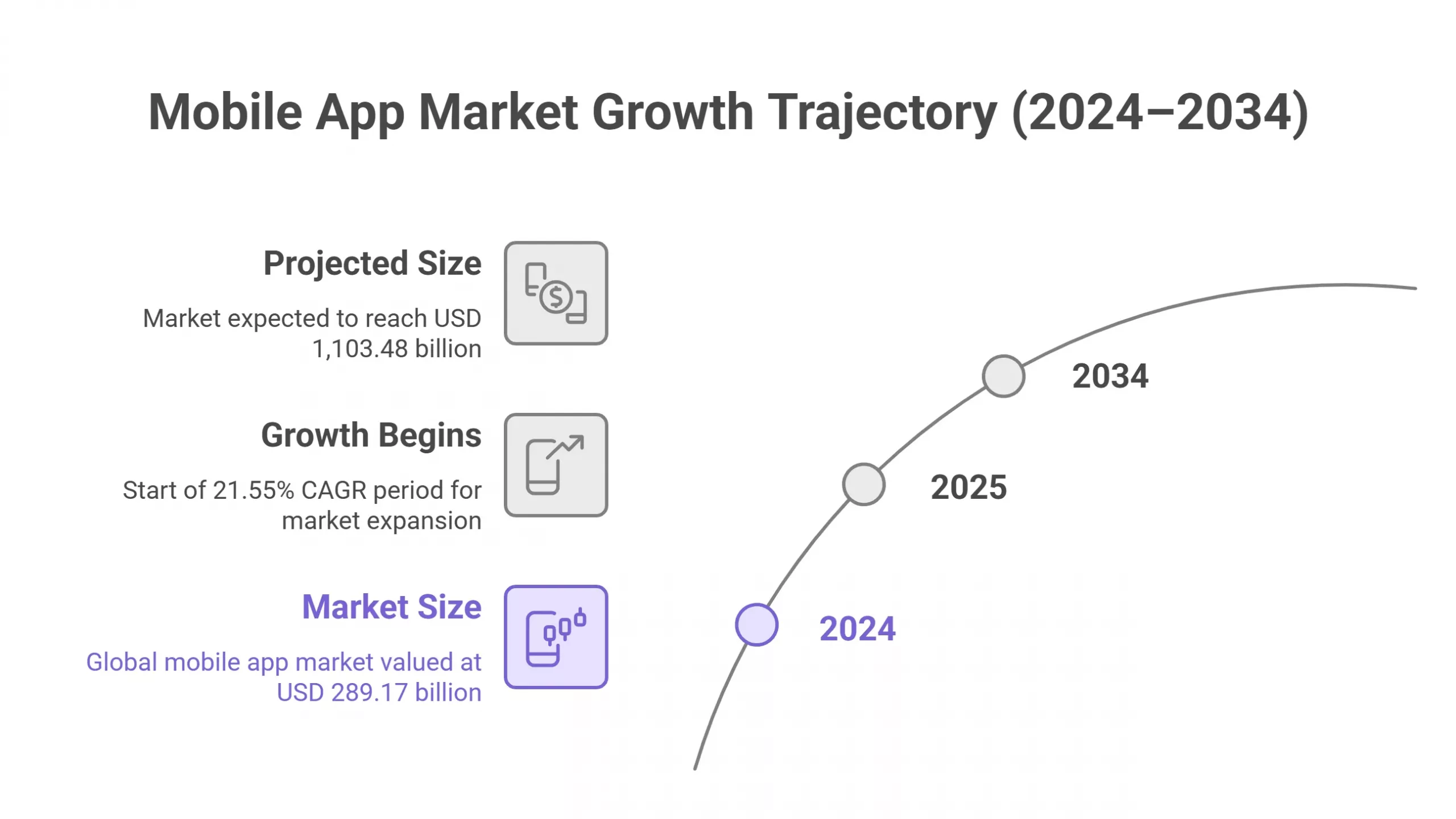
The global mobile application market size accounted for USD 289.17 billion in 2024 and is projected to reach USD 1,103.48 billion by 2034, growing at an impressive CAGR of 21.55% from 2025 to 2034. This growth is largely fueled by the surge in app-based services, the increasing adoption of smartphones, and the expanding reach of high-speed internet across the globe.
For a mobile app to thrive in this competitive market, it must offer features that directly impact user retention, security, personalization, and overall experience. Apps with streamlined onboarding and intuitive UI/UX design retain 3.7% of iOS users and 2.1% of Android users after 30 days — a critical window for user loyalty. Clean, platform-aligned interfaces and minimal friction in the signup process are proven to boost retention rates.
Security is another non-negotiable feature. In 2025, 80% of users preferred apps with robust security measures, while data breaches led to an average 20% user churn. Today, biometric authentication and end-to-end encryption are standard in 65% of finance and healthcare apps, not just as user demands but also due to strict regulatory requirements.
Personalization also plays a pivotal role. Tailored push notifications can increase retention by up to 15%, helping users feel more engaged and valued. However, balance is key — 60% of users disable notifications if they find them too frequent or irrelevant. Smart segmentation and AI-driven recommendations can ensure that app notifications remain helpful rather than intrusive.
Beyond these, offline functionality, seamless performance across devices, and integration with emerging technologies like AI, AR, and voice assistance are becoming essential for future-ready mobile apps. In a market that’s growing this fast, prioritizing these features isn’t just a competitive advantage — it’s a survival strategy.
Read once! Stages Of Mobile App Development
What Are the Essential Features for a Mobile App?
The features for mobile applications refer to the functionalities or systems that integrate into the application to enhance the user experience, achieve goals or objectives, and enhance the overall mobile application capabilities.
Without having any features, the mobile application is nothing except a block of programs or an interface. You cannot make use of the mobile application if there are no functionalities. This is important to implement trending and top features for mobile app success.
The features show the potential of a mobile app. What can it do, and how can it be used to enhance the operations for businesses, individuals, or any organization? Overall, the features are the main aspects that optimize the mobile app by making it useful for various purposes.
Looking for? Best App Ideas With Features, Benefits, & Costs
Top Features Every Successful Mobile App Needs in 2025
There are various top features for mobile app success. Here are a few mentioned below.
1) User-Friendly Interface
User interface is an important feature that should be friendly for each application. The more user-friendly the interface, the more users can interact with the application easily and perform other operations with ease and convenience. It should consist of a visually attractive design with attractive color combinations. The design should be simple so that users can find it easy to navigate and use.
Also, the interface should be accessible for users to make different font sizes, colors, and language changes according to their comfort. And most importantly, the user interface should be responsive in every manner.
Want to know? How Much Does it Cost to Develop an Android App
2) Social Media Integration
Social media integration is another essential feature among the top features for mobile app success. The social media integration feature allows organic marketing tools that can redirect users to the business’s social media account to view the posts and other content. This provider uses different login credentials that make it easy to manage social media components and application aspects differently.
3) Personalization
Users always seek special attention and treatment. The personalization feature can fulfil this need for the users. This feature can enhance the user experience by applying various aspects, controls, and access according to the users ‘ needs. It also provides personalized marketing campaigns for each user that attract their attention in a great manner.
With the personalized feature, the users do not need to reset their profile each time, as every time they come again, the profile and app interface will be the same where they left off previously.
4) Security
Security is not just a feature, but a necessity that must be had in every mobile application. A mobile application deals with businesses and users’ data, which raises the risk of hacking and data breaches. This results in a loss for the businesses and also the potential damage to their reputation. The apps should have all the important and advanced security measures with regulatory compliance.
This enhances the security of mobile applications and users’ data, as well as maintains the reputation of the businesses for which the mobile application is used.
4) Push Notifications
Push notification is one of the features that makes users engage with the application from time to time. Without push notifications, users may not get the information about the critical aspects that reduce their engagement with the application.
The push notification feature allows sending a message or notification straight to the user’s screen, which makes them curious to open it to know further information. This enhances the user engagement even if they are not active regularly, which overall benefits the businesses.
5) Regular Updates and Support
Maintenance and making upgrades with the changing requirements enhance the user experience of the application. The regular update and support are the essential features that show the dedication of the business towards the customers via their mobile applications.
Regular updates fix the bugs, errors and make advanced changes that improve the overall application functionalities. Also, the customer support features like live chat, email support, community support, etc, help customers to solve their issues, which overall enhances their trust towards the mobile application.
6)Multiple Payment Options
Payment options should be of every type that makes different users comfortable to make transactions on the application. There are a lot of users for any mobile application as they use different kinds of payment options.
Having a feature of single payment options may eliminate many users from using the app. The multiple payment options feature may attract a large variety of users, which enhances the application’s reach. Multiple payment option features also enhance the overall revenue generation for the business through the application.
7) Feedback Support
A mobile application can do much better with the feedback from the users as they face the challenges that really occur. There should be feedback support features that help to understand what kind of issues affect the user experience of the application.
This helps businesses to work on the improvement that enhances the overall mobile application functionality. The better functionality, the more users spend time on it, which overall makes a profit for the businesses.
8) Location Tracking in Mobile Apps
Location tracking in mobile apps enables businesses to deliver personalized experiences, improve customer engagement, and drive higher sales conversions. Studies reveal that integrating real-time location tracking features can boost customer retention rates by up to 25%, as users enjoy more relevant and engaging interactions.
Strategies like geofencing and proximity marketing used by Swiss companies become highly effective when combined with accurate location data, helping brands connect with customers at the right place and time. In fact, 70% of shoppers are more likely to visit a store when they receive a personalized location-based message during their shopping journey.
9) Modern Technology
Incorporating modern technologies such as Augmented Reality (AR), Virtual Reality (VR), Machine Learning (ML), and Data Science can significantly enhance a mobile app’s capabilities and user appeal. Apps leveraging these innovations often experience higher popularity and stronger customer loyalty.
For example, data science in mobile apps enables accurate demand forecasting and inventory planning, ensuring businesses are well-prepared for future needs. ML-powered models allow for smarter, data-driven decision-making, improving personalization and efficiency.
Meanwhile, AR and VR applications provide immersive experiences — such as showcasing detailed real estate architecture — offering clients a realistic, interactive preview that elevates user satisfaction.
10) Real-Time Chat and Messaging in Mobile Apps
In-app chat is a built-in communication feature that enables users to connect instantly with each other or directly with a business. In today’s fast-paced digital environment, real-time messaging has become essential for enhancing user engagement, improving customer service, and creating seamless communication experiences.
Developing a secure and feature-rich chat system from scratch can be challenging, which is why many businesses opt for third-party chat SDKs to streamline implementation, maintain high performance, and ensure data security.
Selecting the right in-app chat solution is crucial for organizations aiming to boost user satisfaction, strengthen relationships, and deliver exceptional communication within their mobile apps.
Looking for? Top Android App Development Companies In USA
Challenges in Embedding Features in Mobile Apps
With a lot of essential features, various challenges should be kept in mind. Here are a few key challenges mentioned below.
- Balancing performance with the feature complexity could be a challenge for various mobile applications. The complex feature requires many operations to perform, which may affect the performance of the application due to overloading.
- The more features embedding requires, the higher the cost. Many businesses may not be able to invest too much in best mobile application development. So the cost is a challenge for embedding the features.
- Many features do not support cross-platform compatibility. So this could be a challenge too, that interrupts the integration of many features or compromises the cross-platform compatibility.
Sum up
A mobile application platform-dedicated audience, speed and performance, and an appealing design are just a few of the variables that determine app success rate in today’s competitive market. In today’s competitive business environment, the above-mentioned few top qualities are essential for every business to stand out, engage users, and maximize return on investment. By including these elements, you can make sure that your app engages with and meets the needs and desires of your target market.
User-Generated Queries
How does biometric authentication improve mobile app security in 2025?
Biometric authentication, such as fingerprint scans, facial recognition, and voice ID, provides a faster and more secure login process. In 2025, with increasing data breaches, biometrics reduce reliance on passwords, minimize hacking risks, and comply with stricter security regulations, especially in finance and healthcare apps.
Best real-time chat and messaging solutions for mobile apps?
Popular SDKs like Sendbird, Twilio, and Firebase offer reliable real-time chat features with encryption, file sharing, and push notifications. These solutions speed up development while maintaining performance and security for smooth in-app communication.
Benefits of integrating AI-powered personalization in mobile apps?
AI-powered personalization analyzes user behavior to deliver relevant content, recommendations, and offers. This increases retention, boosts conversions, and enhances user satisfaction by making the app feel more tailored to each individual’s needs.
Why location tracking is important for mobile app success?
Location tracking enables apps to provide targeted services like nearby offers, geofenced notifications, and personalized recommendations. Retail, delivery, and travel apps use this feature to increase engagement and drive sales.
Top push notification strategies to increase app retention
Effective strategies include personalized messaging, timely updates, and behavior-based triggers. Notifications should be valuable, not spammy, to avoid high opt-out rates — keeping users engaged without overwhelming them.
How offline mode enhances mobile app user experience
Offline mode allows users to access key features and data without an internet connection. This improves usability in areas with poor connectivity and builds trust with users who depend on uninterrupted access.
Must-have payment gateway features for mobile applications
A good payment gateway should offer multi-currency support, multiple payment methods (credit card, UPI, PayPal, etc.), secure encryption, and fast processing to ensure smooth transactions and higher conversion rates.
Best geofencing features for retail mobile apps
Retailers can use geofencing to trigger offers when customers are near a store, send reminders for items in their cart, or provide location-specific deals — boosting foot traffic and in-store sales.
How AR and VR features are shaping mobile apps in 2025?
AR (Augmented Reality) and VR (Virtual Reality) create immersive experiences in shopping, gaming, and education apps. From virtual try-ons to interactive learning environments, these technologies set apps apart in a crowded market.
Essential data privacy features for mobile health and finance apps?
Features like end-to-end encryption, multi-factor authentication, HIPAA/GDPR compliance, and secure cloud storage are critical to protecting sensitive user data and building trust in apps that handle financial or health information.