

Cryptocurrency exchanges play a significant role in how digital assets are bought, sold, and traded. As adoption continues to grow, more businesses and startups are exploring opportunities to operate their own exchange platforms.
Building such a system entirely from scratch, however, requires substantial technical expertise, regulatory understanding, and financial investment. This is where white label crypto exchange development has gained attention. By using a ready-made but customizable solution, organizations can focus on branding, compliance, and customer service while relying on a proven technical foundation.
For companies considering this path, understanding how these platforms work, what features they offer, and the exact process of setting one up is essential. The goal is not only to launch quickly but also to do so securely and in a way that can scale as the business grows.
What is a White-Label Crypto Exchange Platform?
A white label cryptocurrency exchange platform is a pre-built software solution that allows businesses to launch their own digital asset trading service under their own brand name. Instead of developing every technical component in-house, companies use a framework provided by a vendor and customize elements such as design, user interface, and branding.
This approach differs from building an exchange from scratch in several ways. Developing a platform internally may take years of engineering effort and significant financial resources. A white label solution, by contrast, can be deployed in weeks or months, depending on the level of customization required. The trade-off is that while speed and cost efficiency are improved, there may be some limitations in how deeply features can be modified.
White label models are not unique to cryptocurrency. They are widely adopted in other industries such as banking, where payment gateways and online banking software are often white labeled by smaller institutions. In the context of digital assets, the same principle applies: businesses get access to tested infrastructure without reinventing the entire system.
Want to know? How to Create a Cryptocurrency Token: A Step-by-Step Guide
How to create a white label crypto exchange platform step-by-step
Building a cryptocurrency exchange requires careful planning and structured execution. Below are seven steps that outline how white label crypto exchange development typically works.
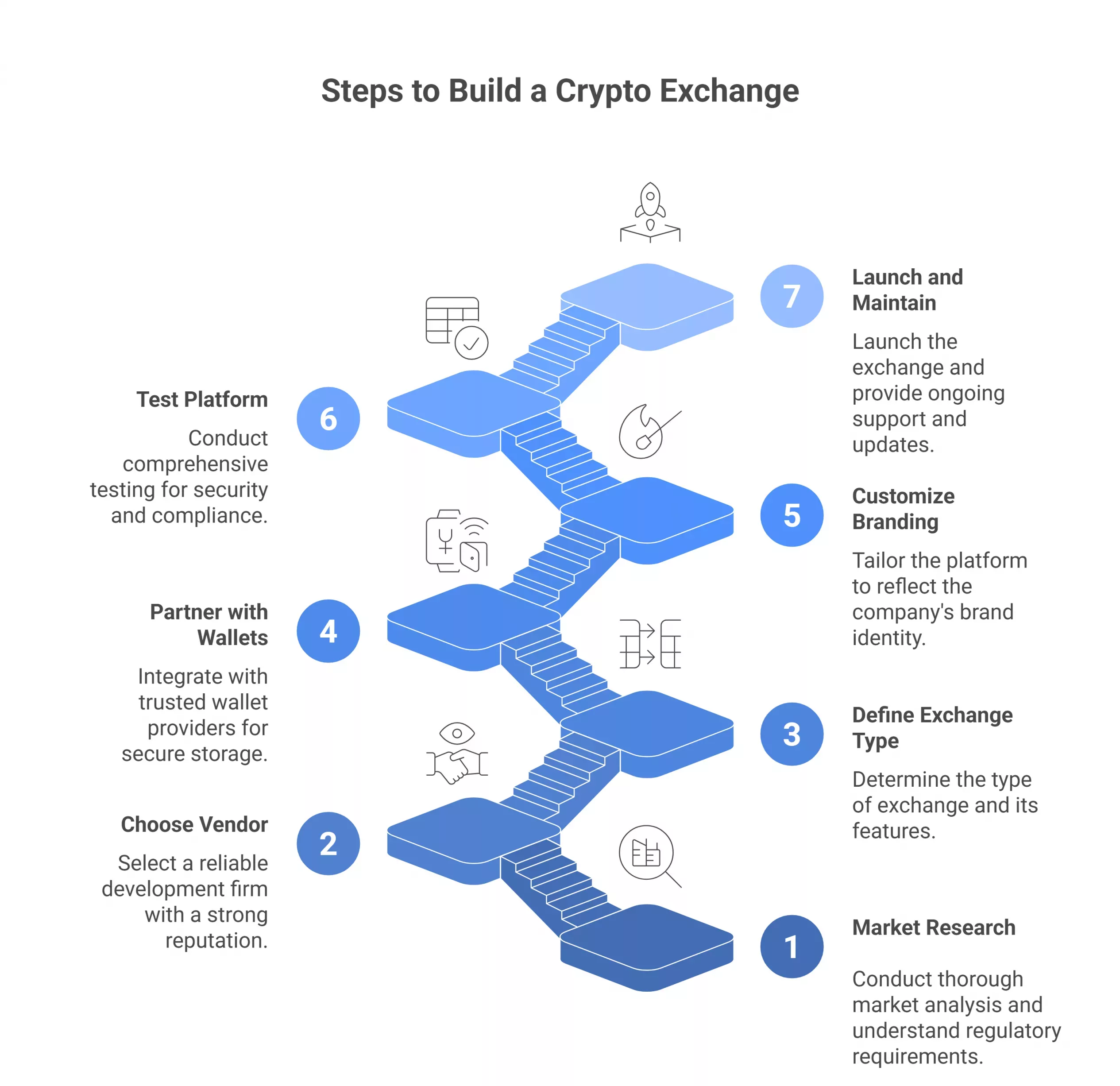
1. Market research and regulatory understanding
Before starting, it is important to research target markets, user expectations, and trading behaviors. At the same time, businesses must understand regulatory requirements in their operating region, such as licensing, Know Your Customer (KYC), and Anti-Money Laundering (AML) compliance. For startups, this step helps prevent legal challenges after launch.
2. Choosing a reliable Cryptocurrency Exchange Development Firm
Selecting the right vendor is critical. A professional provider ensures the platform’s trading engine, security framework, and compliance modules are well-tested. Reputation, past client references, and support services should be part of the evaluation process.
3. Defining exchange type and features
Decide whether the exchange will support spot trading, futures, peer-to-peer (P2P), or a combination. Each type requires different liquidity and operational models. Early definition of features avoids costly modifications later in the process.
4. Partnering with Crypto Wallet Companies
Secure storage of digital assets is essential. Integration with trusted wallet providers enables both hot wallets (for active trading) and cold wallets (for offline storage). Using established Crypto Wallet Companies reduces security risks compared to in-house wallet development.
5. Customizing branding and user interface
White label platforms allow businesses to adjust visual design, logos, color schemes, and customer onboarding flows. This ensures the exchange reflects the company’s brand identity while maintaining usability.
6. Testing for security, scalability, and compliance
Comprehensive testing should include penetration testing for security, load testing for high-traffic scenarios, and verification of compliance with local regulations. This stage confirms that the system is prepared for both daily operations and unexpected spikes in demand.
7. Launch and ongoing maintenance
After successful testing, the exchange can go live. Post-launch, ongoing monitoring, updates, and customer support are required to maintain trust and reliability. Maintenance also includes responding to new regulatory requirements and adding features as markets evolve.
Looking for? Best Crypto Wallet For NFT Storage
Key features of a white label cryptocurrency exchange solution
A strong exchange platform depends on both functionality and security. The following are core features commonly included in a white label solution:
- Trading engine performance: The trading engine matches buy and sell orders. Low latency and high throughput are essential for handling large volumes of trades without delays.
- Security infrastructure: Most platforms include safeguards such as two-factor authentication (2FA), multi-signature wallets, KYC/AML integration, and anti-fraud monitoring. These are significant for building user trust.
- Liquidity management: Access to liquidity pools or external exchanges helps prevent order book gaps. Some providers offer built-in liquidity-sharing arrangements to improve market depth.
- Administrative dashboard: Admin panels allow operators to monitor transactions, manage user accounts, set fees, and generate compliance reports.
- Mobile and cross-device support: Many traders prefer mobile apps or responsive web interfaces. A good platform provides seamless access across devices.
- Scalability: Infrastructure should handle growth in user numbers and trading volume without compromising performance.
These features form the foundation of a white label crypto exchange development project, ensuring that businesses can meet basic market expectations while keeping room for future improvements.
Looking for? Cryptocurrency Exchange Development Companies
Benefits of building a white label crypto exchange solution
Adopting a white label approach offers several advantages, particularly for startups and mid-sized businesses that want to enter the digital asset market efficiently.
- Faster time to market: Since the technical foundation is already developed, deployment can be completed in a shorter period compared to building from scratch.
- Cost efficiency: Development and maintenance expenses are reduced because the vendor provides the core infrastructure. For new entrants, this means more resources can be directed toward compliance and customer acquisition.
- Proven security frameworks: Established vendors often integrate widely adopted safeguards, such as KYC/AML modules and wallet encryption. While no system is immune to risk, using tested solutions reduces vulnerabilities.
- Compliance support: Many providers include built-in tools for meeting regulatory standards, which simplifies operations across multiple jurisdictions.
- Scalability: Platforms can often be upgraded with additional modules, such as derivatives trading or NFT support, when the business grows.
However, there are limitations. White label exchanges may not allow full customization of features or trading logic. Businesses are also dependent on the vendor for ongoing updates and technical support.
For companies evaluating this option, the decision often comes down to weighing speed and reliability against flexibility and control.
How AppsInsight can help with a white label crypto exchange platform development
Navigating the process of launching a cryptocurrency exchange involves many moving parts, from regulatory preparation to technical deployment. At AppsInsight, we focus on making this landscape easier to understand by providing research-driven resources, guides, and case studies on topics such as exchange development, wallet integration, and compliance requirements.
For readers considering white label crypto exchange development, our platform offers insights into practical vendor selection, key industry challenges, and examples of successful implementations. This knowledge helps businesses make informed decisions before committing to a development path.
Contribute to AppsInsight’s knowledge hub
In addition to resources for operators, AppsInsight welcomes contributions from professionals, researchers, and practitioners working in blockchain and fintech. If you have experience or perspectives to share, you can contribute through our write for us page. Sharing expertise not only supports industry growth but also helps others navigate this rapidly evolving space.
Must see! AI Crypto Trading Bots for Better Profits
Sum up
Creating a cryptocurrency exchange can seem complex, but white label crypto exchange development provides a structured way to simplify the process. By following a clear seven-step approach, businesses can understand the path from market research to launch. Exploring the core features ensures the platform meets industry standards, while weighing both the benefits and limitations helps determine whether a white label solution is the right fit.
FAQ
What is the average cost of white label crypto exchange development?
Costs vary depending on features, customization level, and vendor reputation. On average, expenses can range from tens of thousands to several hundred thousand dollars. Additional costs often include licensing, compliance, and ongoing maintenance.
How long does it take to launch a white label cryptocurrency exchange platform?
Deployment timelines are shorter than building from scratch. A basic platform may be ready in a few weeks, while customized solutions with advanced features may take several months.
Are white label solutions secure enough for large-scale trading?
Most vendors integrate industry-standard security practices, such as 2FA, KYC/AML, and multi-signature wallets. However, long-term security also depends on proper maintenance, regular audits, and adherence to regulatory requirements.
Can a startup scale its platform later if starting with white label?
Many providers offer modular upgrades that allow businesses to add features like derivatives trading or mobile apps as demand increases. That said, scalability depends on the vendor’s infrastructure, so it is important to confirm capacity in advance.