
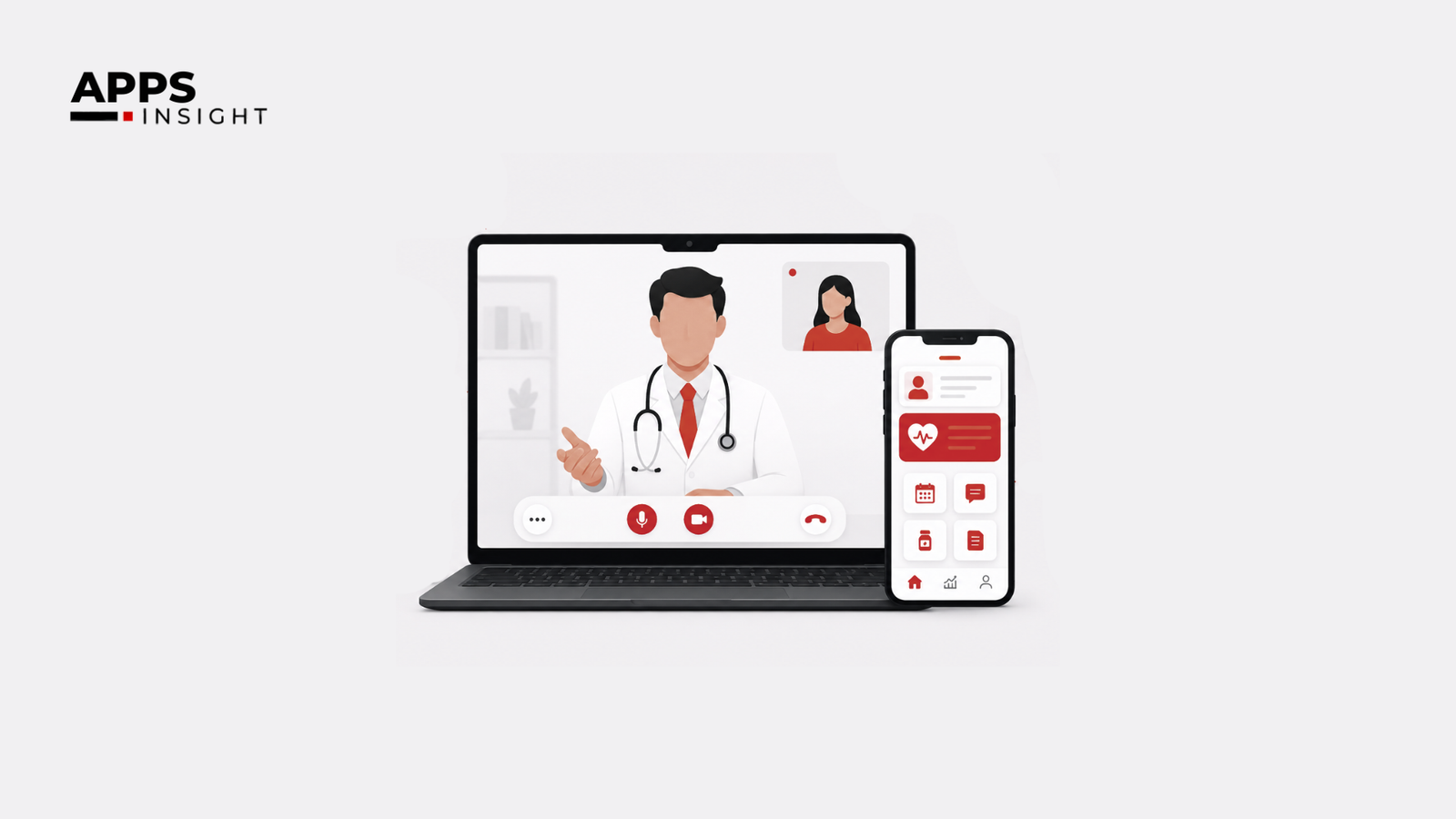
Telemedicine is no longer just a video call between a patient and a doctor. Healthcare software is transforming telemedicine by connecting virtual consultations with appointments, electronic health records, prescriptions, payments, patient communication, remote monitoring, and follow-up care. This makes virtual healthcare part of a broader digital workflow rather than a standalone service.
The shift is already measurable.
According to the American Medical Association’s 2024 Physician Practice Benchmark Survey, 71.4% of physicians reported using telehealth in their practices in 2024, compared with 25.1% in 2018.
American Medical Association The U.S. Department of Health and Human Services also reports that 25% of Medicare fee-for-service users received a telehealth service in 2024, while 95% of HRSA-funded health centers used telehealth to provide primary care that year.
For healthcare providers, founders, and businesses building digital health services, this growth creates a practical question: what makes telemedicine work effectively at scale?
The answer is the software infrastructure behind it. A well-designed platform can bring clinical information, communication, administrative processes, and patient services into one connected environment. This article explains how that happens, which technologies matter, what features are commonly required, and what businesses should consider before developing a telemedicine solution.
What Healthcare Software Adds to Telemedicine
A basic telemedicine service may allow a patient to book an appointment and speak with a doctor online. However, healthcare delivery involves much more than the consultation itself.
Before a consultation, the patient may need to register, complete forms, select a doctor, provide medical information, and receive an appointment reminder. During the consultation, the provider may need access to previous records, medications, test results, or clinical notes. Afterward, the patient may need a prescription, follow-up appointment, payment receipt, or remote monitoring.
This is where the role of healthcare software in telemedicine becomes important. Software connects these activities so that information does not have to be entered repeatedly into separate systems.
For example, a patient can schedule a virtual consultation through an application. The system can automatically create the appointment in the provider’s calendar, send a reminder, verify the patient’s information, enable the video consultation, store clinical notes, and support a follow-up appointment.
The exact workflow depends on the type of healthcare organization, but the basic principle remains the same: software connects the different steps involved in delivering virtual care.
This also explains why Custom Healthcare Software can be useful for organizations with specialized workflows. Instead of changing an established process to fit a generic platform, the technology can be designed around the organization’s actual requirements.
How Software Is Changing Virtual Healthcare
1) Improving access to healthcare
One of the clearest advantages of telemedicine is that patients can receive certain types of care without physically visiting a healthcare facility.
A patient living far from a specialist, for example, may be able to attend a consultation remotely. This can reduce travel requirements and make specialist access easier in locations where healthcare resources are limited.
However, access isn’t only about having a video connection. The software needs to make the entire process understandable and usable.
Patients should be able to find available appointments, receive reminders, join consultations, access instructions, and communicate with providers without navigating unnecessarily complicated interfaces.
The World Health Organization has emphasized this broader approach. In 2024, WHO released guidance to help countries strengthen telemedicine services, noting potential benefits including improved accessibility, shorter waiting times, and better follow-up and management of health conditions.
2) Connecting patient information
A virtual consultation becomes more useful when the provider has access to relevant patient information.
Electronic health records can contain medical history, diagnoses, medications, allergies, laboratory results, and other clinical information. When appropriate systems are connected, clinicians don’t have to rely entirely on information supplied verbally during the appointment.
This is particularly important for patients with ongoing conditions.
For instance, a patient managing diabetes may have several consultations over a period of months. Connecting consultation records with relevant health information allows the provider to understand previous treatment decisions and monitor changes over time.
Interoperability is therefore an important consideration. WHO identifies interoperability and data sharing as key areas in digital health because disconnected systems can limit the value of digital information.
3) Supporting remote patient monitoring
Telemedicine can extend beyond scheduled video appointments. Connected devices can collect information such as blood pressure, blood glucose, heart rate, weight, or oxygen saturation. Depending on the clinical use case, that information can be transferred to a healthcare platform for review.
This allows healthcare teams to monitor certain patients between appointments.
For example, a patient recovering at home may submit readings regularly. If the platform identifies a reading that requires attention, the provider can review it according to the organization’s clinical workflow.
The important point is that software doesn’t replace clinical judgment. It provides a system for collecting, organizing, and presenting information so healthcare professionals can make decisions using available data.
4) Making follow-up care easier
A telemedicine consultation shouldn’t necessarily end when the video call ends. Software can support the next steps, including prescription management, appointment scheduling, patient messages, reminders, and care instructions.
Consider a patient who has a virtual consultation for a recurring condition. Instead of manually arranging every follow-up activity, the platform can help manage the process digitally.
This creates continuity between appointments and can reduce some administrative work for both patients and providers.
Important Features of a Telemedicine Software
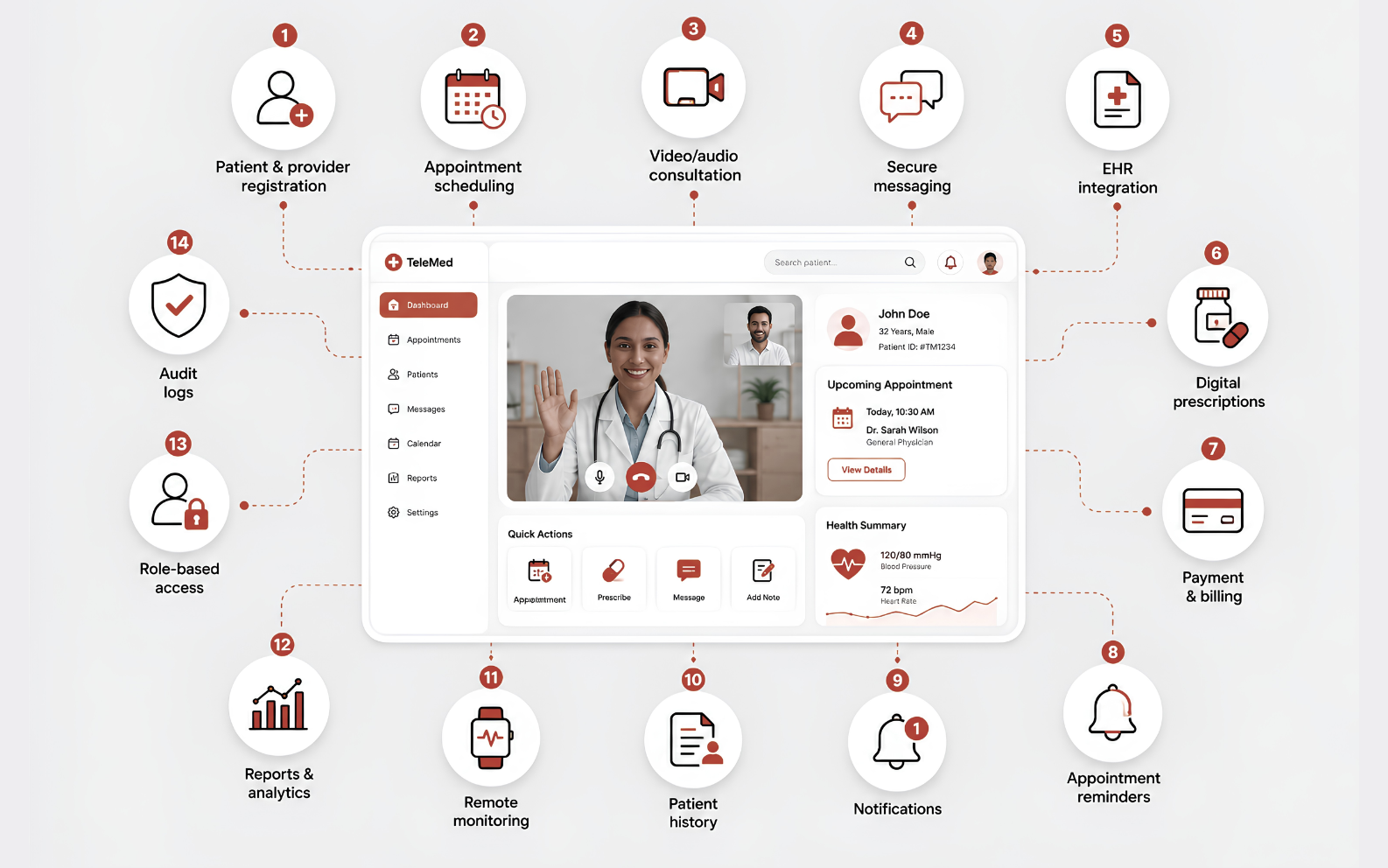
The required functionality varies by healthcare business, but common features of telemedicine software include:
- Patient and provider registration
- Appointment scheduling
- Video and audio consultations
- Secure messaging
- Electronic health record integration
- Digital prescriptions
- Payment and billing
- Appointment reminders
- Notifications
- Patient history
- Remote monitoring
- Reports and analytics
- Role-based access
- Audit logs
Not every platform needs all of these functions. A small specialist clinic may primarily need appointment scheduling, video consultations, patient records, payments, and follow-up communication. A larger healthcare network may require deeper integration with existing clinical and administrative systems.
This distinction matters for businesses planning development because adding unnecessary functionality increases complexity without necessarily improving the service.
The Features of Healthcare App requirements should therefore come from the actual healthcare workflow rather than from a generic checklist.
Integration With Existing Healthcare Systems
One of the biggest differences between a simple communication application and a healthcare platform is the need for integration. Telemedicine may need to communicate with:
- Electronic health record systems
- Hospital systems
- Pharmacy platforms
- Laboratory systems
- Payment gateways
- Identity systems
- Medical devices
- Patient portals
- Scheduling systems
For example, Hospital Management Software may already contain patient registration, billing, appointment, and clinical information. If a healthcare organization introduces a separate telemedicine system, the two platforms may need to exchange relevant information.
Without appropriate integration, staff may have to enter the same information in multiple systems. That creates additional work and can increase the possibility of inconsistent data.
Interoperability also affects long-term scalability. WHO’s Global Initiative on Digital Health reported in 2024 that more than 70% of countries had a digital health strategy with scaled digital health programs underway, while also highlighting fragmented resources, inconsistent technical standards, and governance challenges.
For founders, this means integration should be considered during planning rather than treated as a later technical addition.
It also affects project budgets. The Cost to develop an EHR Software solution, for example, cannot be determined from the number of screens alone. Data architecture, integrations, security requirements, user roles, compliance needs, and maintenance requirements can all affect the overall scope.
Security and Privacy Are Core Requirements
Healthcare software handles sensitive information, so security needs to be part of the system design from the beginning. Common technical measures include:
- Encryption
- Strong authentication
- Role-based permissions
- Secure API connections
- Audit trails
- Data backups
- Access controls
- Session management
- Monitoring and logging
- Disaster recovery planning
The exact legal requirements depend on the countries and healthcare markets involved. A platform operating in the United States, for example, may have different regulatory obligations from one operating in India, Europe, or another market.
Privacy also involves more than protecting databases. Patients should understand what information is collected, why it is needed, and how it is used.
Accessibility is another part of responsible software design. WHO and the International Telecommunication Union published an accessibility standard for telehealth and later released an implementation toolkit. WHO notes that approximately 1.3 billion people worldwide live with a significant disability, making accessibility an important consideration when designing digital healthcare services.
Features such as captions, screen-reader compatibility, clear navigation, appropriate contrast, and accessible forms can make telemedicine easier to use for more people.
Benefits for Patients, Providers, and Healthcare Businesses
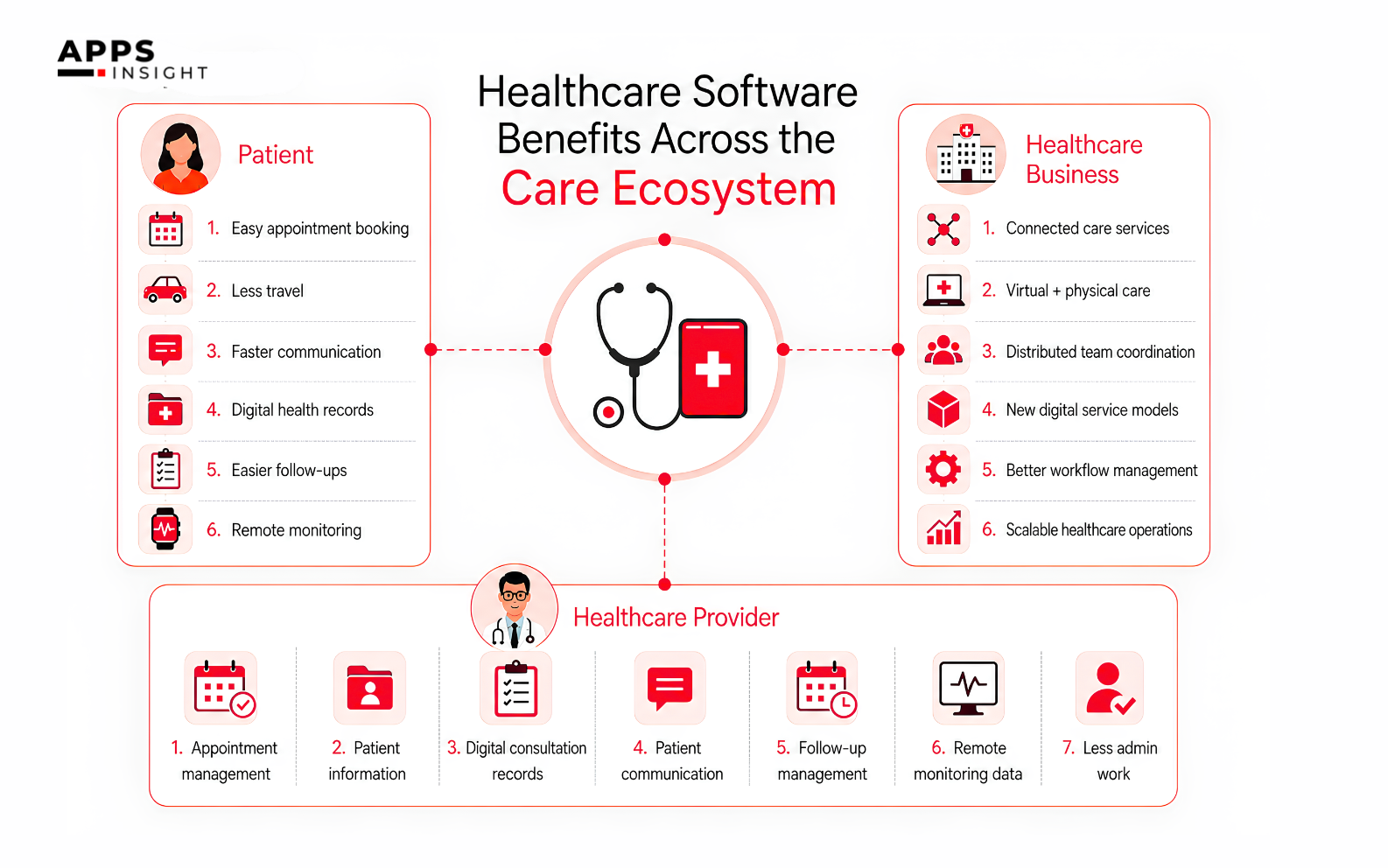
The benefits of healthcare software in telemedicine can be considered from three perspectives.
For patients
Patients can benefit from:
- Easier appointment booking
- Reduced travel for suitable consultations
- Faster communication
- Digital access to health information
- Easier follow-up
- Remote monitoring where clinically appropriate
These benefits are particularly relevant when distance, mobility, time, or limited access to specialists makes traditional appointments difficult.
For healthcare providers
Providers can use connected software to:
- Manage appointments
- Review patient information
- Document consultations
- Communicate with patients
- Manage follow-ups
- Review remote monitoring data
- Reduce repetitive administrative tasks
The goal isn’t to remove healthcare professionals from the process. Instead, software can handle information and administrative workflows so professionals can focus on clinical decisions and patient interaction.
For healthcare businesses
Healthcare organizations can use digital platforms to support new service models, coordinate distributed teams, and manage virtual and physical care through connected systems.
WHO’s 2024 work on digital health and noncommunicable diseases also highlights telemedicine, mobile health, and other digital interventions as tools that can support prevention and disease management.
The practical value depends on implementation. A poorly designed platform can create additional work, while a well-planned one can simplify specific processes.
What Founders Should Consider Before Building Telemedicine Software
Building a telemedicine platform starts with defining the healthcare problem, not selecting technology. Before development begins, founders and healthcare businesses should answer several basic questions:
Who will use the platform?
Patients, doctors, nurses, pharmacists, administrators, and other users may need different interfaces and permissions.
What healthcare workflow will it support?
A mental health consultation platform may have very different requirements from a remote cardiology monitoring service.
Does it need EHR integration?
If healthcare professionals need existing clinical information, integration should be included in the technical plan.
What regulations apply?
The target market determines many of the privacy, security, data storage, and operational requirements.
What needs to happen after a consultation?
Prescription, payment, follow-up, referrals, monitoring, and messaging may all need to be part of the workflow.
How will the system scale?
Architecture should account for increasing users, consultations, data volume, integrations, and administrative requirements.
Organizations comparing Healthcare App Development firms should therefore look beyond portfolios and development speed. They should evaluate experience with healthcare workflows, security, integrations, testing, maintenance, and regulatory requirements.
Similarly, selecting a Healthcare App Development Company should involve understanding who will own the software, how updates will be managed, and how integrations will be maintained over time.
The same principle applies to digital pharmacy products. The issues highlighted in Entrepreneurs Should Know Before Launching a Digital Pharmacy App include prescription handling, patient information, payments, pharmacy integration, and regulatory requirements. These considerations show why healthcare applications need domain-specific planning.
Technology Trends Shaping Telemedicine Apps
Several Healthcare App Trends are influencing how virtual care platforms are being developed.
Remote monitoring
Wearables and connected medical devices can provide health information between appointments. This is particularly relevant for chronic disease management and post-treatment monitoring.
AI-assisted workflows
AI can support tasks such as summarizing information, organizing records, assisting with administrative work, and identifying patterns in data. However, its role needs to be clearly defined, especially where clinical decisions are involved.
Better interoperability
Healthcare organizations increasingly need systems that can exchange information instead of operating as isolated applications.
Patient-centered applications
Patients increasingly expect straightforward digital experiences for appointments, communication, records, payments, and follow-up care.
Accessibility
Healthcare software needs to work for people with different physical, sensory, cognitive, and digital-literacy needs. WHO’s accessibility guidance specifically encourages accessibility to be considered during the planning and development of telehealth services rather than added later.
These trends do not mean every healthcare business needs every new technology. The appropriate technology depends on the clinical problem and the people using the system.
What This Means for Healthcare Businesses
For healthcare businesses evaluating Healthcare Software Companies, the important question isn’t simply whether a provider can build an application. The better question is whether the technology can support the organization’s healthcare workflow safely and reliably.
For some businesses, existing software may provide everything required. A custom solution becomes more relevant when the organization needs specialized workflows, unique integrations, specific user roles, or functionality that standard products cannot provide.
This is also important when evaluating Profitable Healthcare Business Ideas. A digital health concept may appear commercially attractive, but its success depends on whether it solves a genuine healthcare problem, fits existing workflows, meets regulatory requirements, and can operate reliably.
The software should support the business model rather than become the business model itself.
For organizations with specific operational requirements, Custom Healthcare Software can provide greater control over workflows and integrations. But that flexibility also brings responsibility for security, maintenance, testing, infrastructure, and future updates.
Sum up
Healthcare software is changing telemedicine by connecting virtual consultations with the rest of the healthcare process. Scheduling, patient records, digital prescriptions, payments, messaging, remote monitoring, and follow-up can now work together within a connected digital workflow.
The growth in adoption shows that telemedicine has become an established part of healthcare delivery. AMA data indicates that 71.4% of physicians were using telehealth in 2024, while HHS reports that one-quarter of Medicare fee-for-service users received a telehealth service during the same year.
For founders and healthcare service providers, the key is not to add technology simply because it is available. The system should address a specific healthcare need, fit the way providers work, protect patient information, integrate with relevant systems, and remain usable for patients.
When those requirements are clear, Custom Healthcare Software can be one approach for building a telemedicine platform around a specific workflow instead of forcing that workflow into a generic product.
For more related healthcare technology insights, readers can explore AppsInsight.
FAQs
How is healthcare software transforming telemedicine?
Healthcare software connects virtual consultations with appointments, electronic health records, prescriptions, payments, messaging, remote monitoring, and follow-up care. This turns telemedicine from a standalone video service into a more connected healthcare workflow.
What are the main features of telemedicine software?
Common features include patient and provider profiles, appointment scheduling, video consultations, secure messaging, EHR integration, digital prescriptions, payments, notifications, remote monitoring, reporting, and role-based access.
What are the benefits of healthcare software in telemedicine?
It can make healthcare access more convenient, support remote monitoring, reduce some administrative work, improve information sharing, simplify follow-up care, and help providers manage virtual consultations alongside other healthcare services.
How does healthcare software support remote patient monitoring?
Software can receive information from connected devices, organize patient readings, display relevant data to healthcare professionals, and support follow-up workflows. The specific use depends on the patient’s condition and the healthcare provider’s clinical process.
What should businesses consider before developing telemedicine software?
Businesses should define their target users and healthcare workflow, identify integration and compliance requirements, plan security and accessibility, select necessary features, estimate development and maintenance costs, and determine how the platform will scale.
Is telemedicine the same as a video consultation?
No. A video consultation is one part of telemedicine. A complete telemedicine workflow can also include scheduling, patient records, prescriptions, payments, secure communication, remote monitoring, and follow-up.
Does every telemedicine platform need EHR integration?
The requirement depends on the service. However, EHR integration can be important when providers need access to existing clinical information during virtual care.
Can telemedicine software support chronic disease management?
Yes. When appropriate, telemedicine platforms can support recurring consultations, remote monitoring, patient communication, reminders, and follow-up workflows for chronic conditions.
Is custom healthcare software better than an off-the-shelf platform?
An off-the-shelf product can be suitable when its features and integrations match the organization’s needs. Custom development may be appropriate when specialized workflows, integrations, or functionality require greater control.
Why is accessibility important in telemedicine?
Accessibility determines whether people with disabilities and other users can effectively use digital healthcare services. WHO and ITU have published specific technical guidance to help telehealth providers address accessibility barriers.