

The future of cross-platform app development is poised for remarkable growth in 2026, driven by businesses’ increasing need to deliver seamless experiences across multiple devices. With smartphones, tablets, wearables, and even smart TVs becoming integral to daily life, organizations are seeking development strategies that allow them to build apps once and deploy them everywhere.
Cross-platform development offers a strategic advantage by reducing time-to-market, minimizing development costs, and providing consistent user experiences, making it an essential approach for both startups and enterprises looking to stay competitive in the fast-evolving digital landscape.
Advancements in tools, frameworks, and technologies are also reshaping the way developers approach app creation. The best cross-platform tools for developers now enable rapid prototyping, high-performance apps, and integration with cloud services and serverless architectures.
As we move toward 2026, innovations such as AI-powered features, enhanced UI/UX capabilities, and stronger security measures are expected to become standard in cross-platform apps. Businesses that adopt these technologies early will not only streamline development but also deliver scalable, future-ready applications that meet user expectations across devices.
Rise of Cross-Platform Development
The future of cross-platform app development is being shaped by the growing need for apps that function seamlessly across multiple devices and platforms. Businesses no longer want to invest in separate native apps for Android, iOS, and web, as this approach increases development costs and maintenance efforts.
Cross-platform solutions allow a single codebase to run on multiple platforms, providing efficiency, cost savings, and consistent user experiences. The rise of cross-platform development reflects not only technological advancement but also a shift in business strategy toward agile, scalable, and user-centric solutions.
Increasing Demand for Multi-Platform Apps
With users accessing apps on smartphones, tablets, desktops, and wearables, companies need applications that perform consistently across devices. Cross-platform development addresses this demand by enabling developers to write code once and deploy it across all target platforms, reducing duplication of effort and ensuring uniform functionality.
Cost-Effectiveness and Faster Time-to-Market
Developing native apps for each platform can be expensive and time-consuming. Cross-platform frameworks allow businesses to save on development and maintenance costs while accelerating time-to-market. This speed enables organizations to respond quickly to market trends, launch updates efficiently, and stay competitive in 2026.
Popularity Among Startups and Enterprises
Startups prefer cross-platform development because it allows them to release a functional product without heavy upfront investment. Large enterprises adopt it to maintain consistent branding and functionality across multiple platforms while reducing development overhead. The versatility and scalability of cross-platform solutions make them appealing to organizations of all sizes.
Impact on User Experience and Engagement
Maintaining a consistent user interface and experience across devices is critical for engagement. Cross-platform development ensures that design and functionality are uniform, helping users navigate apps intuitively, which improves retention and satisfaction. Emerging tools and frameworks further enhance UI responsiveness and animation quality, creating near-native experiences.
Trends Driving Adoption
Several factors drive the adoption of cross-platform development, including cloud integration, AI-powered features, low-code/no-code solutions, and the availability of advanced frameworks. Developers can now create high-performance apps that are visually appealing, secure, and feature-rich, making cross-platform development a preferred strategy in 2026.
Looking for? What is the Best Way to Hire App Developers in 2026?
Advancements in Cross-Platform Frameworks 2026
The future of cross-platform app development heavily relies on the continuous evolution of frameworks that enable developers to create high-performance apps efficiently. In 2026, frameworks are expected to offer near-native performance, smoother animations, improved integration capabilities, and simplified maintenance.
These advancements allow businesses to develop scalable, secure, and visually appealing apps while reducing development time and cost. With rapid improvements in cross-platform frameworks 2026, developers can focus more on delivering innovative features and enhancing user experience rather than dealing with platform-specific challenges.
Flutter Updates and Improvements
Flutter has become one of the most popular cross-platform frameworks due to its single codebase approach and native-like performance. The 2026 updates focus on enhanced GPU rendering, smoother animations, better memory management, and expanded widget libraries. Flutter’s integration with cloud services and support for desktop and web applications ensures that developers can build highly scalable and visually consistent apps.
React Native Evolution
React Native continues to evolve with faster bridge communication, improved modular architecture, and better support for native APIs. In 2026, React Native enables developers to optimize app performance while maintaining flexibility in integrating third-party libraries and tools. This evolution strengthens its position as a reliable framework for businesses seeking rapid deployment and multi-platform reach.
Emerging Frameworks
New frameworks and tools are emerging to address specific limitations of traditional cross-platform solutions. These include lightweight frameworks focused on performance, frameworks that integrate AI/ML seamlessly, and tools optimized for IoT or AR/VR applications. Adopting emerging frameworks allows businesses to leverage cutting-edge technology for unique app experiences.
Performance Optimization in Frameworks
Modern frameworks are increasingly designed to deliver near-native performance. Features like hot reload, precompiled components, hardware acceleration, and optimized memory management reduce latency and improve responsiveness. Developers can now create apps that feel natural on both Android and iOS, minimizing the traditional performance gap between native and cross-platform apps.
Integration with Cloud Services
Cross-platform frameworks now offer built-in support for cloud integration, enabling seamless connection with backend services, APIs, and serverless architectures. This integration enhances app scalability, real-time data processing, and multi-device synchronization. Businesses can deploy apps faster while leveraging the advantages of cloud infrastructure for storage, analytics, and security.
Community Support and Ecosystem Growth
Strong developer communities and active ecosystems are vital for framework evolution. Frameworks like Flutter and React Native benefit from extensive libraries, plugins, and open-source contributions that accelerate development, simplify problem-solving, and provide innovative solutions. In 2026, the community-driven ecosystem will continue to drive adoption and innovation in cross-platform development.
Ease of Maintenance and Updates
Framework advancements also simplify maintenance by allowing a single codebase to be updated across multiple platforms simultaneously. Bug fixes, feature updates, and performance enhancements can be applied efficiently, reducing downtime and ensuring consistent app quality. This capability is especially valuable for businesses aiming for long-term app sustainability and scalability.
Want to know? Where To Find Skilled App Developers In 2026
Performance Enhancements and Optimization
Optimizing performance is a crucial aspect of the future of cross-platform app development. While cross-platform frameworks offer the advantage of a single codebase, achieving native-like speed and responsiveness remains a key challenge.
In 2026, developers focus on advanced optimization techniques, efficient coding practices, and leveraging hardware acceleration to ensure apps run smoothly across multiple platforms. High-performance apps improve user engagement, reduce churn, and enhance overall satisfaction, making performance optimization a priority in modern cross-platform development.
Techniques for Native-Like Performance
Modern cross-platform apps employ techniques such as asynchronous programming, lazy loading, and code splitting to enhance responsiveness. Frameworks now provide tools to optimize rendering pipelines and manage resource-intensive operations efficiently, ensuring apps perform close to native standards on both Android and iOS devices.
Code Sharing Strategies
One of the primary advantages of cross-platform development is code sharing. In 2026, developers are implementing modular code structures that allow reusing components without compromising performance. Well-structured shared code reduces redundancy, simplifies debugging, and accelerates development while maintaining efficiency across platforms.
Hardware Acceleration and GPU Utilization
Hardware acceleration leverages device GPUs to handle graphics-intensive tasks, animations, and complex UI elements. By offloading processing from the CPU to the GPU, apps run smoother and maintain higher frame rates. This technique is particularly valuable for gaming apps, AR/VR experiences, and highly interactive applications.
Optimizing Memory and Battery Usage
Efficient memory management and low battery consumption are essential for user retention. Developers now employ techniques like object pooling, memory profiling, and minimizing background processes to ensure apps do not drain device resources. Optimized apps provide better performance on lower-end devices, expanding market reach.
Testing and Debugging Improvements
Cross-platform frameworks in 2026 include advanced testing tools for performance profiling, debugging, and error detection. Automated testing, continuous integration, and performance monitoring help developers identify bottlenecks early, ensuring that apps meet high-quality standards before deployment.
Responsive UI and Smooth Animations
Performance optimization also focuses on UI responsiveness. Frameworks now support high-frame-rate animations, gesture handling, and adaptive layouts that respond fluidly across screen sizes. Smooth animations and transitions contribute to a near-native user experience, enhancing overall app appeal.
Predictive Performance Monitoring
Emerging tools allow predictive monitoring, where analytics and AI are used to forecast potential performance issues before they affect users. This proactive approach ensures that apps remain stable under varying user loads and system conditions, further improving reliability and user satisfaction.
Do you know? How AI Is Reshaping Android App Development
Best Cross-Platform Tools for Developers
In 2026, the future of cross-platform app development is closely tied to the evolution of tools that enable developers to build high-performance, scalable, and visually appealing apps efficiently. Selecting the right tools can significantly impact development speed, app quality, and maintainability.
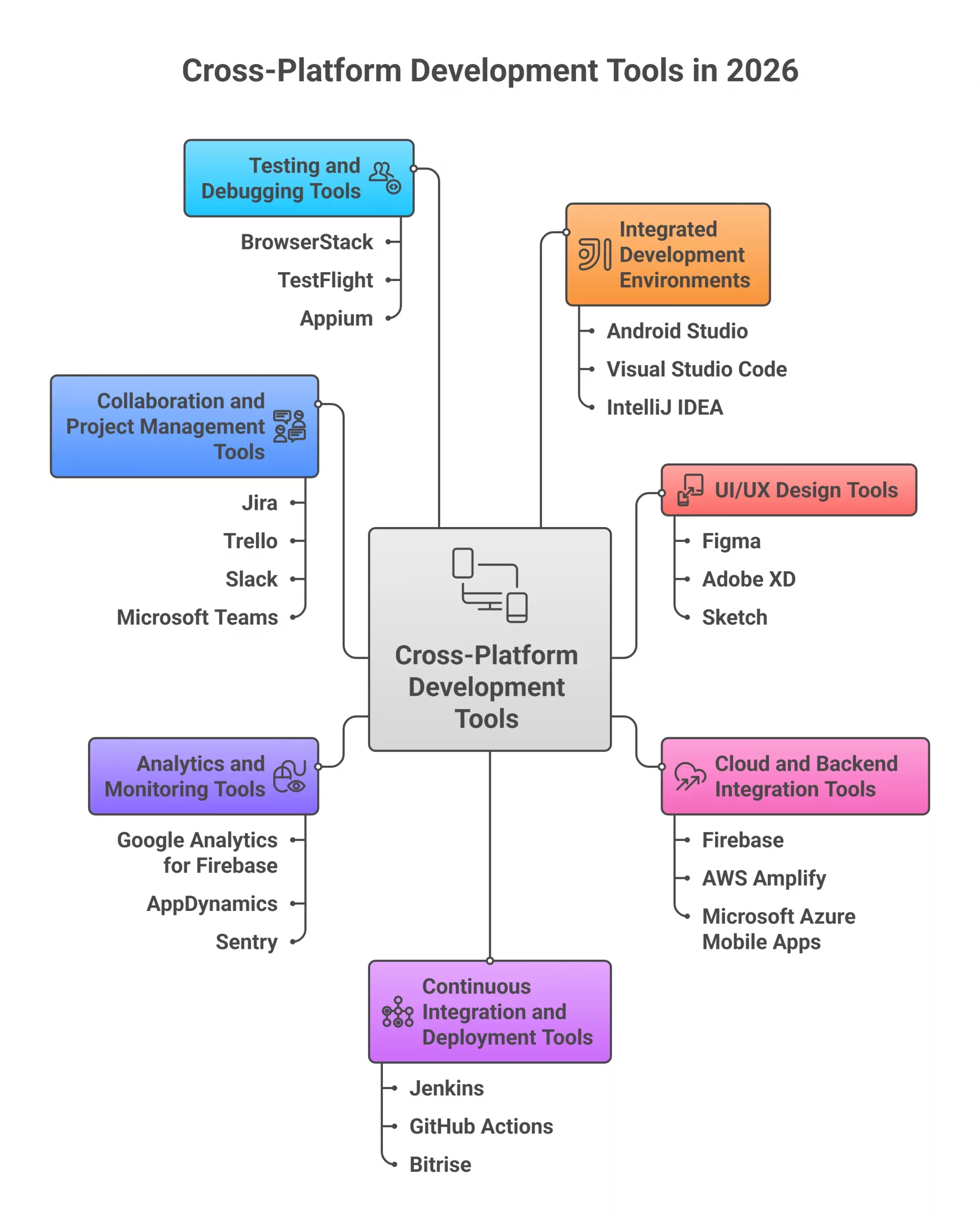
Modern cross-platform tools integrate advanced features such as cloud connectivity, AI integration, UI/UX optimization, and automated testing, making them indispensable for developers aiming to deliver robust applications.
Understanding these tools helps businesses and developers leverage new technology effectively and stay ahead in the competitive mobile landscape.
Integrated Development Environments (IDEs)
IDEs like Android Studio, Visual Studio Code, and IntelliJ IDEA are optimized for cross-platform development. They offer intelligent code completion, syntax highlighting, debugging capabilities, and version control integration. Modern IDEs also support hot reload features, allowing developers to instantly see changes, which accelerates testing, iteration, and overall development efficiency.
UI/UX Design Tools
High-quality apps depend on seamless user experiences. Tools such as Figma, Adobe XD, and Sketch allow developers to design responsive interfaces that adapt across devices and screen sizes. These tools integrate with cross-platform frameworks, enabling developers to directly implement designs and reduce manual adjustments, ensuring consistency and high usability.
Cloud and Backend Integration Tools
Cross-platform apps in 2026 often rely on cloud services for scalability, storage, and real-time data synchronization. Tools like Firebase, AWS Amplify, and Microsoft Azure Mobile Apps simplify backend integration, serverless computing, and API management. Developers can easily implement authentication, database management, notifications, and analytics, reducing the complexity of backend operations.
Continuous Integration and Deployment (CI/CD) Tools
CI/CD tools such as Jenkins, GitHub Actions, and Bitrise automate the building, testing, and deployment of cross-platform apps. These tools ensure faster release cycles, minimize human errors, and maintain high code quality. Developers can quickly detect performance issues or bugs and deploy fixes efficiently, supporting agile development practices.
Analytics and Monitoring Tools
Understanding user behavior and app performance is critical for success. Tools like Google Analytics for Firebase, AppDynamics, and Sentry provide insights into crash reports, user interactions, and system performance. This data enables developers to optimize app functionality, improve engagement, and proactively address potential issues.
Collaboration and Project Management Tools
Effective team collaboration is essential for cross-platform development, especially with distributed teams. Tools like Jira, Trello, Slack, and Microsoft Teams facilitate task management, progress tracking, and real-time communication. These platforms ensure seamless coordination between developers, designers, and stakeholders, enhancing productivity and project transparency.
Testing and Debugging Tools
Cross-platform apps require rigorous testing to ensure functionality and performance across devices. Tools such as BrowserStack, TestFlight, and Appium enable automated and manual testing on multiple platforms, reducing the risk of device-specific issues. Advanced debugging features help developers identify and resolve errors efficiently, ensuring reliable and stable app releases.
Emerging AI-Powered Development Tools
In 2026, AI-powered development tools are increasingly being integrated into cross-platform workflows. These tools assist with code generation, bug prediction, performance optimization, and UI/UX personalization. Leveraging AI allows developers to reduce repetitive tasks, enhance accuracy, and innovate faster, improving both development efficiency and app quality.
Serverless and Cloud Integration Trends
The future of cross-platform app development is closely linked to serverless computing and cloud integration, which are transforming how developers build, deploy, and scale applications. Serverless architectures remove the need for traditional server management, allowing developers to focus on writing code while cloud providers handle infrastructure, scaling, and maintenance.
In 2026, using serverless and cloud integration trends enables cross-platform apps to deliver faster performance, real-time updates, and enhanced scalability, making them ideal for modern business demands.
Advantages of Serverless Architecture
Serverless computing offers several advantages, including automatic scaling, cost efficiency, and simplified deployment. Developers are charged only for the actual compute resources used, reducing operational costs. Serverless functions can handle multiple requests simultaneously, enabling cross-platform apps to maintain high performance under varying loads without manual intervention.
Cloud-Native Backend Integration
Cross-platform apps increasingly integrate with cloud-native backends such as AWS Lambda, Google Cloud Functions, and Microsoft Azure Functions. This integration allows developers to build microservices, handle APIs efficiently, and synchronize data in real-time across platforms. Cloud-native integration ensures robust performance, minimal downtime, and easy maintenance.
API Management and Microservices
Serverless architecture promotes microservices, which divide an app into modular, independent services. Each service can be updated, scaled, or deployed independently, improving agility and reliability. API management tools like Apigee and Postman help maintain consistent communication between microservices, ensuring smooth functionality across Android, iOS, and web platforms.
Scalability and Load Management
Serverless and cloud integration make scaling seamless. During traffic spikes, cloud infrastructure automatically allocates additional resources, ensuring consistent performance. Developers can implement load-balancing strategies, caching, and auto-scaling to handle millions of users efficiently, which is critical for large-scale cross-platform applications.
Real-Time Data Processing
Cloud integration enables real-time data processing, allowing apps to deliver live updates, notifications, and analytics. Features like live chat, collaborative tools, and IoT connectivity benefit significantly from serverless and cloud-based solutions, improving user engagement and operational efficiency.
Future Opportunities in Cloud Integration
The future holds more opportunities for cloud-native features in cross-platform development. Edge computing, AI-driven cloud functions, and hybrid cloud deployments will allow developers to optimize latency, improve security, and provide personalized user experiences. Businesses that adopt these trends early can gain a competitive edge by delivering faster, smarter, and more scalable applications.
Cost Optimization and Resource Efficiency
Serverless architectures automatically optimize resource usage by allocating compute power only when needed. This reduces unnecessary server costs and minimizes maintenance overhead. Cross-platform apps built with cloud-native principles can achieve a balance between performance, scalability, and budget efficiency, making them more sustainable in the long term.
Enhanced User Experience and UI/UX Trends
In 2026, the future of cross-platform app development is not just about functionality but also about delivering exceptional user experiences. User expectations are evolving rapidly, and businesses must ensure that their apps are visually appealing, intuitive, and responsive across all devices.
Cross-platform development frameworks now provide tools and libraries that make it possible to maintain consistent design while incorporating advanced interactions, personalized experiences, and accessibility features. A focus on UI/UX trends ensures higher engagement, retention, and overall satisfaction, which are crucial for app success in a competitive landscape.
Cross-Platform UI Consistency
Maintaining a uniform interface across multiple platforms is a core challenge for cross-platform apps. Modern frameworks like Flutter and React Native offer pre-built widgets and components that ensure consistent UI behavior on Android, iOS, and web platforms. Consistency reduces user confusion, strengthens brand identity, and enhances overall usability.
Adaptive and Responsive Design
With a variety of devices available, apps must adapt seamlessly to different screen sizes and resolutions. Developers now use responsive layouts, flexible grids, and scalable assets to create apps that look and function flawlessly on smartphones, tablets, and desktops. Adaptive design ensures that the app maintains usability and aesthetic appeal regardless of the device.
Gesture-Based Interfaces
Gestures such as swipes, pinches, and taps are becoming standard interaction methods. Cross-platform frameworks now support advanced gesture recognition and animation effects, enabling developers to create intuitive and immersive interfaces. Gesture-based navigation enhances interactivity and provides a natural, enjoyable user experience.
Personalized Experiences
AI and machine learning integration allow apps to provide personalized content, recommendations, and notifications. Cross-platform apps can leverage cloud analytics and user behavior data to tailor experiences for individual users, improving engagement and satisfaction. Personalized UX also strengthens user loyalty and encourages repeat usage.
Accessibility Improvements
Accessibility is no longer optional; it’s a critical component of modern app design. Features like screen reader support, voice commands, color contrast optimization, and adjustable font sizes ensure that apps are usable by individuals with diverse abilities. Prioritizing accessibility broadens the user base and reflects socially responsible development practices.
Animation and Micro-Interactions
Animations and micro-interactions enhance app responsiveness and visual appeal. Subtle animations for button presses, transitions, and notifications provide feedback and make interactions more engaging. Cross-platform tools now support smooth animations without compromising performance, contributing to a polished, professional app feel.
User Testing and Feedback Integration
Continuous testing and user feedback are crucial for refining UX. Tools like Firebase Analytics, Hotjar, and UserTesting allow developers to monitor behavior, gather insights, and implement improvements iteratively. Incorporating user feedback ensures that the app evolves according to user needs, improving satisfaction and retention over time.
AR/VR and Immersive Experiences
Emerging AR and VR technologies are enhancing cross-platform apps, offering immersive experiences in gaming, e-commerce, education, and healthcare. Cross-platform frameworks now provide APIs and SDKs for AR/VR integration, enabling developers to create interactive 3D environments that work across multiple devices.
Security and Compliance Considerations
As the future of cross-platform app development evolves, security and compliance have become critical priorities. Cross-platform apps often handle sensitive user data, financial transactions, and proprietary business logic, making them prime targets for cyberattacks. Ensuring robust security measures and adhering to regulatory standards protects users, maintains trust, and safeguards business interests. In 2026, developers are increasingly integrating advanced security protocols, compliance checks, and proactive monitoring into cross-platform apps to deliver secure and reliable experiences.
Data Encryption and Secure Storage
Encrypting data both at rest and in transit is a fundamental security practice. Tools and frameworks now provide built-in encryption methods, secure storage solutions, and tokenization to protect sensitive information. Cross-platform apps can securely manage login credentials, personal data, and payment information, minimizing the risk of breaches.
Authentication and Authorization
Robust authentication mechanisms such as multi-factor authentication (MFA), biometric logins, and OAuth protocols ensure that only authorized users access the app. Role-based access control (RBAC) and fine-grained permission management further enhance security, especially in enterprise or financial applications, by limiting access to sensitive features and data.
Compliance with GDPR and Regional Regulations
Cross-platform apps often operate across multiple regions, requiring adherence to laws like GDPR, CCPA, HIPAA, and others. Developers must implement features such as user consent management, data anonymization, and data access rights to meet regulatory standards. Compliance not only avoids legal penalties but also strengthens user trust.
Secure Communication Protocols
Implementing secure communication channels is essential for protecting data transmitted between the client and server. Protocols such as HTTPS, SSL/TLS, and VPN tunneling ensure that data remains protected from interception, tampering, or eavesdropping. In addition, secure APIs and token-based authentication prevent unauthorized access to backend services.
Regular Security Testing and Audits
Continuous security testing, including penetration testing, vulnerability scanning, and code audits, is vital to identify and fix potential threats. Automated testing tools integrated into cross-platform frameworks help detect weaknesses early in the development cycle, reducing the risk of exploitation after deployment.
Protecting Intellectual Property
Cross-platform apps may include proprietary algorithms, designs, or content. Developers should implement licensing, encryption, and watermarking techniques to protect intellectual property. Additionally, clear agreements regarding code ownership, copyrights, and patents ensure legal protection for businesses and developers.
Proactive Threat Monitoring and Updates
Security is not a one-time task but an ongoing process. Developers now leverage AI-powered monitoring, anomaly detection, and automated patch deployment to identify and respond to threats in real-time. Regular updates and proactive security measures help maintain app integrity, reliability, and compliance throughout its lifecycle.
Security Best Practices for Third-Party Integrations
Cross-platform apps often rely on third-party plugins, APIs, and libraries. Ensuring these integrations are secure, up-to-date, and compliant with regulatory standards is essential. Vetting third-party tools and monitoring their updates prevents vulnerabilities that could compromise the app’s security.
AI and ML Integration in Cross-Platform Apps
The future of cross-platform app development in 2026 is increasingly intertwined with artificial intelligence (AI) and machine learning (ML). These technologies empower developers to create smarter, more adaptive apps that provide personalized experiences, predictive insights, and automated functionalities across platforms.
Integrating AI and ML into cross-platform apps enhances user engagement, improves decision-making, and optimizes operational efficiency, making it a key trend for businesses aiming to remain competitive.
AI-Powered Personalization
AI enables apps to analyze user behavior, preferences, and interactions to deliver personalized content, recommendations, and notifications. For instance, e-commerce apps can suggest products based on browsing patterns, while media apps can customize playlists or content feeds, enhancing user satisfaction and retention.
Predictive Analytics and Decision Making
ML algorithms allow apps to forecast trends, user actions, or potential issues. Predictive analytics helps businesses make informed decisions, optimize features, and improve marketing strategies. Cross-platform apps leveraging predictive insights can anticipate user needs and provide proactive solutions, enhancing overall usability.
Smart Chatbots and Virtual Assistants
AI-driven chatbots and virtual assistants streamline customer support and user interactions. Integrated across platforms, these assistants can handle inquiries, provide guidance, and perform tasks automatically, reducing operational costs and improving response times. Advanced NLP (Natural Language Processing) ensures that interactions are natural, context-aware, and effective.
ML-Driven Recommendations
Cross-platform apps can utilize ML models to recommend content, services, or actions based on historical data. Recommendation engines improve engagement and conversion rates by presenting users with relevant options at the right time. These models continuously learn from user behavior, refining suggestions for better accuracy over time.
AI in App Testing and Optimization
AI tools are increasingly being used for automated testing, bug detection, and performance optimization. These tools analyze code patterns, simulate user interactions, and identify potential issues before deployment. AI-driven testing ensures higher quality apps, reduces manual effort, and accelerates development cycles.
Enhanced Security Through AI
AI and ML algorithms can detect anomalies, potential security threats, and fraudulent activities in real-time. By monitoring user behavior and system interactions, AI enhances the security of cross-platform apps, protecting sensitive data and maintaining trust.
Future AI Trends in Cross-Platform Apps
In 2026, emerging trends include AI-driven AR/VR experiences, predictive maintenance for IoT-integrated apps, and automated content generation. Developers will increasingly rely on AI frameworks compatible with cross-platform tools to build innovative, feature-rich applications that adapt intelligently to user needs.
Comparison of Cross-Platform Frameworks
Evaluating different frameworks is essential for businesses aiming to leverage the future of cross-platform app development in 2026. Each framework comes with its strengths, weaknesses, and unique features that influence development speed, app performance, and scalability. By comparing frameworks systematically, developers and organizations can choose the right technology stack that aligns with project requirements, budget, and long-term goals.
Performance Metrics
Performance is a critical factor in framework selection. Flutter offers near-native performance with smooth animations and fast rendering due to its custom rendering engine. React Native, while slightly behind in raw performance, allows for flexible integration with native modules. Evaluating frame rates, memory usage, and load times helps developers select frameworks that deliver optimal user experiences.
Community Support and Ecosystem
Frameworks with active communities provide extensive libraries, plugins, and regular updates, which accelerate development and troubleshooting. Flutter’s growing ecosystem offers diverse widgets and community-contributed packages, while React Native benefits from Facebook’s support and a large developer base. Strong community support reduces development risks and ensures long-term framework viability.
Ease of Integration
The ability to integrate with backend services, cloud platforms, and third-party APIs is a vital consideration. Flutter offers smooth integration with Firebase and other cloud services, whereas React Native provides flexible access to native modules and SDKs. Emerging frameworks focus on simplified API integration and cross-platform database compatibility.
Scalability and Maintainability
Frameworks should support scaling apps efficiently as user demand grows. Flutter’s structured widget system and React Native’s modular architecture allow developers to maintain and update apps with minimal effort. Assessing maintainability ensures long-term project sustainability and reduces technical debt.
Cost-Effectiveness
Budget constraints often influence framework selection. Flutter allows faster development with fewer resources due to its single codebase, while React Native may require additional native coding in complex scenarios. Evaluating development and maintenance costs alongside performance metrics ensures the best ROI for businesses.
Security Features
Frameworks differ in their built-in security capabilities. Flutter and React Native provide secure storage options, authentication modules, and support for encrypted communication. Understanding security provisions helps developers build compliant, secure applications while minimizing vulnerabilities.
Industry Use Cases
Different frameworks excel in specific industries. Flutter is widely used for e-commerce, fintech, and education apps due to its high performance and smooth UI. React Native is popular for social networking, media, and enterprise applications due to flexibility and wide adoption. Matching frameworks with industry-specific requirements ensures better outcomes.
Future Outlook of Cross-Platform App Development
The future of cross-platform app development is set to redefine how businesses and developers approach mobile and web applications in 2026. As technology evolves, the demand for high-performance, scalable, and user-centric apps across multiple platforms continues to grow.
Emerging trends, innovative frameworks, and integrated technologies such as AI, cloud services, and serverless architectures are shaping the next generation of cross-platform solutions.
Understanding these developments allows businesses to plan strategically and adopt solutions that ensure competitiveness and sustainability.
Emerging Trends and Technologies
The adoption of low-code/no-code platforms, AI-driven features, AR/VR integration and IoT connectivity is on the rise. These technologies allow developers to build smarter, more interactive, and highly personalized apps efficiently. In 2026, cross-platform frameworks are expected to incorporate these capabilities natively, reducing complexity and accelerating development cycles.
Market Predictions for 2026
Analysts predict that cross-platform app development will dominate over traditional native approaches due to cost-efficiency, faster deployment, and broader reach. Businesses are likely to prioritize frameworks that provide scalability, robust security, and seamless multi-device experiences. The global market for cross-platform tools and services is expected to expand, offering new opportunities for innovation and investment.
Advantages Over Native Development
Cross-platform development continues to close the performance gap with native apps while offering significant advantages: a single codebase for multiple platforms, reduced development costs, and easier maintenance. These benefits allow organizations to launch apps faster, implement updates efficiently, and maintain consistency across devices without sacrificing quality.
Potential Challenges
Despite its advantages, cross-platform development faces challenges such as device-specific performance optimization, integration complexities, and security management. Developers must carefully evaluate frameworks, testing strategies, and cloud integration to mitigate these risks. Additionally, balancing customization with code reuse remains a critical consideration for complex projects.
Strategic Recommendations for Businesses
To leverage the future of cross-platform app development, businesses should:
- Choose frameworks aligned with project requirements, performance needs, and scalability goals.
- Invest in skilled developers who understand emerging technologies, cloud integration, and AI-driven solutions.
- Implement robust testing, monitoring, and security practices to ensure reliability and compliance.
- Monitor industry trends and adapt app strategies to incorporate new tools, user expectations, and technological advancements.
Integration with Emerging Technologies
Cross-platform apps in 2026 will increasingly integrate AI, machine learning, AR/VR, and IoT. Such integration enables innovative features, predictive analytics, immersive experiences, and real-time functionality, making apps more engaging and competitive. Businesses that adopt these trends early will benefit from higher user engagement and market differentiation.
Focus on Long-Term Scalability
Sustainable custom app development emphasizes long-term scalability. Cloud-native architectures, serverless computing, and modular code structures allow apps to grow with user demand. Planning for scalability ensures that apps remain performant, maintainable, and cost-efficient over time.
Sum up
The future of cross-platform app development in 2026 promises to transform how businesses and developers create and deploy applications across multiple platforms. With advancements in frameworks, AI and ML integration, cloud-native tools, and serverless architectures, developers can build scalable, high-performance apps while reducing time-to-market and development costs.
Cross-platform solutions enable consistent user experiences, personalized features, and seamless multi-device functionality, making them an essential strategy for organizations seeking to stay competitive in a rapidly evolving digital landscape.
As technology continues to advance, businesses that adopt the latest frameworks, tools, and best practices will gain a significant advantage. Prioritizing performance optimization, robust security, accessibility, and innovative UI/UX design ensures that apps meet user expectations and maintain high engagement.
By leveraging emerging trends such as AI-powered personalization, real-time cloud integration, and immersive AR/VR experiences, organizations can deliver forward-looking applications that are both sustainable and adaptable. Strategic planning, continuous learning, and thoughtful implementation of cross-platform development practices will define success in 2026 and beyond.
FAQs
What is the future of cross-platform app development?
The future of cross-platform app development in 2026 focuses on creating high-performance, scalable, and user-centric apps that work seamlessly across multiple platforms. Emerging trends include AI and ML integration, AR/VR experiences, serverless architectures, and cloud-native tools.
These technologies enable developers to build apps faster, reduce costs, and provide consistent user experiences, making cross-platform development a strategic choice for businesses.
Which are the best cross-platform tools for developers in 2026?
The best cross-platform tools for developers in 2026 include Flutter, React Native, Xamarin, and emerging frameworks optimized for performance and scalability. These tools support seamless UI/UX design, cloud integration, AI-powered features, and efficient testing workflows. Developers can choose tools based on project complexity, performance requirements, and long-term maintainability.
How do cross-platform frameworks compare in terms of performance?
Cross-platform frameworks vary in performance, integration capabilities, and ecosystem support. Flutter offers near-native performance with smooth animations and a rich widget library, while React Native provides flexibility and easy integration with native modules. Emerging frameworks focus on optimized code execution, hardware acceleration, and modular structures to deliver responsive, scalable apps across multiple platforms.
What role does cloud and serverless architecture play in cross-platform apps?
Cloud and serverless architectures are pivotal for scalability, cost efficiency, and real-time functionality in cross-platform apps. Cloud-native integration allows apps to store, process, and sync data efficiently, while serverless functions handle computing dynamically, reducing operational overhead. These technologies ensure apps remain responsive, scalable, and capable of handling high user loads.
How can businesses prepare for cross-platform development in 2026?
Businesses can prepare by adopting a strategic approach: selecting frameworks that align with performance and scalability goals, hiring skilled developers familiar with AI, cloud, and modern UI/UX trends, and implementing robust security, testing, and monitoring practices. Staying updated with emerging tools, technologies, and user experience trends ensures that cross-platform apps remain competitive and future-ready.