
The IT Consulting market is growing as every business and organization is seeking expertise and guidance to adopt digital solutions properly. The absence of an IT consultant could not help to fully optimize the IT infrastructure. Among all industries, the fintech industry is also growing as it generally refers to the combination or integration of financial services and technologies.
With the growth of the fintech industry, the IT consulting services also offer this industry, which is generally referred to as fintech IT consulting. As mentioned, this industry is the combination of technology and financial services, so the consultant could play an important role in making safe, smooth, and efficient operations for the financial services.
Without fintech IT consulting, the fintech industry could face various problems, including theft, cyberattacks, inadequate data-driven decision-making, predictive maintenance issues, a lack of expert guidance, and difficulties in handling emergencies, among others.
The fintech IT consulting services generally provide the best applications and benefits that revolutionize the fintech industry as much as possible. The fintech IT consulting services involve various consulting services such as digital banking advisory, regtech consulting, blockchain consulting, etc. These together offer a package of services that can manage all operations with the consultant’s expertise and guidance without any inefficiency.
The key benefits and applications of fintech IT consulting involve digital transformation and modernization, cutting-edge technology solutions implementation, regulatory technology implementation with reg consulting, enhancement of cybersecurity, enhanced customer experience, and much more. There are also various key trends in fintech IT consulting that we will see later as we move forward in the article.
What are Fintech IT Consulting Trends To Spark Innovation?
Fintech IT consulting generally refers to the IT consulting services that are provided for fintech businesses or organizations by IT consultant firms or organizations. Generally, fintech IT consulting also involves expert and experienced consultants who ensure proper implementation, optimization, and maintenance of the fintech technologies.
The trends in fintech IT consulting refer to the upcoming and ongoing popular technical solutions integration that enhances the fintech industry in a more advanced and secure manner than ever before. The key trend involves AI, ML, blockchain, cloud integration, cloud computing, IoT integration, API interrogation, and much more.
Top Fintech IT Consulting Trends In 2026
There are various top fintech IT consulting trends in 2026. Here are the top trends mentioned below that spark innovation.
1) AI-Driven Financial Automation
AI-driven financial automation is one of the key trends for fintech IT consulting. The fintech IT consultant helps fintech organizations to implement the AI-powered automation and other applications of AI. The AI-powered automation can be used to detect transactions, fraud, unusual patterns, investment optimization, and risk assessment. Also, the AI-powered automation can be used to develop AI-powered chatbots and AI assistants that can answer the queries of customers related to their transactions and financial aspects.
2) Embedded Finance Integration
Embedded finance integration generally refers to the integration or implementation of financial services like payment, UPI application, lending, or insurance into non-financial platforms. This cannot be done without any expertise, especially in non-financial and non-technical organizations. The fintech IT consulting services can help businesses and organizations implement or adapt this trend. The embedded finance integration solutions can enhance the business’s efficacy and customer experience with financial aspects.
3) Blockchain and Decentralized Finance
Blockchain is another key trend in fintech IT consulting that enables secure, advanced, and transparent transactions among fintech organizations. The decentralized finance system enables the smooth flow of amounts. This also prevents the centralization of tokens, which prevents any type of theft and fraud. Blockchain also reduces the infrastructure cost that is only possible with a fintech IT consultant.
4) Regulatory Technology and Compliance Automation
Regulatory technology and compliance automation are other trends in fintech IT consulting to enhance the fintech industry. Generally, the regulatory technology with the integration of AI helps to establish compliance automation to manage anti-money laundering, know your customers, etc. Also, the reg technology enables the following standards that can be implemented with the fintech IT consulting services.
5) Cloud Native Infrastructure and Cybersecurity Integration
Cloud solutions integration and cybersecurity advancement are key trends that enhance the financial and banking sectors. The conventional banking and financial sector does not possess strong cybersecurity and systems to enhance efficiency.
With the help of fintech IT consulting services, it is possible to develop cloud solutions that can save all data, transaction records, and distribute ledger technology to enhance overall efficiency. The advanced cybersecurity system protects all sensitive information and data from breaches, which is very necessary in today’s world.
6) Sustainable and Green Fintech
The maintenance of sustainability among the financial operations is crucial to prevent any bad environmental impacts. Among the various trends, the implementation of sustainability techniques is another key trend that deals with fintech IT consulting.
The fintech IT consultant generally offers methods like carbon footprints, promoting green bonds, and optimizing energy usage that definitely boost sustainability with the financial operations. This not only enhances sustainability but also prevents unnecessary waste generation.
7) Open Banking and API Integration
Open banking and API integration, expanding every day, could be one of the most popular trends. The fintech IT consultant enables the implementation and development of open banking platforms and API interaction with those platforms. This enables banking convenience, safety, and advancement for every individual. The API integration also boosts the user interface that can be used anywhere and anytime.
8) Quantum Computing Exploration
Quantum computing is in its early stages, but it’s definitely going to be the key trend for the future. The fintech IT consultants are still exploring quantum computing execution and implementation. This trend has the potential to advance risk analysis and encryption, which can definitely enable the most secure financial operations. So may this trend grow in the upcoming future and enhance fintech with the help of fintech IT consultants.
9) Green Banking
More than half of consumers around the world are now more concerned about environmental sustainability than they were a year ago. As a result, sustainability has become a critical factor in how investors, customers, and partners evaluate fintech companies and financial institutions.
Many fintech firms and banks are already taking the lead, with several neobanks and payment providers embracing ESG (Environmental, Social, and Governance) reporting. These organizations are actively building eco-friendly financial products and services to reduce their environmental impact.
Compared to traditional cash and card transactions, digital payments are inherently more eco-friendly. To push this even further, many fintech companies are adopting additional measures to lower their carbon footprint — such as committing to carbon neutrality and reducing waste.
As consumer awareness of environmental responsibility continues to grow, people are increasingly choosing financial institutions that demonstrate a strong commitment to sustainability and social responsibility.
10) Neobanking
The pandemic showed us that almost everything can be done from home — including banking — and the financial industry quickly adapted to this shift. FinTech has played a major role in the rise of neobanks, which operate like traditional banks but have no physical branches.
Neobanks offer all the essential features of a conventional bank, but in a fully digital format. Rather than following the traditional branch-based model, many new FinTech startups are focusing entirely on the neobanking concept. This model benefits both businesses and customers, as it significantly reduces operating costs and offers easier access to financial services.
Neobanks aim to lower the cost of banking and improve the user experience by specializing in a smaller range of services and delivering them at a higher level of quality. In 2021 alone, neobanks served over 145 million users globally, and this number is expected to grow to 360 million by 2026. With features like instant transfers, easy account setup, and fully online IBAN/ACH accounts, neobanks provided a critical lifeline during the peak of remote work.
11) Gamification
Fintech gamification refers to the use of game-like elements by financial companies to enhance user experience and increase customer engagement. When used effectively, gamification helps drive higher revenue, boost brand loyalty, and strengthen customer relationships. As users interact more frequently with digital platforms, they have also become more aware of how companies use technology to capture their attention.
The gamification market has grown significantly in recent years. According to Statista, global spending on gamification rose from $4.91 billion in 2016 to $11.94 billion in 2022, reflecting its rising popularity.
To remain engaging and competitive, many businesses are now integrating gamification into their strategies. Companies are leveraging games to promote their products, interact with customers, and provide a greater sense of involvement and value to users.
12) BNPL (Buy Now, Pay Later)
The Buy Now, Pay Later (BNPL) market continues to grow at an extraordinary pace. Global BNPL transactions are projected to reach $576 billion by 2026, a massive jump from $120 billion in 2021. This rapid rise shows how popular flexible payment models have become — and why every business involved in digital payments, eCommerce, or B2B transactions should be paying close attention.
BNPL is a short-term financing option that enables customers to purchase products or services immediately and defer payments over a fixed schedule. In most cases, these payments are interest-free, which makes BNPL attractive to both consumers and businesses. The model typically requires an initial installment at the time of purchase, followed by a series of scheduled payments that are automatically deducted later.
Major brands are already leveraging this trend. Amazon and Affirm, for example, now allow customers to split purchases of $50 or more into smaller monthly installments. Similarly, PayPal offers one of the most widely used BNPL services, enabling users to divide payments of up to $1,509 into four installments, paid every two weeks. The first payment is taken at checkout, and the remaining payments are spread over time — with no late fees and no credit bureau reporting, which makes the service even more appealing to cost-conscious users.
As consumers continue to prioritize flexibility and financial control, BNPL is expected to remain a significant driver of innovation in the FinTech space. For businesses, integrating BNPL options not only improves the customer experience but also increases average order value and reduces cart abandonment rates — making it a powerful tool for growth in 2026 and beyond.
13) Biometric Authentication
The way users access financial services is changing — and traditional passwords are no longer enough. According to the Business Performance Innovation Network, financial companies that still rely on password-based logins are at risk of losing users to competitors with faster and more secure identity verification methods. In fact, 81% of customers actively prefer companies that offer quick biometric authentication when accessing sensitive financial information.
Security has become a defining feature of FinTech products, with 93% of users ranking the safety of their bank accounts as a top concern. As a result, biometric authentication is quickly becoming a standard. Statista projects the global biometrics market to grow from $42.9 billion in 2022 to $68.6 billion by 2026, reflecting its growing importance in digital finance.
Investing in strong biometric security not only protects user data but also improves the overall performance of a FinTech solution. Technologies like fingerprint scanning, facial recognition, voice recognition, and liveness detection offer stronger protection against fraud, account hacking, and identity theft. Unlike passwords and PINs, biometric identifiers are unique and almost impossible to fake, which makes them far more secure and convenient for users.
Even from a usability viewpoint, most users prefer biometric authentication because they don’t have to remember or reset complex passwords. As long as their fingerprint or face is verified, access is smooth and instant — even if their device is lost or stolen, their personal data stays protected.
A great example is the UK-based company IDcheck, which provides biometric verification solutions for financial institutions. It uses advanced face recognition, liveness detection, and motion analysis to verify identities and prevent fraudulent activity. The company also automatically deletes all biometric data after completing the verification process, addressing privacy concerns and improving user trust. Their solutions are widely used for KYC, document verification, and financial onboarding — showcasing how critical biometric authentication has become in modern FinTech infrastructure.
14) Voice Payments
Voice payments are quickly becoming one of the most exciting innovations in the FinTech space. According to Statista, by 2025 there will be 8.4 billion voice assistants in use globally — more than the entire human population. FinTech companies are now integrating voice technology into their products to streamline financial management and align with growing consumer preferences for hands-free, digital interactions.
One of the biggest advantages of voice payments is security. With advanced voice biometrics, users can verify their identity instantly and securely. This makes it possible to perform a wide range of tasks — such as checking account balances, paying bills, or purchasing products — simply by speaking a command. For busy users, voice-enabled banking provides a faster and more convenient alternative to traditional interfaces.
A recent study from the Capgemini Digital Transformation Institute found that 44% of consumers are interested in performing banking transactions through voice assistants, and this number continues to grow. Financial institutions are already responding to this demand — for example, Capital One was an early adopter and integrated its services with Amazon Alexa, allowing customers to pay credit card bills just by using their voice.
Other FinTech companies are now going beyond simple commands and using voice assistants to provide personalized financial advice, replacing traditional chatbots and even customer support agents. From handling complex inquiries to executing secure transactions, voice technology is transforming the way users interact with financial services — and it’s quickly becoming a standard feature in forward-looking mobile apps.
15) Payment Gateways
With over 55% of U.S. customers using credit cards and 52% using debit cards for online purchases, a reliable payment gateway has become a core requirement for any successful mobile or web application. These gateways act as a trusted bridge between customers and merchants, processing payments securely and enabling smooth, real–time bank-to-bank transactions.
The demand for fast and secure digital payments is pushing the payment gateway market to grow rapidly. Currently valued at $17.2 billion, the market is expected to reach $42.9 billion by 2025 as transaction volumes climb and more businesses sell online.
However, many companies still struggle with fragmented payment systems — one platform may lack certain payment methods, another might not support cross-border transactions, and others may charge high commissions. As a result, businesses are forced to integrate multiple solutions just to cover the needs of their customers. In 2024 and beyond, simplifying the payment stack and offering all-in-one solutions is one of the key trends in FinTech.
A great example of this is Payoneer, a universal payment platform used in more than 200 countries. It allows FinTech companies to connect with banks and marketplaces around the world, making it an ideal solution for businesses with global customer bases. Companies such as Airbnb and Univera use Payoneer as their primary international payment method — highlighting a growing trend.
Going forward, FinTech payment providers need to focus on building deep partnerships with international banks and marketplaces, so they can offer seamless global payments and create a more unified experience for merchants and users alike.
What Are the Biggest Challenges FinTech IT Consultants Will Face in 2026?
FinTech is evolving at a rapid pace, and so are the obstacles that come with it. As new technologies and regulatory requirements emerge, IT consultants working in the financial sector must navigate increasingly complex environments. Below are the key challenges that FinTech IT consultants are likely to face in 2026 and why these issues require careful strategic planning.
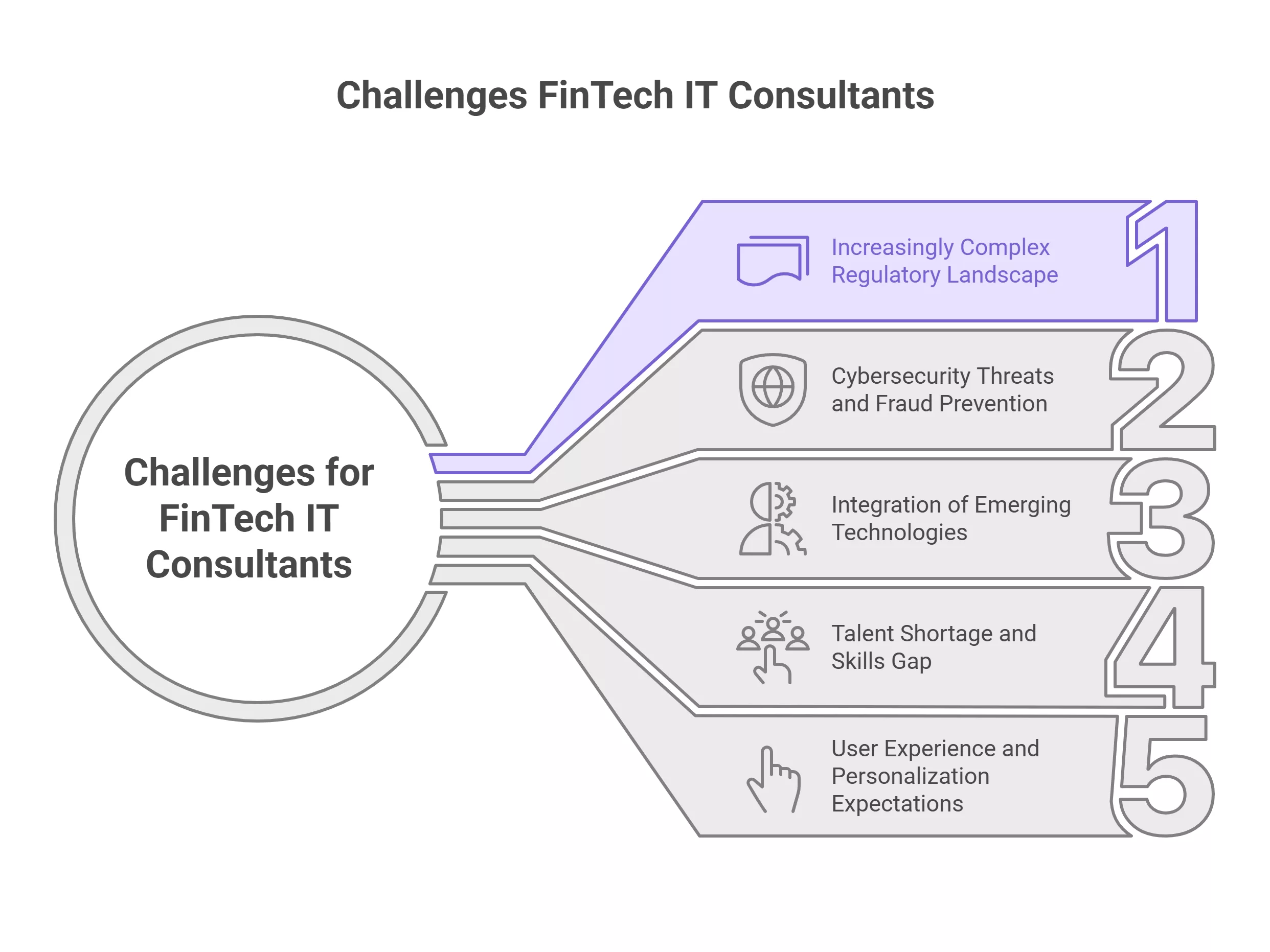
1) Increasingly Complex Regulatory Landscape
As global financial regulations continue to evolve, FinTech IT consultants will face growing pressure to keep up with compliance requirements. New data privacy laws, cross-border payment guidelines, and evolving AML/KYC standards require constant monitoring and rapid adaptation — which increases both the cost and complexity of consulting projects.
2) Cybersecurity Threats and Fraud Prevention
With more financial services moving online, cybersecurity threats are rising. Consultants must design and implement highly secure architectures that protect sensitive data and withstand sophisticated cyberattacks. Detecting fraud in real time and building zero-trust environments will be one of the biggest challenges in 2026.
3) Integration of Emerging Technologies
AI, blockchain, quantum computing, and open finance APIs are evolving fast. FinTech IT consultants not only need to understand each technology but also know how to integrate them seamlessly into legacy systems. Balancing innovation with operational stability will remain a major hurdle.
4) Talent Shortage and Skills Gap
There is a shortage of professionals with deep FinTech and technical expertise. As a result, IT consulting firms may struggle to build teams that can cover advanced use cases like DeFi, generative AI implementations, and privacy-preserving data analytics.
5) User Experience and Personalization Expectations
Customers expect seamless, hyper-personalized digital banking experiences. Helping FinTech companies meet these expectations — while keeping interfaces secure and compliant — requires careful planning and cross-functional alignment, which makes the consulting process more challenging and resource-intensive.
Sum up
Cutting-edge technology or trends like blockchain, machine learning, and artificial intelligence (AI) are used by fintech consulting firms to spur innovation in the industry. By using AI and ML algorithms, these companies enable FinTech applications to provide tailored and data-driven solutions.
These trends are surely going to establish safe, advanced, and digitally transformative financial operations that enhance the whole fintech industry. Every fintech organization should focus on hiring a fintech IT consultant to stay ahead in the competition.
FAQ
How is AI transforming FinTech IT consulting in 2026?
AI is redefining FinTech consulting by automating data analysis, enabling predictive decision-making, and improving risk management processes. In 2026, consultants are using AI to build intelligent recommendation engines, run real-time fraud detection, and deliver hyper-personalized customer experiences. AI-powered tools also accelerate the development of RegTech solutions, helping financial institutions stay compliant with ever-changing regulations.
What new technologies are driving innovation in FinTech consulting?
Several emerging technologies are driving innovation, including Generative AI, blockchain, quantum computing, low-code platforms, and advanced analytics. These tools allow IT consultants to create secure digital ecosystems, rapidly build new financial products, automate backend infrastructure, and process large volumes of data with higher efficiency and accuracy.
What role does blockchain play in FinTech IT consulting trends for 2026?
Blockchain continues to be a cornerstone of FinTech innovation in 2026. IT consultants are helping financial firms implement decentralized finance (DeFi) solutions, smart contracts, and tokenization to increase transparency and reduce transaction costs. Blockchain is also being leveraged for secure KYC/AML processes and cross-border payments, making financial operations faster and more trustworthy.
What innovations are shaping digital banking consulting services in 2026?
Digital banking consulting is increasingly centered around embedded finance, open banking APIs, conversational banking (AI chatbots/voice assistants), and biometric authentication. Consultants are also integrating data-driven personalization and seamless omnichannel experiences to help banks deliver faster, more intuitive services across all digital touchpoints.
How can FinTech companies leverage IT consulting to stay competitive in 2026?
FinTech companies can stay competitive by partnering with IT consultants to assess digital maturity, adopt scalable cloud infrastructure, and implement advanced technologies such as AI, blockchain, and API-first architecture. Consultants also provide strategic guidance on regulatory compliance, cybersecurity, and customer experience optimization — enabling FinTechs to innovate faster and respond to changing market demands with agility.