Multilingual Mobile Apps unlock audience reach far beyond a single home market and give brands a direct bridge into regional cultures. Users engage longer and convert more when navigation, content, and support appear in a language they read comfortably. One global study shows that around 75% of users prefer apps in their regional language, while roughly 40% hesitate to purchase in a foreign language. That preference translates into better retention, stronger brand perception, and higher in‑app revenue for companies that invest in proper localization.
At the same time, the path from a single language product to fully localised Multilingual Mobile Apps demands thoughtful strategy. Teams must select languages, prioritize markets, and align product roadmaps with realistic localization budgets and timelines. Without this, apps often ship partial translations, awkward UI layouts, and inconsistent terminology that erode user trust.
The following challenges show where projects usually stumble and what modern teams need to handle from day one.
Challenge 1: Defining the Right Language and Market Strategy
Many teams start translating menus and labels before they know which markets truly matter. A stronger approach begins with hard data on installs, organic traffic, and current customer locations to decide which languages deserve first‑wave support. Targeting every possible locale usually spreads budget thin and creates long‑term maintenance headaches.
Choosing the wrong language set has a measurable cost. Some localization specialists note that translating into too many languages at once can waste resources when certain markets never reach critical mass. A focused strategy defines primary, secondary, and experimental markets, then adds languages in phases based on adoption and revenue. It also aligns product positioning with local expectations so that features, messaging, and app store descriptions resonate within each region.
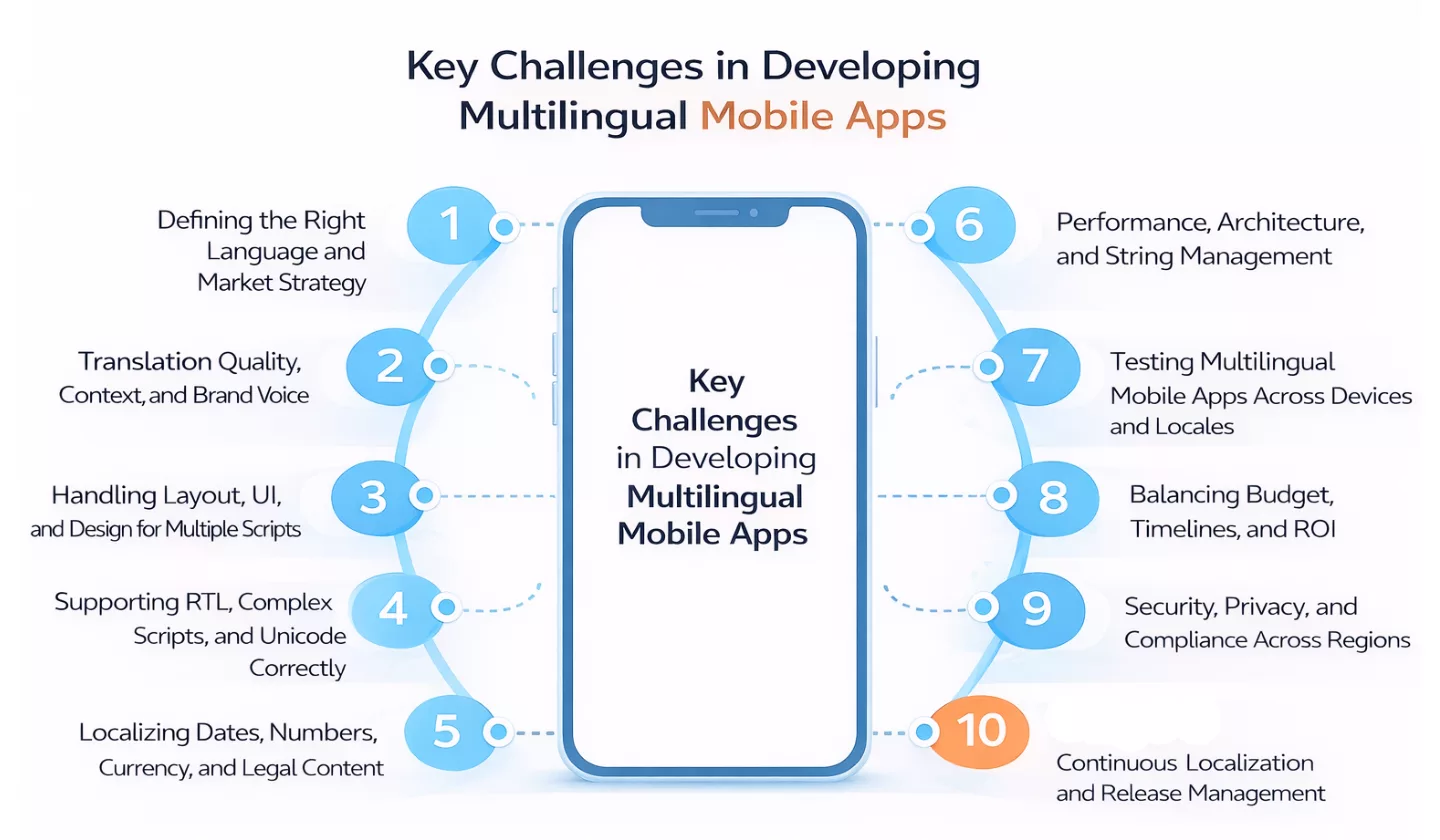
Challenge 2: Translation Quality, Context, and Brand Voice
Surface‑level word conversion rarely works. Translation without context often breaks flows, mislabels actions, and dilutes brand tone, especially in UX microcopy and error messages. Machine translation speeds up coverage yet still struggles with idioms, domain‑specific vocabulary, and emotional nuance, which can make interfaces feel mechanical.
High quality Multilingual Mobile Apps depend on robust linguistic assets like glossaries, style guides, and translation memories shared across product, marketing, and support teams. These assets help translators maintain consistency over time as new features roll out. Smart teams also integrate translators directly into design or prototyping tools so they see screens, user journeys, and character limits instead of isolated text files. That visibility elevates copy quality and reduces back‑and‑forth corrections.
Looking for? Best Translation Apps
Challenge 3: Handling Layout, UI, and Design for Multiple Scripts
Every language stretches the interface differently. Some strings expand by 30–50 per cent after translation, which can break buttons, push labels off screen, or cause overlapping content in compact layouts. Multilingual Mobile Apps therefore need flexible components that adapt to longer or shorter text without manual pixel‑level adjustments for each locale.
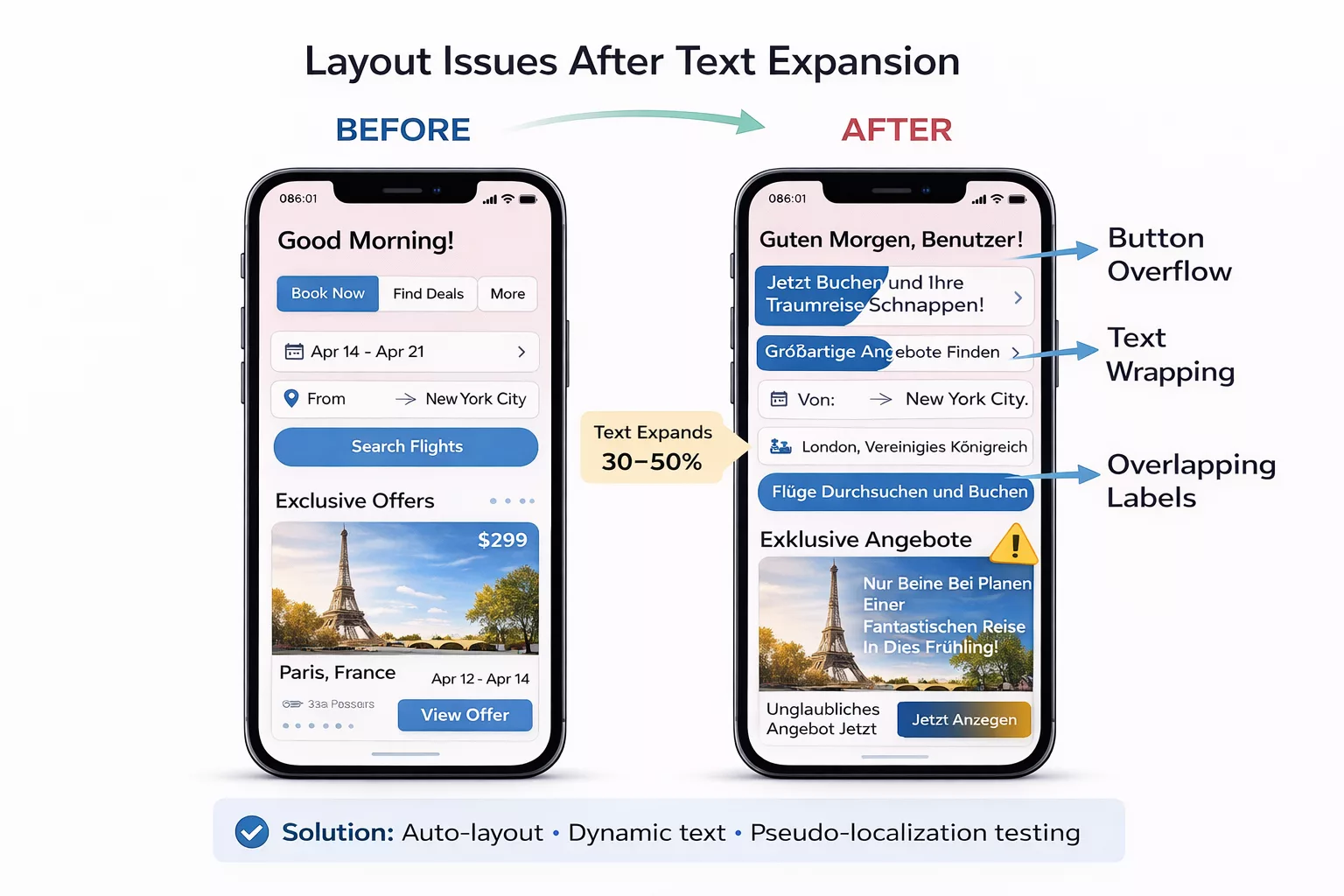
Several industry case studies highlight layout issues as one of the top triggers of failed localizations or emergency hotfix releases. Responsive constraints, dynamic text sizing, and auto‑layout systems help mitigate these problems. Design teams should test early with pseudo-localised text that deliberately exaggerates length and adds unusual characters to expose visual bugs before real translations arrive. This small investment saves significant redesign time later.
Challenge 4: Supporting RTL, Complex Scripts, and Unicode Correctly
Beyond Latin alphabets, Multilingual Mobile Apps must handle Arabic, Hebrew, and other right‑to‑left (RTL) languages, as well as Indic and East Asian scripts. That shift affects navigation patterns, icon direction, animation flow, and even how progress indicators move across the screen. Forgetting to mirror key elements for RTL users leads to confusing experiences and higher abandonment.
Technical foundations play a decisive role. Unicode support through UTF‑8 or UTF‑16 is essential to render global character sets reliably, including emojis and special symbols. Without this, apps risk broken glyphs or crashes from unsupported characters. Platform localization APIs and frameworks that understand RTL layouts, plural rules, and locale‑specific formatting significantly reduce engineering overhead and improve reliability across languages.
Challenge 5: Localizing Dates, Numbers, Currency, and Legal Content
Localization goes deeper than translating sentences. Dates, times, numbers, and currencies follow different conventions across regions, from decimal separators to week starting days. A checkout total formatted in an unfamiliar pattern can confuse buyers even if the language reads correctly. Legal text, privacy notices, and consent dialogues must also reflect each jurisdiction’s requirements.
Poorly localized formats create friction and erode trust during sensitive flows like payments or account verification. Robust Multilingual Mobile Apps use locale‑aware formatting utilities instead of hard coded patterns, which ensures that users see familiar structures automatically. Teams also work with regional legal experts to adapt terms of service and consent language so that compliance does not depend solely on translated templates.
We have listed! Must-Have Features for Mobile App Success and User Growth
Challenge 6: Performance, Architecture, and String Management
Every new language adds strings, assets, and sometimes separate media, and that footprint can impact app size and loading speed. If string resources scatter across multiple repositories or codebases, release cycles slow down and bugs multiply. A clear internationalization (i18n) architecture keeps translations external to code, uses keys consistently, and supports fallback logic when a localized string is missing.
Engineering analyses show that technical issues like missing plural rules, unescaped variables, or unsupported encodings rank among the most common causes of failed or delayed mobile localizations. Automated checks in CI pipelines help catch these failures early. Centralized translation platforms, paired with structured string IDs, provide a single source of truth so developers, translators, and QA work against the same content set instead of outdated spreadsheets.
Challenge 7: Testing Multilingual Mobile Apps Across Devices and Locales
Testing complexity grows sharply with each added language. Real verification requires more than switching device language once and tapping through a few screens. Teams must validate flows across OS versions, device sizes, and network conditions while checking that every string appears correctly and remains readable. That scope easily overwhelms manual testing if no strategy exists.
Best practice involves a mix of automated and manual validation. Automated UI tests can verify layout stability and detect missing or truncated labels by scanning screenshots at scale. Native speakers then run targeted exploratory sessions to judge tone, clarity, and cultural fit. Some organizations also use beta programs in target regions to capture feedback from real users who naturally expose edge cases overlooked in lab environments.

Challenge 8: Balancing Budget, Timelines, and ROI
Global ambitions collide quickly with budget reality. Translation, expert review, engineering changes, and testing outlay add up across multiple releases. Industry commentary stresses that localization is expensive and that entering low‑potential markets too early can divert funds from higher impact regions. Leadership teams must understand this trade‑off instead of treating language support as a simple checkbox.
A solid financial model connects language priorities with measurable outcomes such as new installs, paid conversions, or retention improvements in targeted countries. That model guides decisions on when to expand language coverage and when to deepen existing ones with localized content, campaigns, and support. It also improves planning for initiatives like understanding the Cost To Build An AI Translation App when teams want to embed intelligent translation directly into their products.
Challenge 9: Security, Privacy, and Compliance Across Regions
Multilingual Mobile Apps serving regulated industries like healthcare, finance, or education must align with data protection rules in every region they enter. Even general‑purpose apps often handle personal information that falls under frameworks such as GDPR or local data residency laws. Misaligned consent screens or poorly translated privacy options can introduce compliance gaps.
Security responsibilities extend to third‑party localization tools and translation APIs. Vendor contracts should clarify where user content flows, how long it is stored, and who can access it. Technical controls, including encryption in transit and at rest plus strict access management, keep localized user data as protected as the original language version. That parity builds confidence with users and regulators as language coverage grows.
Challenge 10: Continuous Localization and Release Management
Localization used to be a one‑off project. Modern Multilingual Mobile Apps ship features continuously, so language support has to move at the same pace. If translations lag behind code, users see mixed‑language screens, empty placeholders, or outdated copy that contradicts release notes. That mismatch weakens launches in non‑primary markets.
Continuous localization pipelines integrate translation workflows directly into development. New strings generate tasks automatically, and translators work in parallel while features remain in staging. After review, localized assets flow into builds with minimal manual intervention. This practice keeps release dates aligned across languages and avoids treating non‑English users as second‑class citizens who always receive features late.
Choosing the Right Technology Stack and Tools
Platform level support matters hugely. Modern Android and iOS APIs provide per‑app language preferences and native localization frameworks that reduce custom engineering. Leveraging these capabilities ensures that users can pick languages granularly without changing the whole device setting.
Beyond the OS, teams benefit from proven localization libraries, translation management systems, and automated quality gates. Technical sources emphasize the value of ICU Message Format and similar tools for handling complex plural rules and grammar structures at scale. With that foundation, future features like on‑device language models or embedded translation engines plug in more safely and predictably.
Bonus Insight: Partnering with Specialist App Development Teams
Few organizations maintain deep internal expertise across languages, platforms, and localization tooling. External partners bring experience from previous multilingual launches, which helps avoid repeating common mistakes. Some mobile experts specifically highlight that challenges around design adaptation, RTL integration, and consistent UX require a coordinated product, design, and engineering effort.
Businesses looking to accelerate execution often turn to Top App development Companies with a proven track record in global markets. Others prefer a more focused partner, such as a Custom App Development Company Denver based for local collaboration or niche App Development firms in Switzerland when targeting European audiences. The key is evaluating portfolios for successful Multilingual Mobile Apps rather than generic case studies.
We have listed! AI App Ideas
Wrap up
Multilingual Mobile Apps succeed when teams treat language support as a strategic product capability instead of an afterthought. Addressing translation quality, design for multiple scripts, technical foundations, testing, compliance, and continuous localization turns complexity into a durable competitive advantage. Organizations that get this right see stronger engagement, better retention, and higher conversion from regions that previously felt unreachable.
For teams seeking expert partners across strategy, design, and development, platforms like AppsInsight help identify specialist solution providers who already know how to launch and scale world class Multilingual Mobile Apps.