
Generative AI is increasingly being used by businesses to handle routine, repetitive tasks that once required human time and effort. For many organizations, the main question is not whether generative AI can produce content or process data, but how it actually works in practice to reduce manual workloads.
This article explains how generative AI in business supports daily operations, where it saves measurable time, and what its current limitations look like.
Readers will see how common tasks such as drafting documents or responding to customer queries are automated, gain an understanding of the research showing efficiency improvements, and learn practical ways to apply these tools responsibly within their own organizations.
Let’s start by clarifying what generative AI means in a business context.
What Is Generative AI in Business?
Generative AI refers to systems that can create new content—such as text, images, or code—based on patterns learned from existing data. Unlike traditional automation, which follows fixed rules and workflows, generative AI uses machine learning models to produce outputs that adapt to different contexts. This flexibility makes it especially effective for tasks that involve language, creativity, or unstructured information.
In business settings, generative AI is not limited to producing marketing copy or graphics. It is increasingly being applied to practical functions such as summarizing reports, drafting routine emails, generating training material, or preparing meeting notes. The technology is widely adopted in areas where speed and volume matter, because it can process large amounts of information more quickly than a human team.
Understanding generative AI in business starts with recognizing that it is not a replacement for decision-making but a support tool. Most organizations still require human oversight to check accuracy, provide context, and ensure outputs align with company standards. When integrated this way, generative AI becomes a reliable assistant for repetitive knowledge-based tasks, allowing employees to focus on higher-value work.
How Generative AI Automates Routine Tasks
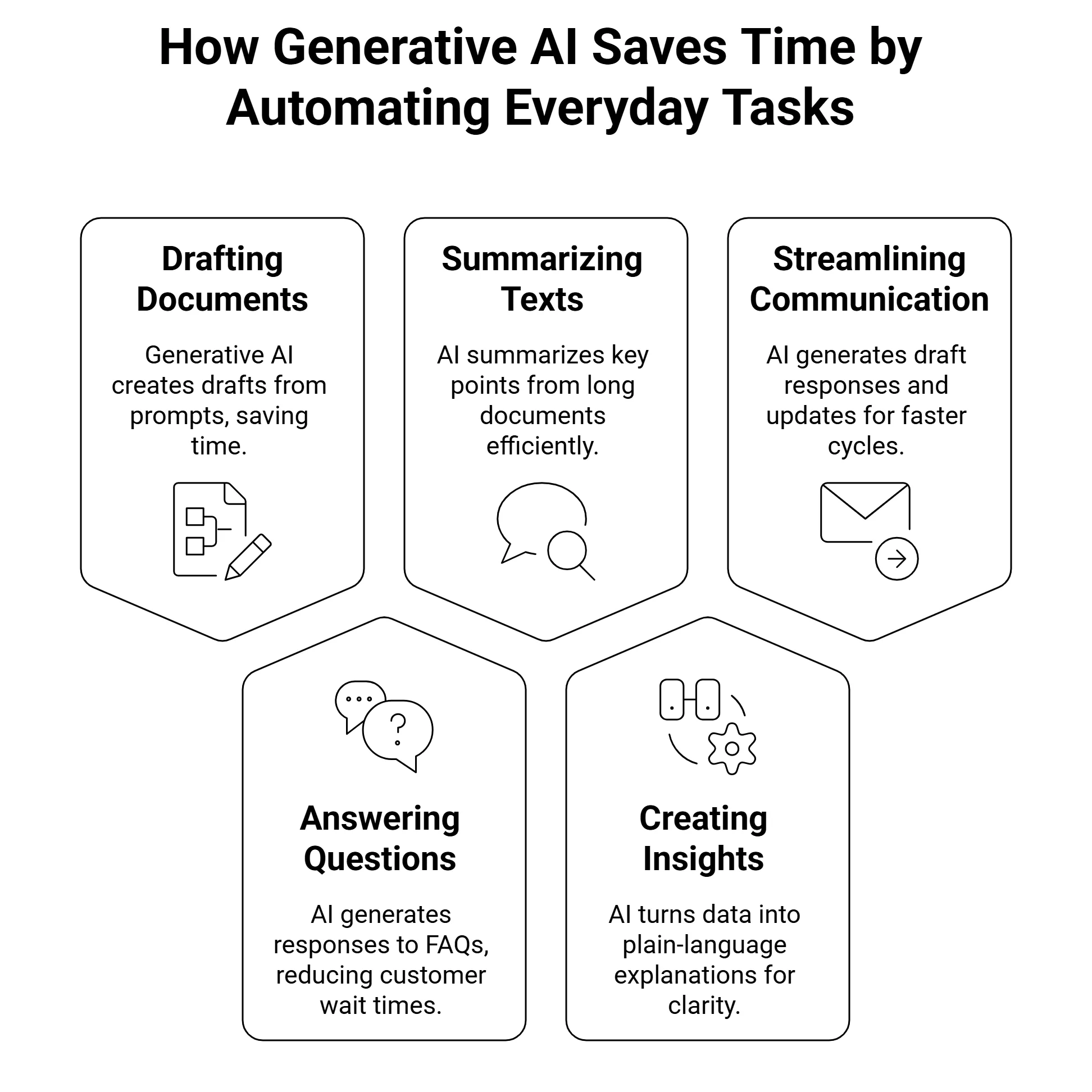
Routine tasks often take up more time than we expect—writing repetitive documents, answering the same customer questions, or trying to make sense of long reports. Integration of AI in business is effective because it reduces the effort required for these activities. Instead of replacing people, it acts as an assistant that speeds up the first draft, organizes information, and helps teams respond faster. Here’s how it works in practice.
Drafting Documents in Minutes
Many professionals spend hours writing standard documents such as reports or proposals. With generative AI, a draft can be created in minutes by entering a clear prompt or template. The user then reviews and edits the output instead of starting from scratch. The time saved is significant, especially when multiple documents need to be produced regularly.
Answering Customer Questions Quickly
Customer support teams often handle the same inquiries again and again. Generative AI can generate accurate responses to frequently asked questions, which reduces the waiting time for customers. From the employee’s perspective, this means fewer repetitive conversations and more time to focus on complex cases that require personal attention.
Summarizing Long Texts
Reading through pages of notes, transcripts, or policies can be exhausting. Generative AI can summarize the key points in a structured way. For example, after a long team meeting, the AI can generate a concise list of decisions and next steps. Instead of spending an hour reviewing notes, a manager can review the summary in minutes and move forward.
Creating Clear Data Insights
Business data is often difficult to interpret. Generative AI can turn spreadsheets or dashboards into plain-language explanations. For someone without a technical background, this means they don’t need to dig through numbers—they receive a clear explanation of trends, risks, or opportunities. This helps teams act faster without waiting for specialist input.
Streamlining Daily Communication
Emails and internal updates take up a surprising amount of time. Generative AI can generate draft responses, reminders, or routine updates that employees can personalize before sending. The result is faster communication cycles, especially in roles that depend heavily on written correspondence.
When used across these areas, generative AI feels less like a tool and more like a supportive colleague who takes care of repetitive steps. The work still requires human judgment, but the time saved creates space for tasks that demand creativity and decision-making.
Evidence of Time Savings and Efficiency Gains
While many discussions about generative AI focus on potential, there is already measurable evidence showing its impact on efficiency. Studies and pilot projects across industries reveal consistent patterns: tasks that once required hours of effort can now be completed in a fraction of the time.
One study, published in Science, found that generative AI reduced the time professionals spent on writing by 40% but also helped workers improve the quality of their writing.
Similarly“A Harvard Business School study, conducted with Boston Consulting Group, showed that consultants using GPT-4 completed 12.2% more tasks, worked 25.1% faster, and produced over 40% higher quality outputs compared to those not using AI.”
Examples from business operations reinforce these findings. Customer service teams using AI-powered chat systems report significantly reduced response times, which improves customer satisfaction.
Marketing departments that rely on generative AI for early drafts of campaigns save hours in the planning stage, allowing them to test and refine strategies more quickly. Even in administrative areas, employees benefit from faster preparation of meeting summaries and internal communications.
The efficiency gains are not only about speed but also about reducing cognitive load. Instead of spending energy on repetitive drafting or sorting through data, employees can dedicate attention to decision-making, strategy, and creative problem-solving.
This shift in focus explains why generative AI in business is being adopted not only by startups with limited staff but also by large enterprises seeking to improve productivity at scale.
Read once! How to Choose the Right Generative AI Consulting Partner
What are the Strengths and Top Benefits of Generative AI in Businesses?
Generative AI in business is most valuable when it removes friction from routine work. Its strengths show up in everyday experiences where speed and consistency matter most.
1) Faster Drafting of Content
Drafting is often one of the most time-consuming parts of knowledge work. Employees may spend hours structuring reports, proposals, or emails.
With generative AI, a draft can be produced in minutes based on a simple prompt such as “create a weekly project update” or “summarize sales performance.” The draft doesn’t need to be perfect—it simply provides a head start.
Instead of beginning with a blank page, the user edits and tailors the AI’s output to fit the company’s needs. This shift saves time and also reduces the pressure many employees feel when facing repetitive writing tasks.
2) Consistent Quality in Outputs
Maintaining consistency in business communication is challenging, especially across large teams. Some employees may write in a very formal style, while others may be less structured.
Generative AI produces outputs that follow a uniform tone, vocabulary, and format, which helps create a professional impression. For example, customer service responses generated by AI are less likely to vary in detail or clarity, which leads to a more reliable customer experience.
This consistency also saves managers time since they don’t need to correct or standardize employee writing as often.
3) Handling High Volumes of Work
One of the clearest strengths of AI is scalability. A human support agent can only respond to one customer at a time, but AI-powered assistants can handle dozens of queries simultaneously.
For businesses facing seasonal spikes in demand—such as e-commerce companies during holiday sales—this can prevent backlogs and reduce customer frustration.
Employees also benefit because they are not overwhelmed by repetitive requests. Instead, they can focus on the complex or sensitive cases that require empathy, negotiation, or detailed product knowledge.
4) Reducing Mental Fatigue
Repetition often leads to burnout. Writing the same style of email or summarizing similar reports each day can become mentally draining. Generative AI takes over these repetitive steps, leaving employees with more energy for higher-value activities.
For instance, instead of spending an afternoon pulling together meeting notes, a project manager can quickly generate a summary and then spend the rest of the time refining project strategy.
Over weeks and months, this reduction in mental fatigue leads to higher productivity and improved job satisfaction, since employees spend more time on meaningful work.
5) Saving Resources for Priority Projects
By completing tasks more quickly, generative AI allows businesses to reallocate time and money. For startups with small teams, this means employees can dedicate more hours to growth activities like product development or investor outreach instead of routine paperwork.
For larger enterprises, resource savings may free up entire teams to work on innovation projects or strategic planning. This reallocation doesn’t just save time—it also provides a competitive advantage. Businesses that effectively apply AI to repetitive tasks can move faster than those that rely solely on traditional workflows.
We have listed! Sign Your Business Needs AI Integration Consulting
What are the Limitations of Generative AI
Despite these strengths, generative AI has clear boundaries. Businesses that treat it as a flawless solution often face setbacks. Understanding its limitations helps avoid disappointment and ensures outputs remain reliable.
1) Risk of Inaccurate Information
Generative AI sometimes produces content that sounds correct but contains factual errors—known as “hallucinations.” For example, a financial report generated by AI might include miscalculated totals or incorrect references if not carefully checked. If employees use such information without verifying, it can lead to poor decisions or compliance issues. This is particularly risky in industries like healthcare, law, or finance where accuracy is critical. Businesses must therefore establish review procedures to ensure AI-generated content is fact-checked before being used.
2) Lack of Deep Context
While AI can recognize general patterns, it does not fully grasp context. For instance, it may write an email draft that sounds professional but ignores the informal style that a specific client expects. In cross-cultural communication, it may also miss subtle tone differences, leading to unintended misunderstandings. This limitation means employees often need to fine-tune AI outputs so they fit the company culture or customer relationship. Without this adjustment, content may appear generic or slightly “off,” which could reduce its effectiveness in real interactions.
3) Dependence on Quality Prompts
Generative AI works best when the user gives precise instructions. A vague prompt like “summarize this meeting” may result in a generic or incomplete output. In contrast, a specific prompt such as “summarize key decisions, action items, and deadlines from this meeting transcript” produces far better results. This means employees must learn prompt-writing skills to get the most out of AI tools. For teams unfamiliar with this, there may be a learning curve, and time could be wasted rewriting prompts until the output is useful.
4) Limited Creativity in Complex Scenarios
While generative AI can create new ideas, they are based on existing patterns in its training data. This makes it useful for brainstorming but less effective for genuinely novel or innovative ideas. For example, it can suggest variations of a marketing slogan but may not capture the unique voice of a brand without human refinement. Creative teams often use AI as a starting point, but they must still apply their imagination and brand expertise to produce content that truly resonates with customers.
5) Need for Human Oversight
Even when AI produces accurate outputs, businesses cannot remove human review from the process. Legal contracts, compliance documents, or public communications require careful checking to ensure accuracy and appropriateness. Without oversight, there is a risk of errors slipping through unnoticed, which could damage trust or even cause financial loss. Companies therefore need clear workflows where employees validate AI outputs before use. This adds time but ensures quality, balancing the efficiency benefits with the responsibility of maintaining standards.
When businesses recognize both strengths and limitations, generative AI becomes a practical support system rather than an overhyped solution. It makes routine work easier but still requires careful oversight to deliver reliable results.
Want to know? How to Hire AI Consultants for Your Business Growth
Generative AI Applications Across Different Business Functions
Generative AI in business is not limited to a single department. Its flexibility allows organizations to apply it across customer service, marketing, operations, and even creative fields. By looking at how it works in practice, we can see where the technology brings measurable improvements.
Customer Support and Service
Customer service teams often deal with repetitive questions: “What is your refund policy?” or “How do I reset my password?” Generative AI can provide instant, accurate responses through chatbots or virtual assistants. This shortens response times for customers and reduces the volume of work for human agents. The AI handles the simple queries, while staff focus on complex cases that require judgment or empathy. Over time, this leads to faster service and better customer satisfaction without increasing staffing costs.
Marketing and Creative Work
Generative AI in creative work is becoming a common practice. Marketing teams use it to draft blog posts, create ad copy variations, or even generate initial designs for campaigns. Instead of spending hours brainstorming slogans, AI can provide a set of options that marketers refine into final versions. The advantage is speed—teams can test multiple ideas quickly and choose the best one to pursue. While it doesn’t replace human creativity, it provides a strong foundation to build on.
Daily Operations and Administration
Routine operations, such as scheduling meetings, preparing reports, or generating compliance summaries, can take up large parts of the workday. Generative AI for daily operations helps by producing structured summaries, organizing tasks, and drafting internal updates. For example, instead of an employee manually summarizing a 30-page compliance document, AI can generate a clear one-page overview. This doesn’t just save time—it also ensures that important details are not overlooked.
Data Analysis and Reporting
Numbers are essential for decision-making, but they can be difficult to interpret quickly. Generative AI can transform raw data into plain-language summaries that highlight trends, risks, and opportunities. A sales manager, for example, might receive a concise AI-generated summary pointing out declining performance in one region while highlighting strong growth in another. This allows managers to act faster without waiting for analysts to prepare detailed reports.
Implementation Support from Consulting Firms
Not every organization has the expertise to deploy AI effectively on its own. This is where generative AI consulting companies play a role. They guide businesses in selecting the right tools, integrating them into workflows, and training employees to use them effectively. For many organizations, especially those with limited technical staff, consulting support ensures that the adoption of generative AI is smooth and aligned with business goals.
Must read! The Most Downloaded Apps
Practical Implications of Generative AI in Business
Generative AI in business is no longer just an experimental tool—it’s becoming part of daily workflows. For companies considering adoption, the question is less about “if” and more about “how” to implement it effectively. The following points highlight practical steps organizations can take to benefit from AI while staying realistic about its role.
Identifying the Right Tasks to Automate
Not every task is suited to generative AI. Businesses should begin with repetitive, low-risk activities such as drafting internal updates, summarizing meeting notes, or generating responses to routine customer questions. By starting small, companies can measure the impact of time saved without exposing themselves to major risks if the AI output needs correction.
Measuring ROI and Efficiency Gains
Time savings should be tracked in a measurable way. For instance, if customer support emails that once took five minutes now take one minute with AI assistance, those four minutes saved can be multiplied across hundreds of inquiries per week. Measuring return on investment (ROI) in terms of time, costs, and customer satisfaction makes it easier to justify scaling AI use across departments.
Training Employees to Use AI Effectively
The quality of AI output often depends on the quality of input. Training employees to write clear prompts, review AI-generated outputs, and provide structured feedback helps maximize benefits. Organizations that invest in training see smoother adoption and avoid frustration that comes from unclear expectations or misuse of the tool.
Balancing Automation with Oversight
Generative AI is powerful, but it requires human review to ensure accuracy and context. Businesses need clear workflows: AI can generate first drafts or summaries, but employees must validate outputs before they are shared externally or used in decision-making. This balance ensures efficiency without compromising trust or compliance.
Planning for Long-Term Integration
Generative AI should not be treated as a temporary experiment. Top AI Companies that plan for long-term integration—by setting guidelines, monitoring performance, and adapting processes—are more likely to sustain its benefits. This involves choosing scalable tools, considering data privacy, and ensuring that employees remain part of the loop.
Read once! Trending Apps In USA
Share Your Insights on AI and Business
The conversation around generative AI in business is still evolving, and different organizations are discovering new ways to apply it every day. At AppsInsight, we welcome contributions from professionals, researchers, and business leaders who want to share practical insights, case studies, or thoughtful perspectives on AI and digital transformation.
If you’ve worked with generative AI—whether in customer support, daily operations, or creative work—your experience can help others understand what works and what challenges remain. Writing for us is an opportunity to add your voice to the discussion and reach a community of readers interested in how technology is shaping modern business.
Sum up
Generative AI in business is proving effective at reducing routine workloads, saving time, and making everyday tasks easier. By examining how it automates document drafting, customer service, and data summaries, we can see the measurable efficiency it brings. Research and case studies further confirm that organizations benefit when they use AI as a support tool rather than a replacement. At the same time, limitations such as accuracy issues and the need for oversight remind us that human input remains essential.
For readers, the key takeaway is that generative AI delivers value when applied thoughtfully: start with low-risk tasks, measure time savings, train staff in effective use, and maintain review processes. In this way, businesses can achieve both efficiency and reliability.
Related FAQs
How is generative AI used in business?
Generative AI in business is used to automate tasks that involve language, content, or data processing. Common applications include drafting reports, summarizing meeting notes, answering customer service questions, and generating marketing copy. By reducing the time required for these routine activities, employees can focus on decision-making and higher-value work.
How can companies measure the ROI of generative AI?
Companies can measure ROI by tracking time saved, costs reduced, and improvements in service quality. For example, if customer emails that once took five minutes are completed in one minute with AI assistance, the savings multiply across hundreds of inquiries. Businesses should also measure qualitative benefits, such as reduced employee fatigue and faster project turnaround times.
Do businesses need consulting support to adopt generative AI?
Not all businesses need outside help, but many turn to AI consulting companies to guide implementation. Consultants can identify the right use cases, help integrate AI into workflows, and train employees to use the tools effectively. For organizations with limited technical staff, consulting support often speeds up adoption and reduces risks.
What role does generative AI play in creative work?
Generative AI in creative work provides a foundation for ideas rather than a complete replacement for human creativity. Marketing teams use it to draft blog posts, suggest campaign slogans, or create early design concepts. Humans then refine these drafts, ensuring the final output matches the brand voice and audience needs.
What are examples of generative AI in daily operations?
Examples of generative AI for daily operations include preparing meeting summaries, generating compliance reports, drafting internal emails, and organizing schedules. These functions reduce time spent on administrative work and make it easier for employees to focus on strategic or customer-facing tasks.
Is generative AI reliable for business decision-making?
Generative AI can support decision-making by providing drafts, summaries, and insights, but it should not be relied on as the sole decision-maker. Because it may produce errors or miss important context, human oversight is essential. Businesses should treat AI as a supportive tool that improves efficiency rather than a replacement for critical judgment.