Every IT consulting project is different — some are small and dynamic, others highly structured and long-term. Because of this, using the same project management approach for every engagement simply doesn’t work. The wrong methodology often leads to delays, increased costs, and even failed delivery.
Two of the most widely adopted approaches in IT consulting are Agile and Waterfall. Each offers a distinct way of planning, managing, and delivering projects — and each comes with its own strengths and limitations. That’s why it’s essential to understand when, where, and how to apply them.
This guide breaks down the core differences, explains use-cases, and helps you determine which approach fits your project — so you can make better, more confident decisions.
In IT consulting, Agile and Waterfall represent two fundamentally different approaches to managing projects. Before diving into their differences, it’s important to understand what each methodology means and how it shapes the overall delivery process. Both aim to improve project efficiency — but they do so in very different ways.
Agile: Flexible and Iterative
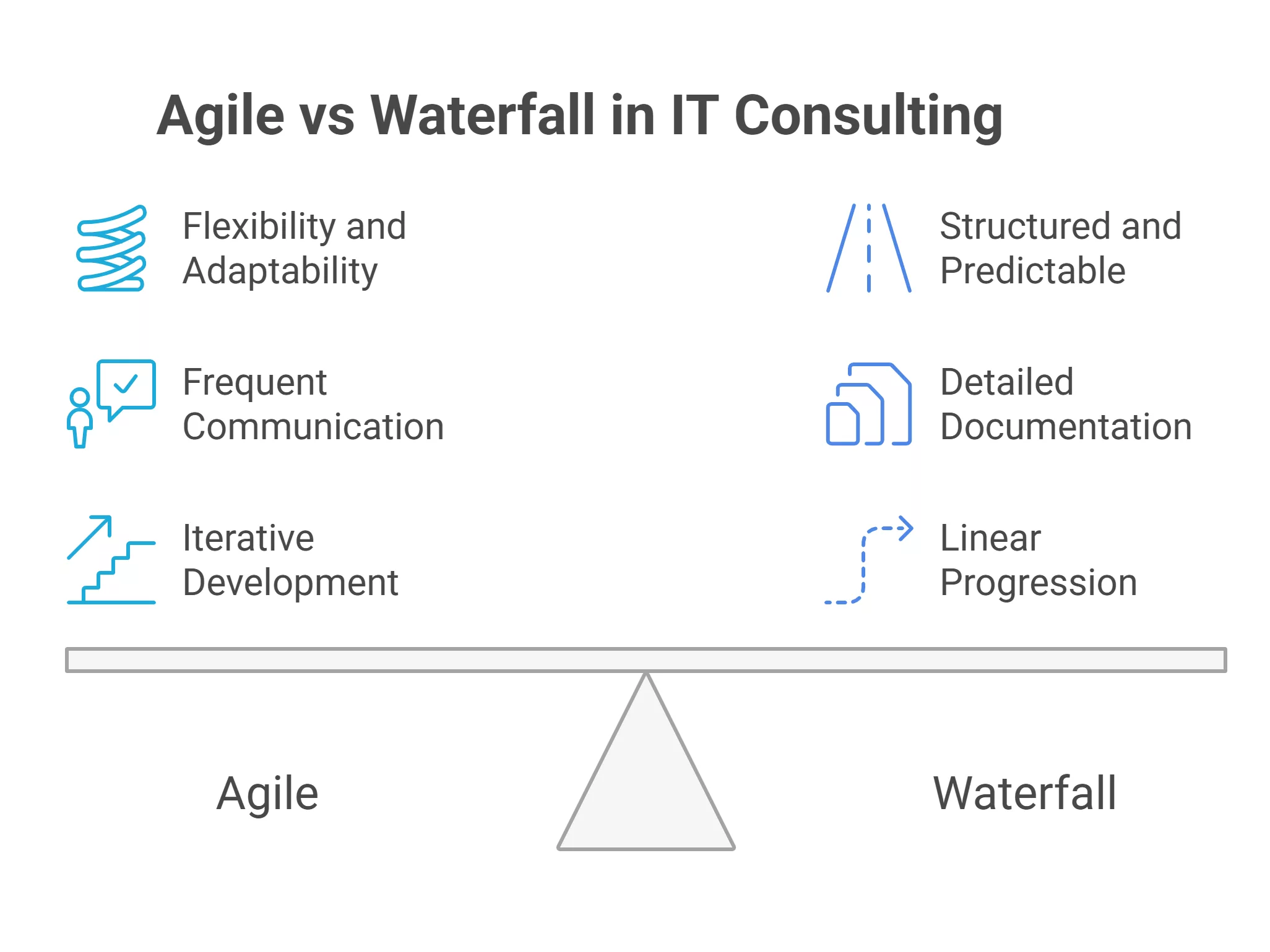
Agile is a project methodology designed for flexibility and continuous delivery. Rather than completing the entire project in one shot, it divides the work into multiple sprints (short cycles). Each sprint delivers a working piece of the project, allowing regular feedback and quick adjustments.
Key characteristics of Agile:
Works well for changing or evolving requirements
Promotes frequent communication and collaboration
Emphasises working software over heavy documentation
Supports continuous testing and improvement
Waterfall: Structured and Sequential
The Waterfall model is a traditional, step-by-step approach. Each stage must be completed before moving to the next one (e.g. planning → design → development → testing → deployment). It’s highly structured and built for projects with clearly defined goals and stable requirements.
Waterfall delivers the final product all at once at the end
➤ Client Involvement
Stage
Agile
Waterfall
Early Stage
High involvement
High involvement
Development Phase
Constant collaboration
Limited involvement
Delivery
Incremental
Final product only
➤ Documentation
Agile → minimal / lightweight documentation
Waterfall → extensive and detailed documentation for each phase
➤ Testing
Agile performs continuous testing after every sprint
Waterfall conducts testing only after full development is complete
➤ Cost Predictability & Project Size
Agile fits smaller, fast-paced, or complex projects with uncertain requirements (cost may change depending on scope)
Waterfall fits large-scale projects with clearly defined requirements and tight regulatory guidelines (cost is easier to estimate)
When to Use Agile vs Waterfall in IT Consulting (and How to Decide)
Choosing between Agile vs Waterfall in IT Consulting requires a clear understanding of your project’s characteristics.
✔ Use Agile If:
Requirements are not fully known at the start
Changes and refinements are expected
You prefer continuous feedback and collaboration
Quick releases and incremental delivery are needed
The team is skilled in Agile practices
✔ Use Waterfall If:
Requirements are stable and clearly defined
You need detailed planning and documentation
The project has a fixed scope and timeline
Regulatory or contractual requirements prevent change
Outcomes are predictable and not subject to frequent updates
How Agile vs Waterfall in IT Consulting Impacts Client Satisfaction and Engagement
1) Adopting Hybrid Methodologies: Combining the Best of Agile and Waterfall
In the real world, not every project sits squarely in either Agile or Waterfall. Many top IT consulting firms are now adopting hybrid methodologies — combining Agile flexibility with Waterfall structure.
Example: Planning and requirements follow Waterfall, but development and delivery are executed in Agile sprints.
This helps teams:
Keep strategic direction aligned with project goals
Maintain flexibility during implementation
Improve communication across technical and non-technical teams
2) Impact of Agile vs Waterfall in IT Consulting on Client Satisfaction
Client satisfaction is closely tied to engagement and transparency during delivery:
Factor
Agile
Waterfall
Feedback Loops
Continuous
One-time (usually early)
Client Visibility
High (regular updates)
Low (waits for completion)
Satisfaction Level
Often higher
Depends on final delivery only
Agile keeps clients engaged throughout the process, while Waterfall often relies on a strong initial briefing to maintain alignment.
3) Choosing the Right Methodology as a Strategic Advantage
The selection between Agile vs Waterfall in IT Consulting isn’t just about project management — it can become a strategic differentiator.
By matching methodology to project type, companies can:
Reduce cost overruns
Improve on-time delivery
Strengthen client relationships
Increase project success rates
The ability to adapt methodology depending on project needs is often what separates great IT consulting firms from average ones.
4) Role of Team Collaboration in Agile vs Waterfall in IT Consulting
Project success isn’t determined by frameworks alone — it also depends on how effectively teams collaborate throughout the delivery cycle.
Agile:
Encourages cross-functional collaboration
Promotes daily communication via stand-ups and sprint reviews
Helps break down silos between developers, designers, and stakeholders
Waterfall:
Collaboration is structured and limited to predefined phases
Works best when roles are clearly separated (e.g., analysts → developers → testers)
Can become disconnected if teams don’t proactively communicate between stages
A collaborative mindset ensures smoother handoffs in Waterfall and faster decision-making in Agile.
5) Long-Term Maintenance and Scalability Considerations
Beyond delivery, IT consulting projects often require maintenance, upgrades, or scalability planning. The way a methodology handles these post-delivery needs can make a big difference.
Agile:
Supports continuous updates and improvements
Makes it easier to expand or modify features over time
Ideal for projects expected to evolve and grow after launch
Waterfall:
Offers a stable baseline and clearly documented structure
Easier to audit and replicate for similar future projects
Best for long-term environments with low change expectations
Selecting a methodology that aligns with future scalability plans will save time and cost in the long run.
Teams sometimes choose a methodology based on trends (e.g., “everyone is using Agile now”) rather than actual project requirements.
How to avoid it: Evaluate complexity, client involvement, flexibility needs and timelines before selecting.
2) Lack of Team Experience
Applying a methodology that the team has never used before can cause delays and confusion.
How to avoid it: Select a methodology the team is experienced with — or allocate time for training and onboarding.
3) Poor Change Management
In Agile, rapid changes can overwhelm teams. In Waterfall, refusal to change can block essential updates.
How to avoid it: Create a clear process for evaluating and approving changes — whether you’re using Agile or Waterfall.
4) Misalignment Between Stakeholders and Technical Teams
Sometimes stakeholders (clients or business leaders) and technical teams have completely different expectations about how the project will be executed. This can lead to delays, frustration, and last-minute changes.
How to avoid it:
Hold alignment meetings at the beginning of the project
Clearly define roles, responsibilities, and communication processes
Use visual tools (roadmaps, timelines, sprint boards) to keep everyone on the same page
5) Methodology Applied Without Adapting to Project Context
One of the most common mistakes is applying a methodology “as-is” without adapting it to the project’s scale, complexity, or industry requirements. This is especially risky for IT consulting projects that deal with highly regulated industries.
How to avoid it:
Tailor the methodology to fit the size and sensitivity of the project
Use hybrid or modified versions when necessary
Review and adjust the process after each phase or sprint to improve delivery
Final Thoughts: Agile vs Waterfall in IT Consulting
There is no universal winner in Agile vs Waterfall in IT Consulting — it all depends on the nature of the project, the level of flexibility required, and the stakeholder expectations.
Both methodologies offer valuable benefits:
Agile is ideal for dynamic projects requiring continuous improvement
Waterfall is perfect for large, well-defined projects with clear deliverables
By understanding the core differences and aligning them with project requirements, IT consulting teams can ensure effective delivery, improved client satisfaction, and long-term success.
FAQs
Which methodology is better for rapid delivery in IT consulting projects — Agile or Waterfall?
Agile is generally better for rapid delivery because it breaks down projects into smaller sprints or iterations. This allows IT consulting teams to deliver functional parts of the project early and continuously refine them based on feedback. Waterfall delivers everything at the end, which often takes longer and doesn’t support early releases.
Is Agile more cost-effective than Waterfall for IT consulting projects?
Agile can be more cost-effective for projects with evolving requirements because it allows adjustments without fully restarting the process. However, if your project has a fixed scope and clear deliverables, Waterfall may be more cost-predictable and easier to budget. The most cost-effective option depends on whether your requirements are stable or likely to change.
What are the main risks of using Waterfall in IT consulting projects?
The primary risks include:
Limited flexibility once the project starts
Delayed detection of issues because testing occurs at the end
Low client involvement during development If requirements change mid-project, Waterfall may require major rework or contract renegotiation, which can increase cost and timeline.
What types of IT consulting projects benefit most from the Agile methodology?
Software development and application enhancement projects
Projects where continuous feedback and rapid iteration improve outcomes These types of projects benefit from Agile’s adaptability and incremental delivery model.
How do IT consulting firms decide between Agile vs Waterfall for a project?
Most IT consulting firms use the following decision criteria:
Requirement clarity: If requirements are well defined → Waterfall. If not → Agile.
Client involvement: If ongoing feedback is needed → Agile. If involvement is limited → Waterfall.
Project size and timeline: Large, long-term projects → Waterfall. Short or innovation-driven projects → Agile.
Flexibility: High flexibility → Agile. Strict regulatory or documentation needs → Waterfall.